FENDER STRATOCASTER 1954–1982
Fender's flagship electric guitar, The Stratocaster, was first made in 1954. That was 67 years ago, in the 29th year of the Showa era. At that time, even Tokyo Tower and the Shinkansen (bullet trains) did not exist yet. For such a legendary instrument to be created in such an era, even though it happened overseas, is nothing short of a miracle.
By the way, Leo Fender (hereafter referred to as Leo) "could not play guitar at all." Not only that, but he also struggled with tuning the open strings of the guitars he invented, and he was severely hard of hearing. He could not play the guitar at all. His usual method of tuning was just strumming the strings loudly and repeatedly, which probably led the employees around him to think, "Leo's playing is just noise."
However, Leo’s "practical experiments for development" were marked by extraordinary focus, and he can be said to be a genius when it came to turning artists' requests into tangible results. His many passionate inventions were surely gifts from the God of success. Additionally, Leo never acted arrogantly. He did not wear a suit in the factory, and while he probably dressed properly when important customers visited, he was often seen wandering around the factory in work clothes. There was even a time when a young craftsman said to him, "Hey, old man, get out of the way!" Despite this, Leo would work late into the night with writing tools stuffed to bursting in the pocket of his work clothes.
Let's name three important figures involved in creating the Stratocaster at Fender in the 1950s. Leo Fender, who had previous work experience as an accountant in radio and PA (public address) systems, Freddy Tavares, a talented musician, and George Fullerton, a truck driver. None of these three had a professional background in instrument manufacturing. These amateur-like developers went on to establish an instrument manufacturing company that could create guitars that would continue to resonate in modern popular music. This, too, was a miracle.
Another person worth mentioning is the "test pilot" guitarist, the passionate Bill Carson. He started as a janitor and eventually became a full-time employee. His opinions were highly valued. He once claimed, "95% of the Stratocaster was my idea," indicating that he was a very confident person.
The results of their work were a combination of luck and hard work. For example, the Stratocaster's weight was about 3.5 kg on average, which was just right for wearing it on your shoulder. The materials were sourced domestically—Alder wood, primarily from Oregon and Washington on the West Coast. Maple, basswood, swamp ash, and other materials, except for rosewood, were mostly sourced from within the United States.
This year in 2021, there were massive wildfires in California, which caused significant hardships for many residents, as reported in the news in Japan as well. While we pray for the safety of the people affected, I do wonder if this will have an impact on Fender's production numbers and selling prices. It's something that worries me a bit.
This year has seen a particularly high number of natural disasters, so as a company that heavily relies on wood materials, it seems unlikely that Fender's traditional marketing approach will suffice. If their management strategy involves simply raising prices, they may fail to connect with loyal customers.
The synchronized tremolo unit.
Now, let’s talk about the biggest challenge in the development of the Stratocaster—the "Synchronized Tremolo Unit"—and how it came to be invented. I will revisit and elaborate on something I wrote in my earlier post, "How to Fix the Fender Stratocaster Tremolo Arm" (hereafter referred to as the Tremolo Unit).
As I mentioned in my initial post, the more correct name for Fender's tremolo unit would be "Vibrato Unit." However, Fender chose to call it the "Synchronized Tremolo Unit." By the way, "synchronized" means "at the same time," much like synchronized swimming, which should make the meaning clearer.
When Leo Fender first set out to develop a tremolo unit, he initially designed a tremolo system similar to the one on the Jazzmaster, where the bridge and tailpiece are separated. He then asked "test pilot" Bill Carson to try it out live.
When Bill tried it, he pointed out that there was no sustain at all. This led Leo to reconsider the pickups, but he found that there was no issue with them. Some guitarists even had a positive view of the first version of the tremolo unit. However, it was discovered that the bridge was vibrating sideways, which was a major flaw. Leo had to destroy the body he had been working on and spent a significant amount of money. This set him on the path to developing a new tremolo unit. This was perhaps the most dramatic challenge of Leo's remarkable career.
Around this time, a musician named Freddy Tavares joined the company and became one of Leo's closest aides. Freddy was calm, humble, and very intelligent, earning the affection of his colleagues in the factory.
Leo and Freddy were both highly focused on the development of the tremolo system. They worked tirelessly, experimenting late into the night, and eventually, one day, they realized that by placing a piece of iron under the saddle and bridge plate, they could achieve the sustain they were after. This marked the beginning of their success.
The key to the tremolo system was the balance between the spring tension of the tremolo unit and the string tension of the six strings. The knife edge of the bridge plate acted as the pivot point, and the tension of the springs and strings would balance each other out. When the balance was achieved, the system became stable.
At the time, the bridge plate was shipped in a floating state. In 1954, prototypes were made with the intention of introducing them to musicians who would provide feedback. The marketing department also handed them out to salespeople at distributors, and sometimes the guitars wouldn’t be returned. By the summer of 1954, only a small number of Stratocasters had been sold, and some even had decals from the stores placed on the headstock. The string-through holes on the spring cover were perfectly round, and they weren’t the oval or rectangular holes that we see today. The system was designed so that, when set to the floating tremolo position, the tremolo block would always align with the small hole. It seems that Leo and his team were very confident in their tremolo design, and they were deeply committed to it. When customers purchased the guitars, they were given a manual with detailed instructions on how to set up the tremolo to float properly. Without the manual, even the most skilled guitarists would have been unable to figure it out.
Another important factor in the success of the tremolo was the high quality of the tremolo block. In the spring of 2021, I did a blind test comparing the current Fender tremolo block to the Calaham block (available at Sound House) through a YouTube video. The current Fender block had more power, but the Calaham block produced a sound that was more pleasing to the ears and had a warmer tone. I also noted in my equipment log that “with 09 strings, it sounded like a 10,” which was an interesting observation. Titanium tremolo blocks have been available in the U.S. for at least 10 years, but there is no distributor in Japan. I often see ads for them in English, but of course, the price is likely very high... It’s so frustrating!
FENDER / Pure Vintage Stratocaster Tremolo Block
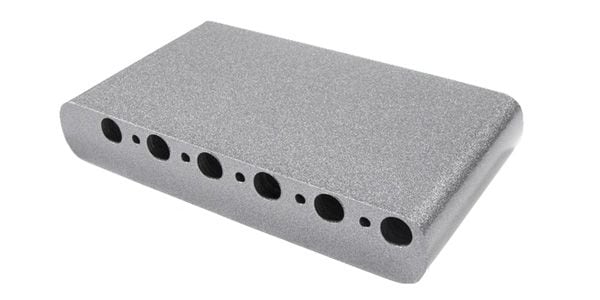
Additionally, the quality of the saddles is exceptional. The saddles, which allow for precise adjustment of string height, use two set screws. To ensure stress-free playing, the set screws for the 1st and 6th strings are shorter. This is a very thoughtful design, especially for guitarists who play near the bridge, as it prevents the set screws from interfering with their playing. The octave tuning can be adjusted with just a single driver. One downside is that the 6th string octave tuning is a bit harder to adjust. When using 09–42 gauge strings on the 6th string, I wish the saddle could move a little further toward the body. Moreover, the small size of the hole that the string passes through on the saddle, especially as the screw almost touches the 6th string (see the photo), makes the saddle tricky for repairmen to work with. The short hole in the saddle can interfere with string vibration, leading to issues with string breakage, sustain, and tuning. Since around 2000, modifying vintage guitar saddles has become common, and improvements in Stratocasters have become widespread.
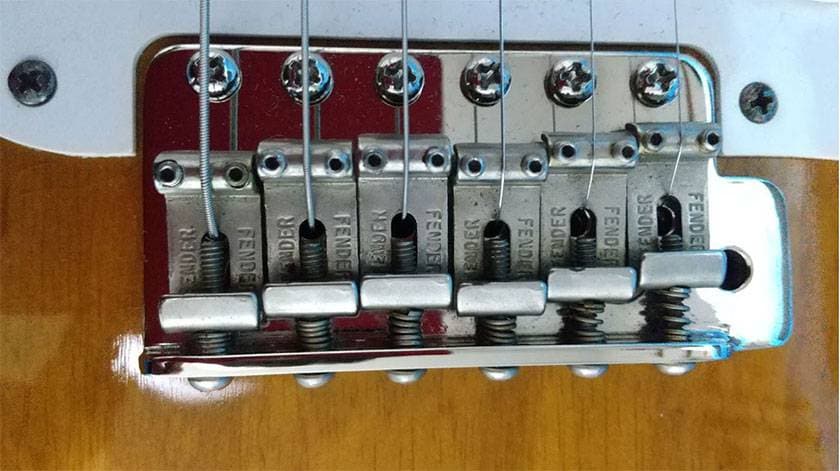
6th string saddle screw almost touching. It’s also difficult to change strings with this setup.
The only original parts on my main guitar that I have continued to use after many modifications are the neck, body (wood), saddle, and various screws.
I changed the screws, replacing the six tapping screws that fixed the bridge plate with wood screws. After swapping out the bridge plate, I immediately noticed an increase in sustain, but I couldn’t detect any noticeable change from the screw replacement alone.
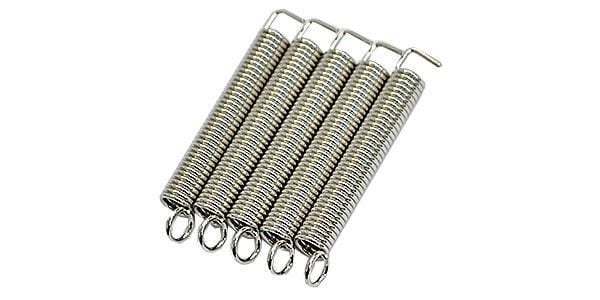
There are many parts available for improving the tremolo unit, but one of the most affordable and easy-to-try upgrades is the springs. (Available at Sound House) The RAW VINTAGE springs are priced around ¥2000. When all five springs are installed, they produce a rich, warm sound, although I wouldn’t recommend them for aggressive playing. Additionally, the description on the packaging really encourages a purchase. The springs are made from soft material, and they can be easily removed with bare hands (but take caution if you're not familiar with the process to avoid injury). Typically, when I’m not using the tremolo arm, I install five springs, and when I want to use the arm, I install four. I always carry an extra spring in my guitar case. Simply changing the number of springs can alter the tone. If I don’t like the softer sound of the springs, I’ll replace a few with springs from a different brand. For Stratocaster players who are particular about tone, I highly recommend trying this out.
RAW VINTAGE / RVTS-1 Tremolo Springs
This time, we discussed the synchronized tremolo unit, but next time, we will talk about the original body shape, pickups, and more.
To be continued.
The column "sound & person" is made up of contributions from our readers.
For details on how to submit, click here.




 GOTOH(ゴトー)ギター用ペグ よくある質問まとめ!
 Fender プロダクトラインナップ
 7弦ギタースタートガイド
 FENDER(フェンダー)ブランドサイト
 愛されたフェンダーギターたち
 Discount Sale
 Outlet
 New Arrivals
 Podcast (streaming)
 Headphones / Earphones
 Microphones
 Wireless Equipment
 Speakers
 Power Amps
 Mixers
 Processors
 Portable PA Systems
 Recorders
 Karaoke
 Guitars
 Basses
 Ukuleles
 Drums & Percussion
 Pianos / Synthesizers
 Wind Instruments
 Stringed Instruments
 Japanese Instruments
 Harmonicas, Other
 Software
 DJ & VJ
 Stands
 Cables & Connectors
 Racks & Cases
 Lighting
 Stage & Truss
 Video Equipment
 PC PERIPHERALS
 Power Supplies
 Studio Furniture
 Household Items, Other
 Alcoholic Beverages