Most people have probably never heard the advice to “train your back muscles.” You might be wondering why you should train them, or how to do it. For those people, here’s something to consider: when you look at elderly people walking around town, how many of them are walking with a dignified posture, upright and normal? In reality, the majority of people are probably walking with rounded backs, leaning forward, and looking down. Many use canes as well. As people age, their backs naturally begin to round.
Throughout a long life, the way we use our bodies hardly changes. Ideally, humans are said to have the best body balance when the back is straight, the spine extends up to the neck in a straight line, and the head sits directly on top. This posture puts the least stress on the spine, which makes perfect sense. Unfortunately, very few people truly understand this simple principle.
Looking around, the reality is clear. Everyone tends to face forward while working. Most tasks require leaning slightly forward—whether it’s factory work, repairing things, household chores, cleaning, scrubbing floors, sewing—every small action involves leaning forward. There are very few workplaces where people lean backward while working. On top of that, modern people spend hours every day looking downward at their smartphones. Staring at a computer screen for extended periods also creates a habit of pushing the neck forward without even noticing. The result is that many people naturally develop a straight neck, or “forward head posture.”
For most people, life is simply repeating daily activities while placing stress on the neck. At the company where I work, Sound House, I’ve witnessed a particularly troubling reality. This is common among people in their 20s and 30s: many sit slouched in their chairs, bending only their necks sharply to look at the display in front of them. They are completely unaware that this is an extreme mistake. Well, I had no idea when I was young either, so it’s hardly fair to blame today’s youth. However, in reality, they are damaging their cervical vertebrae as if destroying their own bodies—and they don’t yet realize what that means. On top of that, most of them don’t exercise regularly. At this rate, it’s not an exaggeration to say they are essentially inviting early physical decline—or even death—upon themselves.
Why am I writing about this? There are two reasons. The first is that I personally suffered from cervical spondylosis and experienced three months of absolute hell, an ordeal I will never forget. The second is that through this experience, I learned firsthand that the only way to improve my condition was to strengthen my back muscles. I have no choice but to sound the alarm. “Ring that bell~”
My cervical spondylosis struck suddenly, out of nowhere. The intervertebral discs of my cervical spine—specifically on the 5th and 6th—were damaged. I didn’t have numbness in my arms, but I lost sensation from my shoulders to my chest muscles. That alone was bad enough, but it didn’t end there. Severe pain shot through my neck, and even the painkillers prescribed by the hospital barely helped. For three months, I endured the pain at work while silently screaming “Ahh!” out of frustration. Of course, I couldn’t concentrate on anything. The only comfort was the doctor saying, “Well, 2-3 months!” And after enduring those three months of trial, the pain gradually subsided.
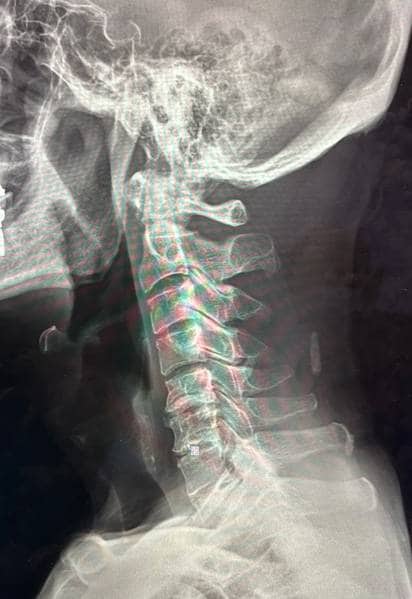
However, cervical spondylosis tends to recur. The cause of this latest episode was my straight neck. Over many years of long hours at a desk, I had unconsciously developed a posture with my head jutting forward. As a result, the cervical vertebrae, which are supposed to curve slightly, had become completely straight and pushed forward. This caused the spaces between the vertebrae to disappear, and the intervertebral discs began to protrude. That was the source of the severe pain—a truly formidable opponent.
The second reason is that I realized there is a way to improve the condition through back muscle training. For more than half a century, I had been doing strength training. In fact, my training history exceeds 50 years. My circuit training mainly focused on exercises like back extensions, bench presses, and dumbbell work, but for some reason, I rarely trained the back side of the body—my back muscles, the soles of my feet, and the hamstrings. I probably thought, “Let’s just train the parts of the body I can see in the mirror!” As a result, I had been concentrating almost entirely on the front of my body.
However, I finally began to understand the importance of strengthening the back muscles. I also discovered that there is a temporary way to relieve cervical spondylosis. By consciously pulling the head backward so it sits directly above the spine and tucking in the chin, the strain on the cervical vertebrae is reduced—a fact I experienced firsthand. The problem is that maintaining this posture is extremely difficult. If I am not conscious of it, my neck immediately returns to its straight posture. You simply cannot keep your head pulled back 24 hours a day! Still, I try to do it as much as possible.
When training the body, it’s natural to start with the chest and arms because those are the parts you can see. However, it’s the back muscles that support the cervical vertebrae—the muscles on the back of the body are the main players. Furthermore, the back muscles, the muscles of the lower back, and the hamstrings on the back of the thighs are all connected, so each is crucial. I realized the importance of movements that engage the back muscles and pull the back and neck. With this in mind, I seriously began training my back, lower back, and hamstrings—the very muscle groups I had almost completely neglected for 50 years.
To be honest, it’s tough! For an ordinary person, their first reaction would probably be, “No way!” It’s painful. It is exhausting. I felt the same way. Since I was putting stress on muscles that had never been trained before, it required tremendous effort. More than effort, it was about how much discomfort I could endure. In my case, I also had the condition of not raising my blood pressure too much, so I had previously increased the number of reps—from 10 in my youth to 22—and then decided to push it further to 50. In other words, each exercise is repeated 50 times, and by the 50th rep, I would push myself to the point of utter exhaustion, saying, “I can’t go on!” I did this in sets of two. I had to do something of that magnitude; otherwise, the muscles wouldn’t develop! I told myself this and challenged my endurance.
Why did I endure this? Because I knew the pain of a cervical hernia. Having experienced that kind of hell, I wanted to avoid it again at all costs. Seeing people on the brink of that suffering, I find myself, perhaps with a bit of unsolicited concern, ringing the alarm: “Wait a minute! Do some exercises!”
It’s been about six months since I started including back and hamstring training. The results became noticeable within just a few months. I can now consciously engage my back muscles, pull my neck backward, and position my head atop my spine. Medically speaking, I’m not sure of the exact effects, but at least I feel that my head is properly aligned along the back. What’s more, I can do this even while walking, consciously engaging my back muscles and pulling my neck up and back. This is a significant shift in awareness.
When I keep my head pulled back, I experience no pain in my neck at all. Conversely, when I get absorbed in work and unconsciously jut my head forward, my neck and shoulders become numb and painful. I realized that with the strength of my back muscles, I can avoid that pain and discomfort! Isn’t that incredible? It’s not a painkiller, or an injection, nor the magic of iPS cells—this relief comes purely from my own effort. There’s no reason not to do it. So recently, I’ve been going to a 24-hour fitness center near my home for 40 minutes a day, paying 6,000 yen a month, and training relentlessly.
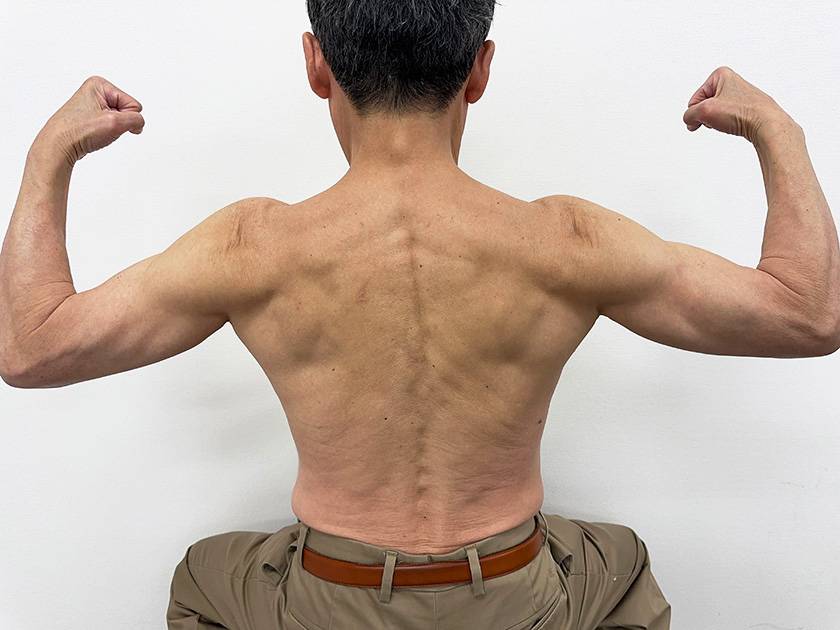
Let me be clear. My back muscles now are truly stronger and more resilient than when I trained in my teens 50 years ago. With this back strength, I can support the weight of my head while working 12 hours a day, pulling it back to keep my spine upright, and I continue to make the effort. To live forever at the age of 50, this level of effort is nothing. Just recently at a shop in Tokyo, I was asked for my date of birth to register as a customer. I blurted out, “Huh? I’m supposed to tell you my birth date?” and added, “I’m really old, you know…” I noticed the staff scrolling through the decades on her smartphone. And she stopped at the 1970s! “Yes!” That was my motivation. By strengthening my back and keeping it upright, I can rejuvenate myself! By doing these simple, obvious things, life can still have turning points.






 Discount Sale
 Outlet
 New Arrivals
 Podcast (streaming)
 Headphones / Earphones
 Microphones
 Wireless Equipment
 Speakers
 Power Amps
 Mixers
 Processors
 Portable PA Systems
 Recorders
 Karaoke
 Guitars
 Basses
 Ukuleles
 Drums & Percussion
 Pianos / Synthesizers
 Wind Instruments
 Stringed Instruments
 Japanese Instruments
 Harmonicas, Other
 Software
 DJ & VJ
 Stands
 Cables & Connectors
 Racks & Cases
 Lighting
 Stage & Truss
 Video Equipment
 PC PERIPHERALS
 Power Supplies
 Studio Furniture
 Household Items, Other
 Alcoholic Beverages