Now that September has arrived, I’ve recently noticed that, at night, the heat stored in the asphalt throughout the day still rises into the air, yet the air itself somehow feels cool. If I’m not careful, it feels like winter could arrive in an instant.
Around this time every year, I feel a little sad thinking, “Another summer has gone by without me doing anything...” But when I think about it, it was so hot that I didn’t even feel like going outside, so I guess it couldn't be helped. This fall, I’d like to get out and be more active.
...Active?
Speaking of active, in the world of audio equipment, powered speakers are sometimes called ‘active speakers’.
Yes, that was quite a stretch, but it brings us to today’s topic!
When looking for PA speakers, you’ll almost certainly come across the terms ‘powered’ and ‘passive’.
Have you ever wondered what the difference is, even though they both look like speakers? Or which one you should ultimately choose?
This time, I’m going to explain the differences between powered and passive speakers in a way that’s easy for PA beginners to understand!
■ What’s the Difference in the First Place?
The biggest difference between the two is whether or not they have a power amplifier built into the speaker.
...Even if I say that, PA beginners might be wondering, “What exactly is a power amplifier in the first place?”
I was the same when I started out. Audio signals sent from a microphone or mixer are extremely weak on their own and cannot drive a speaker at a sufficient volume. That’s where a power amplifier comes in.
A power amplifier is a piece of equipment that amplifies audio signals sent from a mixer or other source to a level that can actually drive a speaker. You can think of it as the ‘engine’ that powers the speaker.
Speakers are classified as ‘powered’ or ‘passive’ depending on whether this power amplifier is built into the speaker itself or provided separately.
Powered speakers have a power amplifier built into the unit. This means you can produce sound simply by connecting the audio signal from a mixer, microphone, or other source and turning on the speaker’s power.
Passive speakers, on the other hand, do not have a built-in power amplifier. Audio signals from a mixer alone cannot drive the speakers, so you need to provide a separate power amplifier.
The signal flow can be illustrated simply as follows.
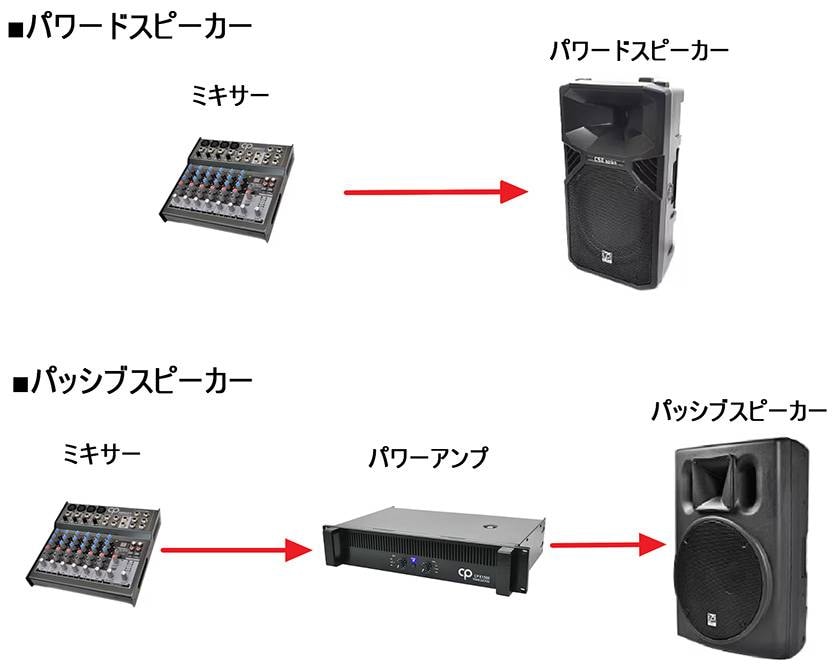
To sum it up:
- Built-in amplifier = Powered speaker
- No built-in amplifier = Passive speaker
That’s the basic idea.
■ Advantages of Powered Speakers
The biggest appeal of powered speakers is how easy it is to put together a simple system!
You don’t need to select a separate power amplifier; you can use them simply by connecting the mixer to the speakers. Since an amplifier suited to the speaker is already built in, there’s no need to worry about whether the speaker and amplifier outputs are compatible.
Depending on the model, features may include microphone inputs, a simple mixer, Bluetooth, and DSP. Some products can handle most of what you need with just a single speaker.
They’re extremely convenient for small live performances, meetings, school events, store events, and other situations where you want to set up and pack away quickly.
One thing to keep in mind, however, is that each speaker needs its own power supply. If you’re setting up two speakers, one on the left and one on the right, you’ll need to provide power to each speaker in addition to connecting the audio cables.
■ Advantages of Passive Speakers
Passive speakers are used in combination with an external power amplifier.
You might think, “If that means I need more equipment, wouldn’t powered speakers be better?”
However, passive speakers also offer some major advantages.
First, you don’t need to supply power directly to the speakers. You only need to run speaker cables from the power amplifier, making passive speakers convenient when installing speakers high up or in places where it’s difficult to access a power outlet.
For example, you might want to suspend speakers from the ceiling or high up on a wall in a dance studio. With powered speakers, you'd have to bring out a stepladder and turn off the power on each speaker after every day’s use, then turn them back on in the same way the next time they’re needed.
Nobody wants to deal with that kind of inefficiency, right? I like to believe it’s not just because I’m lazy!
In situations like this, you can simply run speaker cables from the power amplifier and easily turn the system on and off at the amplifier itself. This is one of the advantages of passive speakers.
They’re also well suited to installed sound systems and permanent installations because you can keep the power amplifiers together in one location and manage them centrally. Another advantage is that you can replace the amplifier and speakers separately in the event of a failure or a system change. Managing risk is important in everything, after all!
On the other hand, you need to check the amplifier’s output, the speaker’s impedance, its power-handling capacity, and other specifications to make sure the components are compatible. You also need to use speaker cables rather than ordinary microphone cables.
In other words, this type of system requires a little more knowledge than a powered-speaker setup.
We’ve also covered how to choose speakers and power amplifiers in our guide, so be sure to check that out as well!

■ So, Which Should You Choose?
For beginners and people who frequently transport their equipment, powered speakers are generally the best choice.
Since you don’t have to worry as much about selecting an amplifier and relatively little additional equipment is required, they’re easy to get started with, even if you’re putting together your first PA system.
On the other hand, passive speakers are worth considering if you want a permanent installation in a store or hall, need to manage a large number of speakers centrally, or want the flexibility to replace amplifiers and speakers individually in the future.
In other words, these are some useful guidelines:
- Choose powered speakers if you prioritize convenience and portability.
- Choose passive speakers if you prioritize expandability, wiring for permanent installations, and centralized management.
However, neither type is inherently better than the other. The most suitable system depends on where and how you plan to use it, as well as the number of speakers you need.
■ Recommended Powered and Passive Speakers
“So, I understand the difference, but which products do you actually recommend...?” If you’ve been waiting impatiently for this part, thanks for bearing with me!
From here, I’ll introduce my personal recommendations for both passive and powered speakers—my own picks!
Of course, the right speaker will vary depending on the size of the venue, the intended use, the required volume, your budget, and other factors. These are simply my personal recommendations, so please keep that in mind!
Recommended Passive Speakers
CLASSIC PRO / CSP12 PA Speaker
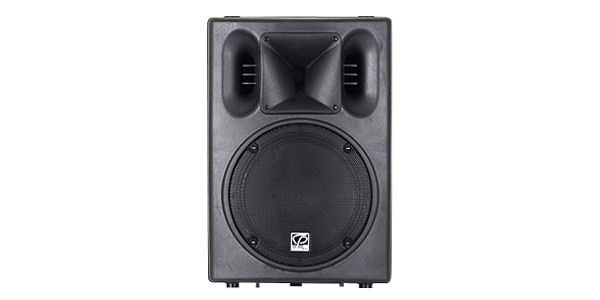
First up is the CLASSIC PRO CSP12, a must-consider option when looking for passive speakers at Sound House!
This is a two-way full-range speaker equipped with a 12-inch woofer. Its appeal lies in its clear, well-balanced sound from low to high frequencies. It’s suitable for all kinds of applications, including live performances, acoustic shows, meetings, and presentations.
If you’re thinking, “I want to keep costs down as much as possible, but I still need a PA speaker that can do the job properly,” this is the first model I’d recommend checking out.
JBL / JRX215 PA Speaker

Next up is the JBL JRX215!
One of its biggest features is its ample low-frequency response, thanks to its 15-inch woofer. It delivers a powerful sound while maintaining a clear sense of definition, making it ideal for situations where you want to really crank up the music, such as band performances, DJ events, and clubs.
Its maximum SPL is 129 dB, which is reassuring if you need plenty of output. Personally, I like the punchy, beefy bass character of JBL speakers because it gives the sound a real live-performance feel, which is why I’ve included this model in my recommendations. It lets you enjoy JBL’s signature sound at a relatively accessible price, making it a good choice if you want powerful bass or need a main speaker for a small- to medium-sized venue.
Mackie / C300z PA Speaker

The Mackie C300z is a passive speaker equipped with a 12-inch woofer. It was designed and tuned by EAW’s loudspeaker team, and its appeal lies in its natural, clear sound. Vocals and instruments are less likely to get buried in the mix, allowing them to come through clearly to the audience. What’s more, it features an asymmetrical cabinet, so it can be used not only as a conventional main speaker but also as a floor monitor when placed horizontally on the floor! This makes it convenient when you want one speaker to serve a variety of roles at live performances, events, and band rehearsals.
In addition to stand mounting, it supports flying installation, so it’s worth considering not only for portable use but also for permanent installations in stores and small live venues.
This is an outstanding speaker I’d wholeheartedly recommend to anyone who doesn’t want to compromise on sound quality.
Recommended Powered Speakers
JBL / EON710 10-Inch Powered PA Speaker (Bluetooth Compatible)

Our first powered speaker is the JBL EON710!
It’s a relatively compact model equipped with a 10-inch woofer, but with an amplifier output of 1,300 W and a maximum SPL of 125 dB, it’s more powerful than its appearance might suggest. At the same time, it weighs just 11.9 kg. High sound quality, extensive features, and portability—all three are here.
In addition to Bluetooth music playback, it has a built-in three-channel digital mixer and dbx DSP. It comes packed with practical features for real-world use, including automatic feedback suppression, ducking, delay, and EQ.
I’d recommend it to anyone looking for a conventional box-style powered speaker who doesn’t want to compromise on either sound quality or functionality.
QSC / CB10 Battery-Powered Speaker

Next up is the QSC CB10, released in January 2026!
Its biggest selling point is, of course, its ability to run on battery power. With up to approximately 12 hours of continuous operation, it’s a great choice for street performances, outdoor events, and other situations where access to a power supply is difficult.
It features a 10-inch woofer and a 1-inch compression driver. Despite its compact size, it delivers a maximum SPL of 127 dB. It’s ideal for anyone who wants portability without sacrificing sound quality or volume.
It also has a built-in three-channel mixer and Bluetooth, allowing you to connect microphones, instruments, smartphones, and other devices to create a simple system centered around the CB10. It can be controlled remotely via a dedicated app and can also be mounted on a stand or used as a floor monitor.
This is a highly mobile speaker that solves the problem of “I can’t make any sound because there’s no power outlet!”
*Battery life varies depending on volume, the audio source being played, ambient temperature, and other factors.
Mackie / Thrash12v2 Powered Speaker
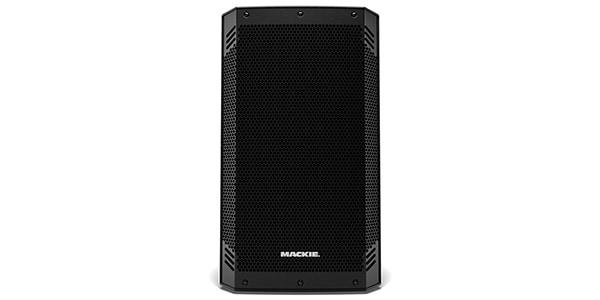
Next, let me introduce the Mackie Thrash12v2.
I like this model because I think its sleek, streamlined appearance looks really cool.
It features a 12-inch woofer, a 1-inch driver, and a highly efficient 1,300 W amplifier, delivering a maximum SPL of 129 dB. It produces a strong, commanding sound for live performances, band rehearsals, DJ events, and more.
You can choose from four sound modes—Flat, DJ, Live, and Wedge—depending on the application, making it suitable not only as a main speaker but also as a floor monitor.
It also features a feedback eliminator that automatically suppresses feedback, as well as Bluetooth music playback. Another handy feature is the ability to wirelessly link two units and play audio in stereo or dual mono.
The controls are kept simple, so I’d recommend this highly practical speaker to anyone who struggles with complicated settings but doesn’t want to compromise on volume or functionality!
JBL / EON ONE MK2
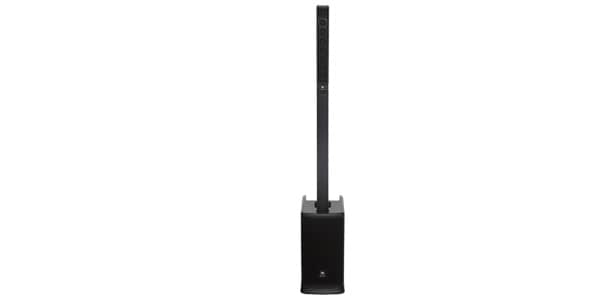
Last but not least is the JBL EON ONE MK2!
This is an all-in-one column PA system that combines a speaker, a 1,500 W peak amplifier, a five-channel digital mixer, DSP, and a battery in a single package.
One of its key features is its eight tweeters, which help distribute sound widely in the horizontal direction. Its appearance is also quite different from that of conventional box-style speakers, making it particularly useful for acoustic performances, presentations, store events, and other situations where you want sound to reach a wide area of the audience.
It comes equipped with Lexicon effects such as reverb, chorus, and delay, along with dbx automatic feedback suppression. You can connect microphones and instruments directly and shape your sound using the unit itself.
It can operate on battery power for approximately six hours, and the speaker components can be stored inside the woofer section. It’s great to see how carefully this system has been designed with setup, teardown, and portability in mind.
If you’re thinking, “I don’t want to bring several separate pieces of equipment, such as a mixer,” or “I want to run a full-fledged live performance or event with just one system,” this is a dependable all-in-one solution!
■ Conclusion
This time, I’ve introduced the differences between powered and passive speakers.
Although they may look similar, whether or not an amplifier is built in makes a big difference to the equipment and cabling required, as well as the applications for which each type is best suited.
If ease of use is your priority, especially when setting up your first PA system, powered speakers are a great choice. If you want to manage multiple speakers centrally or have the flexibility to build a system for a permanent installation, passive speakers are worth exploring.
Choose speakers that suit your needs and enjoy a great PA experience!
See you next time!!
See ya!













 JBL スピーカー SRX800(パワード)シリーズ
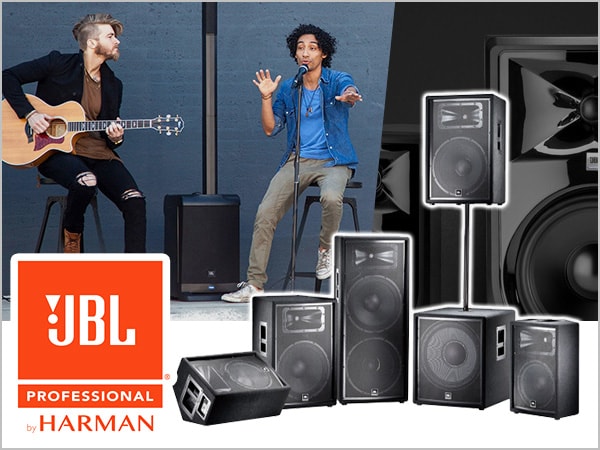 JBL スピーカー特集
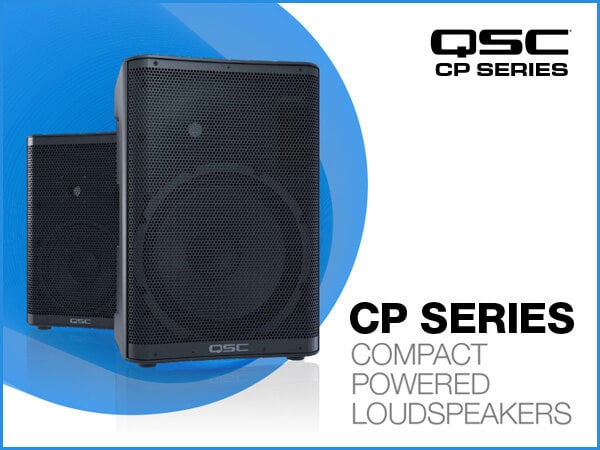 QSC パワードスピーカー CPシリーズ
 CLASSIC PRO 簡易PAシステム特集
 Mackie PAスピーカー比較表
 Discount Sale
 Outlet
 New Arrivals
 Podcast (streaming)
 Headphones / Earphones
 Microphones
 Wireless Equipment
 Speakers
 Power Amps
 Mixers
 Processors
 Portable PA Systems
 Recorders
 Karaoke
 Guitars
 Basses
 Ukuleles
 Drums & Percussion
 Pianos / Synthesizers
 Wind Instruments
 Stringed Instruments
 Japanese Instruments
 Harmonicas, Other
 Software
 DJ & VJ
 Stands
 Cables & Connectors
 Racks & Cases
 Lighting
 Stage & Truss
 Video Equipment
 PC PERIPHERALS
 Power Supplies
 Studio Furniture
 Household Items, Other
 Alcoholic Beverages