“Is it okay to keep using violin strings until they break?” “Lately, it feels like the sound isn’t coming out as easily as before. Could it be the strings?” For those who have just started playing the violin, it can be surprisingly difficult to know when to change the strings.
Even when there are no visible problems, violin strings gradually deteriorate with repeated playing. Old strings can lose their brightness, resonance, and responsiveness, and may also affect tuning and intonation.
In this article, I, a stringed-instrument specialist at Sound House, explain when to consider changing violin strings, signs of wear, tips for making strings last longer, and popular string sets that are easy to choose when it’s time for a replacement.
The Bottom Line!
- There is no absolute rule for when to change strings. Use six months as a starting guideline, and check them sooner if you play frequently.
- Consider replacing your strings if you notice signs such as a dull tone, unstable tuning, or fraying windings.
- Rather than waiting until a string breaks, I recommend judging when to replace it based on changes in tone and playing feel.
How Often Should You Change Violin Strings?
The lifespan of violin strings varies depending on the type of strings, the amount of time you play each day, how much you sweat, how you care for them, and the temperature and humidity. There is no fixed rule that says you must replace them every certain number of months.
As a general guideline, if you play regularly, checking the condition of your strings every six months is a good place to start. Those who practice for long hours every day, or who prioritize tone and responsiveness for performances or recording, may consider replacing their strings every three to six months.
Replacement Guidelines by Playing Frequency
| Playing Frequency | Guideline | Suitable For |
|---|---|---|
| At least one hour every day | 3-6 months | Those who play in school clubs, attend music lessons, or practice regularly |
| Several times a week | 6-9 months | Those who play regularly as a hobby |
| Occasionally | Approximately 6 months to 1 year | Those who play infrequently but want to keep their strings in good condition |
*The periods above are only guidelines. String lifespan varies considerably depending on the type of strings and playing environment. Check the actual sound and condition of your strings rather than relying on time alone.
“Not Broken” Doesn’t Necessarily Mean “Still Good to Use”
Even if strings don’t break, their performance gradually declines. If you notice that the tone sounds more muffled than when the strings were new, the attack feels sluggish, or it’s harder to produce sufficient volume even when playing in the same way, your strings may have deteriorated. In particular, if you’ve recently found the violin harder to play, check the condition of the strings as well as the instrument itself.
5 Signs That It’s Time to Change Your Strings
1. The Tone Sounds Duller and More Muffled Than Before
As strings age, they may lose brightness and overtones, making the tone seem flatter. If your instrument is properly set up but you feel that its resonance has diminished, this is a sign that it may be time to replace your strings.
2. Tuning Becomes Difficult to Keep Stable
If the pitch doesn’t settle even after repeated tuning, or certain notes sound noticeably off, string deterioration may be a contributing factor.
3. The Windings Are Fraying or the Surface Feels Rough
I recommend replacing your strings if the windings on the A, D, or G strings are fraying, or if you can clearly feel unevenness or roughness when touching them. Areas around the nut, along the fingerboard, and near the bridge are particularly prone to wear.
4. Discoloration, Rust, or Dirt Becomes Noticeable
Strings are more likely to deteriorate if sweat, skin oils, and rosin dust are left on them. If dark discoloration or rust becomes noticeable, check their condition.
5. The Attack and Responsiveness Have Deteriorated
If the sound takes longer to speak when you draw the bow across the strings, or if it has become harder to produce soft notes, this is another indication that it may be time to replace them.
Should You Replace All 4 Strings, or Is It Okay to Replace Just One?
If only one string breaks, there is no problem with replacing just that string. However, if all four strings have been in use for a long time, they may all have deteriorated to a similar degree. If you want to maintain a consistent tone and balance, I recommend replacing the entire set.
When changing strings, you should generally replace them one at a time rather than removing all four at once. Be careful, as removing every string can cause the bridge to fall over or potentially affect the soundpost inside the instrument.
Tip: If you’re changing strings for the first time, taking a photo of the bridge’s position and orientation before you begin can be helpful. After restringing, also check that the bridge hasn’t tilted forward.
3 Tips for Making Your Strings Last Longer
1. Wipe the Strings with a Dry Cloth After Playing
Gently wipe away sweat, skin oils, and rosin dust after playing. Lightly cleaning the area around the fingerboard as well as the strings will help keep everything in good condition.
2. Don’t Apply Too Much Rosin
Applying more rosin than necessary can cause rosin dust to accumulate on the strings. Use an appropriate amount while checking how smoothly the bow moves across them.
3. Avoid High Temperatures, High Humidity, and Sudden Temperature Changes
Extreme changes in temperature and humidity can put stress on the violin itself as well as its strings. After playing, place the instrument in its case and store it in as stable an environment as possible.
Which Strings Should You Choose? 3 Popular Violin String Sets
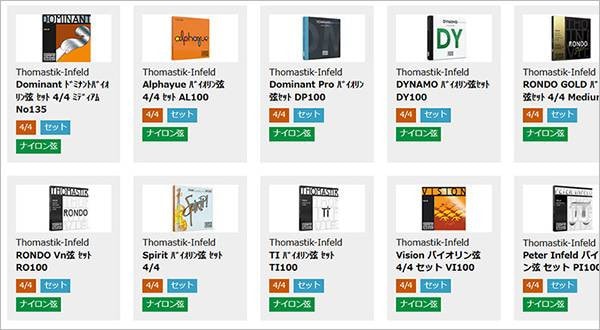
If you’ve realized that it’s time to change your strings but aren’t sure what to choose next, here are three popular series from Thomastik-Infeld that are easy to choose from at Sound House.
If You’re Unsure, Start with the Classic Dominant
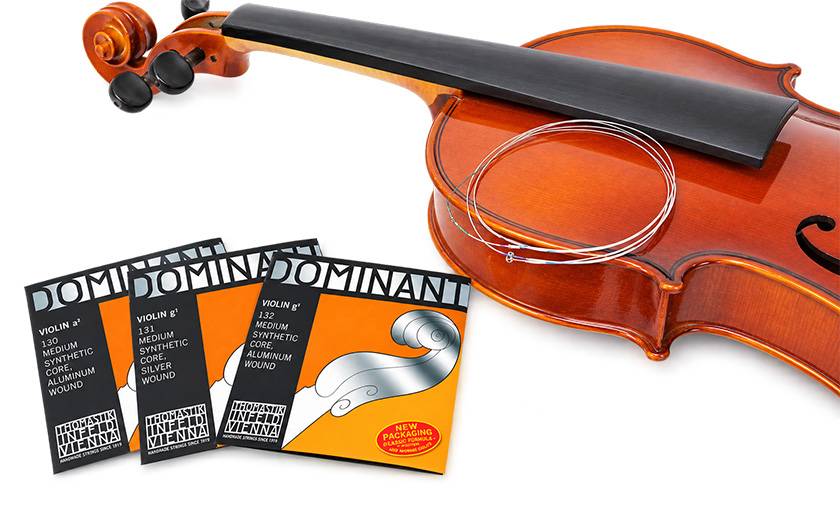
A classic series that has been used around the world for many years. Its appeal lies in its rich resonance and ease of use, made possible by its nylon-based synthetic core. I recommend these strings to players looking to upgrade their strings for the first time or those who want to try a reliable reference point.
Thomastik-Infeld / Dominant Violin String Set, 135 Medium, 4/4

If You Want a Bright, Clear Tone, Choose Vision
These strings are characterized by a clear, focused sound and excellent responsiveness. They’re recommended for players who want to bring out the definition of each note or prioritize response.
Thomastik-Infeld / Vision Violin String Set, 4/4, VI100

If You Want to Keep Costs Down, Choose Alphayue
A series that is accessible to students and beginners alike. It’s also a good choice for those who want to take a step up from the strings supplied with their instrument when it’s time for a replacement.
Thomastik-Infeld / Alphayue Violin String Set, 4/4, AL100

What to Check Before Changing Your Strings
- Make sure the string size matches your instrument (4/4, 3/4, 1/2, 1/4, etc.)
- Check that the tailpiece-end specification matches, such as ball-end or loop-end strings for the E string
- Make sure the tension or gauge is appropriate, such as Light, Medium, or Heavy
- When changing strings, do not remove all four at once. Replace them one at a time
Simply Changing Your Strings Can Transform the Way Your Violin Sounds
Violin strings are consumable items, but they’re also important components that have a major impact on your instrument’s tone and playing feel. Rather than continuing to use them until they break, consider replacing them if you notice that the tone has become dull, tuning is unstable, or the string surfaces are showing signs of wear.
Simply fitting a new set of strings can improve the attack and make the tone sound brighter than before. Changing strings is not only a form of maintenance but also an enjoyable way to explore the sound you prefer.
At Sound House, we carry a wide range of violin strings, from options for beginners to those for professional players. Find the strings that suit your playing style and preferences!








 鈴木バイオリン製造
 バイオリン 入門ガイド
 バイオリン弦 セレクター
 バイオリンスタートガイド
 バイオリンの弦交換
 バイオリンの調弦(チューニング)
 Discount Sale
 Outlet
 New Arrivals
 Podcast (streaming)
 Headphones / Earphones
 Microphones
 Wireless Equipment
 Speakers
 Power Amps
 Mixers
 Processors
 Portable PA Systems
 Recorders
 Karaoke
 Guitars
 Basses
 Ukuleles
 Drums & Percussion
 Pianos / Synthesizers
 Wind Instruments
 Stringed Instruments
 Japanese Instruments
 Harmonicas, Other
 Software
 DJ & VJ
 Stands
 Cables & Connectors
 Racks & Cases
 Lighting
 Stage & Truss
 Video Equipment
 PC PERIPHERALS
 Power Supplies
 Studio Furniture
 Household Items, Other
 Alcoholic Beverages