“With great power comes great responsibility.”
That’s a great proverb, isn’t it? Ah, sorry for the sudden interruption. Have you all watched it?
(´・ω`・) Huh? What am I talking about? Obviously, I mean the new Spider-Man movie.
Man, it was good, wasn’t it? If you haven’t watched it yet, go check it out. I’m sure you’ll be moved.
These days, I find myself daydreaming about whether I might be able to shoot webs from my wrists.
Anyway, enough of my silly talk. Let me suddenly ask you this: Have you ever looked at a PA equipment product page or manual and thought, “...It’s supposed to be written in Japanese, but I have no idea what it’s saying”?
I have. Actually, when I first started studying PA equipment, this happened almost every day, lol.
Gain, impedance, SPL, phantom power, DSP...
English! Alphabet letters!! “I just want to make the sound louder, so why are there so many words I’ve never heard before...?”
I remember holding my head in my hands.
However, as I continued studying PA, I realized that the number of terms that appear frequently is surprisingly limited.
So this time, from among the audio terms that made me think “What is this!?” when I was first studying PA, I’ve picked out 10 that I especially want beginners to remember and will introduce them here!
If you dig all the way down into the technical details, it’s an extremely deep world, so this time, this is strictly for beginners!
Let’s go through them with the goal of “getting a general idea of what they mean”!
1. What is Gain?
Gain is used to adjust the level of an input audio signal to an appropriate level that can be easily handled by the stages that follow.
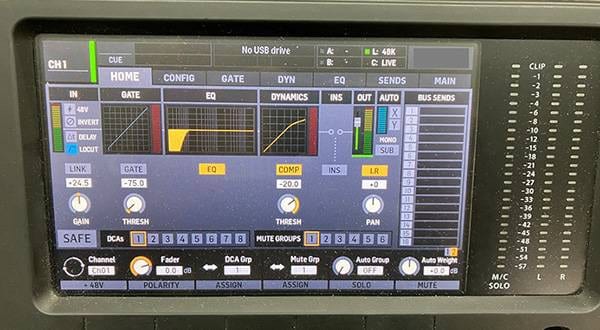
When you look at a mixer, you see a knob labeled ‘Gain’, right?
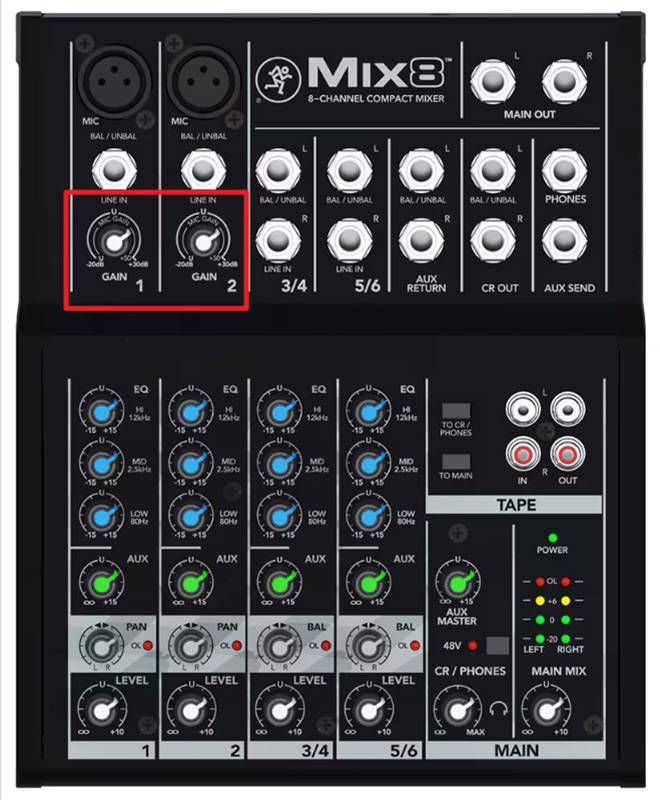
When I first saw one, I thought:
“What’s the difference between this and the volume???”
In simple terms, gain adjusts the signal to an appropriate level at the point where it enters the mixer. On the other hand, volume controls such as the fader adjust the volume further down the signal path. If the gain is too low, you won’t get a sufficient signal level, while if it is too high, the signal may clip at the input stage or elsewhere, causing distortion.
In PA, it’s important not to just set everything to ‘max’ but to set the level appropriately at the very beginning of the signal path.
2. What is dB (Decibel)?
dB (decibel) is a unit used to express how much a quantity such as sound level or signal level differs “in comparison with a reference.”
When you’re researching PA equipment, it appears all the time.
“Maximum sound pressure level: 130 dB”
“Gain: +10 dB”
“Fader: -5 dB”
And so on.
At first, I also thought, “dB is a unit for expressing how loud a sound is, right?”
But actually, that explanation alone is a little insufficient.
dB is originally a unit used to express the ‘ratio’ between two quantities logarithmically. By defining a reference value, it can also be used to express sound pressure or signal level itself, as in ‘dB SPL’, ‘dBu’, and ‘dBV’.
For example, you often see the specification “Maximum Sound Pressure Level XX dB SPL” on PA speaker product pages.
In this case, it indicates the sound pressure level that the speaker can produce, and the higher the number, the greater the sound pressure the speaker can produce, making it a useful guideline.
On the other hand, mixer faders also have markings such as ‘0 dB’ and ‘-10 dB’.
Here’s something to be careful about! ‘0 dB’ on a fader does not mean ‘zero volume’!
When you first used a mixer, didn’t some of you think, “It makes sound even though it’s at zero!?”
The 0 dB position on a fader is generally called ‘unity gain’, and it is the position where the signal is neither amplified nor attenuated by the fader. If you lower the fader from there to ‘-10 dB’, the signal level is reduced. Conversely, on mixers that allow you to move the fader above 0 dB, you can increase the signal level. Something else that makes this a little confusing is that dB is not a unit where the number itself directly means ‘X times’. Because dB is expressed logarithmically, you cannot simply think, “An increase of 10 dB means 10 times the original value.”
...Logarithm.
This is suddenly starting to feel like a math class, isn’t it? As someone who is extremely humanities-oriented, I’m already feeling like stopping here, lol.
But don’t worry. At the beginner stage of learning PA, you don’t need to memorize complicated formulas.
“dB is used to express a change in comparison with a reference.”
“Even with the same dB value, check what it is being used to describe.”
“0 dB does not mean silence.”
For now, if you remember these three things, PA equipment product pages and mixer displays will become much easier to understand!
In particular, when comparing PA speakers, don’t just look at the output expressed in ‘XX W’. Be sure to pay attention to the ‘Maximum Sound Pressure Level (Max SPL)’ as well.
...By the way, what is this ‘SPL’ that has been coming up?
Don’t worry.
I’ll explain it in the next section!
3. What is SPL?
SPL stands for ‘Sound Pressure Level’.
Here comes another three-word English phrase! Repeat after me: “Sound Pressure Level.”
...Okay.
On PA speaker product pages, you may see terms such as ‘Max SPL’ or ‘Maximum SPL’.
SPL represents sound pressure level. In PA speaker specifications, it is often listed as ‘Max SPL (Maximum Sound Pressure Level)’, and it serves as a guideline for understanding the level of sound pressure that the speaker can produce.
*The measurement and calculation conditions for Max SPL may vary depending on the manufacturer.
When you’re a beginner, it’s easy to think, “Higher W (watts) = the sound is definitely louder,” but when considering the volume of a speaker, you need to check not only the wattage but also specifications related to sound pressure like this.
If you’re thinking, “I’m comparing PA speakers, but what should I look at besides the wattage?” then remembering the term ‘SPL’ first may make product pages a little easier to understand!
4. What is Impedance?
Impedance is a value that represents electrical resistance to an AC signal, and Ω (ohms) is used as its unit.
...Yes.
This explanation alone is enough to make a beginner want to give up. I did too, lol.
I remember thinking, “I feel like I learned this when I was in middle school...”
At the beginner stage of learning PA, for now, just remember it as “an important value that must be checked when combining an amplifier and passive speakers”!
For example, when connecting a passive speaker to a power amplifier, you need to check the impedance of the speaker and the impedance supported by the amplifier. In particular, when multiple passive speakers are connected in parallel, the combined impedance as seen by the amplifier decreases. (For example, “Two 8Ω speakers connected in parallel = 4Ω.”) You need to make sure that you do not go below the minimum load impedance supported by the amplifier. “Since there’s a terminal, I’ll just connect it!” can be dangerous.
With powered speakers, the amplifier is built into the speaker, so beginners don’t have to worry about matching the power amplifier and speaker load impedance themselves. That’s another point that makes powered speakers easy to understand for beginners.
5. What are MIC Level and LINE Level?
MIC level and LINE level refer to differences in the level, or magnitude, of an audio signal.
The signal coming from a microphone is extremely small, so it is amplified and handled by a mixer or other equipment.
On the other hand, LINE-level signals output from many devices such as keyboards, mixers, and audio equipment are generally at a higher level than microphone signals. In other words, it’s not simply, “They’re both audio signals, so they’re the same!” Mixers are labeled ‘MIC’ and ‘LINE’ because they are designed for different signal levels.
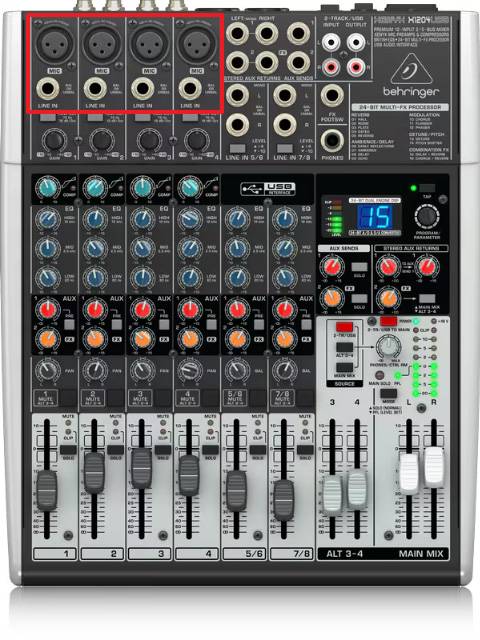
When making connections, get into the habit of checking ‘what’ you are connecting and ‘which input’ you are connecting it to!
6. What is Phantom Power?
Phantom power is power supplied from a mixer or other device, mainly to operate condenser microphones and similar equipment.
When looking at a mixer, you may see a button labeled ‘+48 V’.
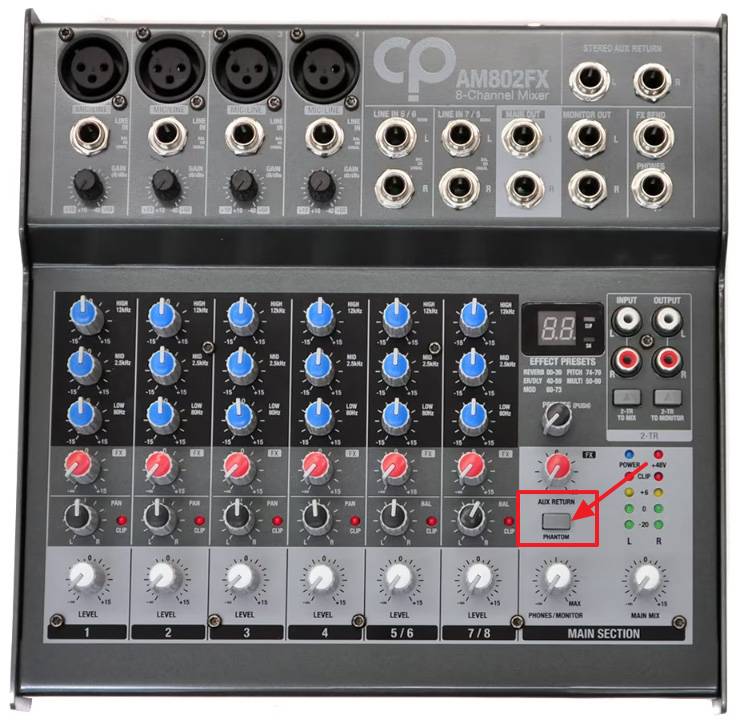
From a beginner’s perspective, that sounds scary. It says 48 V, so isn’t something going to explode if I press it? Of course, it’s not that kind of button, lol.
Some common condenser microphones require power to operate. Phantom power is a system that supplies that power through an XLR cable. However, compatibility varies depending on the connected equipment, so you should not just turn +48 V on for everything.
Many devices do not require phantom power, and depending on what you connect, caution may be necessary. Check the specifications of the microphone and connected equipment before use.
Also, when turning phantom power on or off, the basic practice is to mute the output to the speakers or amplifier, or lower the faders and other controls before operating it.
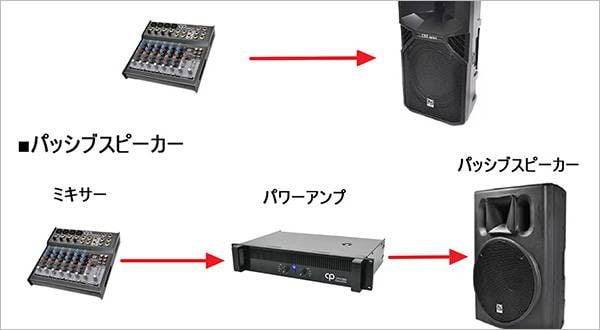
7. What are Passive Speakers and Powered Speakers?
The words ‘passive’ and ‘powered’ appear frequently when dealing with PA equipment. When talking about speakers, roughly speaking, the difference is:
Passive speaker = Requires a separate power amplifier
Powered speaker = Has a built-in power amplifier
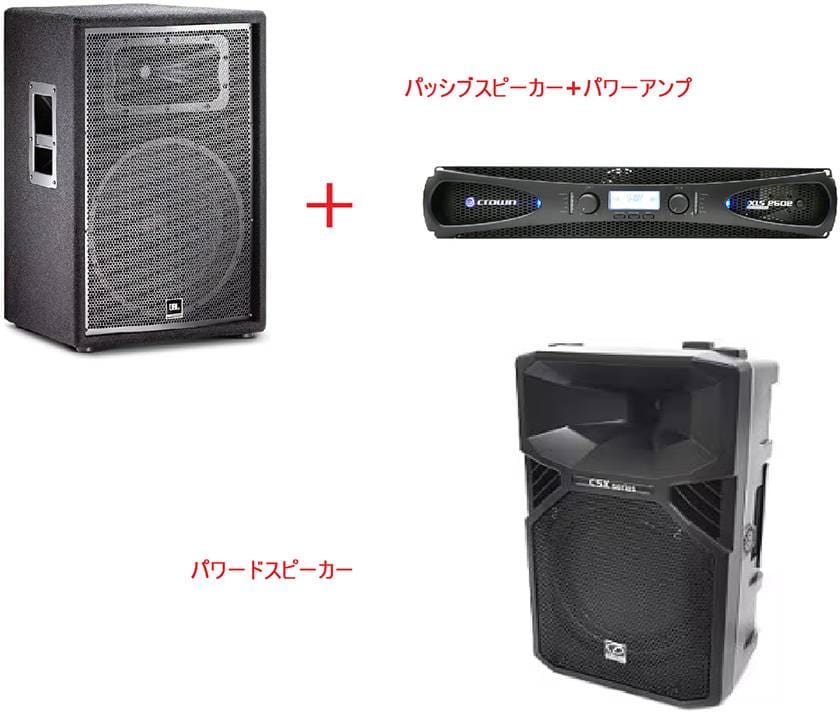
That’s the difference.
Because powered speakers do not require you to think about matching them with an amplifier, you can build a system relatively simply. For outdoor events and similar situations, you don’t need to prepare an external power amplifier, making it easier to keep the system configuration simple and reducing the setup work somewhat. On the other hand, passive speakers require a separate power amplifier, but they allow you to combine amplifiers and speakers according to your needs. Another advantage is that if either the power amplifier or passive speaker breaks down, it is easier to replace just the failed component. ‘Passive = low performance’ and ‘Powered = high performance’ is not what these terms mean! Which is more suitable depends on the application and system configuration.
8. What is DSP?
DSP stands for ‘Digital Signal Processor’, a processor that performs digital signal processing.
In PA equipment, DSP is used to perform various types of processing on audio signals.
And here comes another three-word English phrase. Repeat after me: “Digital Signal Processor!”
...Okay.
It kind of sounds like the name of a special attack, doesn’t it?
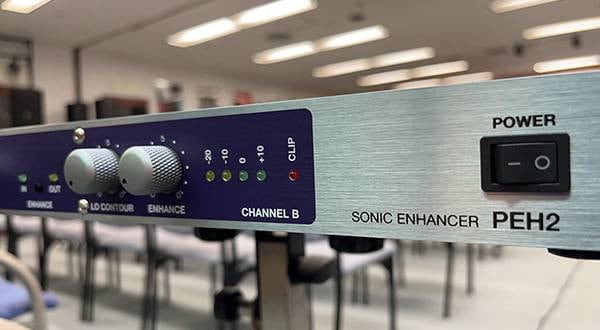
PA equipment equipped with DSP can perform various types of audio processing, such as EQ (equalization), limiting, crossover processing, and delay. These days, you often see DSP-equipped models among powered speakers and power amplifiers as well. If you’ve ever wondered, “The product page says it has DSP, but what can it actually do?” I’ve explained this in more detail in a previous article, so please check that out as well!
⇒ [I Can’t Believe I’m Asking This!] What Exactly Is a DSP? - Power Amp Edition
9. What is Feedback?
Have you ever been using a microphone when suddenly you hear a loud ‘Keeeeeeeeeeen!!’?
It’s startling, isn’t it? I’m not a fan of that sound, lol.
This phenomenon occurs when a microphone picks up sound coming from a speaker, that sound comes out of the speaker again, the microphone picks it up again... and within this acoustic loop, specific frequencies are repeatedly amplified until they oscillate.
Some countermeasures include:
- Reviewing the positioning of the microphone and speakers
- Not increasing the gain or volume more than necessary
- Adjusting problematic frequency ranges with EQ
This is one of the reasons why, in PA, you can’t simply say, “Just turn up the volume and everything will be fine!”
10. What is DI (Direct Box)?
And finally, we have this one.
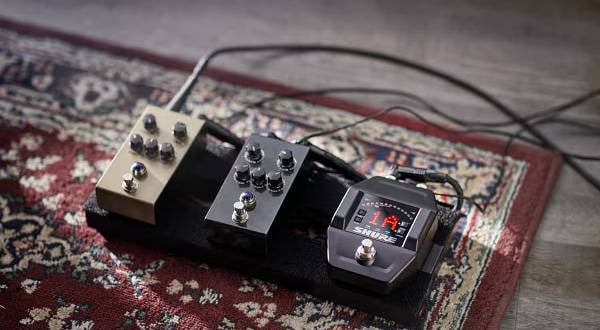
A DI (Direct Box) is a device that makes it easier to send signals from instruments and other sources to a mixer by converting unbalanced signals into balanced signals and/or converting impedance. Using balanced transmission also makes the signal less susceptible to noise when running long cables. It is a device used to send signals from instruments and other sources to PA equipment appropriately.
You may encounter one when connecting a bass, electric-acoustic guitar, keyboard, or similar instrument at a live venue.
You might think, “Can’t I just connect the instrument directly to the mixer?” However, a DI has various roles that make instrument signals easier to handle in a PA system, such as converting signals, adjusting impedance, and reducing the effects of noise when using long cables.
There are also passive DIs and active DIs, and some active DI models use batteries or phantom power.
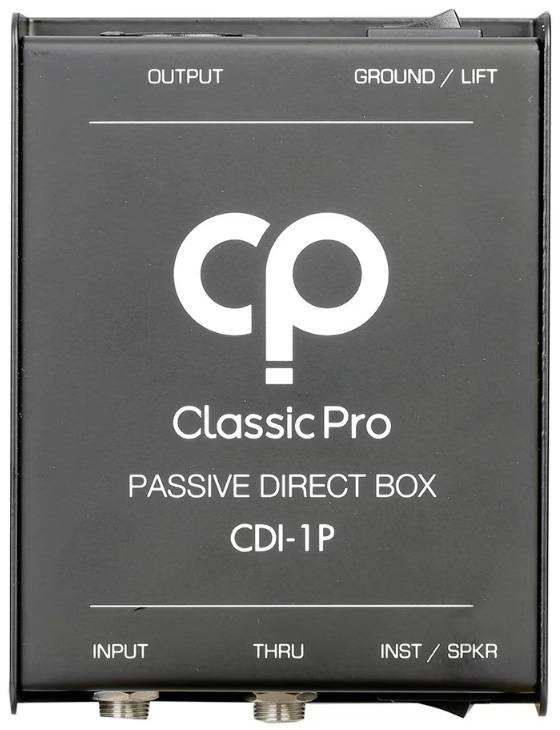
By this point, aren’t you thinking, “Oh! Phantom power and passive/active, which came up earlier, are showing up again!” That’s right. PA terminology can seem difficult when you look at each term individually, but as you learn the basic terms, you gradually start to see how the different pieces of knowledge connect with one another.
This time, I focused mainly on the terms that made me think “What is this!?” when I first started studying PA, and introduced these 10:
- Gain
- dB
- SPL
- Impedance
- MIC Level / LINE Level
- Phantom Power
- Passive / Powered
- DSP
- Feedback
- DI (Direct Box)
There are still many, many more technical terms in the world of PA.
There are still many, many more technical terms in the world of PA.
If you try to understand everything from the very beginning, you’ll end up thinking, “PA is way too difficult!!!!” But don’t worry. I’m still studying too, lol.
First, when you look at a product page or manual, try starting with simply thinking, “Oh, I’ve seen this word before!” You understand what gain means. You understand the difference between MIC and LINE. You see ‘+48 V’ and know that it means phantom power. You see a passive speaker and think, “It needs an amplifier.”
Even just being able to do those things should make PA equipment product pages much easier to read than before! And when you come across a word you don’t understand, just look it up one at a time. That’s all you need to do!
I’m going to keep absorbing more and more PA knowledge myself!
See ya.


![[I Can’t Believe I’m Asking This!] What Exactly Is a DSP? - Power Amp Edition](/contents/uploads/thumbs/2/2026/2/20260218_2_34490_1.jpg)
![The PA Beginner’s Ally! A Thorough Comparison of [Simple PA Systems]!](/contents/uploads/thumbs/2/2025/2/20250218_2_30586_1.jpg)
![[Latest for 2026] Easy for Beginners! Recommended Portable PA Systems](/contents/uploads/thumbs/2/2024/8/20240831_2_28455_1.jpg)
![[PA Guide for Beginners] Let’s Put Together A PA System for Your Live Show!](/contents/uploads/thumbs/2/2023/1/20230131_2_20980_1.jpg)

 CLASSIC PRO 簡易PAシステム特集
 MACKIE GOシリーズ特集
 CLASSIC PRO
 簡易PAシステム タイプ別おすすめランキング
 学校向け機材特設ページ
 簡易PAセットとは
 Discount Sale
 Outlet
 New Arrivals
 Podcast (streaming)
 Headphones / Earphones
 Microphones
 Wireless Equipment
 Speakers
 Power Amps
 Mixers
 Processors
 Portable PA Systems
 Recorders
 Karaoke
 Guitars
 Basses
 Ukuleles
 Drums & Percussion
 Pianos / Synthesizers
 Wind Instruments
 Stringed Instruments
 Japanese Instruments
 Harmonicas, Other
 Software
 DJ & VJ
 Stands
 Cables & Connectors
 Racks & Cases
 Lighting
 Stage & Truss
 Video Equipment
 PC PERIPHERALS
 Power Supplies
 Studio Furniture
 Household Items, Other
 Alcoholic Beverages