Hello everyone! I’m Yuuki Kitou, a guitar instructor.
Lately, in addition to teaching lessons, I’ve been uploading explanation videos to my YouTube channel, writing articles for Sound House, among other activities.
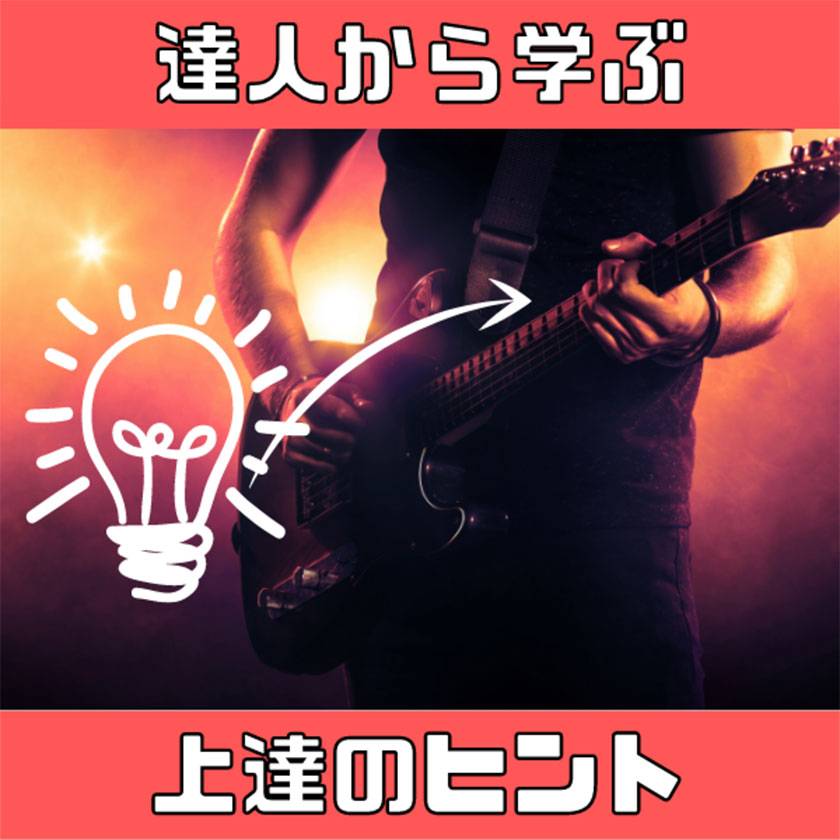
This time, I would like to share some tips for improving blues guitar, especially guitar solos.
Usually, I only write articles about gear, but the content here was so educational that I wanted to convey it as much as possible in text form.
By the way, the videos I’m referencing are listed below. Be sure to check them out☆
■ Tips for Improvement: Drawing Solo Ideas from Your Backing
When it comes to the blues, you can’t separate it from the minor pentatonic scale, or commonly called the minor pentatonic.
It’s an essential scale for guitar solos, whether you’re a master, a beginner, or a rock guitarist—deep in theory, yet very playable.
However, guitarists who have memorized the pentatonic positions from 1 to 5 often face a common struggle:
that feeling of being “stuck.”
In theory, you should be able to play solos using many different notes, not just the pentatonic…
but once you become too accustomed to it, you start to wonder, “How can I get any better than this?”
This is where the tip to “draw solo ideas from your backing” comes in handy.
Let me explain what this means.
For example, imagine you’re playing an A blues chord progression. The A blues chord progression is:
l A7 l A7 l A7 l A7 l
l D7 l D7 l A7 l A7 l
l E7 l D7 l A7 l E7 l
This is a 12-bar progression that loops. First, try playing the backing you usually play over this progression.
Some of you may already be doing this, while others may be hearing it for the first time, but in blues, there’s a trick around the 4th bar—looking at the chords above, it’s just before the chord changes from A7 to D7 in the second line. Here, when moving to D7, you can play a seventh chord a half-step up.
In other words, represented in chord notation, it looks like this:
l A7 l A7 l A7 l A7 Eb7 l
l D7 l D7 l A7 l A7 l
This way, you can play your backing with a bit of variation. If it’s not clicking yet, I recommend watching the reference YouTube video while reading along.
And here’s the important part:
What I want to convey is this—
“What you can do in your backing, you can also do in your solo.”
So, if you bypass the Eb7 right before the code moves from A7 to D7, you can replicate that same idea in your solo. Represented in TAB, it looks like this:
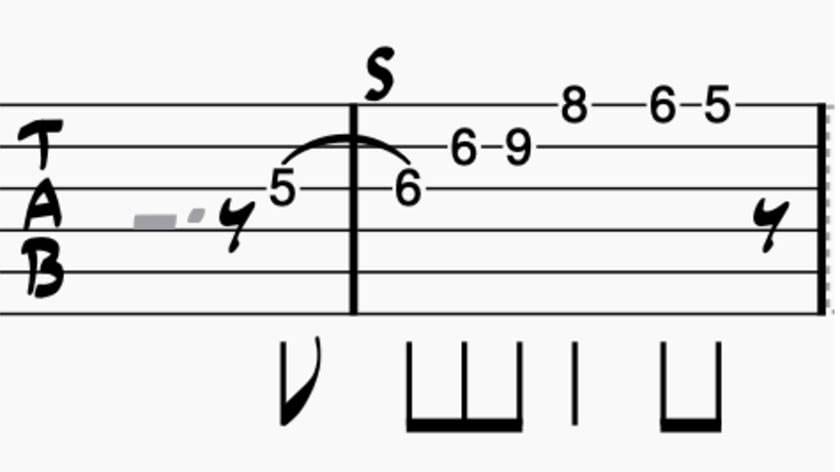
From here, let’s break down why it works.
Since these parts involve heavy use of chord tones, I highly recommend digesting the original video while following along.
Next, we’ll look at the chord tones in the above TAB one by one.
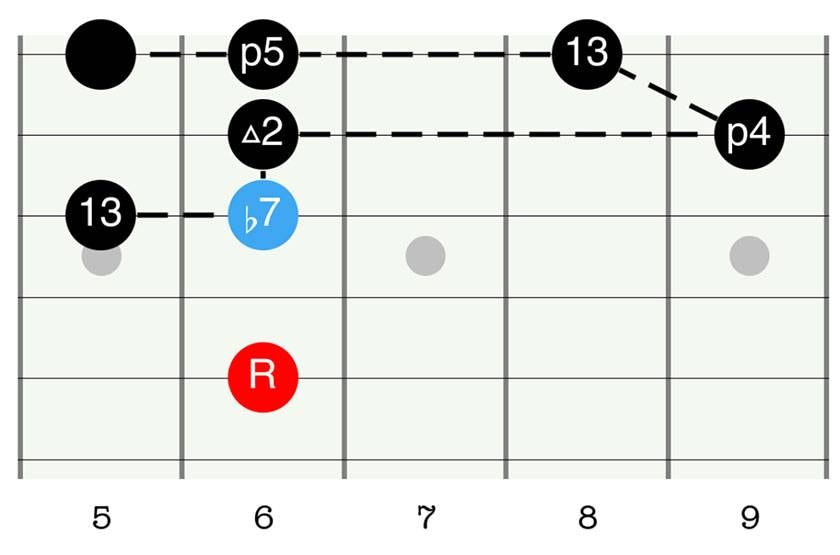
The first note you play is on the 3rd string, 5th fret, which is the 13th degree.
From there, you hammer-on or slide directly to the next note, the B7th.
Next, move from the 6th fret (9th) on the 2nd string up to the 9th fret (11th).
Finally, on the 1st string, go from the 8th fret (13th) → 6th fret (5th) → land on the 5th fret to finish.
You might notice that the last 5th fret doesn’t have a degree indicated, and there’s a reason for that.
By the time you land on the 5th fret, the underlying chord has already changed from Eb7 to D7, so you’re landing on the 5th of D7.
Effectively, this is almost the same as playing Eb9 and D9 as chords.
By following this, you can increase your soloing options by breaking down the chord tones from the backing chords and playing them individually.
Writing this out in text is definitely tricky (lol). If anything is unclear, I’ll be happy if you share this article on Twitter!
(@kitoyuki_guitar) and I’ll try to reply if you tag me.
So, this time, under the title “Tips for Improving from Josh Smith,” I introduced a way to play guitar solos without relying solely on the minor pentatonic scale.
This is almost my first time presenting phrases in article form rather than on video—what do you think?
In blues, where the minor pentatonic is overwhelmingly dominant, playing outside the pentatonic can really add variety and dynamics to your performance.
See you next time!
The “sound & person” column is made up of contributions from you.
For details about contributing, click here.


![[BOSS BD-2] -Comparing the original made in 1996 with one made in 2018-](/contents/uploads/thumbs/5/2020/9/20200923_5_11199_1.jpg)
![Learning from Tomoyasu Hotei, How to use your right hand for cutting [Guitar Hero Posture Analysis]](/contents/uploads/thumbs/5/2020/8/20200815_5_10914_1.jpg)


 7弦ギタースタートガイド
 ギターケーブルの作り方
 ギターアンプ スタックタイプ編
 ギターアンプ コンボタイプ編
 愛されたフェンダーギターたち
 ピックアップの種類(エレキギター)
 Discount Sale
 Outlet
 New Arrivals
 Podcast (streaming)
 Headphones / Earphones
 Microphones
 Wireless Equipment
 Speakers
 Power Amps
 Mixers
 Processors
 Portable PA Systems
 Recorders
 Karaoke
 Guitars
 Basses
 Ukuleles
 Drums & Percussion
 Pianos / Synthesizers
 Wind Instruments
 Stringed Instruments
 Japanese Instruments
 Harmonicas, Other
 Software
 DJ & VJ
 Stands
 Cables & Connectors
 Racks & Cases
 Lighting
 Stage & Truss
 Video Equipment
 PC PERIPHERALS
 Power Supplies
 Studio Furniture
 Household Items, Other
 Alcoholic Beverages