There are many different kinds of musical instruments in the world, but surprisingly few are polyphonic instruments capable of producing chords; most are monophonic instruments that produce only single notes. Even among instruments that can handle chords, when it comes to freely playing chords, keyboard instruments and string instruments have an advantage, while other instruments either cannot play chords or are not very good at it.
Specifically, the following instruments are polyphonic instruments capable of playing chords:
- Keyboard instruments such as piano, organ, accordion, and electronic instruments
- String instruments with frets, such as the guitar
- String instruments with many strings, such as the harp
Other than these, instruments that can play chords are not very common. Since the number of harp players is not that large, keyboard instruments and guitars account for the majority. Guitars, with their simple structure, have long been inexpensive and easy to obtain, and the guitar-playing population has always exceeded that of acoustic keyboard instruments. However, since electronic instruments became widespread, keyboards have also become affordable, and if toys are included, keyboards may now be more prevalent.
■ Complete Instruments
An instrument that can perform the three elements of melody, harmony, and rhythm simultaneously with a single instrument is called a “complete instrument.” Keyboard instruments are considered to be complete instruments, and among them the piano surpasses others in expressive capability, such as range and dynamic expression.
The guitar is also treated as a complete instrument, but it doesn’t offer the same level of freedom as keyboard instruments. Its range is not especially wide, and since it only has six strings, it can produce chords of up to six notes. In terms of technique, the left hand determines the pitch while the right hand produces the sound, so its limitations are relatively easy to see. Even though both are considered to be complete instruments, there is a significant difference between guitars and keyboard instruments.
■ Instruments Suitable for Studying Harmony and Music Theory
To study harmony, you naturally need an instrument capable of producing chords, and performers of any instrument usually learn using a keyboard. For now, it is safe to say that keyboards are indispensable for learning music.
However, since the guitar can produce chords on its own, it’s possible to study harmony without relying on a keyboard. In many cases, though, learning methods are written from a keyboard-based perspective, which makes them difficult to apply to the guitar. Considering the number of guitar players, it would not be surprising if learning methods using the guitar were more developed. But at present, it seems that guitarists would benefit from honestly studying using a keyboard as well. Understanding keyboard-based thinking should also be helpful when playing the guitar. Once you understand the keyboard, you may come to recognize that the guitar is an instrument that can play chords to some extent.
■ The Future of Polyphonic Instruments
By taking advantage of the flexibility of electronic instruments, it is possible to create polyphonic instruments with various interfaces, but it seems difficult to break free from the dominance of the keyboard. There are instruments that can play chords with the press of a single button, but since they do not allow you to understand the structure of chords, they are not suitable for learning. Even if a structurally excellent interface suitable for learning were devised, since the current learning standard is based on the keyboard, it still seems unlikely that it would spread widely. In terms of learning, the real standard is not so much the keyboard as it is the staff notation, so an instrument with a staff-based interface might prove useful in many ways.
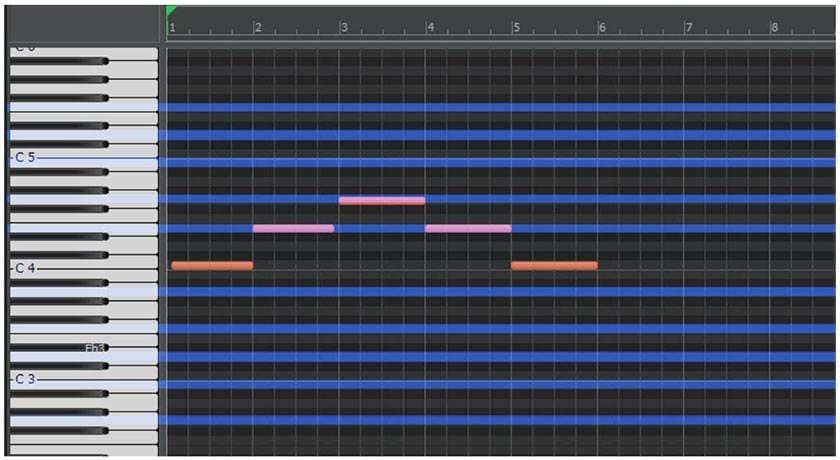
The piano roll found in DAWs is, as its name suggests, an interface modeled after a keyboard. If staff-like elements were added to it, it might become an interface that is easier to use for learning as well. The diagram below is an image of staff notation layered over a piano roll. When the key changes, the position of the staff lines would also shift accordingly. With further refinements, it could likely become even more compatible with standard sheet music.
So it seems that the keyboard will continue to reign as the de facto standard and the king of polyphonic instruments.
The guitar, with its straightforward approach of making the most out of just six strings, will likely continue to maintain its position as a popular instrument. While it prioritizes keeping costs down and may not be ideal for learning music, it has also played a central role in creating new genres such as rock. It’s precisely because the guitar is not well suited for academic learning, it can inspire ideas that break away from existing concepts and even give rise to new musical cultures. Music might become dull if only ideal instruments existed. At the very least, if the world had only keyboard instruments, it would have been much harder for musical diversity to emerge.

If there is an instrument capable of challenging the keyboard and guitar as polyphonic instruments, it will probably come from something far removed from existing instruments. Practices such as remixing, which extract and reconstruct music, may be one example. In the future, automatic generation technologies using AI will likely continue to develop, and it should become possible to create improvisations or compositions exactly as imagined simply by giving instructions to AI. By using the tools of civilization, it becomes possible to skip over the parts that would normally require steady effort, but this doesn’t mean the gap with those who have firmly mastered the fundamentals will disappear. Still, these unprecedented methods hold the potential to bring about new musical cultures.
The “sound & person” column is made up of contributions from you.
For details about contributing, click here.
![Enchanting Instruments 13 - Timbre of Instruments [Resonance]](/contents/uploads/thumbs/5/2021/10/20211025_5_14727_1.jpg)
![Enchanting Instruments 11 - Timbre of Instruments [Harmonics 2]](/contents/uploads/thumbs/5/2021/9/20210930_5_14386_1.jpg)
![Enchanting Instruments 10 - Timbre of Instruments [Harmonics 1]](/contents/uploads/thumbs/5/2021/9/20210928_5_14268_1.jpg)
 Roland 電子ピアノデジタルピアノ購入ガイド
 7弦ギタースタートガイド
 おすすめの電子ピアノ
 超オススメのフレーズ道場 アコースティックギター
 自分にあったピアノを選ぼう!役立つピアノ用語集
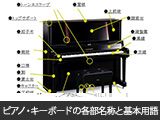 ピアノ・キーボードの各部名称
 Discount Sale
 Outlet
 New Arrivals
 Podcast (streaming)
 Headphones / Earphones
 Microphones
 Wireless Equipment
 Speakers
 Power Amps
 Mixers
 Processors
 Portable PA Systems
 Recorders
 Karaoke
 Guitars
 Basses
 Ukuleles
 Drums & Percussion
 Pianos / Synthesizers
 Wind Instruments
 Stringed Instruments
 Japanese Instruments
 Harmonicas, Other
 Software
 DJ & VJ
 Stands
 Cables & Connectors
 Racks & Cases
 Lighting
 Stage & Truss
 Video Equipment
 PC PERIPHERALS
 Power Supplies
 Studio Furniture
 Household Items, Other
 Alcoholic Beverages