This time, I would like to explain the temporal changes in tone.
The sound of acoustic instruments continues to change moment by moment from the instant a note is played until it fades away. This is unavoidable due to physical properties, but performers try to compensate by adjusting volume and tone quality to achieve as stable a sound as possible.
On the other hand, electronic instruments can easily produce a stable sound, so as they are, they can feel somewhat bland; therefore, they tend to incorporate slightly unstable elements that imitate acoustic instruments.
It is interesting that humans and machines take completely opposite approaches. By bringing these closer together, various structures become visible.

■ Temporal Changes in Acoustic Instruments
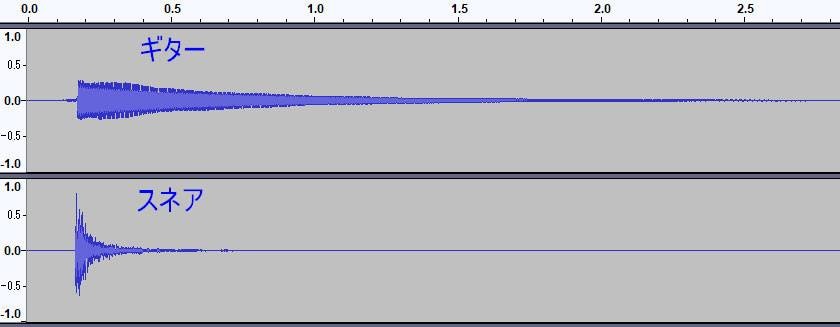
In plucked string instruments such as piano and guitar, as well as percussion instruments, the sound begins loudly and gradually decays.
The diagram below shows the volume changes of a guitar and a snare drum (percussion). Compared to the guitar, the snare has a shorter sustain and a more rapid decay. There is a small noise before the guitar sound begins, which is the sound of the pick rubbing against the string. After that, the string is released and the sound begins.
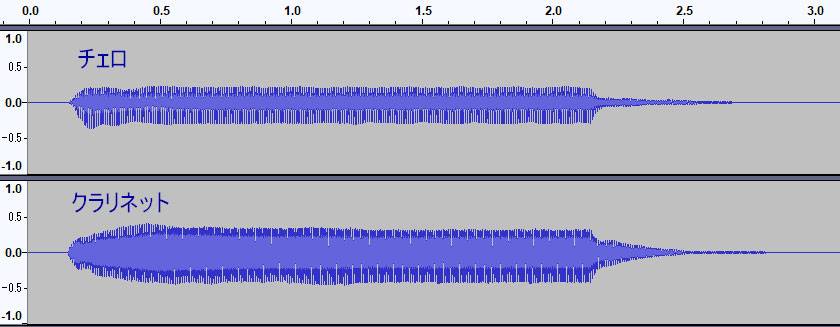
These are waveforms of a bowed string instrument (cello) and a wind instrument (clarinet). Both are instruments capable of sustaining sound, but some fluctuation is normal. Also, the character of each instrument appears in the attack and the ending of the sound.
When analyzing changes over time, looking at them through methods used in electronic instruments simplifies the concept and reveals its essence. I would like to explain using methods commonly adopted in synthesizers.
■ Temporal Changes in Volume: ADSR
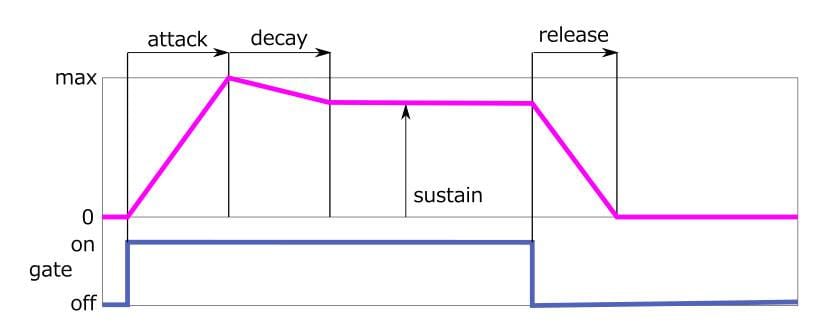
In electronic instruments, the concept of an envelope (ADSR) is commonly used to control changes in volume over time. It can reproduce the volume changes of the acoustic instruments mentioned above to a certain extent. The pink line represents the actual volume, and the blue line represents the gate, which indicates the ON/OFF timing when a key is pressed and released.
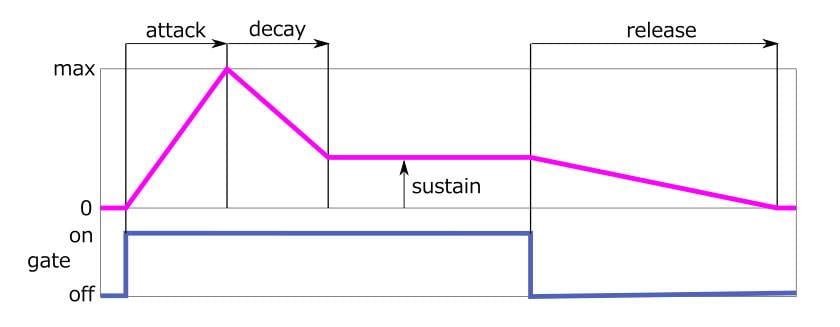
- attack (A)
The time it takes to reach maximum volume after the gate turns on - decay (D)
The time it takes to decrease to the sustain level - sustain (S)
The volume level of the sustained sound - release (R)
The time it takes for the sound to fade after the gate turns off
Here are some examples of ADSR settings.
For mechanically sustained sounds such as an organ, the settings are as follows. It operates in complete synchronization with the gate. This is the simplest envelope.
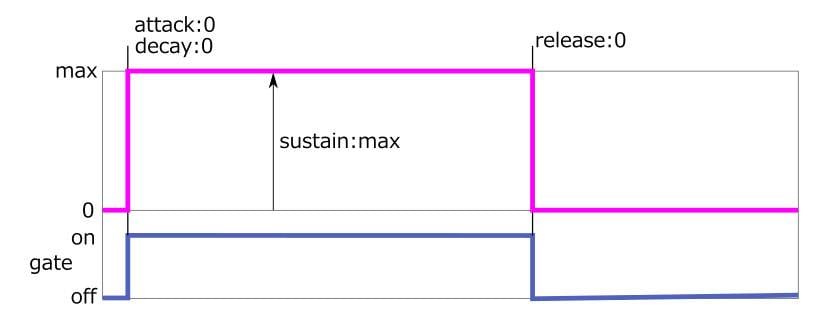
Wind instruments have a relatively strong attack and sustain their sound, so their settings are as follows.
However, with only the above, the sustain portion lacks expression, so it is often modulated in volume. While vibrato is generally thought of as pitch variation, in reality, the volume also fluctuates at the same time.
Next, when creating sounds that gradually decay, such as those of a piano or guitar, the sustain is set to 0, eliminating the sustained portion. In the diagram below, the gate off position occurs after the release phase, but the volume has already reached 0.
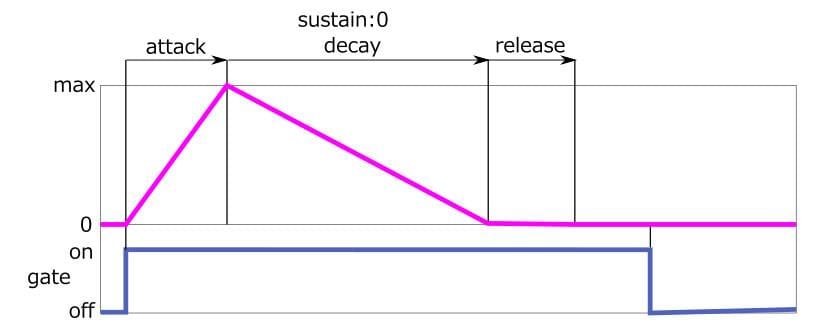
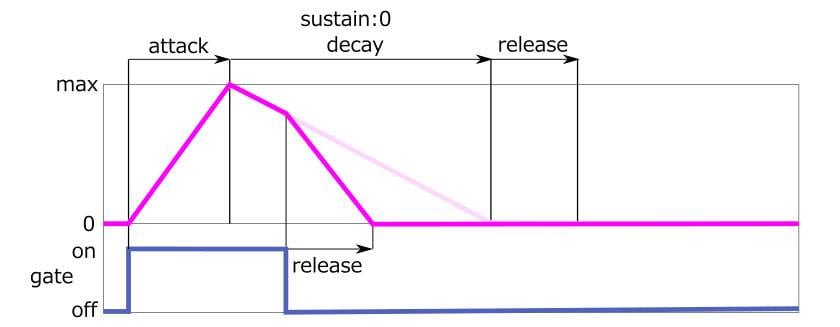
With the above settings, when playing in a staccato style, it transitions to the release phase during the decay. In the case of a piano, the release corresponds to the lingering resonance after the key is released.
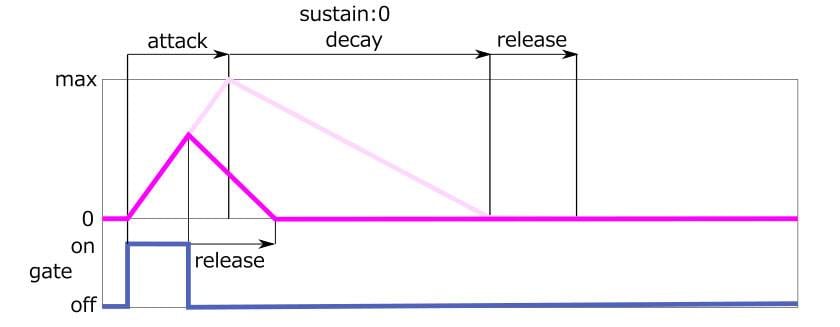
As an extreme example, if the gate turns off during the attack phase, it will look like the following.
Simple volume changes can be controlled in this way to sound somewhat realistic, but linear changes can feel dull, so in practice, various curves are used to create more natural, acoustic-like volume changes even in electronic instruments. In recent years, ADSR has been expanded to allow the creation of more complex envelopes.
Since the concept of ADSR differs slightly depending on the manufacturer and model, it does not always behave exactly as described above.
Even with the harmonic structure of each instrument discussed previously and the envelope described above, it is possible to produce somewhat acoustic-like sounds. However, by adding the following elements, it becomes even more realistic.
■ Transients and Noise
A transient refers to the contour of a sound that the human ear reacts to sensitively, particularly the noticeable sound that occurs at the attack of an instrument. Treating the noise component generated at the attack as a transient would not be a significant mistake.
In plucked string instruments, this is a crucial element; without the noise component at the attack, the sound will not feel true to the instrument. Guitars in particular, where strings are directly struck with a pick, produce a wide variety of transients. These can often stand out more than the actual vibration of the string itself and are a defining characteristic of the guitar sound. It is often said that electronically reproducing a guitar is difficult, and this is largely due to the challenge of recreating this noise component. Simply adding uniform noise sounds unnatural. Since the strength and quality of transients vary greatly with each rhythm, reproducing them requires very detailed editing for each phrase. For this reason, it is often faster to play the instrument than to program it.
The unstable, slightly distorted pitch at the attack of brass instruments has a unique strength and appeal. However, it cannot be expressed by noise components alone, so more complex synthesis methods are required. In sustained instruments such as bowed strings and wind instruments, not only the attack but also noises like bow friction and breath noise during the sustain phase play an important role.
By adding these noise components to the tone, it becomes possible to create a more acoustic-like sound. Noise is sometimes treated as something undesirable, but in musical expression—especially emotional expression—it is indispensable, so it is recommended to make use of it regardless of whether the sound is acoustic or electronic.
Actual noise components vary, but when recreating them electronically, white noise, which contains all frequencies, is often processed and used due to its convenience.
■ Temporal Changes in Tone
Tone also changes over time. In instruments where the sound decays, higher-order harmonics diminish first. When reproducing acoustic instruments with a synthesizer, recreating these aspects allows the sound to become fairly realistic. The diagram below shows a video of the frequency spectrum when playing a C3 note on an electric piano.

■ Temporal Changes in Pitch
Instruments like percussion do not have a clear pitch, so it may be harder to notice, but there are often subtle pitch changes. Especially in low-pitched percussion, the sound tends to converge toward a specific frequency.
In instruments capable of sustaining sound, slight fluctuations similar to unintentional vibrato are usually present, and these may also be considered part of the instrument’s tone. Producing a perfectly straight, unwavering pitch is actually quite difficult, so slight fluctuations help maintain the pitch.
■ Summary
We have looked at the main elements of how sound changes over time. Most of the concepts described above are based on synthesis ideas incorporated into the Moog synthesizer developed in the 1960s, about half a century ago. The reason these concepts are still in practical use today is that they are simple, flexible, and relatively easy to implement.
By analyzing the tones of acoustic instruments and reconstructing them, it becomes possible to create convincing electronic sounds. The knowledge gained through this process is useful not only for sound synthesis but also for learning acoustic instruments, recording, mixing, and many other areas.
The “sound & person” column is made up of contributions from you.
For details about contributing, click here.

![Enchanting Instruments 11 - Timbre of Instruments [Harmonics 2]](/contents/uploads/thumbs/5/2021/9/20210930_5_14386_1.jpg)
![Enchanting Instruments 10 - Timbre of Instruments [Harmonics 1]](/contents/uploads/thumbs/5/2021/9/20210928_5_14268_1.jpg)
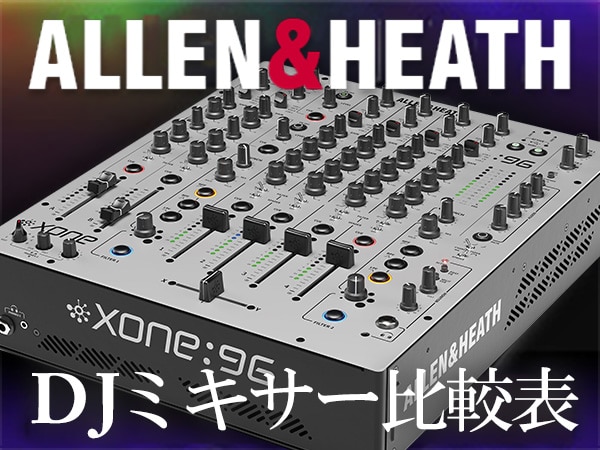 Allen&Heath DJミキサー比較表
 Allen & Heath ミキサー機能比較
 QSC デジタルミキサー TouchMixシリーズ
 Mackie ミキサー比較
 テクノ・ハウスミキサー編
 DJミキサー編
 Discount Sale
 Outlet
 New Arrivals
 Podcast (streaming)
 Headphones / Earphones
 Microphones
 Wireless Equipment
 Speakers
 Power Amps
 Mixers
 Processors
 Portable PA Systems
 Recorders
 Karaoke
 Guitars
 Basses
 Ukuleles
 Drums & Percussion
 Pianos / Synthesizers
 Wind Instruments
 Stringed Instruments
 Japanese Instruments
 Harmonicas, Other
 Software
 DJ & VJ
 Stands
 Cables & Connectors
 Racks & Cases
 Lighting
 Stage & Truss
 Video Equipment
 PC PERIPHERALS
 Power Supplies
 Studio Furniture
 Household Items, Other
 Alcoholic Beverages