In this installment, I would like to examine how changes in the way overtones are produced affect timbre. First, let's look at the relationship between typical waveforms and their overtones. Here, I will omit the attack sound and focus only on the sustained sound. By doing so, we can perceive the timbre more simply. Additionally, the artificial waveforms below were generated via programming, and the fundamental frequency is unified at A3 (220 Hz).
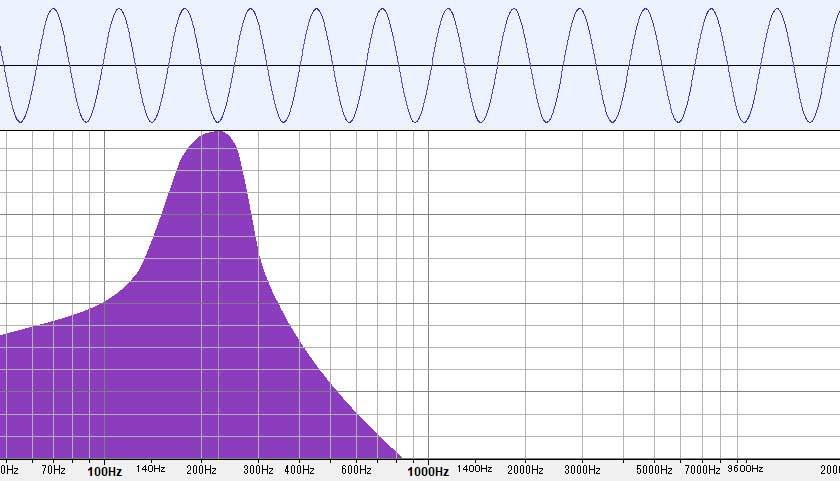
■ Sine Wave
The sine wave is the most fundamental wave, also called a pure tone, which contains no overtones. It is said not to exist in the natural world. It can be created artificially using a tuning fork or electronic methods.
By preparing sine waves for each overtone and synthesizing them, it becomes possible to create various basic waveforms.
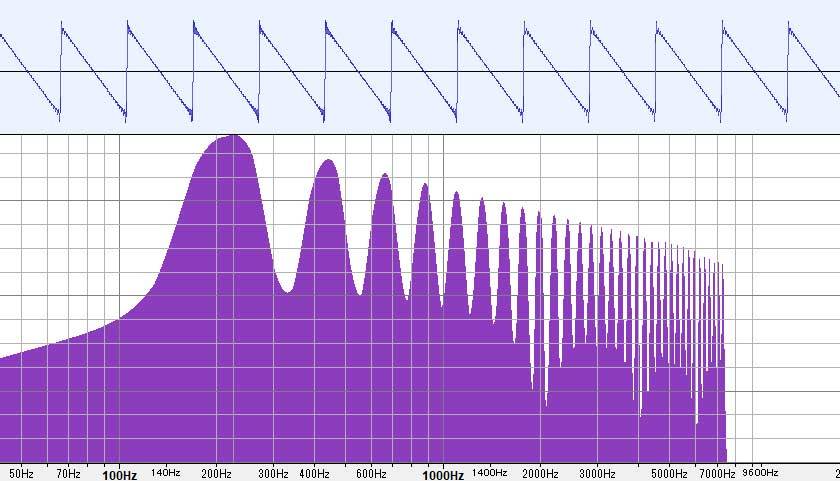
■ Sawtooth Wave
A sawtooth wave is created by synthesizing sine waves at integer multiples of the fundamental frequency. By dividing the amplitude by the same number as the overtone and reducing it accordingly, a clean sawtooth wave is formed. Below is a sawtooth wave synthesized up to the 30th harmonic overtone.
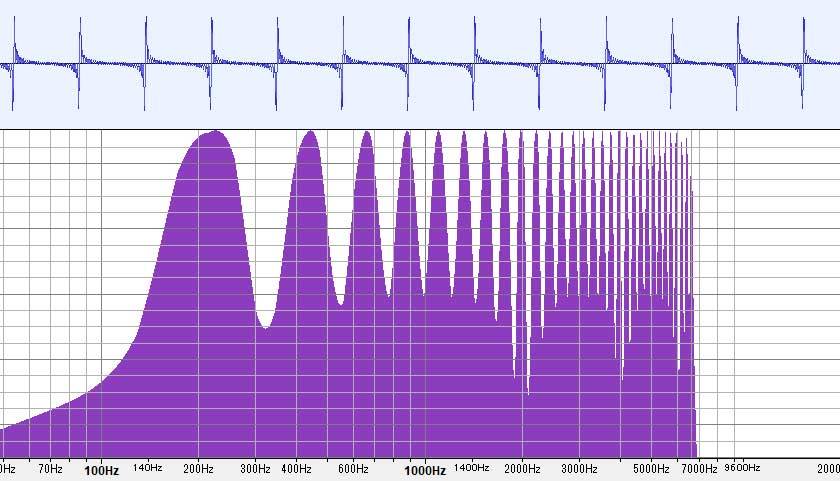
For reference, if the amplitudes of the overtones are synthesized at the same level as the fundamental tone, the resulting waveform looks like the one below, and it becomes unpleasant to listen to as a sound.
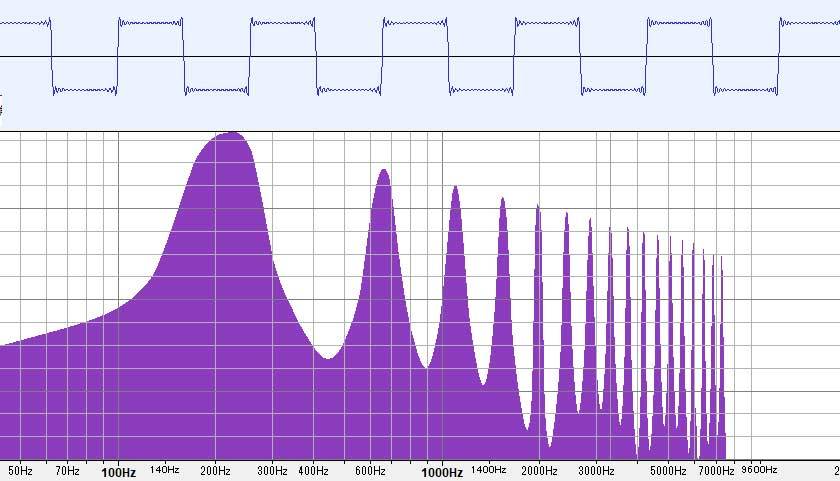
■ Square Wave
This is obtained by synthesizing sine waves of odd-numbered overtones. Just like the sawtooth wave, the amplitude is divided by the same number as the overtone when synthesized.
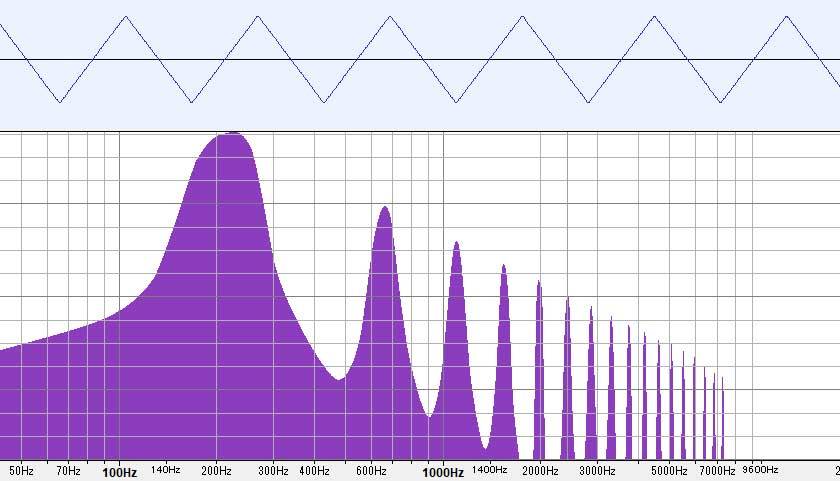
■ Triangle Wave
This is synthesized using sine waves of odd-numbered overtones. While the overtone structure is the same as the square wave, the amplitude is divided by the overtone number squared ($n^2$), causing the level to drop more rapidly.
■ Synthesizing Even-Numbered Overtones
Incidentally, synthesizing only even-numbered overtones results in the waveform shown below.
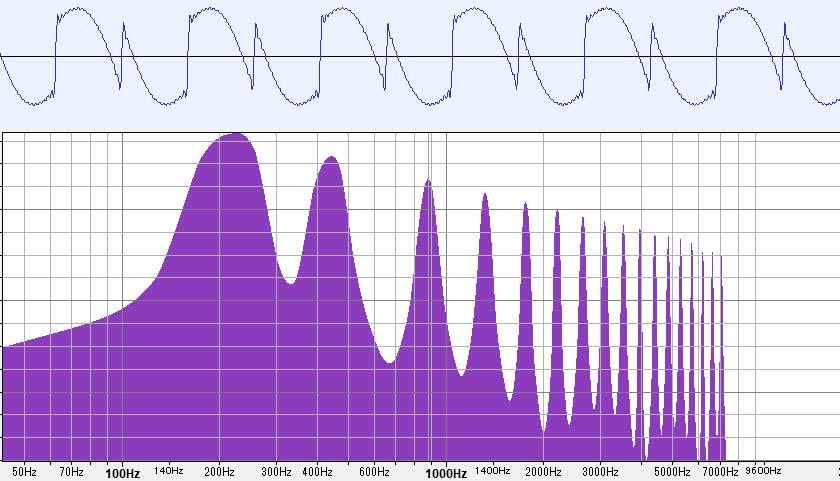
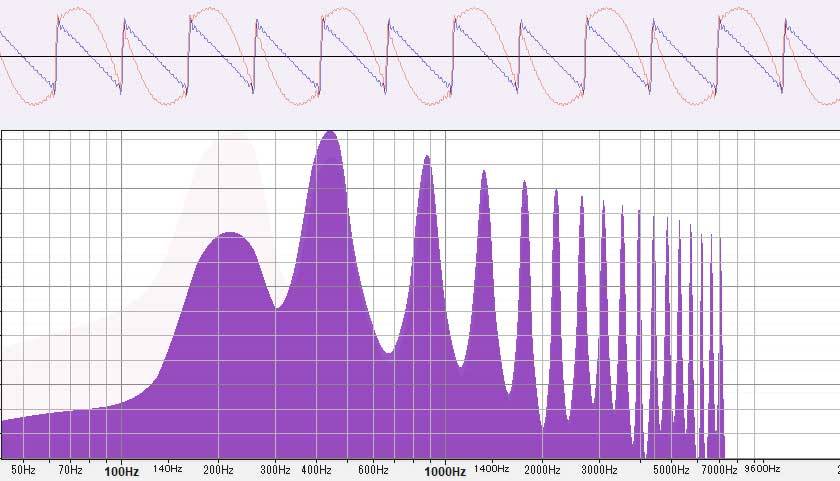
This waveform has no name, and its shape may seem cryptic, but if you cut only the fundamental tone, a sawtooth wave one octave higher appears, as shown in the diagram below. (The red line represents the original waveform.) The reason for this becomes clear when looking at the overtone structure. This is because even-numbered overtones with the fundamental tone removed form an array of integer multiples starting from an octave higher.
■ White Noise
Although it is not a waveform in the traditional sense, I would like to touch upon noise, which is important here. The definition of white noise is a sound that contains all frequencies in equal measure, and naturally, it has no specific pitch. It is difficult to create such a sound in reality, and the ideal white noise does not exist in the natural world. In most cases, when it’s created as a synthetic sound, it’s generated somewhat randomly by combining random frequencies.
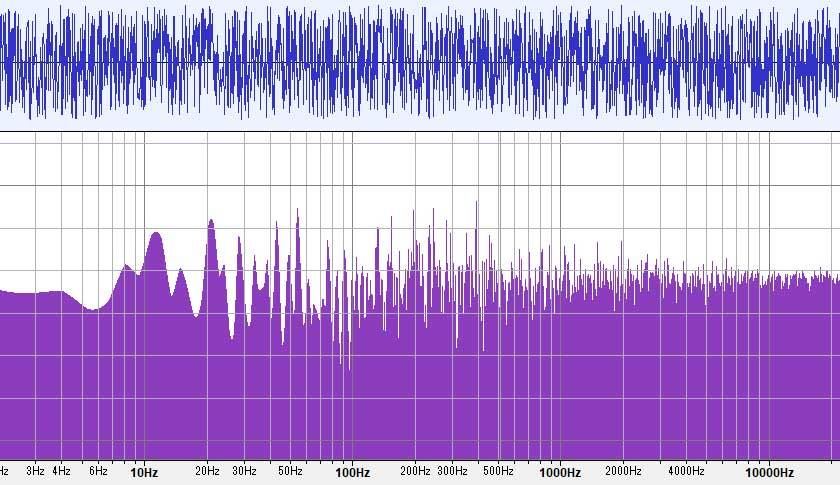
Looking at the frequency spectrum, you can confirm that there is a reasonably even distribution of sound across the entire band. In actual acoustic instruments, components similar to white noise are included in sounds such as attack noise or breath sounds. Many percussion instruments are composed of noise components, and among them, metallic instruments resemble white noise instantaneously.
■ About Fourier Transform
Theoretically, any periodic waveform can be decomposed into sine waves. This is called the Fourier transform, and it’s applied in a wide variety of fields. In the case of the artificial waveforms mentioned above, the overtone components are sine waves; for example, a sawtooth wave is composed of 30 overtones (sine waves). In this instance, I only calculated up to the 30th overtone, so as you can see, the edges are rippling, and it cannot be called an ideal waveform. If you want to create an ideal sawtooth wave without ripples, you would need an infinite number of sine waves. However, since the calculation would never finish, in practice, we calculate up to the necessary frequency. In digital processing, there is a sampling frequency, which determines the maximum possible frequency, so we can calculate up to that limit. If you calculate beyond that, the signal will alias, and strange sounds will enter the audible range, so caution is required. For example, if you create a square wave by thinking of it as an ON/OFF switch, you can create ideal edges; however, because it exceeds the frequency that can be handled digitally, problems arise.
■ Waveforms of Actual Acoustic Instruments
The above are artificial waveforms, but actual acoustic instruments typically change from moment to moment, and that is what leads to their expressive power. I will pick out a few waveforms that are close to those I mentioned above.
■ Sine Wave: Guitar
In the sustain portion of plucked instruments and the like, the waveform often becomes closer to a sine wave. The waveform below is the sustain portion of a high-pitched guitar note. Lower notes have many overtones, so it’s quite difficult for them to become a sine wave.

■ Sawtooth Wave: Violin
Violins are said to have a sawtooth wave, but in reality, as shown in the waveform below, various noise components and overtones are changing, making it chaotic. Even this is a section that is relatively close to a sawtooth wave.

■ Square Wave: Clarinet
Woodwind instruments sometimes produce sounds close to a square wave, but they are still significantly different from waveforms obtained through calculation, and they also change greatly depending on the strength of the breath and the pitch.

■ Noise: Cymbals
Instruments like cymbals are closer to white noise, but the temporal changes in timbre from the attack to the sustain are chaotic, making this a field that is still difficult to reproduce artificially even today.

The timbre sections covered this time are those with periodicity. In the case of instruments with a pitch, it is this periodicity that allows us to perceive a pitch, so they always have a periodic waveform. Furthermore, they contain enough information to allow us to recognize which instrument is being played. This is largely due to the overtone structure. However, for actual instruments, the "attack"—the initial part of the sound—is quite important. For instruments where the sound decays, the attack is particularly crucial; if this part were missing, it would even hinder our ability to identify the instrument. Next time, I would like to talk about temporal changes, including the attack.
The “sound & person” column is made up of contributions from you.
For details about contributing, click here.


![Enchanting Instruments 10 - Timbre of Instruments [Harmonics 1]](/contents/uploads/thumbs/5/2021/9/20210928_5_14268_1.jpg)

 DTMセール情報まとめ
 おすすめサイレント楽器特集
 ○○やってみた!
 みんなでつくる 新・音楽用語事典
 最新コラム&動画をCheck!! OTOYA通信
 サウンドハウス虎の巻 !
 Discount Sale
 Outlet
 New Arrivals
 Podcast (streaming)
 Headphones / Earphones
 Microphones
 Wireless Equipment
 Speakers
 Power Amps
 Mixers
 Processors
 Portable PA Systems
 Recorders
 Karaoke
 Guitars
 Basses
 Ukuleles
 Drums & Percussion
 Pianos / Synthesizers
 Wind Instruments
 Stringed Instruments
 Japanese Instruments
 Harmonicas, Other
 Software
 DJ & VJ
 Stands
 Cables & Connectors
 Racks & Cases
 Lighting
 Stage & Truss
 Video Equipment
 PC PERIPHERALS
 Power Supplies
 Studio Furniture
 Household Items, Other
 Alcoholic Beverages