With the spread of inexpensive DAW software and plug-ins, and the improvement in computer specifications, DTM (Desktop Music) has become accessible to many people.
If you make a little effort, even amateurs can easily obtain the same software that professionals use.
Naturally, this makes people want to be able to create audio sources with sound quality equal to or approaching that of professionals.
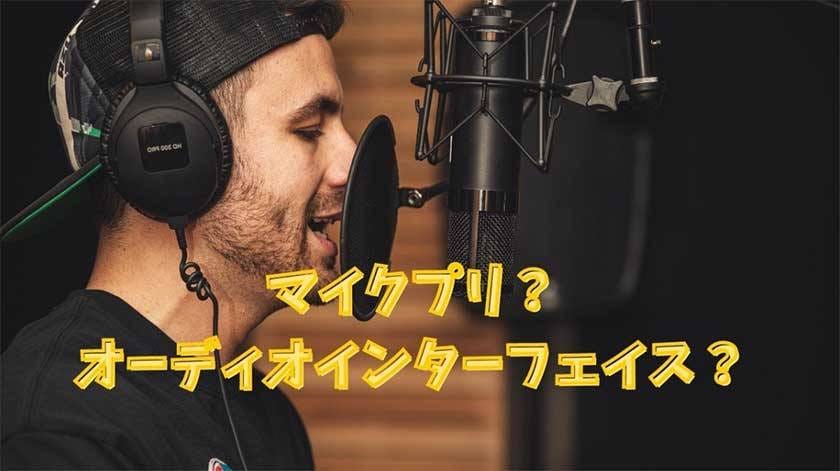
In creating sound quality equivalent to a professional level, the existence of a mic preamp is something that cannot be avoided.
Since a mic preamp is built into standard audio interfaces, few people go out of their way to purchase a separate one, but this time I will write about the why of doing so.
■ What exactly is a mic preamp?
It refers to a preamplifier for microphones, and just as you use a preamp for guitars and basses, you must also use a preamp for the sound passed through a microphone.
Most people who record at home use the mic preamp built into their audio interface.
It is such a standard feature that some people use it without even being aware that a mic preamp is built into the interface, and unless you are someone who is aiming for extremely high-quality recordings, most people will not buy a separate mic preamp.
Professionals do not use these types of mic preamps; they use standalone mic preamps.
Some people might have thought about buying a mic preamp to get pro-quality recordings, but they are priced accordingly.
You need over 500,000 yen just for a preamplifier, and it is said that there are vintage models that cost millions or even tens of millions of yen.
It’s unrealistic for amateur musicians to buy these.
■ Preamps built into audio interfaces
Judging from metrics such as the number of ratings on Sound House, the price range for best-selling audio interfaces frequently used by amateur musicians seems to be around 10,000 to 20,000 yen.
I also use a product from Presonus, the Studio 24c, which costs a little under 20,000 yen.
PRESONUS / Studio 24c Audio Interface
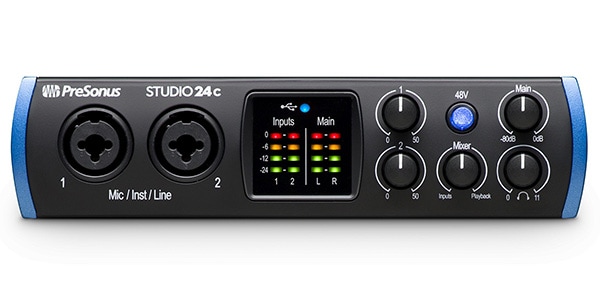
I apologize for the oversight. Here is the translation of the text provided: I didn't choose it for the mic preamp; I was aiming for the bundled Studio One Artist software.
If it hadn't been for that, I would have purchased something in the 10,000 yen range.
This is because the mic preamps built into audio interfaces in this price range are difficult to distinguish from one another.
If you can think about the DAC that comes standard with a PC or the speakers that come pre-installed in a car, it’s actually easy to understand.
Those are intended for the purpose of "just getting sound out," and are not meant to meet the expectation of wanting good sound.
It might be best to think of the mic preamps included in low-priced audio interfaces as being at the level of "it's okay as long as the sound is amplified for now."
*Note: There are some models where the manufacturer has paid close attention to the sound quality of the mic preamp.
■ Recommended mic preamps for amateur musicians
The mic preamps included in best-selling audio interfaces are a bit unreliable.
However, professional-grade ones cost over 500,000 yen.
Therefore, aiming for a price range in between is a safe option for amateur musicians.
APOGEE / Symphony Desktop
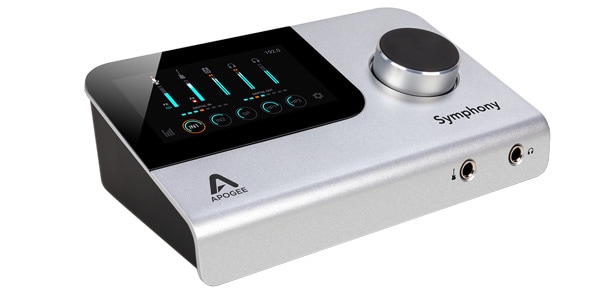
This product is a desktop version of the Symphony I/O MKII, APOGEE's flagship model used in many recording studios, kept at an affordable price.
Strictly speaking, it is not the exact same sound, but compared to cheaper audio interfaces, the difference is clear.
The mic preamp combines analog circuits with DSP processing, and you can also use emulations of vintage preamps like the Neve 1066 and Ampex 601.
Furthermore, it is well-differentiated from low-cost products in areas other than the preamp, such as zero latency and support for up to 75dB of gain.
Personally, I believe that for use at home or in a simple home studio, you probably don't need anything more than this.
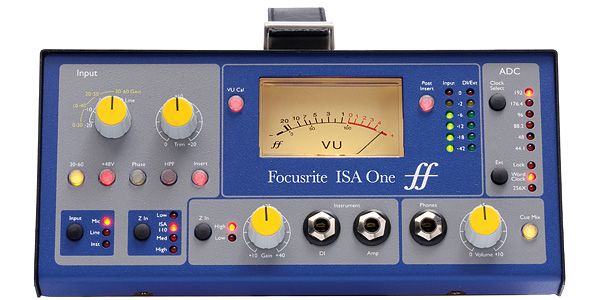
FOCUSRITE / ISA One /DI
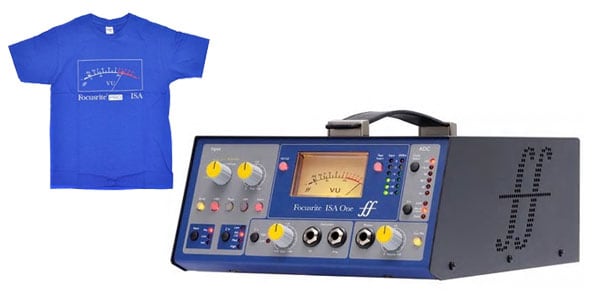
The price is much lower than the Symphony Desktop, at around 50,000 yen.
Since it’s not an audio interface, it is a product designed to be used in conjunction with the audio interface you already own.
If your audio interface has an ON/OFF switch for the mic preamp, be sure to turn it OFF, and if it does not, don't forget to turn the GAIN down.
It is a popular item among mic preamps, and products around this price point are where anyone can clearly notice a change in sound.
This was the first mic preamp I personally used, and I was surprised by the difference it made.
Compared to recording without a mic preamp, the vocals sounded as if I had changed the microphone itself.
Conversely, just by running the signal through the ISA One, even a cheap microphone can sound decent to a certain extent.
■ The Necessity of High-End Audio Interfaces and Mic Preamps
While it is possible to achieve the goal of recording with an audio interface costing just a few thousand yen, there are still those who choose mic preamps costing millions.
As the price goes up, the sound quality does improve, but you need to consider the balance between cost and the level of sound quality you actually require.
If you simply want to record "play-along" videos for YouTube as a hobby, an audio interface costing a few thousand yen is perfectly sufficient.
The same applies to a hobbyist band that only records once every few years.
However, if you are an amateur who wants to distribute original songs on subscription services, or if you are aiming to go professional, it becomes necessary to be particular about sound quality by using equipment one rank higher, such as those introduced earlier.
So, what about when the price exceeds 500,000 yen?
If you are wealthy and can afford to spend a lot of money on your musical hobby, then I think you should go ahead and buy them.
But wouldn't most people rather spend 500,000 yen on a new instrument?
Also, if you are going to use a mic preamp at that price point, you cannot maximize its performance unless you also spend money on microphones and soundproofing.
If you buy a 200,000 yen microphone, spend 300,000 yen on soundproofing the room, upgrade to high-quality cables, and buy noise reduction software as well as the top-tier grade of Melodyne...
The total amount of money becomes astronomical.
Why not start by introducing a mic preamp or upgrading your audio interface in the 50,000 to 150,000 yen price range?
That alone will create a significant difference in your recorded sound.
The “sound & person” column is made up of contributions from you.
For details about contributing, click here.





![[2022 Latest Edition] Overview of Some New Audio Interfaces!](/contents/uploads/thumbs/2/2021/3/20210311_2_12472_1.jpg)
![[2023 Latest Edition] Overview of Some New Audio Interfaces!](/contents/uploads/thumbs/2/2021/1/20210108_2_12044_1.jpg)

 厳選!人気のおすすめオーディオインターフェイス特集
 Focusriteオーディオインターフェイスで始める音楽制作
 機能で選ぶ オーディオインターフェイス
 DTMに必要な機材
 最新コラム&動画をCheck!! OTOYA通信
 サウンドハウス虎の巻 !
 Discount Sale
 Outlet
 New Arrivals
 Podcast (streaming)
 Headphones / Earphones
 Microphones
 Wireless Equipment
 Speakers
 Power Amps
 Mixers
 Processors
 Portable PA Systems
 Recorders
 Karaoke
 Guitars
 Basses
 Ukuleles
 Drums & Percussion
 Pianos / Synthesizers
 Wind Instruments
 Stringed Instruments
 Japanese Instruments
 Harmonicas, Other
 Software
 DJ & VJ
 Stands
 Cables & Connectors
 Racks & Cases
 Lighting
 Stage & Truss
 Video Equipment
 PC PERIPHERALS
 Power Supplies
 Studio Furniture
 Household Items, Other
 Alcoholic Beverages