“OKUCHIBA Fes” is an event that brings excitement to the “inside” of Chiba Prefecture, when viewed from Tokyo! It’s already been four years since the first event was held in 2021. By now, it must have become a familiar festival for many!
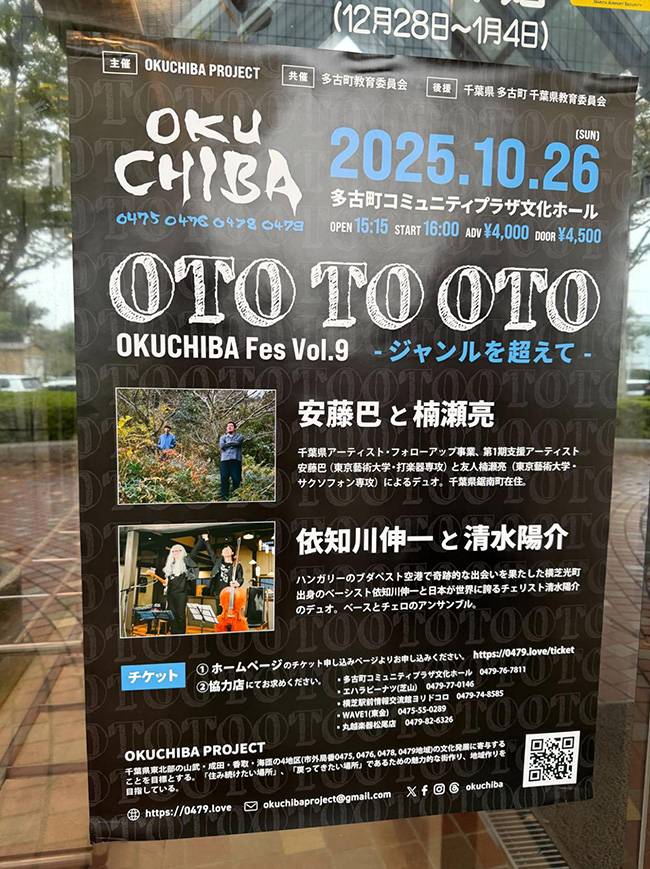
What is OKUCHIBA Fes?
It is a music festival organized by the Okuchiba Project (an evolved form of the former 0479 Club), founded by bassist Shinichi Ichikawa, who hails from Yokoshiba Hikari Town, Chiba Prefecture. The Okuchiba Project is an organization that aims to contribute to the cultural development of Chiba Prefecture, focusing mainly on the northeastern area (Sambu, Narita, Katori, Kaisai). It holds concerts twice a year in halls within the region.
https://0479.love
https://okuchiba.com
⇒ Report on the 1st Toso Music Festival
⇒ Report on the 2nd Toso Music Festival
⇒ Report on the 4th Toso Music Festival
⇒ Report on the 5th Toso Music Festival
⇒ Report on the 6th Toso Music Festival
⇒ Report on the 7th Toso Music Festival
⇒ Report on OKUCHIBA Fes Vol.8
This time, the venue is the Community Plaza Cultural Hall in Tako Town, famous for its Tako Rice.
Up until now, the festival has featured dynamic live events by professional musicians, but this time the tone has changed. It’s a stage featuring young artists who are crossing the boundaries of genres.
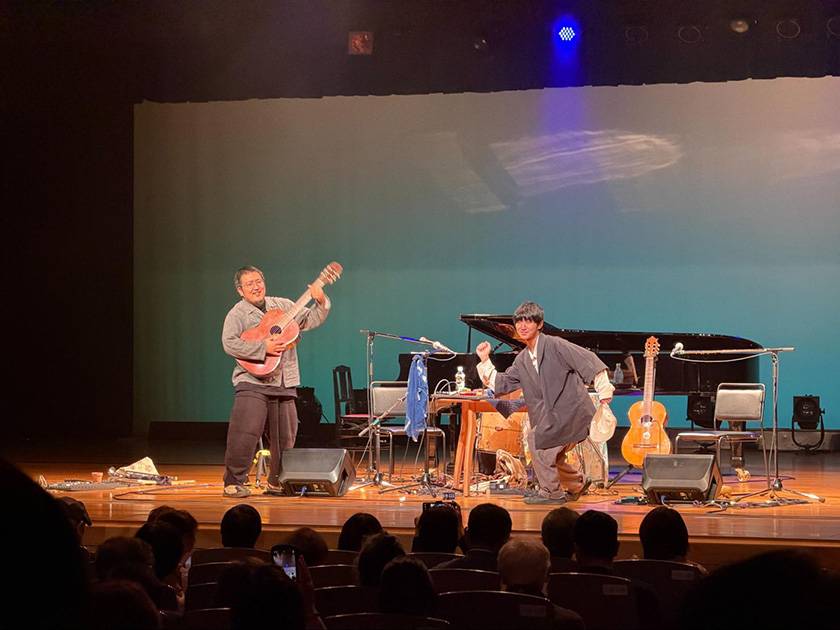
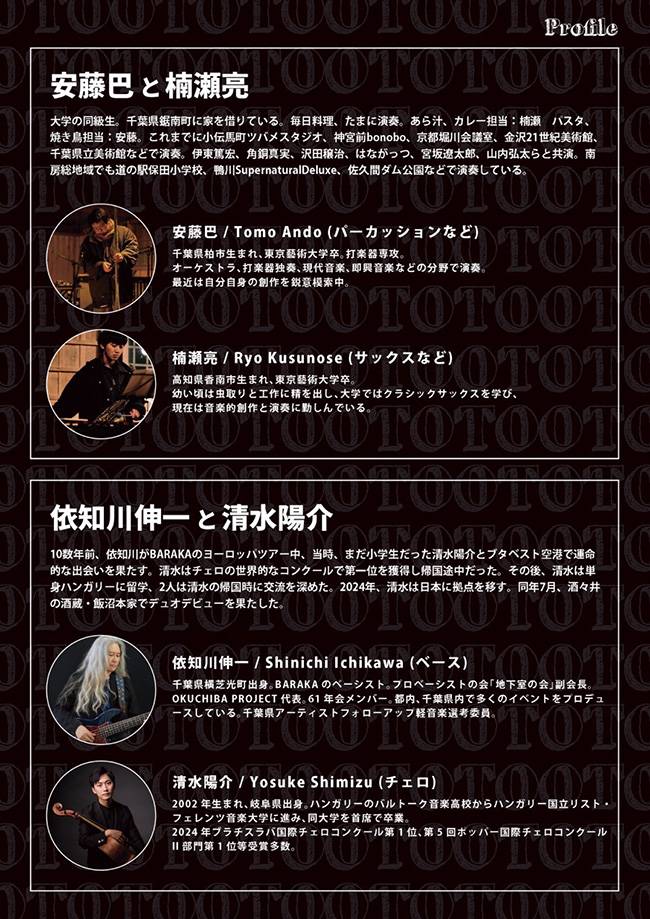
Ichikawa-san introduced Tomo Ando and Ryo Kusunose, both musicians are 28 years old and were classmates at Tokyo University of the Arts. They are a multi-instrumentalist duo now based in Kyonan Town, Chiba Prefecture, which is known for Mt. Nokogiri.
Their encounter began when Ando-san applied for the first round of Chiba Prefecture’s Artist Follow-Up Project, for which Ichikawa-san served as a selection committee member.
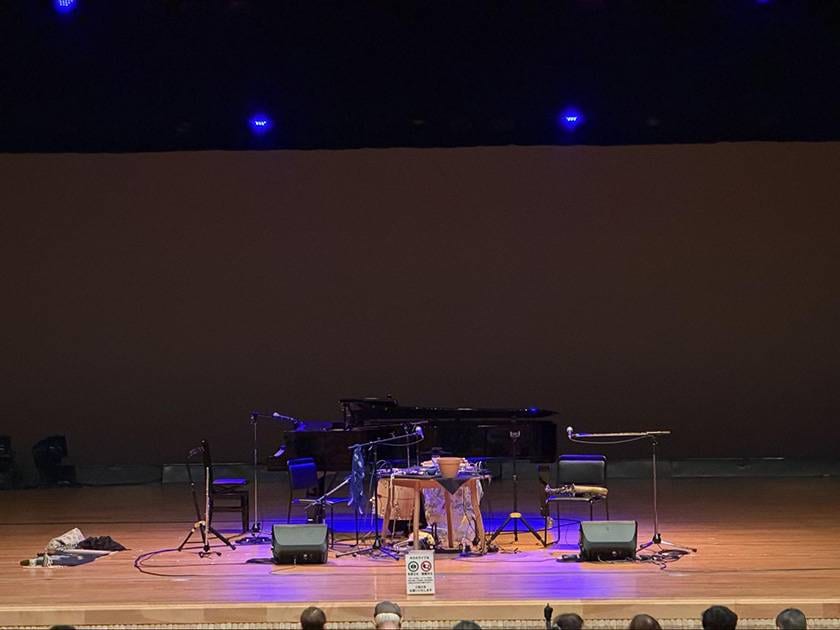
The two said they hadn’t decided what songs to play today.
Standing on either side of a set that looked almost like a cozy living room, they exchanged eye contact — “What should we do?” Before anything seemed decided, Kusunose picked up his saxophone and began to play slow, unstructured phrases that could hardly be called a song.
Listening closely, Ando-san began taking small percussion instruments one after another from a large drawstring bag, arranging them neatly on the table. In the middle of this, he put a small whistle to his mouth and occasionally made a high-pitched, birdlike whistle — tweet...
What on earth is about to happen…!?
After placing the percussion instruments on the table, Ando began adding them in one by one to match the saxophone. Instrument after instrument appeared. There were ones that many in the audience had likely never seen used before, and everyone was captivated by their sounds.
After a short while, Kusunose set down his saxophone and moved to the piano. He gently traced the same phrases he had played on the saxophone, and the performance continued at a relaxed pace.
It was music layered like brushstrokes in an oil painting.
“Hello.”
With that single word, the first piece ended, as if a soft breeze had passed through the room. They bowed politely, and their uniquely calm MC style began to ease the tension in the audience.
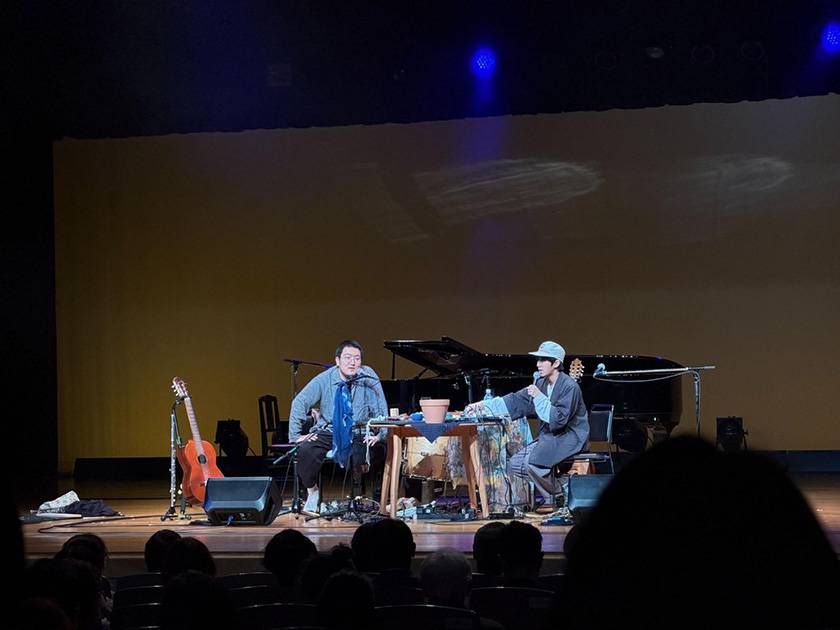
While Ando was talking, Kusunose adjusted some equipment with a microphone in hand — and then, slowly, the next performance began.
Using a looper, Kusunose layered multiple patterns of whistling, one over another, creating a mysterious, airy sound — light and fluttering, whirring and chirping.
Riding over that sound, Ando gently played a few notes on a panpipe with several tubes lined up, then plucked softly at a kalimba resting near his hands.
The audience watched in breathless anticipation, trying to follow where the performance would lead.
Then Kusunose picked up a gut guitar, and Ando began to sing the children’s song “Kanariya” (The Canary).
Ahhh—! So that whistling was the call of a canary!
The moment the audience realized what the piece was really about, the surprise transformed into deep emotion… What a piece of artwork!
It might seem improvised, yet everything felt perfectly calculated — a world that can only be created through genuine skill and mastery.
They explained that “Kanariya” was written by Saijō Yaso, a lyricist connected to their hometown in Kyonan Town, which is why they chose to perform it.
Suddenly, Ando slowly stood up and wrapped a stole around his shoulders with a meaningful gesture.
Just as the audience wondered, “Is he going to act now too!?” — he began striking a glockenspiel placed a short distance away on the floor.
Beside him, Kusunose sang and played guitar, performing a song born from a local elementary school exchange project. It turned out the song had no title — leading to a surprise moment when they decided on the name right there on stage.
Next came Ando’s piano solo with vocals. He layered choral harmonies using the looper, creating a breeze-like flow of sound.
He said, “This song doesn’t have lyrics, but if any words come to me, I’ll sing them.”
Apparently, many of his songs are like that.
After that, the surprises kept coming — he tapped on a half-finished bottle of Hennessy, played a flute that was a gift from a friend in Indonesia, and even performed with two ultra-mini kalimbas at the same time. During an autumn medley, they used various instruments to express the sounds of insects, one after another, with a continuous stream of fresh and inventive tones.
“I’m going to the bathroom!”
Once again, suddenly! In the middle of the MC, Ando dashed offstage!
But on this stage, where there was no such thing as a scripted routine, even that kind of “emergency” was effortlessly absorbed into the flow.
For the finale, the two performed a duet with guitars.
♪ “Name-take gohan ga mottainai~” (“It’s a waste of nameko rice~”) — Playful words bounced lightly from Ando’s clear, pure vocals.
The mysterious stage, as if fairies were at play, ended just like the wind — softly, fleetingly. Still, there was so much to take in!
In an age where everything has become digital, I couldn’t help but feel strongly that Sound House must continue to support artists like these two.
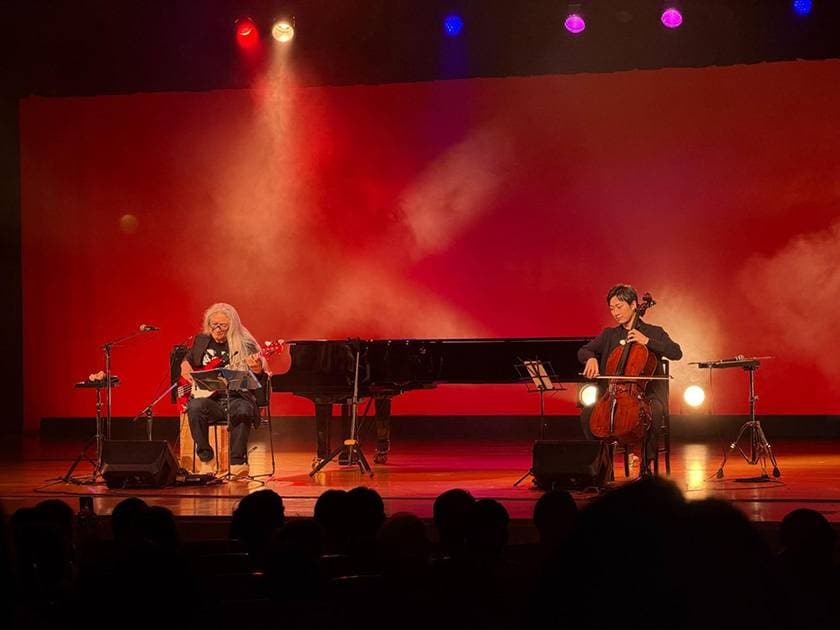
The second part featured a collaboration stage between electric bass and cello — a performance by Shinichi Ichikawa and Yosuke Shimizu, a young cellist who has won first place multiple times in international competitions.
This cross-genre collaboration came to life thanks to a fateful encounter the two had ten years ago. For more details on their story, please check out their profile!
“Has anyone here ever heard a bass and cello duo besides us?”
Both instruments are known for their deep tones — but how would they blend together?
The performance began with just the two instruments, playing “Jonetsu Tairiku” (The Continent of Passion)! A grand, earthy groove filled the hall, like the pulse of the land itself.
“There’s really no such thing as instruments that don’t go together!” Ichikawa said with satisfaction, clearly pleased with the result.
The second song was the classic “STAND BY ME”, starting with a rich, full bass line and featuring Ichikawa on vocals. The original version is memorable for its double bass and strings, making it a perfect choice for this duo!
Next, the two performed the school song of Hikari Elementary School in Yokoshiba Hikari Town — Ichikawa’s alma mater — which he had composed for the school. This song is usually sung cheerfully by children and the melody’s beauty stood out even more when voiced through the cello.
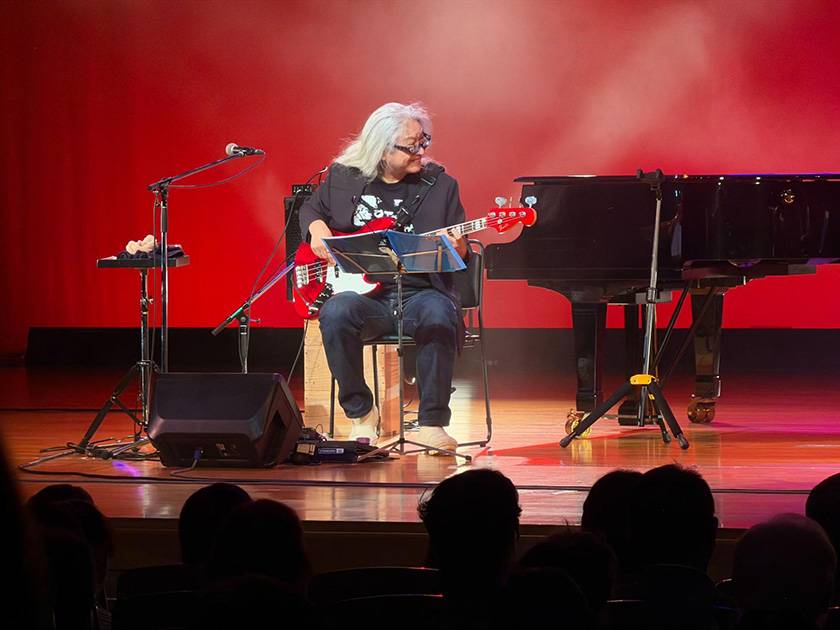
As the audience settled into a relaxed mood, suddenly a familiar, ominous phrase echoed through the hall… It was the theme from the movie “Godzilla”! In an instant, the warm atmosphere transformed into one of fear and tension — all created by the very same instruments. What power!
Ichikawa then took up vocals again, this time for another classic, “Ue o Muite Arukou” (Sukiyaki), performed in a light, easy flow. The cello’s phrasing, gently weaving in and out around the vocals, was wonderfully soothing.
“Well then,” Ichikawa said, “since Yosuke-kun has joined us today, I’d love for everyone to hear a cello solo!”
Amidst the loud applause, the stage was left to Shimizu and his cello alone. His dignified and graceful presence was strikingly beautiful — the very image of a true contest champion.
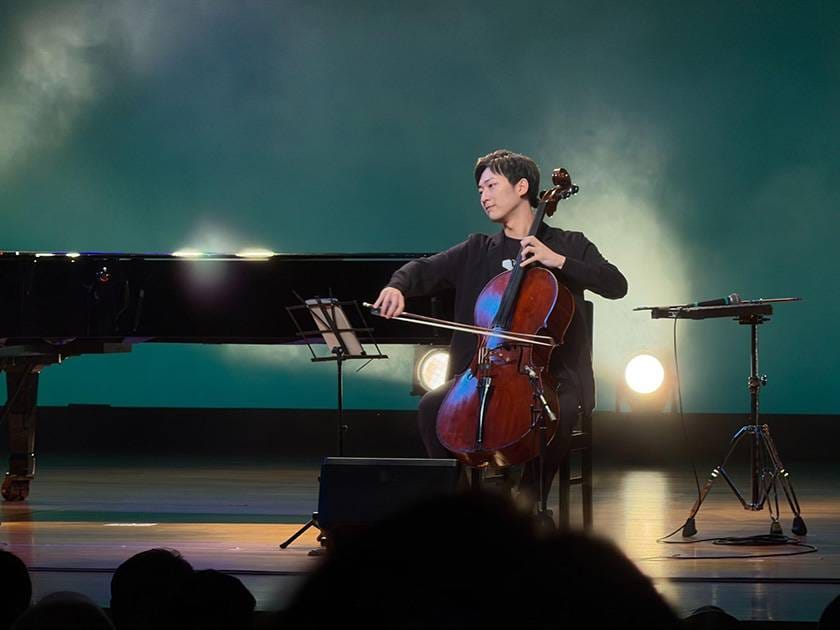
“From wondering, ‘I wonder what this will sound like?’ to building up a repertoire together, I feel truly happy that we can enjoy performing as a duo like this now.”
He then shared a heartwarming story about how he first met Ichikawa during an airport security check, which brought gentle laughter to the audience. After giving a brief introduction to the cello as an instrument, he added,
“I would like to perform while trying to get a feel for this place.”
The performance began with birdlike tones played in high positions — it was “El Cant dels Ocells” (Song of the Birds). This piece, arranged for cello by the “god of the cello” Pablo Casals, is based on a folk song from his homeland, Catalonia, Spain. The rich, soaring tones of the cello resonated powerfully throughout the hall.
The second piece was “Black Run” by British musician Svante Henryson.
“I think you’ll enjoy some eye-opening cello techniques in this one,” said Shimizu.
弦The piece was filled with techniques rarely seen before — plucking the strings, tapping the cello’s body — making the audience nervous as they wondered, “Is it really okay to hit a valuable cello made in 1854!?” But Shimizu swept the hall away with his lightning-fast cello work. In just this one piece, it felt as if he had explored the entire range of sounds the cello could possibly produce.
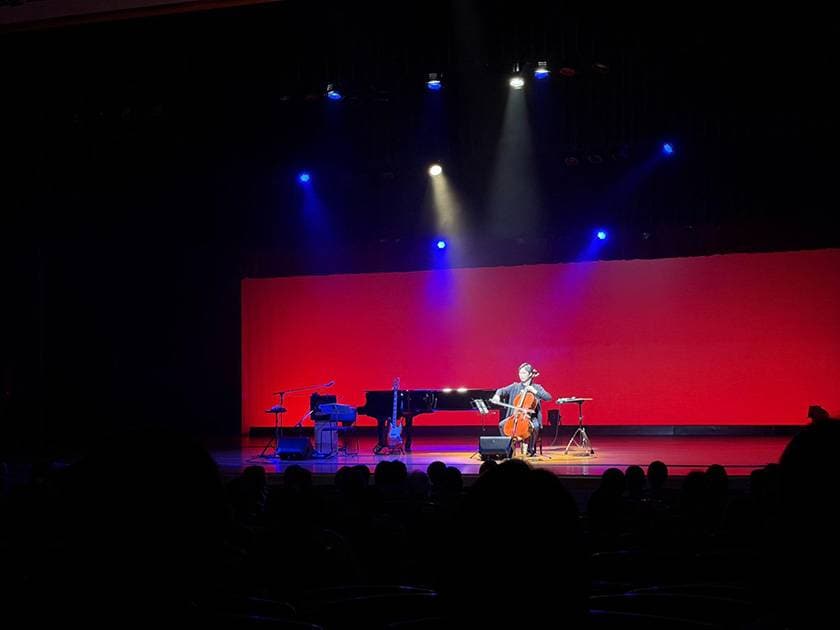
“It’s hard to learn cello unless you start as a child,” Ichikawa remarked.
“I’d still love for anyone to start anytime!” Shimizu replied with a smile.
If you’re the kind of person who thrives on challenges, why not give it a try?
In fact, Sound House has recently started carrying cellos!
⇒ Check out the cello lineup here
By the way, there are even people who start playing electric bass at age 70 — and by their 80s, play in three bands at once!
⇒ Check out the electric bass lineup here
“We’ll play a bit more together,” they said.
They began with The Beatles’ “Come Together”. With its iconic bass intro, it was another perfect choice for a low-end duo.
The main set concluded with “Inochi no Uta” (Song of Life) — a grand, life-filled soundscape that painted a vast and moving picture.
Amidst the roaring applause, the duo was immediately called back for an encore. For their final performance, they played “Kagemusha” by the cello duo 2CELLOS. By replacing the electric bass, the piece took on an even more industrial feel than the original.
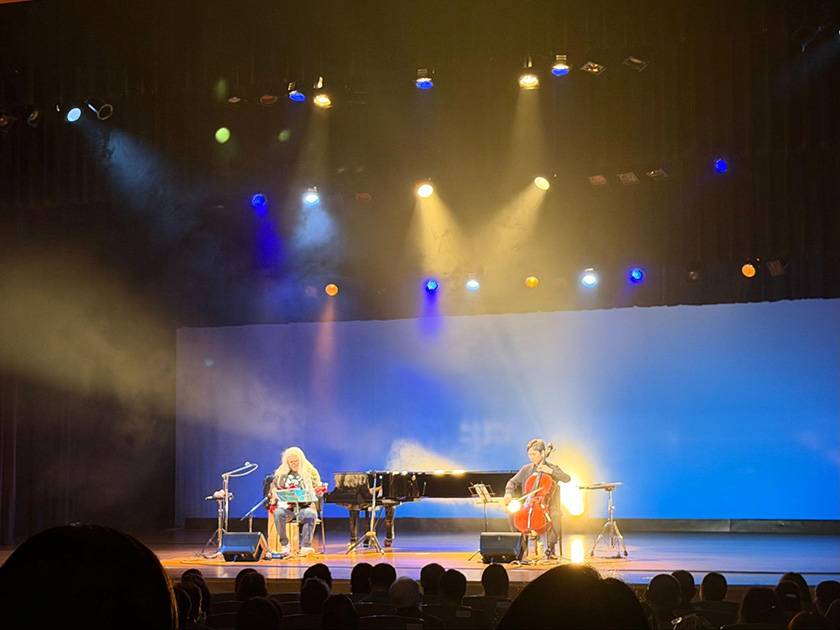
This event offered the audience a rich experience of stimulating music.
It was a fresh and heartwarming festival that clearly reflected Ichikawa’s high hopes for young musicians!
The date for the next OKUCHIBA Fes has not yet been decided, but it’s certain that it will surprise attendees again with another exciting program.
The Oku-Chiba Project continues to focus not only on music but also on promoting and developing sports and agriculture.
For more details, check out their website!
![[Narita City Music Event Report] Going to Narita Hub Groovin Vol. 2!](/contents/uploads/thumbs/2/2025/10/20251001_2_33117_1.jpg)
![OKUCHIBA Fes Vol. 8 [ROCK in ASAHI II]](/contents/uploads/thumbs/2/2025/6/20250602_2_31579_1.jpg)
![[Event Report] Toso Art Music Festival Vol. 1 - TOSO ART ROCK FESTIVAL](/contents/uploads/thumbs/2/2021/11/20211115_2_15153_1.jpg)
 夏フェスを盛り上げる良音ヘッドホン・イヤホン!大特集
 ミュージシャン数珠つなぎ インディーズバンド編
 音楽好きSNSアプリ SOUND NAVI
 サウンドハウスは高校生にききたい!!
 音楽フェスをご紹介
 キャンプしよう!キャンプinフェスでも活躍!アウトドア特集
 Discount Sale
 Outlet
 New Arrivals
 Podcast (streaming)
 Headphones / Earphones
 Microphones
 Wireless Equipment
 Speakers
 Power Amps
 Mixers
 Processors
 Portable PA Systems
 Recorders
 Karaoke
 Guitars
 Basses
 Ukuleles
 Drums & Percussion
 Pianos / Synthesizers
 Wind Instruments
 Stringed Instruments
 Japanese Instruments
 Harmonicas, Other
 Software
 DJ & VJ
 Stands
 Cables & Connectors
 Racks & Cases
 Lighting
 Stage & Truss
 Video Equipment
 PC PERIPHERALS
 Power Supplies
 Studio Furniture
 Household Items, Other
 Alcoholic Beverages