Here we have safely arrived at Part 2.
Last time, I covered buying two new Waves products and two classic UAD compressors and talked about how good they are.
This time, I want to introduce four UAD plugins that aren’t very famous (or maybe it’s just me who thinks that) and wrap up the 2025 Black Friday sale.
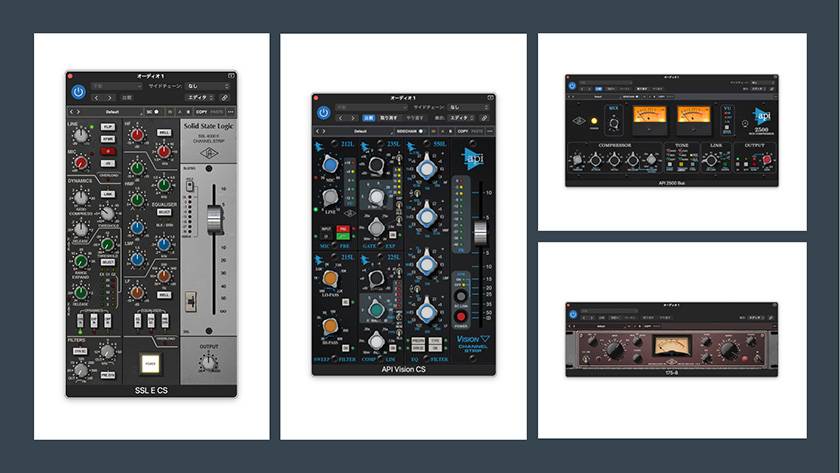
First: UAD – SSL E Channel Strip Colletcion
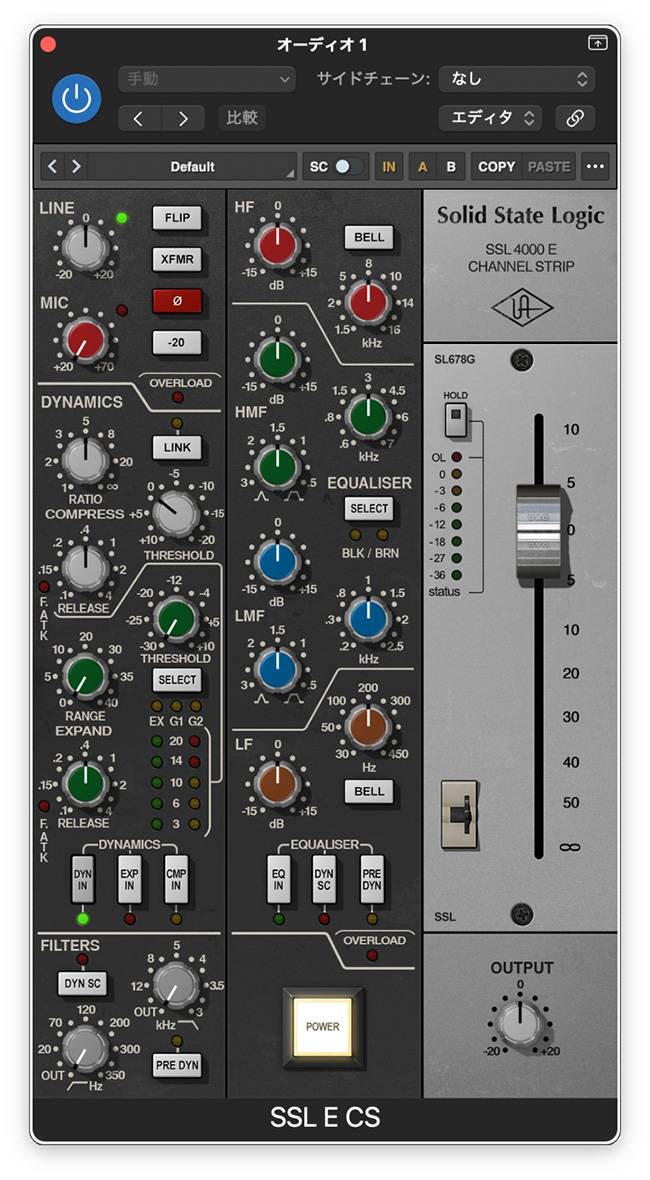
This one is modeled after the SSL 4000 E, which became the studio standard console from the late 1970s into 1980. It’s known for a “tight, forward sound” and was one of the first “all-in-one consoles” with EQ, compression, and gating on each channel.
The console focused on making energetic sounds energetic. That doesn’t mean it actively changes the sound—it trims the unnecessary, tightens things up, makes them clear, and lets the natural drive come through. That’s the concept.
Even as a plugin, it follows the same philosophy. No parameter has an exaggerated range, so it’s easy to use. You can just tweak things intuitively and get the result you expect.
It’s my first time using a console-style plugin, and I have to say—it’s very convenient.
Running a track through it naturally:
- Tightens the low end and prevents it from swelling
- Pushes the mids forward
- Adds a little presence so it cuts through without becoming flashy
These are the preamp-like effects it gives you, starting from that base.
Then there’s:
- The solid BROWN EQ with ±15dB range and a 6dB/octave curve
- The bold BLACK EQ with ±18dB range and an 18dB/octave curve
- Each with different high-pass/low-pass filters
You can choose between BROWN and BLACK, making parametric EQ adjustments very intuitive. Honestly, it feels a lot like a NEVE 1073, though I think this one offers more flexibility.
Then, in the dynamics section, it has:
- A simple attack setting with SLOW (30ms) and FAST (3ms)
- A continuously variable ratio from 1:1 to 1:∞
- A release from 0.1 to 4 seconds
It’s a VCA compressor with these options, plus a Gate with two modes, Expand and Gate, letting you tidy up your sound.
Literally, it’s all-in-one. You could finish your sound design with just this.
My current workflow is mainly picking a favorite from UAD’s excellent presets and fine-tuning it.
I insert it on any track because it naturally aligns with the sound I’m going for.
I use the EQ and gate a lot, but the compression is still left entirely to the two I introduced last time. The convenience is on a whole different level.
That said, layering this compressor with something like an 1176 can also sound fantastic, so it really comes down to personal preference. I guess that’s music for you.
The console itself is no longer in production, but a 1U outboard channel strip has been released. If you’re curious about the hardware, that’s an option. The price? Well, let’s not get bogged down with the details.
Second UAD – API Vision Channel Strip Collection
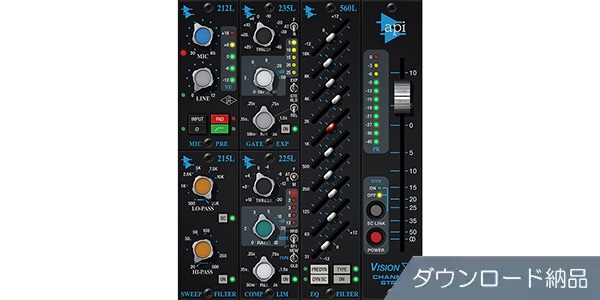
UNIVERSAL AUDIO / API Vision Channel Strip Collection Download Version
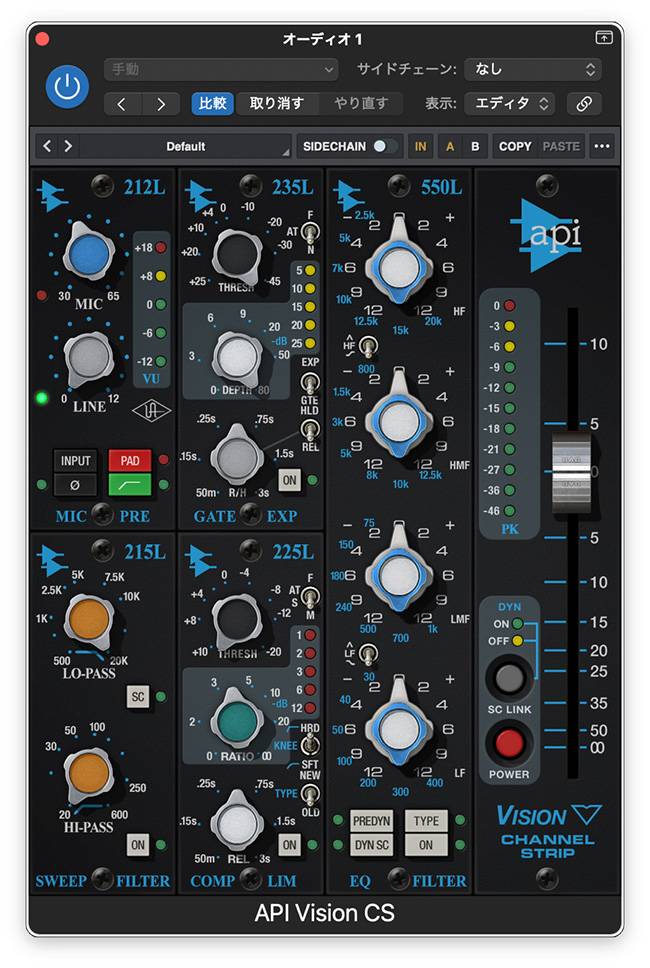
Continuing with channel strips, this time it’s from API.
The SSL 4000 I introduced earlier focused on tightness, but the Vision emphasizes punch and attack.
The Vision is API’s flagship console, and it seems to still be sold today. Its main era of prominence, like the 4000 E, was from the 1970s to ’80s.
Until I saw it in UAD, I hadn’t heard of API as a company, but apparently, they’re a big deal in the audio world.
As for the sound character, the low end is thick, the mids really push forward, the highs are rough but present, and the transients are lightning fast. In other words, it delivers a punchy, attack-heavy sound.
I tried it on drums, mostly cymbals, and oh wow—it felt incredible. The SSL 4000 is better suited for tightening and accentuating specific parts, whereas API Vision pushes everything forward as a whole.
Compared to the SSL E 4000, I feel there’s a clear difference in how it interacts with rhythm instruments and in its approach to sound design. It’s more proactive in shaping the sound, so just inserting it and choosing a preset can easily make things feel great.
That said, it can get too exciting and loud, so you have to judge with both your eyes and ears. Rhythm instruments shouldn’t stand out too much—they should remain the unsung heroes in the mix.
The structure is almost the same as the SSL. It has a preamp section, filters, gate, compressor, and EQ. The usability is nearly identical, but there’s a clear difference in the EQ.
SSL had two character options, BROWN and BLACK, whereas Vision lets you choose between parametric and graphic EQ, giving a more precise impression.
When miking cymbals or overheads, there are often very specific frequencies you want to cut. With parametric EQ, cutting one frequency can often affect the neighboring ones, so for rhythm instruments, having a graphic EQ makes perfect sense. They really understand the demand.
My usage is similar to the SSL. Ultimately, I mainly use the gate and EQ—it’s more for adding some flavor. The compressor is quite tight, so it’s selective with instruments, but the EQ can be used subtly for character, so I can insert it on guitars or backing pianos without any problems.
Third UAD – API 2500 Bus Compressor
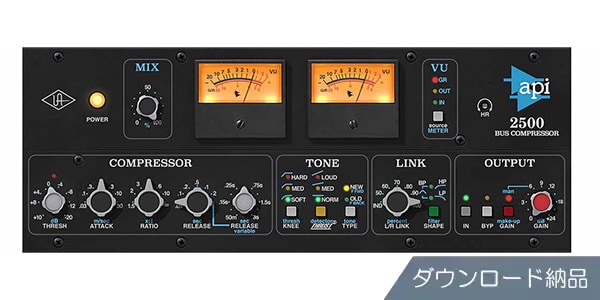
UNIVERSAL AUDIO / API 2500 Bus Compressor Download Version
Wow, we’re already at around 2,000 characters. Time flies.
Next up is API’s bus compressor. When it comes to bus compressors, the SSL 4000 G is probably the most famous, but using this made me realize the roles are different.
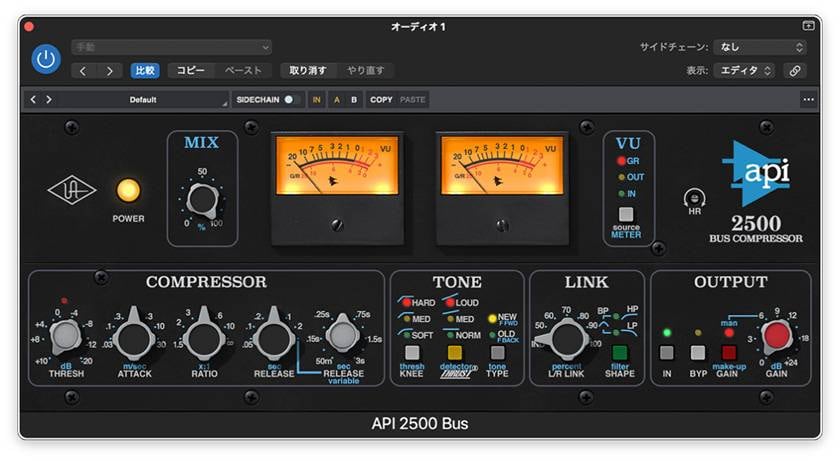
The API 2500 is API’s flagship stereo bus compressor. As a bus comp, it serves as the “glue” for the mix. Being stereo is part of that purpose.
Although the hardware was introduced in the 2000s, making it relatively new in the pro audio world, it features API’s signature discrete circuitry, transformers, and 2520 op-amps, giving it a rock-solid reputation already.
As for its character, it’s very API-like: present without letting the low end sink, pushing the mids forward, increasing compression without killing the attack, and maintaining energy while controlling dynamics.
If you think of the SSL G as more subdued → leveling volumes, the API 2500 pushes out the sound more → creating punch and groove.
For band sounds like rock or alternative, just a little tweak with this bus comp can make the mix feel alive and groovy.
A unique feature of the 2500 is the THRUST circuit. It’s a sidechain adjustment system that prevents the low end from dominating, which means:
- The kick doesn’t run wild
- You can control the mix without squashing the low end
- As a result, the punch comes through
This is a behavior that’s really useful for band music. It’s a compressor where changes are very noticeable, and, true to API style, it’s aggressive.
There are also two voice positions, OLD and NEW. OLD uses API-style feedback for a thick, sticky character, while NEW is more modern and clear, with a feedforward design reminiscent of the Fairchild or 1176.
Overall, it really feels like an API compressor—rough, rock’n’roll, and adds energy. Nowadays, there are easy digital plugins like Waves’ Vitamin to boost energy, but doing it with an analog-character plugin like this is equally fun.
For reduction, while an SSL G can handle about 3 dB without issue, the 2500 only needs 1–2 dB. Beyond that, it might get too aggressive.
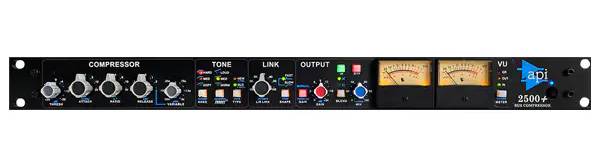
And here’s the hardware version. The price? As you might guess, it’s priced around ¥500,000. Compressors are expensive! But with the plugin version and a good sale, it can be around ¥2,000. There’s no reason not to buy it!
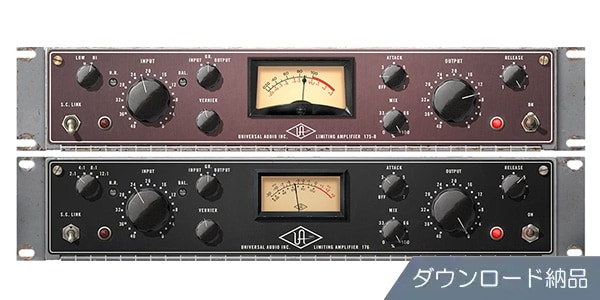
Fourth UAD – UAD 175B & 176 Tube Compressor Collection
UNIVERSAL AUDIO / UAD 175B & 176 Tube Compressor Collection Download Version
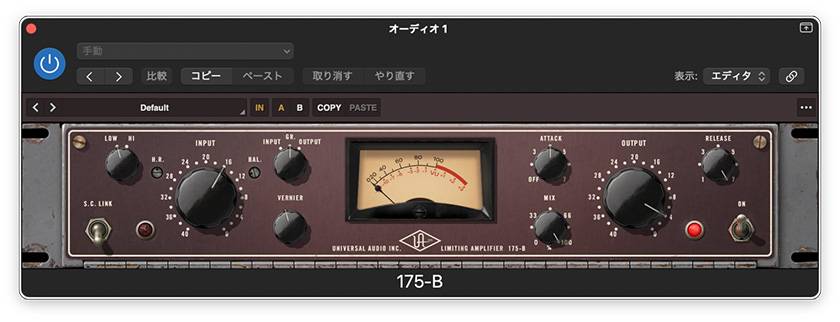
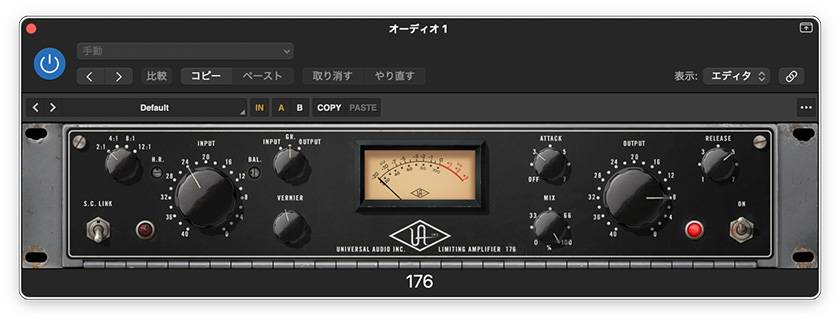
We’re nearing the finish line—it’s the home stretch.
The last ones I’ll cover are from Universal Audio. UAD plugins are made by Universal Audio. The 175B and 176? Also made by Universal Audio. Yep, they’re homegrown.
These are UA tube compressors from the early 1960s, just before the 1176 was born, and designed by Bill Putnam himself. Using tubes and transformers for gain reduction, they don’t exactly “crush” the sound. Instead, they control while adding character.
The 175B leans more toward limiter-style, either LOW or HI, while the 176 is a flexible model with ratios from 2:1 to 12:1.
What I notice in both:
- The attack is fast but never harsh
- Even when compressing, the depth remains
- The sound is slightly thicker and pushed forward
Unlike the 1176, it doesn’t have that razor-sharp bite, but it’s perfect for coloring drum buses, room mics, or vocals.
What I especially like is the slight graininess you get when you set the attack and release to the fastest settings. It adds texture without sounding artificial, giving the sound a solid presence.
This works really well with the plugin’s parallel mix feature, letting you subtly layer in compressed sound—“adding just a little of the crushed signal”—which I find really effective. I also use it with compression off as a tone box, when I just want a little tube-like warmth. Kind of like a Fairchild 670.
So I mostly use it not to compress aggressively, but to thicken and soften the sound. Due to this, the gain reduction is often close to zero.
For example, if I want to round off the harshness of overhead cymbals without losing the nice tonal qualities that EQ or a de-esser might remove, this compressor can improve it dramatically in one pass.
With this one plugin, you can get the rounded warmth unique to tube analog sound. If you apply it to cymbals, bright guitars, or fizzy synths, you can achieve a lo-fi texture while keeping the sound controlled, so I highly recommend it.
Ah, the difference with the Fairchild 670 really comes down to personal preference. The 670 is better for coloring and flavor, while I feel the 175B/176 are more “correctly” used as compressors or limiters. But again, it’s just my personal taste—I like both, and I choose depending on the genre and instrument.
Well, that wraps up this two-part series—thanks so much for sticking with me.
In the end, there’s always the issue of buying plugins but not using them, but until you buy them, you can’t really know what they’ll be like, whether you’ll enjoy them, or whether they’ll suit your tracks and instruments.
Buying and trying them out, and then thinking “eh, not quite,” can be part of the fun too.
That said, everything I introduced this time is ready-to-go professional level. Just having all of these plugins in your collection is enough to make some really great sounds.
The “sound & person” column is made up of contributions from you.
For details about contributing, click here.




![[DTM] Become a Budget DTM-er!](/contents/uploads/thumbs/5/2025/10/20251006_5_33197_1.jpg)


![[For beginners!] Choose an audio interface one rank higher](/contents/uploads/thumbs/2/2020/7/20200702_2_10515_1.jpg)
 DTMセール情報まとめ
 機能で選ぶ オーディオインターフェイス
 DTMに必要な機材
 UNIVERSAL AUDIO
 人気スタジオモニター徹底比較
 DTM・DAW購入ガイド
 Discount Sale
 Outlet
 New Arrivals
 Podcast (streaming)
 Headphones / Earphones
 Microphones
 Wireless Equipment
 Speakers
 Power Amps
 Mixers
 Processors
 Portable PA Systems
 Recorders
 Karaoke
 Guitars
 Basses
 Ukuleles
 Drums & Percussion
 Pianos / Synthesizers
 Wind Instruments
 Stringed Instruments
 Japanese Instruments
 Harmonicas, Other
 Software
 DJ & VJ
 Stands
 Cables & Connectors
 Racks & Cases
 Lighting
 Stage & Truss
 Video Equipment
 PC PERIPHERALS
 Power Supplies
 Studio Furniture
 Household Items, Other
 Alcoholic Beverages