■ Before Current Equal Temperament Came into Use
Tuning refers to the relative arrangement of each interval. Today, the equal temperament system, which divides one octave evenly into 12 tones, is mainstream, and as for scales, the major scale (Ionian scale) and the minor scale (Aeolian scale), which use seven of those tones, serve as the standard. Originally, various scales and tuning systems existed around the world, but today they are often forcibly performed using equal temperament. Since most Western instruments are made in equal temperament, this is more convenient. In traditional music that doesn’t use Western instruments, unique tuning systems remain alive. In addition, when recreating classical pieces composed before equal temperament, classical tuning systems are sometimes still used today. There is also the concept of microtones, which further divide semitones. With these, it’s possible to reproduce ethnic music.
There are various theories about how tuning systems were created, but in the case of Western music, it is said to have begun with the Pythagorean tuning of the Pythagorean school in the 6th century BCE; however, it is so ancient that it is not clearly understood how directly it is connected to present-day music.
When creating a tuning system, there is a reference tone, and the key point is in determining the next tone. What is common worldwide is the tone that differs from the reference tone by one octave. Every region has the concept of the octave. It was likely recognized as the most similar tone at a different pitch.
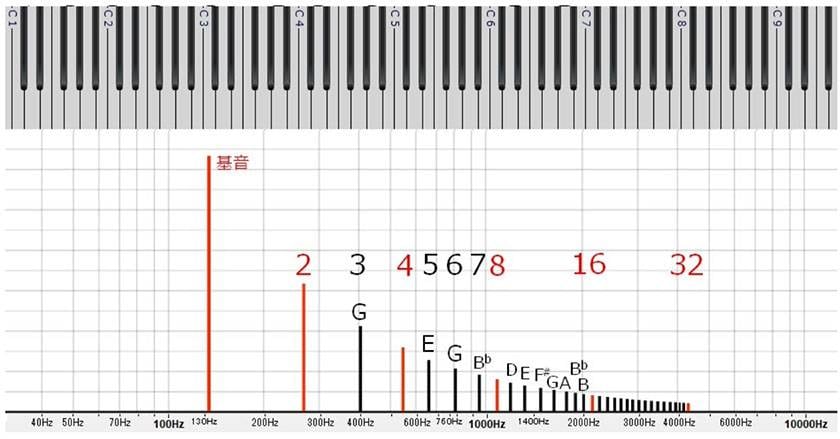
The next issue is dividing the tones within one octave, and from here it varies by region. However, in many cases, tones similar to the reference tone seem to have been adopted. In other words, tones included in the overtone series are prioritized. The diagram below shows the overtone structure when a single tone is sounded, and tones such as the third overtone (a perfect fifth above), the fifth overtone (a major third), and the seventh overtone (a minor seventh) are easily adopted. A tone that’s a perfect fifth above can also be described as a perfect fourth below, so scales combining these form a pentatonic scale that is acoustically natural in terms of overtones. Compared to equal temperament, the major third and minor seventh are slightly out of tune, and to ears accustomed to equal temperament, they may sound somewhat unpleasant, but as harmony they resonate beautifully. However, in many areas of the world the concept of harmony is weak, and there is a tendency to emphasize melody.
It’s said that the pentatonic scale is the most common worldwide. Traditional Japanese scales are also basically pentatonic. However, they differ from the pentatonic scale described above and have a unique sound. Also, the fewer the notes in a scale, the easier it is to remember, but for creating melodies, only about five notes were necessary.
■ Pythagorean Tuning Also Based on Natural Overtones
Pythagorean tuning is often cited because it has a structural explanation. The octave is divided into 12 tones based on the concept that, relative to a reference tone, the most consonant tone is the one a fifth above, corresponding to the third overtone. Indeed, when a reference tone is sounded, the tone a fifth above is already strongly present as an overtone, which is why it is consonant. This is a major difference from approaches in other parts of the world. The Pythagorean school considered harmony from the very beginning. It can be said that their achievement in systematizing orderly harmony was significant. The second tone is a fifth above, and the next tone is derived by taking a further fifth above that tone. By continuing in this chain-like manner, twelve tones are derived, eventually returning to the original reference tone. However, in reality there is a slight discrepancy. This is called the Pythagorean comma. The twelve tones created in this way differ from equal temperament, yet they appear to be a well-constructed set of twelve tones. They also serve as a basis for dividing an octave into twelve tones. However, when it comes to harmony, important intervals such as the major third have large discrepancies and sound unpleasant. With many shortcomings, various other tuning systems were subsequently developed.
The Pythagorean chain process is also interesting in terms of scales. It seems as though the important tones appear one after another. Taking C as an example and arranging seven tones in successive fifths in ascending order,
C, G, D, A, E, B, F#
When rearranged, it becomes:
C, D, E, F#, G, A, B
This forms the Lydian scale. It’s not the Ionian scale, which is the mainstream major scale today, but it appears this scale was more commonly used in the past.
Additionally, if only up to five tones are used, we get:
C, G, D, A, E
When rearranged, it becomes:
C, D, E, G, A
This forms the Pentatonic scale.
However, it’s unclear to what extent the Pythagorean tuning system has been passed down through history. As is evident in modern pianos, the seven-tone scale has become the standard basis.The design of the piano, with black keys added later, was intended to allow for modulation. If we were to think in terms of Pythagorean tuning, one might think that a twelve-tone system could have been the base instead.
Various tuning systems have since been developed, with one famous example being the Just Intonation system. This system is faithful to the overtones based on integer ratios, and it is still used today because it produces harmony with minimal dissonance. However, since it includes major and minor scales and requires tuning for each key, it is not suited for modulation. In practice, it is often used in choral music since that music prioritizes harmony.
Another well-known system is the Meantone temperament, a type of middle temperament. It is not based on the Pythagorean fifth, but rather on the third, and it is designed with harmony in mind. However, while it provides good harmony, it is said to be unsuitable for melody. This system was widely used in keyboard instruments during the 16th century.
■ And Then There’s Equal Temperament
As music began to make greater use of modulation, the shift toward equal temperament—essentially a compromise—became more widespread. Equal temperament, as its name suggests, is a simple tuning system that divides the octave into twelve equal parts, but it is exceptionally strong when it comes to modulation. However, it does have the drawback that harmony always tends to sound somewhat muddied. Despite this, on instruments like the piano and guitar, which are plucked string instruments and the sound quickly decays, this issue is barely noticeable. The real problem arises with instruments like the organ, which produce sustained tones. This is why there are organs tuned to Just Intonation, creating a rather troublesome interface.
With current electronic technology, it’s easy to change tunings instantly. It might be interesting to experiment with tuning systems, such as playing harmony-heavy parts using Just Intonation. In fact, research into microtones has gained renewed energy with the advent of electronic instruments.
The “sound & person” column is made up of contributions from you.
For details about contributing, click here.






![Enchanting Instruments 13 - Timbre of Instruments [Resonance]](/contents/uploads/thumbs/5/2021/10/20211025_5_14727_1.jpg)
 お化けを倒してサウンドGET!
 バンドあるある相談
 サウンドハウス社員が選ぶ 『おもしろ商品』はコレだ!
 ○○やってみた!
 最新コラム&動画をCheck!! OTOYA通信
 サウンドハウス虎の巻 !
 Discount Sale
 Outlet
 New Arrivals
 Podcast (streaming)
 Headphones / Earphones
 Microphones
 Wireless Equipment
 Speakers
 Power Amps
 Mixers
 Processors
 Portable PA Systems
 Recorders
 Karaoke
 Guitars
 Basses
 Ukuleles
 Drums & Percussion
 Pianos / Synthesizers
 Wind Instruments
 Stringed Instruments
 Japanese Instruments
 Harmonicas, Other
 Software
 DJ & VJ
 Stands
 Cables & Connectors
 Racks & Cases
 Lighting
 Stage & Truss
 Video Equipment
 PC PERIPHERALS
 Power Supplies
 Studio Furniture
 Household Items, Other
 Alcoholic Beverages