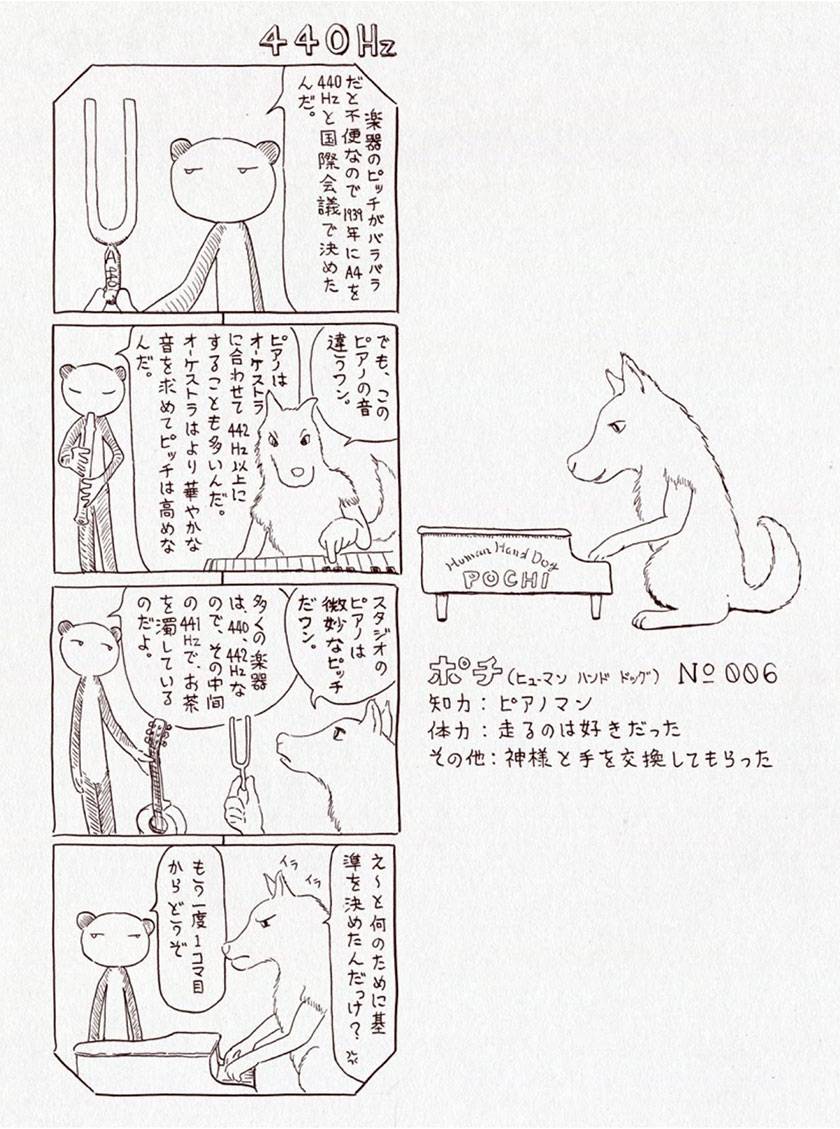
As it stands, even though A4=440Hz is set as the international standard, the reality is that there is still no uniformity. In fact, in classical music, 442Hz is often considered the norm.
Raising the pitch not only makes the sound slightly higher, but it also affects the timbre, resulting in a more brilliant sound. In the case of string instruments, the higher tension on the strings produces a stronger, more vibrant sound, but it also places more strain on the performer. The force required to press down on the strings increases. In classical music, since the emphasis is often on the natural acoustic sound, there seems to be a desire to raise the pitch in search of a more brilliant tone. Additionally, as the pitch rises, the volume tends to increase as well.
In the 1800s, the standard pitch was set lower at 435Hz. This means that the pitch has risen by 5Hz (about 20 cents) since then. During the Baroque period, it is said that the pitch was even lower by about a half-step compared to today. This would mean that the music of Bach, for example, may have sounded quite different in timbre between performances from the Baroque era and those of today.
On the other hand, is there any demand for lowering the pitch? In heavy rock and similar genres, it’s not about standard pitch, but they tend to lower the pitch by a half-step to create a darker tone. The purpose is tonal, similar to the intention of raising the pitch. Additionally, by tuning down by a half-step, the tension in instruments like guitars is reduced, which provides the performer with some advantages in terms of playability. In classical music, it is also common to lower the pitch by a half-step in order to authentically recreate Baroque-era music. The bright sound of today’s tuning often fails to capture the atmosphere of that period.
From the perspective of the instrument, raising the pitch means tightening the strings on string instruments, which has led to an increased burden on the instrument over time. It seems quite harsh for instruments like violins that were made hundreds of years ago. The pitch has been raised by nearly a half-step more than originally intended. Additionally, to produce more volume, the material of the strings has also changed, further increasing the strain on the instrument. In fact, old violins and similar instruments have often been modified to withstand modern performances. Looking at the history of classical music, classical originally began as court music, where performances were relatively intimate. However, after the construction of the oversized Carnegie Hall in America, the demand for louder volumes grew, and many instruments, including pianos, were modified to increase their volume. Acoustic instruments were considered better the louder they could play. Today, while classical music still relies on natural sound, many other genres have adopted electrical amplification, allowing performances in any venue. This shift means that the necessity for raising pitch or producing loud natural sounds has diminished.
It is interesting that well-mannered classical music has broken from the standard and moved to 442Hz or even higher, while seemingly unruly genres like rock often adhere to 440Hz. No one knows what will happen in the future, but a new standard pitch may be established somewhere down the line. For now, the ISO (International Organization for Standardization) set 440Hz as the standard pitch in 1955. It was reaffirmed again 20 years later in 1975. Perhaps there were many who did not follow it. Even today, the standard remains 440Hz, but the classical music world does not seem inclined to abide by it.
When the standard pitch varies depending on the time and situation, it becomes a very troublesome issue from the standpoint of instrument makers. String instruments have some flexibility, as they can be tuned on the spot. However, pianos have far too many strings to adjust their pitch easily. As for fixed-pitch instruments such as free-reed instruments and keyboard percussion, there is no solution if the pitch differs. In fact, instruments for orchestras are made to be set at 442Hz, while those for general use are made at 440Hz. It is quite a difficult problem.
The column “sound & person” is made possible by submissions from readers.
For more details on submissions, click here.





![Enchanting Instruments 13 - Timbre of Instruments [Resonance]](/contents/uploads/thumbs/5/2021/10/20211025_5_14727_1.jpg)
![Enchanting Instruments 11 - Timbre of Instruments [Harmonics 2]](/contents/uploads/thumbs/5/2021/9/20210930_5_14386_1.jpg)
 お化けを倒してサウンドGET!
 バンドあるある相談
 サウンドハウス社員が選ぶ 『おもしろ商品』はコレだ!
 ○○やってみた!
 最新コラム&動画をCheck!! OTOYA通信
 サウンドハウス虎の巻 !
 Discount Sale
 Outlet
 New Arrivals
 Podcast (streaming)
 Headphones / Earphones
 Microphones
 Wireless Equipment
 Speakers
 Power Amps
 Mixers
 Processors
 Portable PA Systems
 Recorders
 Karaoke
 Guitars
 Basses
 Ukuleles
 Drums & Percussion
 Pianos / Synthesizers
 Wind Instruments
 Stringed Instruments
 Japanese Instruments
 Harmonicas, Other
 Software
 DJ & VJ
 Stands
 Cables & Connectors
 Racks & Cases
 Lighting
 Stage & Truss
 Video Equipment
 PC PERIPHERALS
 Power Supplies
 Studio Furniture
 Household Items, Other
 Alcoholic Beverages