“More knowledge, more worries!” — This is an immortal proverb recorded in the Bible. Japan also has a saying, “Ignorance is bliss.” Something that you would never have paid attention to if you had not known about it can become a source of worry and suffering simply because you have learned about it. The meanings are quite similar.
Just the other day, I went trail running on Mount Tsurugi, in Tokushima Prefecture, the fifth-highest mountain in western Japan. It was a midsummer day under the blazing sun. Running uphill along a mountain trail is not something you can do half-heartedly. However, my motto is “nonstop to the summit.” Without stopping my feet, I pushed all the way to the top! Actually, about three months ago, when I ran up Mount Ishizuchi during a mountain-climbing tour with newly hired employees, I suffered a calf muscle strain for the first time in 10 years, and after that, I was unable to run for more than two months. That is why I was particularly careful on this climb.
I was excited and nervous about climbing a mountain again after such a long time. Thinking, “I’m not going to strain my calf again,” I cautiously made my way uphill at a running pace. However, the final 300 meters were much tougher than I had imagined. My legs almost stopped, to the point where I wanted to blurt out, “I’ve had enough!” Even so, I somehow made it to the summit. Without even having time to catch my breath, I turned around and descended the mountain. Then, when I returned to my car and was changing clothes, I happened to notice that both of my arms were red. What? I had gotten sunburned!
Three years ago, a doctor advised me, “Make sure you properly use sunscreen,” and at the age of 65, I started putting sunscreen on my face for the first time in my life. I tried various products, but I found that some suited my skin and others did not. The ones that didn’t suit me would quickly make my skin feel prickly and itchy. After much trial and error, I eventually settled on Shiseido’s Anessa. I confirmed that it was a perfect match for my skin. However, I had not applied sunscreen to my arms, so the area between the ends of my short sleeves and my gloves got sunburned! I had forgotten that ultraviolet rays at an altitude of 2,000 meters are considerably harsher than those at ground level.
To begin with, more than half a century ago, I was active as a tennis player and studied tennis in the United States. I was always tanned, with a completely blackened face. I was proud of how my arms and legs were beautifully browned by the sun. I wanted to show everyone. My glorious figure had even appeared in a magazine. So, getting a tan was simply a matter of course for me. Yet, 50 years later, I am surprised to find myself bothered by a little sunburn on my arms. Times have certainly changed. The biggest factor is that I learned that sunburn causes age spots. And, shockingly, a few days after the mountain climb, when I looked at my arms, I discovered for the first time in my life that they were covered with age spots. Or rather, I became extremely conscious of the spots on my arms. I never imagined that I would get age spots on my arms... And it wasn’t just the spots. The ultraviolet rays had also damaged the skin on my forearms, making it rough and coarse.
At an altitude of 2,000 meters, the intensity of ultraviolet rays is simply different. Compared with at ground level, UV rays are at least about 20% stronger. Moreover, when climbing a mountain on a sunny day, you are exposed to intense ultraviolet rays continuously for five or six hours. As a result, when I climbed Mount Ishizuchi in April, partly because I had not applied enough sunscreen, the facial skin that I had worked so hard to keep in good condition became red and developed age spots. I had been doing my best to somehow fix that, and now I couldn’t stop worrying about my arms. I wanted to say, “Come on, why are you worrying about that?” But once you know the reality of age spots caused by sunburn, there’s nothing you can do about it.
I sometimes find myself feeling nostalgic for my teenage years, when I never cared about getting a tan. Somehow, these days, as soon as the sun starts shining, I find myself unwilling to go outside without that bottle, as if saying, “Hey, Anessa!”—no, that’s not right—“Anessa!” At this age, I am surprised to find myself practically brainwashed into hating the age spots caused by sunburn. Even so, I sometimes look at my arms. They are tiny spots, only about 1-2 mm in size, something I normally wouldn’t even give a second glance. Yet somehow my eyes are drawn to them. And I find myself thinking, “Oh no, I’ve got an age spot.” I am truly a severe case of “More knowledge, more worries!”
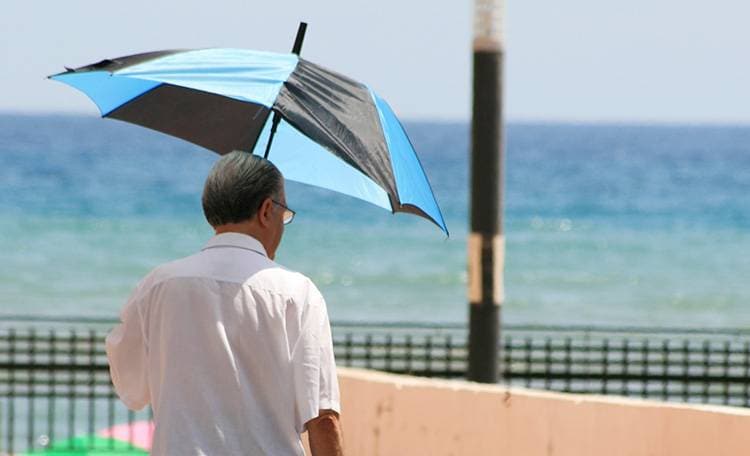
Lately, as I have been tormented by these thoughts, I have started seeing men carrying parasols in Tokyo. And this has only been happening for the past few months. Until then, in all my years growing up in Tokyo, I had never once seen a man carrying a parasol in the city. But today, I noticed three men walking around town with parasols. For me, it was an extremely fresh and shocking sight. It was the same kind of shock I felt in the 1950s and ’60s, when I saw young people holding hands in front of the Hachiko statue in Shibuya, at a time when it was considered absolutely unacceptable for men and women to hold hands. In other words, times have changed dramatically, and we have entered an era in which men carry parasols. Wow...
Of course, one factor behind this is that the number of days with strong ultraviolet radiation has doubled compared with 1990. In addition, there is the recent boom in men’s beauty care. Particularly among younger generations, it is no longer unusual for men to take an interest in makeup, skincare, and beauty. The old value that “boys are supposed to play outside and get completely tanned” seems to be changing itself. Young men’s interests have gradually diversified, and more of them are enjoying not only sports but also fashion, makeup, cooking, shopping, and so on. As a result, the growing number of men who want to avoid tanning and keep their skin looking good may also be one reason why parasols for men are sold. On the other hand, it is also known that exposure to sunlight is important for both physical and mental health. So, should we really be so afraid of ultraviolet rays?
By coincidence, an article on the front page of today’s evening edition of the Nihon Keizai Shimbun was titled “Men Take a Keen Interest in UV Protection,” and was prominently featured on the page. As someone who regularly uses Anessa, I was unaware of this, but Shiseido has apparently started selling a sunscreen for men called “Anessa Multi Control UV Gel.” Suntory has also reportedly begun selling a sunscreen product targeting men. And, surprisingly, the article says that sales of parasols for men at variety stores are growing rapidly. What’s more, it says that the market is being supported by young people in their 20s. The “Men’s Parasol” series produced by Hands has apparently increased its number of products by as much as 40% recently. Meanwhile, Aoyama has expanded the number of stores carrying parasols to 260, five times as many as last year. The number of units sold has also increased to nearly five times the previous year’s level—a truly astonishing fact.
For young men, wearing makeup is no longer unusual either. Not only sunscreen, but also visiting beauty salons and taking care of their appearance is becoming commonplace. The psychological barrier toward cosmetic surgery has also become dramatically lower than it used to be. What’s more, just as among women, it has become increasingly common to hear young people say that one of the reasons they work part-time and save money is “to get cosmetic surgery on my face.” If you think about it that way, it is hardly surprising that parasols for men are sold as a way to avoid facial age spots caused by sun exposure. ATSUGI has also reportedly “introduced arm covers for the first time in about five years.” Men wearing arm covers? Have we really entered an era when men even worry about getting their arms tanned...? Thinking about that, I suddenly look at my own arms. I’m hardly in a position to talk about other people.
I believe these kinds of social changes may also have a considerable impact on the popularity of outdoor sports. Going to the beach in summer and getting a tan may soon become unthinkable. Mountain climbing may also be avoided, and if people absolutely have to climb a mountain, they may cover their entire bodies with clothing to avoid direct sunlight. And what about my beloved tennis? Naturally, will its popularity also decline? Tennis used to be considered a rich and cool sport, but now it risks being seen as a sport that exposes people directly to the harmful effects of sunburn. After all, it is a sport in which you cannot cover your body with clothing. Perhaps soccer is about the only popular sport in which people can play boldly outdoors in the sun without worrying about getting a tan. That is why I still think athletes running around in the sun with tanned skin look cool, just like the high school baseball players at Koshien. But I feel that way of thinking may disappear within the next few years. Japanese summers have simply become too hot for playing baseball outdoors.
What am I trying to say? Even I am starting to lose track. In the end, I arrive at exactly the same conclusion as the biblical proverb: “More knowledge, more worries!” Because I have learned so many things, I have even started worrying about my own body. There was once a time when people didn’t worry about such things at all. Everyone went fishing at the beach, worked in the fields, went hunting in the mountains, and enjoyed as much sunlight as they could. Tanned skin was, if anything, a symbol of good health. And now, I find a tiny 1-2 mm age spot on my arm and think, “Oh no!” And in the city, young men are walking around carrying parasols. Times are changing, and perhaps I will change along with them. In the middle of this scorching summer, when I next walk outside under the blazing sun, will I carry a parasol myself? ...The possibility seems quite high.
 Discount Sale
 Outlet
 New Arrivals
 Podcast (streaming)
 Headphones / Earphones
 Microphones
 Wireless Equipment
 Speakers
 Power Amps
 Mixers
 Processors
 Portable PA Systems
 Recorders
 Karaoke
 Guitars
 Basses
 Ukuleles
 Drums & Percussion
 Pianos / Synthesizers
 Wind Instruments
 Stringed Instruments
 Japanese Instruments
 Harmonicas, Other
 Software
 DJ & VJ
 Stands
 Cables & Connectors
 Racks & Cases
 Lighting
 Stage & Truss
 Video Equipment
 PC PERIPHERALS
 Power Supplies
 Studio Furniture
 Household Items, Other
 Alcoholic Beverages