The Tantrum products reviewed this time are The Angry Box studio monitor, which catches the eye with its vivid red color, and The Really Mean Sub subwoofer.
How much sound can the compact The Angry Box deliver on its own? And how will the sound change when it is combined with The Really Mean Sub?
I took my time listening to them while playing a variety of songs.
Here are the products reviewed this time!!
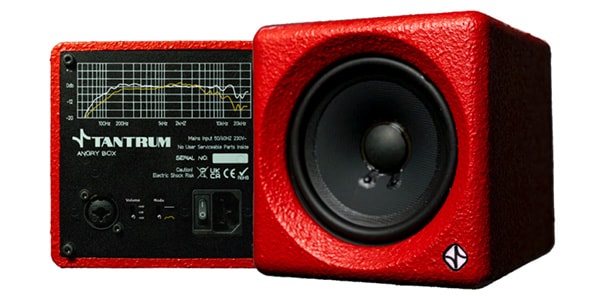

The first thing that catches your eye is the vivid red!
When you unpack The Angry Box, the first thing that catches your eye is its vivid red color.
When you think of studio monitors, you may have the impression that many feature understated designs based around black, but The Angry Box is quite distinctive.
It is not simply flashy. When you actually pick it up, the texture also feels good. It has a strong presence when placed on a desk, and personally, I felt that the words ‘cool’ and ‘eye-catching’ fit it perfectly.
A music production environment is a place where you spend a long time, which is why you want to pay attention not only to the sound but also to the design. This is a monitor speaker that I would like people who feel that way to take a look at as well.
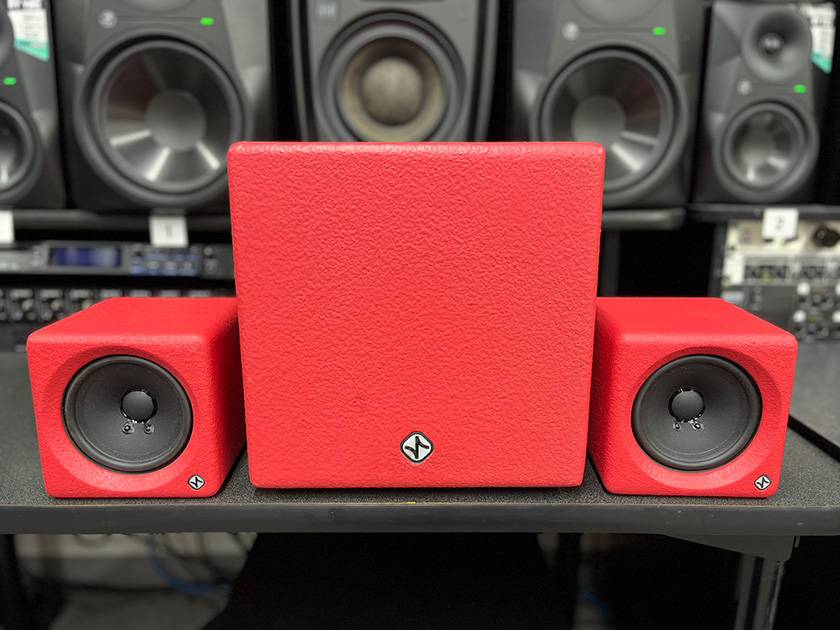
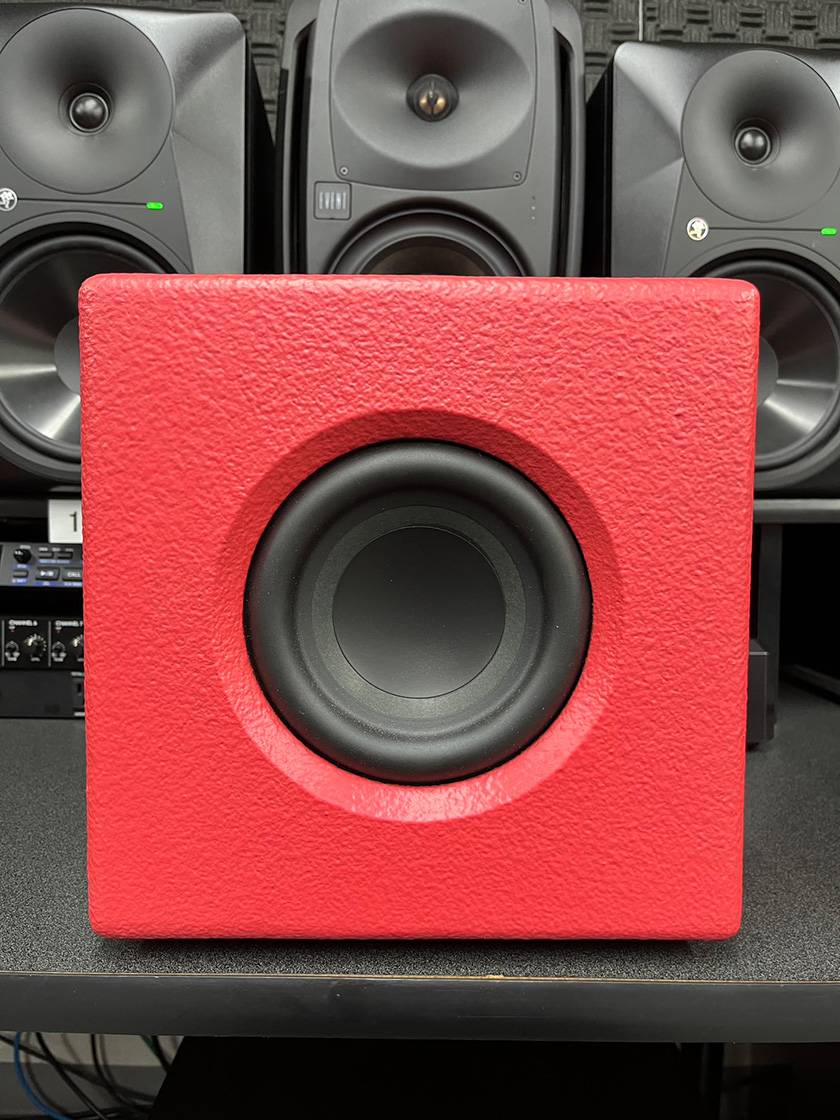
The ultra-compact 14cm-square: The Angry Box
The Angry Box is a monitor speaker equipped with a 4.5-inch full-range driver.
Its dimensions are approximately 14 x 14 x 14 cm.
Its cube-shaped enclosure is extremely compact, and one of its characteristics is that it is easy to reduce the amount of space needed for placement compared with typical studio monitors.
It seems easy to incorporate not only into environments where desk space is limited, but also when you do not want to place large speakers on either side of a computer display.
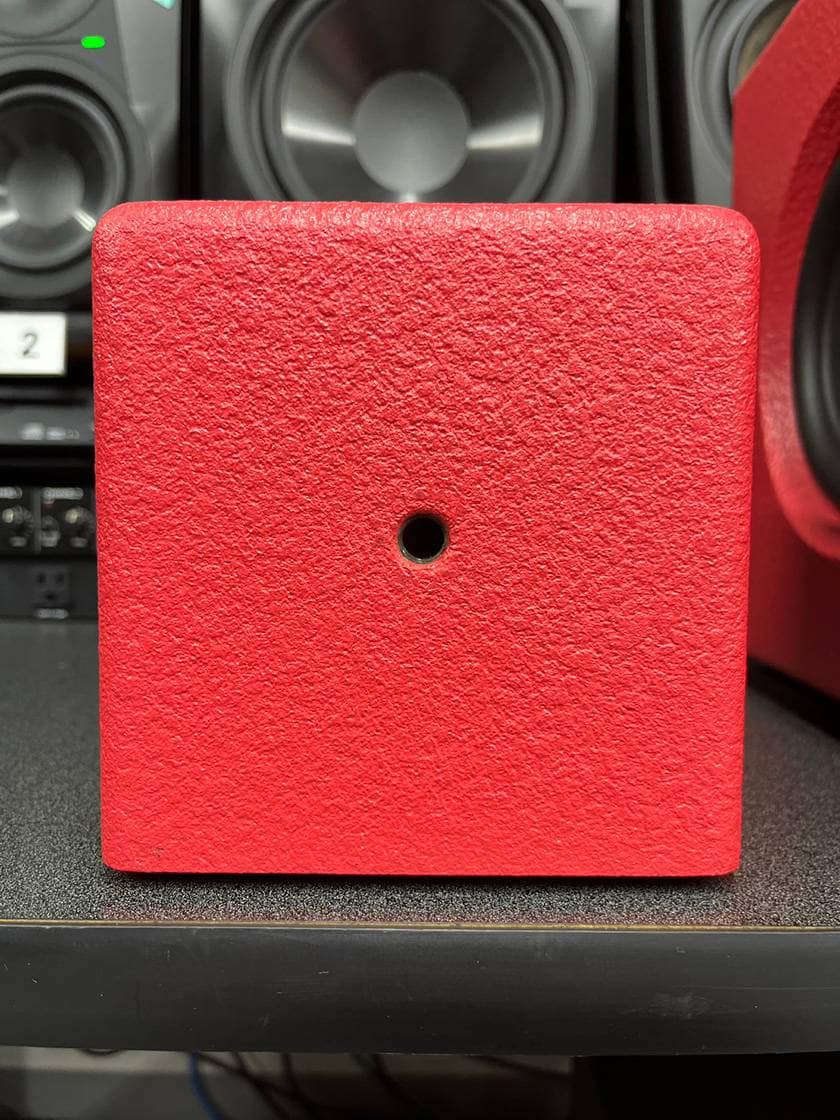
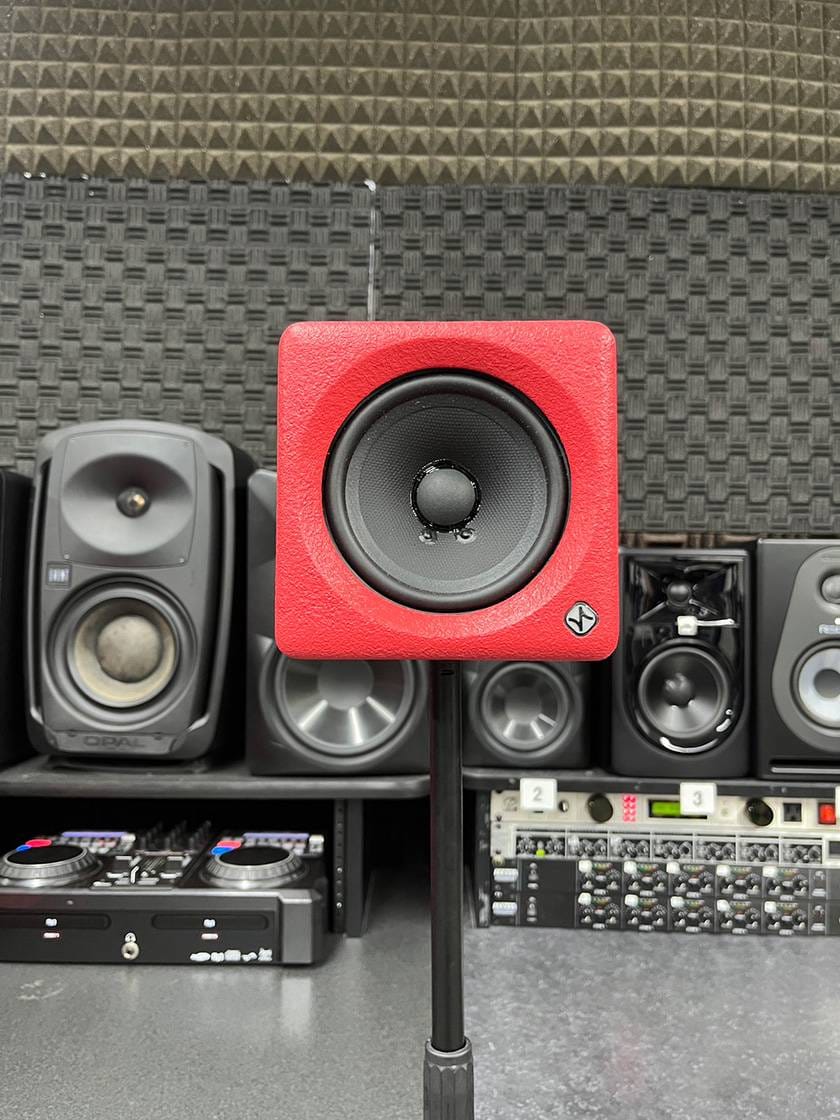
In addition, the bottom is equipped with a 3/8-inch threaded hole. By using a compatible stand or adapter, you can consider various setups rather than simply placing it directly on a desk.
Along with its compact enclosure, I felt that the high degree of freedom in placement is another appealing point of The Angry Box.
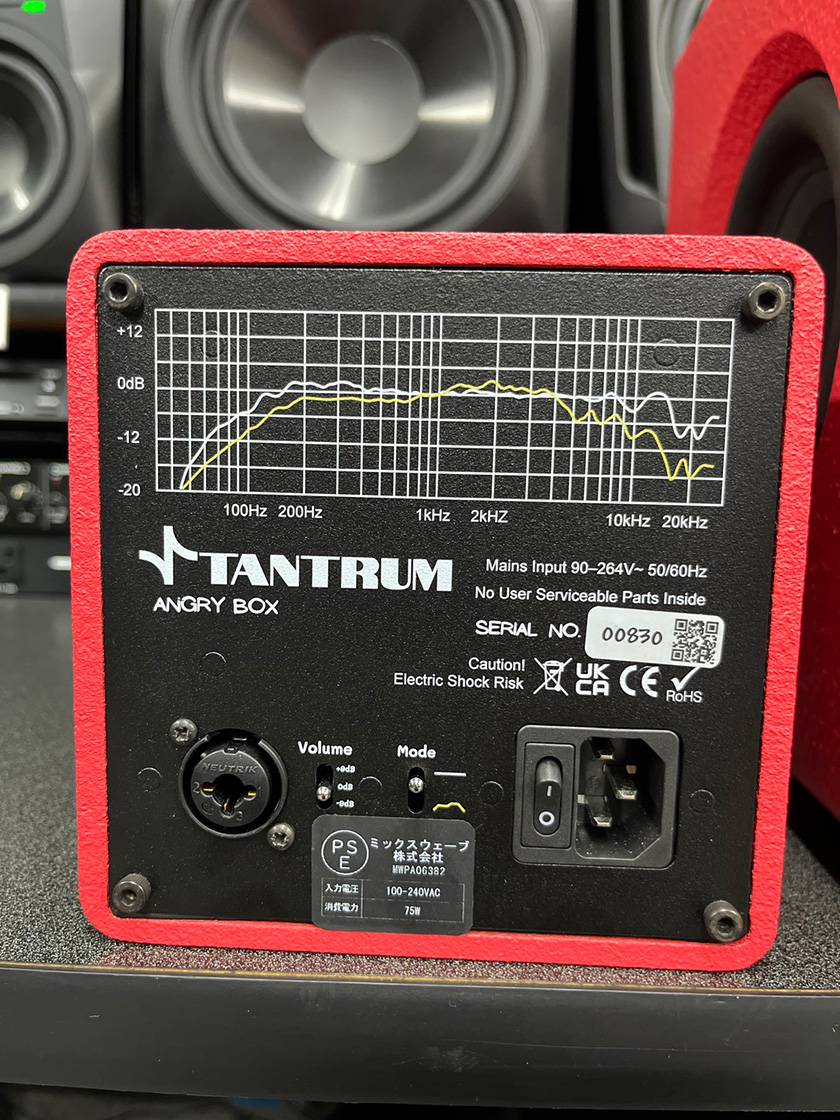
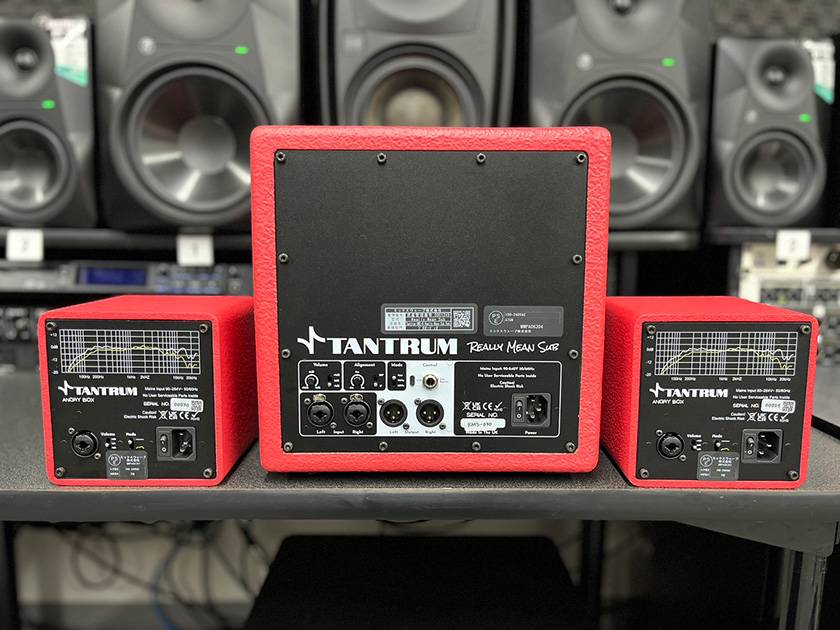
The rear panel is very simple
Looking at the rear panel, the controls are quite simple.
Rather than the continuously variable volume knobs and multiple EQ knobs commonly found on monitor speakers, it is configured with stepped Volume settings and a choice between two types of EQ curves.
There are two types of EQ:
- Linear (straight-line mark)
- The basic setting for full-range playback.
- Mid Focus (curved-line mark)
- A setting suitable for monitoring with an emphasis on the midrange.
This time, because I wanted to check the sound of The Angry Box itself, I listened with the Linear setting.
Rather than making detailed EQ adjustments on the speaker itself, it gives the impression of being designed to be simply set according to the intended use.
Let’s also check out The Really Mean Sub
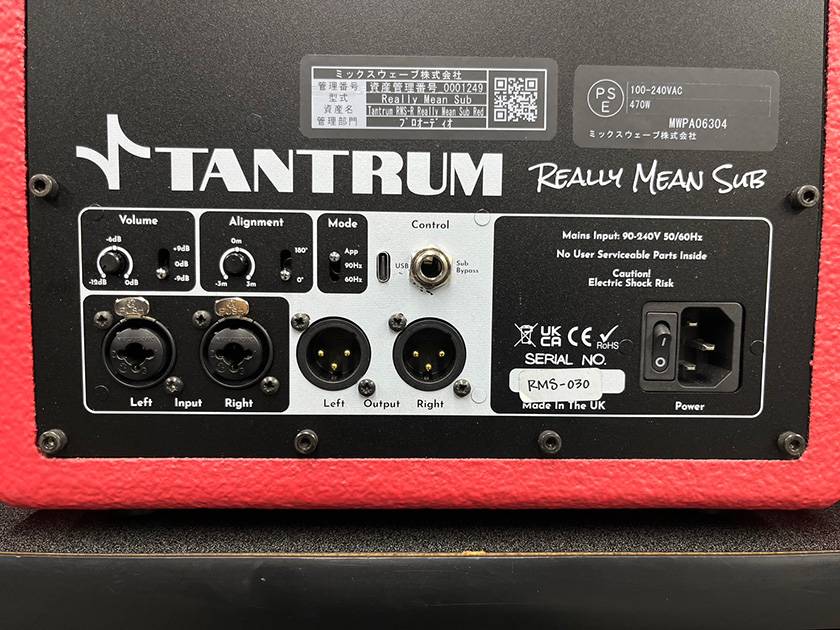
Next, let’s take a look at the subwoofer The Really Mean Sub, which is intended to be used in combination with The Angry Box.
It is equipped with Volume, Alignment, and Mode adjustment functions, allowing you to configure it according to The Angry Box and the installation environment.
This time, I mainly listened using the 90 Hz setting so that I could easily check the difference made by adding the low frequencies.
Comparing it with a typical two-way monitor
The clarity of the mid and high frequencies is impressive
When I listened to The Angry Box, the first thing that left an impression on me was the clarity of the mid and high frequencies.
I listened while comparing it with a typical two-way studio monitor, and when switching to The Angry Box, I had the feeling that the subtle sounds contained in the music came straight into my ears.
Even though you could say that it has “a lot of information,” it does not give the impression that each individual sound is making a cluttered or overly assertive presence.
My personal impression was that it was easy to follow the position and contours of each sound, such as vocals, guitar, keyboards, and drums, and to get an overall view of the entire song.
The difference was particularly noticeable with acoustic-oriented songs centered around female vocals.
In addition to subtle nuances such as the luster of the voice and the sound of the singer’s breathing, I also found it easy to check how far the reverb extended and how high-frequency components such as hi-hats and bells were sounding.
Even with songs I normally listen to, there were moments when I realized, “So this is the sound that was playing here.”
This is an interesting aspect for listening purposes, where you simply enjoy music, but I think it is an especially beneficial point for monitoring applications where you want to check subtle sounds, such as mixing and editing.
When listening to high-priced monitor speakers, we sometimes describe the experience by saying that they “feel like the musicians are performing right in front of you,” and I had a similar feeling when listening to The Angry Box.
Can you really enjoy the low frequencies with a 4.5-inch speaker?
Of course, there are differences due to the physical size.
When comparing the low frequencies of The Angry Box on its own with a slightly larger 5-inch-class monitor speaker, there were times when the amount and depth of the low frequencies felt somewhat restrained.
Considering that it uses a 4.5-inch full-range driver and a compact enclosure, this is, in a sense, a natural result.
However, I did not get the impression that “it doesn’t produce bass.”
Personally, I feel that the word ‘restrained’ fits best.
Even though it is reproducing sound with a single full-range driver, the overall balance is well maintained, and I had the impression that it was easy to follow the contours of the bass line.
There was little sense of the low frequencies being inflated more than necessary, and I was able to comfortably enjoy the tight bass.
Considering it as a compact monitor, I felt that The Angry Box on its own offers a balance that is more than sufficient for enjoying music.
Here is what the listening session looked like.
【Tantrum比較試聴してみました】
— サウンドハウス PAチーム (@soundhouse_pa) August 25, 2026
1. Tantrum/The Angry Box
2. MACKIE/MR524
3. JBL/305P MKII
4. SAMSON/Resolv SE5
The Angry Boxは、中高音域の解像度がとにかく高く、「目の前で演奏しているみたいに聞こえる」でした😆#サウンドハウス https://t.co/7LIcmtkkjK pic.twitter.com/nOdhlNv4gV
If you want to check deeper low frequencies, The Really Mean Sub
Although I was able to enjoy a well-balanced sound with The Angry Box on its own, if you want to monitor down to lower frequency ranges as well, I recommend adding The Really Mean Sub.
The Really Mean Sub has a relatively compact enclosure for a subwoofer designed for studio monitors.
When actually placing it next to a JBL LSR310S, you can clearly see the difference in size.
Large subwoofers can make securing enough space for installation a challenge, but The Really Mean Sub seems easy to incorporate around a desk or into a space with limited room.
Especially when considering typical residential environments and home studios in Japan, I think this compact size could be a major advantage.
Adding the subwoofer completely changes the sense of scale of the sound
This time, I selected the 90 Hz setting and compared the sound while switching The Really Mean Sub on and off.
When the subwoofer is added, it fills in the lower frequencies whose output was somewhat restrained with The Angry Box alone, and the overall sense of scale of the music changes significantly.
With the added weight of the kick drum’s ‘thump’ and the lower frequencies of the bass, the reproduction felt larger than its physical size, to the point where it was hard to believe it was a system centered around speakers measuring just 14cm square.
The difference was particularly easy to understand with heavy rock tracks.
Even with The Angry Box alone, the finer details of guitars and vocals are very easy to hear, but when The Really Mean Sub is added, the added thickness of the kick and rumble of the bass make the presence of the rhythm section increase dramatically.
Personally, it became closer to the sensation of being able to feel the low frequencies with your body, like when listening to music at a live music venue.
A subwoofer is not just about “increasing the bass”
When you think of a subwoofer, you may think that it is only necessary for music with strong low frequencies, such as EDM or rock.
However, after actually listening to a variety of genres, I found that the benefits were not simply that “the bass gets louder.”
Being able to reproduce down to lower frequencies makes it easier to grasp the pitch and decay of the kick and bass, and also makes it easier to understand the overall range of the song and the sense of scale of the sound image.
Even with acoustic-oriented songs, I found it easier to perceive information contained in the lower frequencies, such as the resonance of the instruments' bodies and the reverberation of the space.
Here is the listening video.
【Tantrumサブありなし比較試聴してみました】
— サウンドハウス PAチーム (@soundhouse_pa) August 25, 2026
1. Tantrum/The Angry Box+The Really Mean Sub
2. MACKIE/MR524
3. JBL/305P MKII
4. SAMSON/Resolv SE5 #サウンドハウス
The Angry Box Pair https://t.co/7LIcmtkkjK
The Really Mean Sub https://t.co/p58bVvfomT pic.twitter.com/iRHlaZM0CY
【Tantrumサブウーファーありなし比較試聴してみました】
— サウンドハウス PAチーム (@soundhouse_pa) August 25, 2026
Tantrum/The Really Mean Subは、フットスイッチでサブウーファーのON/OFFをすることができるので、簡単に比較できます✨#サウンドハウス
The Angry Box Pair https://t.co/ChnUeTqvCr The Really Mean Sub https://t.co/Gn05t9WYmj pic.twitter.com/kAQCZEbp2J
Conclusion: A Monitoring Environment That Exceeds What You Might Expect from Its Compact Size
The phrase “a monitoring environment one level above” is often used, but after spending time listening closely to The Angry Box and The Really Mean Sub this time, I felt that it was a combination that really suited that description.
The Angry Box is extremely compact, yet it makes it easy to check subtle information in the mid and high frequencies, and there is a certain enjoyment in following the nuances of vocals and instruments.
And when you want to thoroughly check lower frequency ranges as well, you can add The Really Mean Sub.
By making use of The Angry Box's compact size and the appeal of its mid and high frequencies, while supplementing the reproduction range toward the low frequencies, the sense of scale of the entire system expands significantly.
What particularly left an impression on me was how it pleasantly overturned the preconception that “because it’s a small speaker, the sound is also small and confined.”
For those who want to create a space-saving production environment, those who want to keep the area around their desk neat and uncluttered, and those who are looking for a monitoring environment that can check even subtle sounds despite its compact size, this is a combination I would definitely like you to check out.
You can use The Angry Box on its own for a simple setup.
And if you want to check even further down into the low frequencies, you can add The Really Mean Sub.
It was a very good monitoring system whose appeal can be understood not just from its visual impact, but only by actually listening to the sound.





![Surprisingly Useful Selectors [2025 Edition]](/contents/uploads/thumbs/2/2023/8/20230828_2_23765_1.jpg)

 YAMAHA スタジオモニター HS4/HS3 特集
 JBL スタジオモニター 3 SERIES MkIIシリーズ
 TANNOY 特集
 スタジオモニタースピーカーを選ぶ
 人気スタジオモニター徹底比較
 Discount Sale
 Outlet
 New Arrivals
 Podcast (streaming)
 Headphones / Earphones
 Microphones
 Wireless Equipment
 Speakers
 Power Amps
 Mixers
 Processors
 Portable PA Systems
 Recorders
 Karaoke
 Guitars
 Basses
 Ukuleles
 Drums & Percussion
 Pianos / Synthesizers
 Wind Instruments
 Stringed Instruments
 Japanese Instruments
 Harmonicas, Other
 Software
 DJ & VJ
 Stands
 Cables & Connectors
 Racks & Cases
 Lighting
 Stage & Truss
 Video Equipment
 PC PERIPHERALS
 Power Supplies
 Studio Furniture
 Household Items, Other
 Alcoholic Beverages