Today, I will talk about how the bow hair is installed, which is otherwise known as “rehairing.”
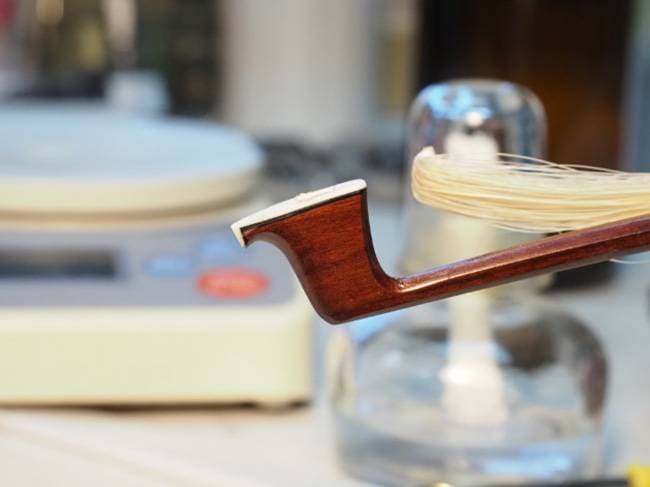

As a review, the points to look at when you want to judge the quality and performance of a string instrument bow were as written in the previous blog entries:
- Precision of craftsmanship: whether it is simply well-made and carefully constructed
- Overall form: the shape of the head, the way the stick is carved
- Material: pernambuco is considered ideal, but there are also good bows made from other Brazilian woods
The inherent characteristics of items 1 to 3 in the manufacturing process cannot be altered by the player once the bow has been completed as a product.
- Weight 〇
- Bow elasticity 〇
- Balance point 〇
- Quality of the hair 〇
- How the hair is rehaired 〇
Items 4 and 5 are also inherent properties, but weight can be adjusted slightly by rewrapping the winding, and for item 5, “bow elasticity”, there is some possibility of correction through procedures such as re-cambering or fixing warping. For item 6, the balance point is thought that the work done for items 4 and 5 can have some effect.
Video of re-cambering the bow: this was filmed about 10 years ago, and the person doing the work is yours truly.
However, I would like to be clear to avoid misunderstanding: weight, elasticity, and balance point should not be adjusted unless the player has a clear intention for the modification and the person performing the work agrees to it. This is because it is impossible to return the bow to its pre-adjusted state.
I’m not following the numbering order, but the topic this time is hair. The bow hair is the “part” (though this word may not give the best impression) that touches the string directly with rosin applied to it, and it plays a major role in producing sound. When the bow hair wears down, it is replaced ⇒ this is called “rehairing”. In other words, using good hair increases the likelihood of achieving better results. Let me explain.
- ① Quality of the hair — horse tails are black, so why is violin bow hair white?
- ② How the hair is rehaired
- ③ Amount of hair — How much is too much? too little? or just right?
“Quality of the Hair — Horse tail hair is black, so why is violin bow hair white?”
Horse tail hair is black, but most bow hair for string instruments is white. This is because the tail hair is bleached. There is a theory that the tail hair of white horses is naturally white, but I have never seen actual tail hair that someone could say with certainty, “This is from a white horse.”
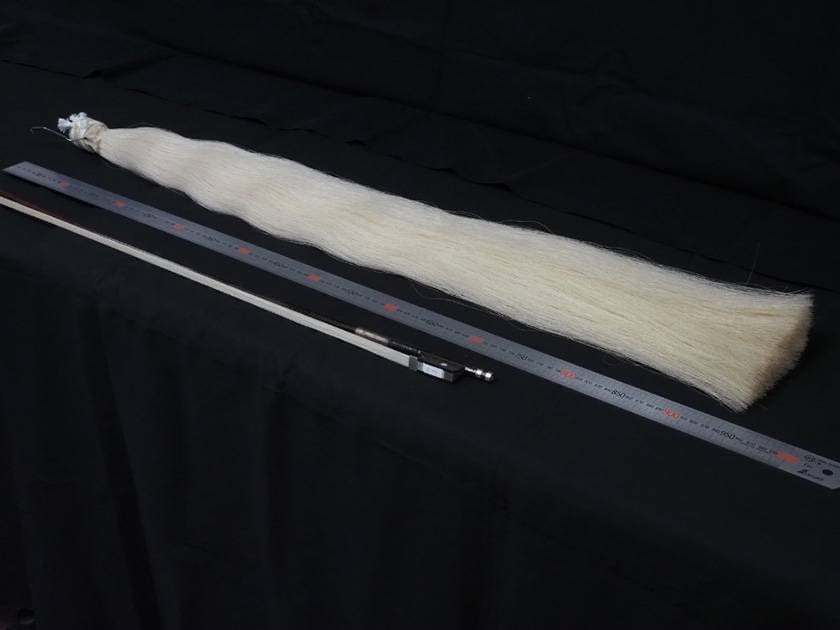
This bleached tail hair is trimmed to a length of about 90 cm, bundled into a stick-shaped unit weighing around 1 kg, and distributed as a product. This is commonly called a “hair bundle”. I won’t list the price here, but it is shockingly expensive. Mongolian hair is considered high quality, but I have never seen hair bundles from any other region. The hair bundle in this image is 95 cm long. The lower right of the image shows the tips of the hairs, which are slightly brownish.
The bow placed next to it is a 4/4 violin bow. In other words, the colored hair tips are almost never used.
Image of hair tips
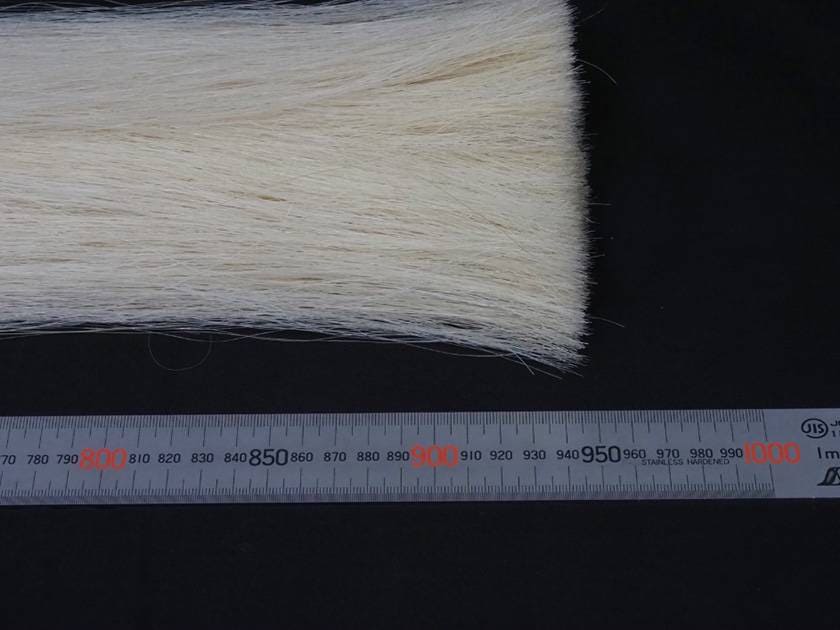
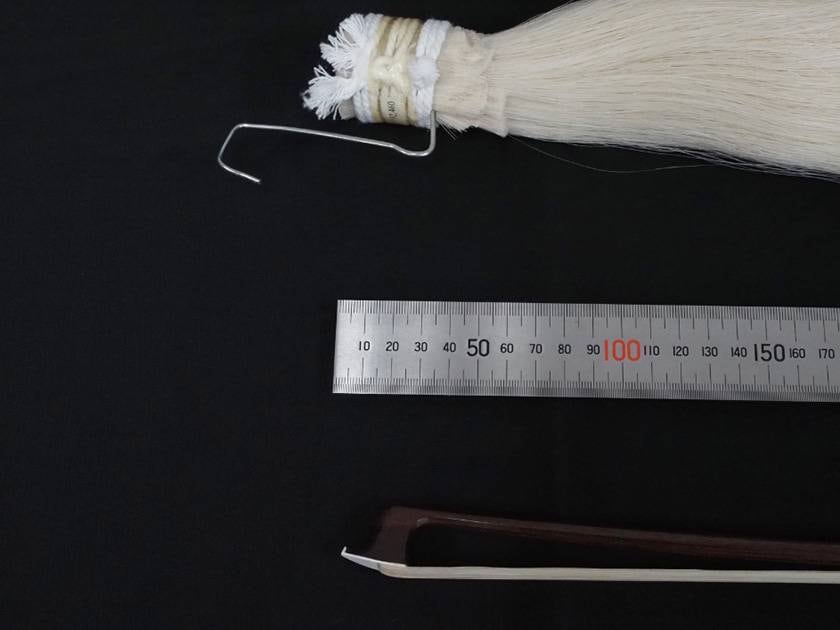
The roots of the hair — since this side is bundled for storage, the hair loses about 5 cm.
Because it is animal hair, it is not uniform like an industrial product; there are variations in thickness, and there may also be broken hairs or split ends. It seems that the bleaching process also serves the purpose of degreasing. If the degreasing is insufficient, rosin will not adhere and the hair becomes unusable. In the hair bundle cut this time, there were no split ends and it was relatively high-quality hair, so the likelihood of finding such defects was low.
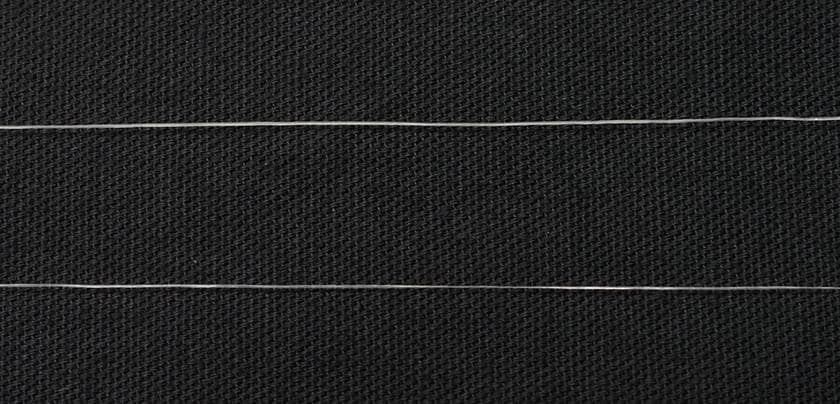
Even so, as shown in the lower part of this image, there are hairs with obvious thickness inconsistencies or hairs that are too thin, and these are removed before use. In addition, hairs with extremely dark coloration or any that may affect the appearance when the bow is finished are avoided as much as possible.
This kind of information varies greatly depending on the technician, and it is not something that I can state definitively.
“How the Hair Is Installed = How the Bow is Rehaired”
I believe that rehairing should not show extreme individuality, but each craftsperson has different levels of experience and their own sense of technique. Combined with compatibility with the player, many people likely find this to be quite a difficult issue.
Checking the bow before starting the rehairing process is also important.
I want to understand what the player thinks about the condition of the bow before rehairing it. In other words, whether the player likes their bow (its condition) as it is. In most cases, the purpose of rehairing is simply to replace the hair because it has aged, and the player naturally expects the bow’s condition to remain the same as before rehairing it.
This quiet expectation is actually a very high-level requirement, and I believe that a certain procedure is necessary.
1. Play the bow before rehairing.
Players have many different reasons for deciding it is time for a rehair—some do it on a fixed schedule, while others simply feel like it is time. In any case, it is natural for the bow’s condition to change before and after rehairing, so ideally the post-rehair condition should be something the player can be satisfied with as much as possible. Simply put, it is best when the player feels, “After the rehair, the sound improved and it became easier to play.”
In many cases, even if a bow has certain quirks, the player may have adjusted to them during use. In other words, they have become accustomed to those quirks.
The rehairing procedure itself is almost fixed in its steps. However, for the player, their impression when playing the bow after the rehair is everything.
Therefore, I believe that checking the bow’s condition before rehairing is an essential step.
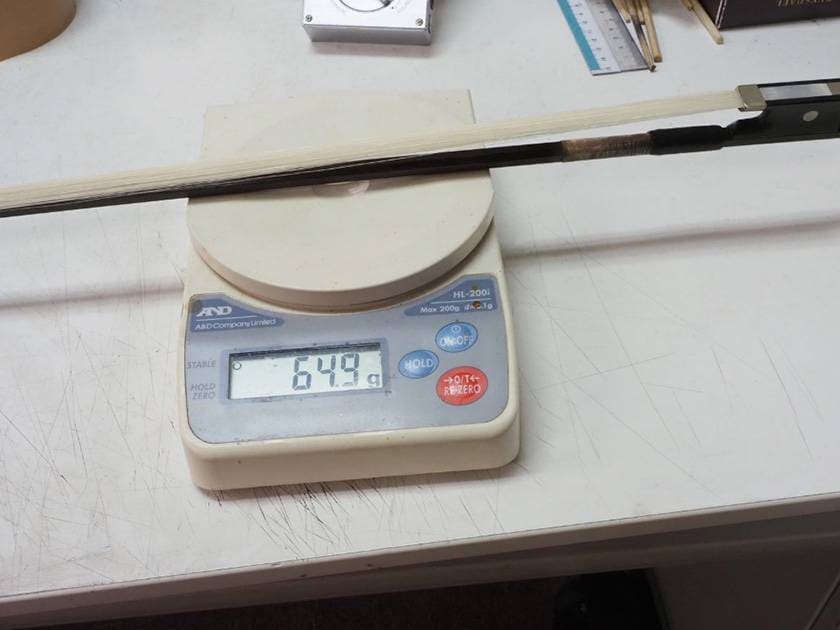
2. Measure the weight of the bow before rehairing, and in some cases measure the weight of the removed hair as well.
Weight before rehairing: 64.9g
Weight of the hair alone
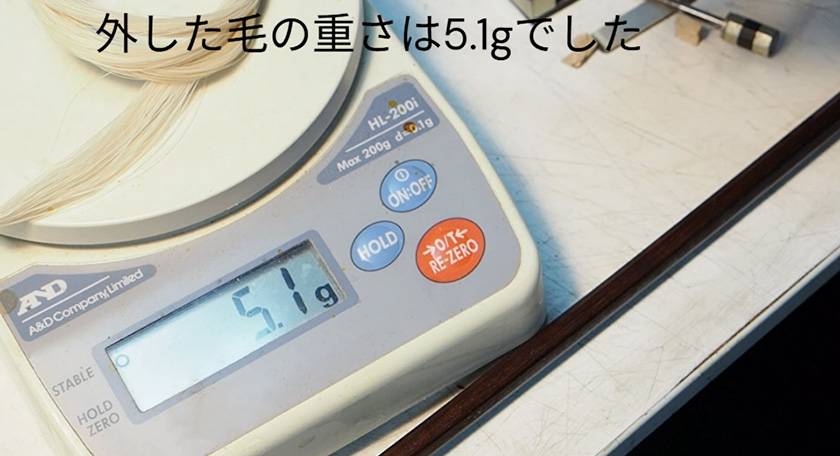
If you can determine the amount of hair to use and make the final weight the same as before the rehair, the result should be optimal. However, slight differences can occur depending on the type of rosin used and how it is applied, so achieving a perfectly identical weight is difficult. Also, in this measurement, the wrapping was not removed, so I will explain this in a future article.
Since it is not practical to make a video of the entire rehairing process, please take a look at the video of removing the hair from an actual old bow.
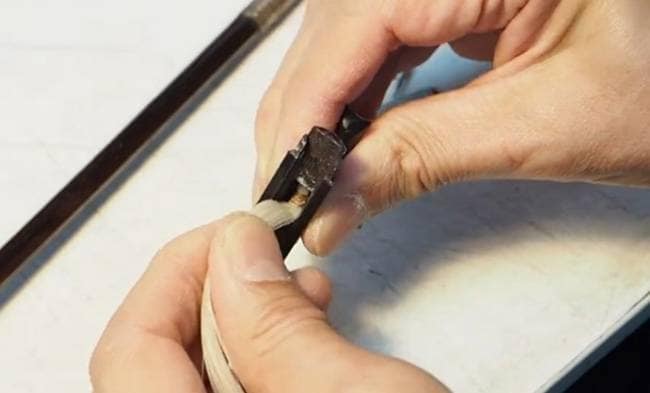
The person doing the work in the video is yours truly.
“The Amount of Hair — Is it Too Much? Too Little? Or Just Right?”
As explained so far, when rehairing a bow, the amount of hair used is determined based on the type of instrument and, in some cases, by calculating from the bow’s original total weight. If the weight after rehairing ends up being drastically different from the original, rehairing work may need to be redone.
The bow used in the video (a mass-produced German bow) had 5.1 g of hair. In my opinion, this is slightly on the heavier side. That said, this bow clearly falls into the category of “heavy bows”. Even if the weight were 0.5 g less, it would still be within a usable range, so this value is taken into account when installing new hair.
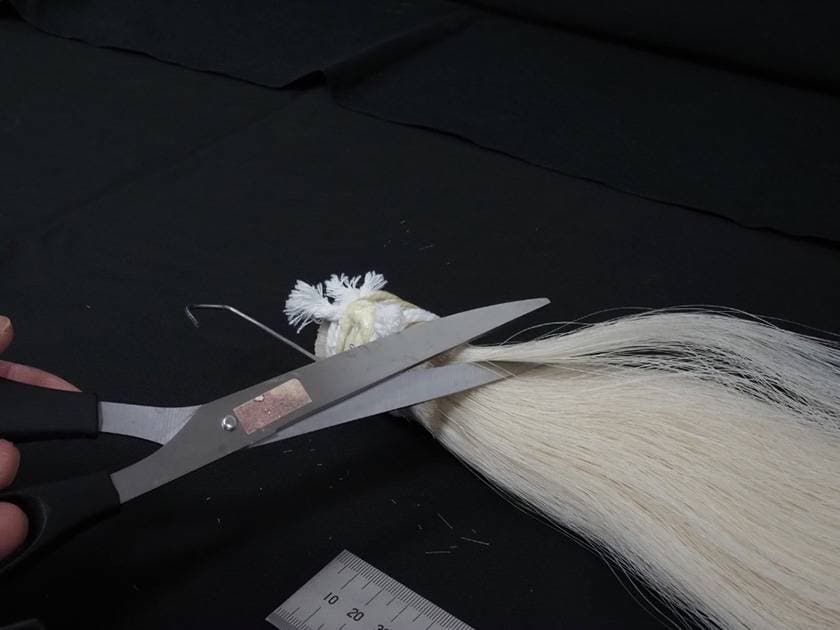
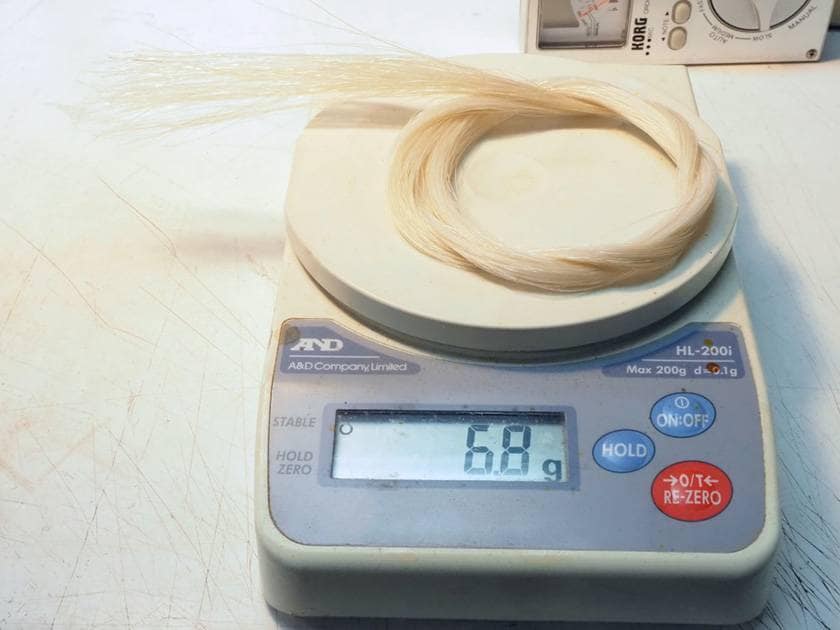
This is the measurement of new hair cut by eyeballing it from the bundle. It may seem surprisingly heavy, but the length of the hair bundle and the length of hair actually used differ quite a bit, and since the hair will still be selected and sorted here, I start by cutting slightly more than I actually need.
During playing, instead of the hair contacting the string evenly across its width, the part that makes contact often ends up concentrated on one side of the ribbon. Taking this into consideration, some makers will increase the amount of hair slightly on the side that tends to contact the string.
Some players prefer less hair, while others—perhaps not to the point of being bushy—prefer a slightly fuller ribbon. This is adjusted according to the player’s preference.
To Summarize
Even though we simply call this process “rehairing”, in reality it incorporates a variety of know-how, and there is always some kind of individualized “something” that cannot be fulfilled by merely following a standard set of steps and declaring the work finished.
Exceptionally skilled players can instantly perceive a bow’s quirks the moment they pick it up, and they have the technique to control them—so much so that they can produce good sound with almost any bow.
Still, a truly fine bow, as I mentioned in a blog entry two posts ago, can at times create the illusion that the bow itself has a will of its own and is producing sound on its own.
I sincerely hope that as many people as possible can share that sensation, ideally without having to spend too much money. And, I believe the only way to increase the chances of such encounters is to consistently maintain the attitude of searching for the sound you want, and to take every opportunity to try many instruments and bows and build experience.
Affordable bows from PLAYTECH can be found here:
⇒ PLAYTECH Bows List
High-quality and reasonably priced bows from SUZUKI VIOLIN can be found here:
⇒ SUZUKI Bows List
The next article will likely continue the discussion on rehairing. See you next time.
![[Violin Bows] Trying Out the PLAYTECH PCV100 Carbon Bow](/contents/uploads/thumbs/2/2025/5/20250515_2_31443_1.jpg)
![[Violin Bows] Trying out the PLAYTECH PVB300](/contents/uploads/thumbs/2/2024/3/20240321_2_26199_1.jpg)
![[PLAYTECH] Round Bow vs. Square Bow Comparison](/contents/uploads/thumbs/2/2023/5/20230531_2_22832_1.jpg)
 バイオリン 入門ガイド
 バイオリン弦 セレクター
 バイオリンスタートガイド
 PLAYTECH 弦楽器
 バイオリンの弓の持ち方
 弦楽器 初心者講座
 Discount Sale
 Outlet
 New Arrivals
 Podcast (streaming)
 Headphones / Earphones
 Microphones
 Wireless Equipment
 Speakers
 Power Amps
 Mixers
 Processors
 Portable PA Systems
 Recorders
 Karaoke
 Guitars
 Basses
 Ukuleles
 Drums & Percussion
 Pianos / Synthesizers
 Wind Instruments
 Stringed Instruments
 Japanese Instruments
 Harmonicas, Other
 Software
 DJ & VJ
 Stands
 Cables & Connectors
 Racks & Cases
 Lighting
 Stage & Truss
 Video Equipment
 PC PERIPHERALS
 Power Supplies
 Studio Furniture
 Household Items, Other
 Alcoholic Beverages