When you want to judge the quality or performance of a string instrument bow, the key points are:
- Craftsmanship Precision — Simply put, is it clean and carefully made?
- Overall Form — The shape of the head, how the stick is carved
- Material — (Pernambuco wood is considered good, but other Brazilian woods can also make fine bows)
- Weight — (Explained below)
In addition, also consider:
- Bow elasticity
- Position of the balance point
- Quality of the hair
- How the hair is tensioned
There are points that should be looked at first, but most of them are based on personal perception, and in most cases, it is not so much your own judgment as it is:
“I bought it at a reputable music store and they said it was good and recommended it, but I still had my doubts about it.”
“I thought it was good because a famous person’s article on the internet said so.”
“I had no choice but to buy it because my violin teacher recommended it.”
In other words, the presence of a “trusted advisor” largely determines the evaluation for the majority of people buying a bow.
Being able to judge and choose a quality bow on your own is difficult unless you have seen a certain number of bows. Even for those people, they probably do not think that their own opinion or perspective is the absolute truth.
The more you see, the more varied they are, and bow selection is something you realize is difficult even for experienced people.
Today, I will try to take the role of a “trusted advisor,” but will it go well??
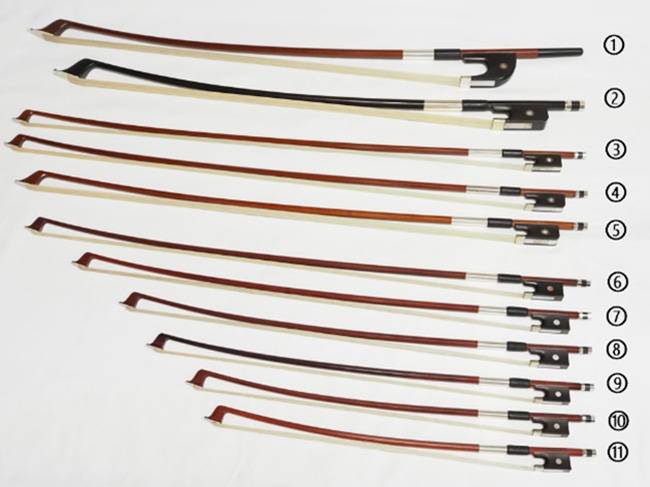
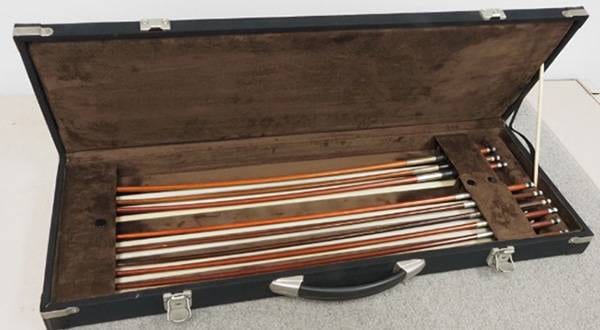
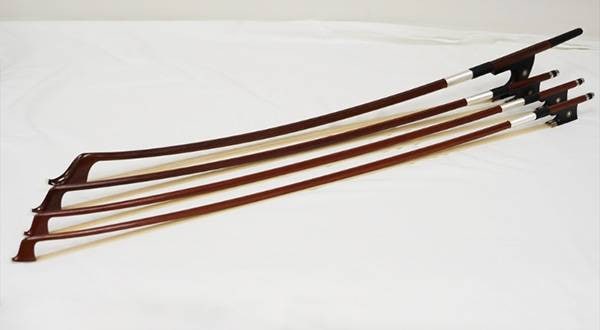
The shape and size of string instrument bows differ depending on the type of instrument.
The top two in the image are for contrabass.
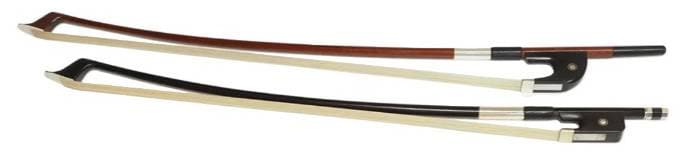
① German style – Length: approx. 80 cm, Weight: around 150 g
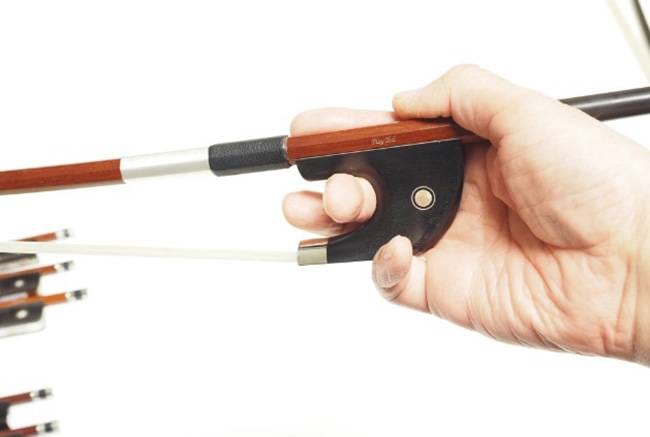
The frog is large, which makes the bow hold reversed (compared to the French bow).
② French style
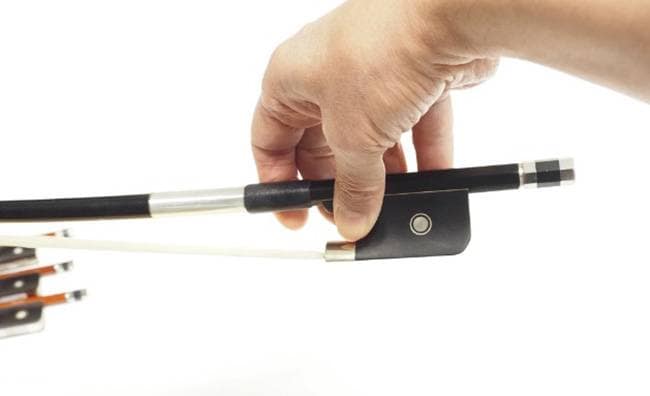
Imagine a cello bow made much bigger and thicker. The hold is also similar to a cello bow.
③ Violin
Full size (4/4), length approx. 74 cm. Weight ranges from about 58 g to 65 g. Many say 60.0 g to 61.5 g is just the right weight, but in reality, the sound varies greatly depending on the instrument and the bow’s characteristics.

④ Viola
Length is about 75 cm, almost the same as a violin bow, but weight is often around 70 g. The image shows violin, viola, and cello bows in that order.
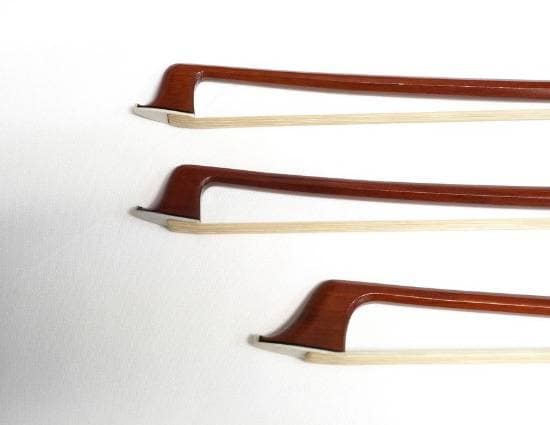
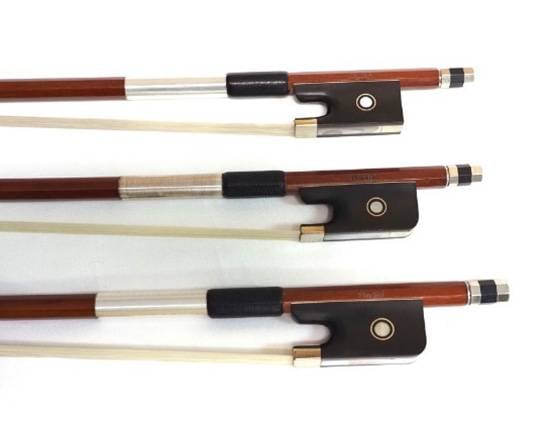
At first glance, it can be difficult to distinguish from a violin bow, so many have frogs with rounded corners. (Some older bows, however, have more angular corners.)
⑤ Cello
Length: approx. 70 cm, Weight: around 80 g
The shape is easier to distinguish from violin and viola bows. Cello bows also often have rounded frog corners (some older bows have angular corners).
⑥ - ⑪(3/4,1/2,1/4,1/8,1/10,1/16)
he length and weight of fractional violin bows vary by manufacturer. There are no strict standards, and it is not entirely clear what criteria each manufacturer follows.
The table below summarizes actual measurements of PLAYTECH PVB300 series fractional bows and a SUZUKI No.10 bow.
For PLAYTECH PVB300 bows, lengths are mostly consistent, but weights vary, so the table shows average values from multiple measurements.
Looking at the data, there is no significant difference between PLAYTECH and SUZUKI bows.
| Maker | Model no. | Size | Length(mm) | Avg. weight | PVB compared to SUZUKI |
|---|---|---|---|---|---|
| PLAYTECH | PVB334 | 3/4 | 691 | 57.25 | 11mm longer; weight is roughly the same |
| PVB312 | 1/2 | 620 | 50.81 | 5mm longer; 1 g lighter | |
| PVB314 | 1/4 | 551 | 46.45 | 3mm shorter; 0.75g heavier | |
| PVB318 | 1/8 | 508 | 41.13 | 12mm shorter; 1g lighter | |
| PVB310 | 1/10 | 455 | 36.95 | 13mm shorter; 1g lighter | |
| PVB316 | 1/16 | 428 | 36.11 | 2mmshorter; 4g lighter |
| Maker | Model no. | Size | Length(mm) | Avg. weight | Default |
|---|---|---|---|---|---|
| SUZUKI | N10 | 3/4 | 680 | 57.3 | |
| 1/2 | 615 | 51.8 | |||
| 1/4 | 554 | 45.7 | |||
| 1/8 | 520 | 42.2 | |||
| 1/10 | 468 | 41.1 | |||
| 1/16 | 430 | 40.2 |
Note: The SUZUKI table values are not official manufacturer specifications; they were measured specifically for this blog. Therefore, the data in the table should not be taken as manufacturer-provided specifications.
These are provided solely as reference for comparison purposes.
For PLAYTECH bows at affordable prices, see here:
⇒ PLAYTECH Bows List
For SUZUKI VIOLIN bows, see here:
⇒ SUZUKI Bows List
Let’s go back to the initial points.
- Craftsmanship precision – Is it simply clean and neatly made?
- Overall form – Shape of the head, how the stick is carved
- Material – Pernambuco wood is considered good, but there are also good bows made from other Brazilian woods
Points 1–3 are innate qualities from manufacturing, so once the bow is finished as a product, the player cannot modify them.
- Weight – 〇
- Bow elasticity – 〇
- Balance point – 〇
- Hair quality – 〇
- Hair tension – 〇
Among these, numbers 4–8 are items that you can assess as a player. Among them, weight is an objective piece of data and an important point to pay attention to. However, the most crucial element; the sound can only be judged by playing it yourself. Therefore, the aspects that can be felt directly by holding and playing the bow become the actual points of evaluation.
Bow Weight
It’s difficult to explain the weight of bows for all instrument types, so here we’ll focus on 4/4 violin bows.
In my previous blog, “A Talk About String Instrument Bows - Prologue: Casual Conversations About Bows and the Issues That Can Be Found From Them”
I mentioned that a bow matched to a Francesco Viotoni violin weighed about 62g and, although it’s slightly heavy, produced a wonderfully good sound. It is clear from the context that this does not mean “the optimal weight for a 4/4 violin bow is 62g.”
(The concern is that if only the content within the quotation marks is searched, someone might misunderstand and take it at face value.)
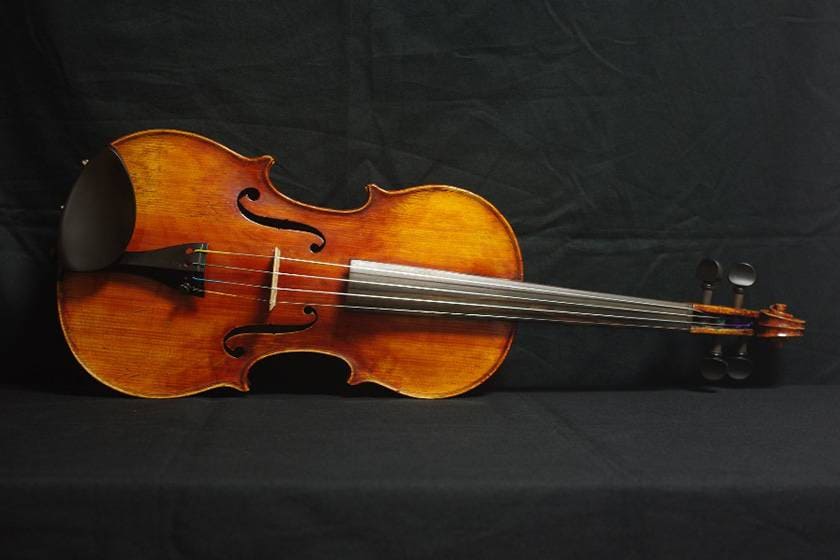
Francesco Viotoni Violin 1925
Francesco Viotoni Violin 1925 – 4/4 Size Violin Bow
Even though we simply say “4/4 size violin bow”, there is a huge range of bows that are mass produced priced around ¥3,000 to extravagant “king-level” bows costing tens of millions of yen—bows that make you gasp in shock. These two extremes would never appear on the same table, and the latter is something most people might only see once in a lifetime.
So, regarding the “king-level” bows, we generally consider them “existences we don’t need to think about”, and I’m only mentioning it here for the sake of discussion.
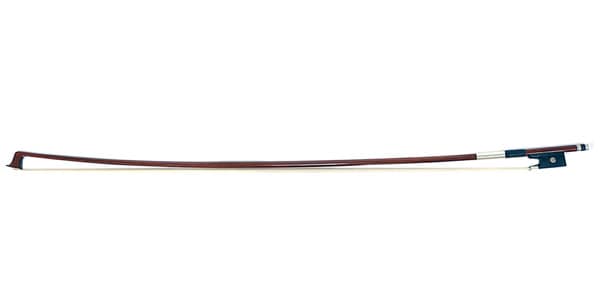
The bow priced at ¥3,000 (exactly) is the PLAYTECH PVB300:
PLAYTECH / PVB300 Violin Bow 4/4 Size, Square Stick
What about weight, regardless of price?
Naturally, the ¥3,000 bow and a “king-level” bow do not differ drastically in weight.
For example, if we assume a king-level bow weighs 61.5g, finding a ¥3,000 bow that also weighs 61.5g isn’t particularly difficult. Indeed:
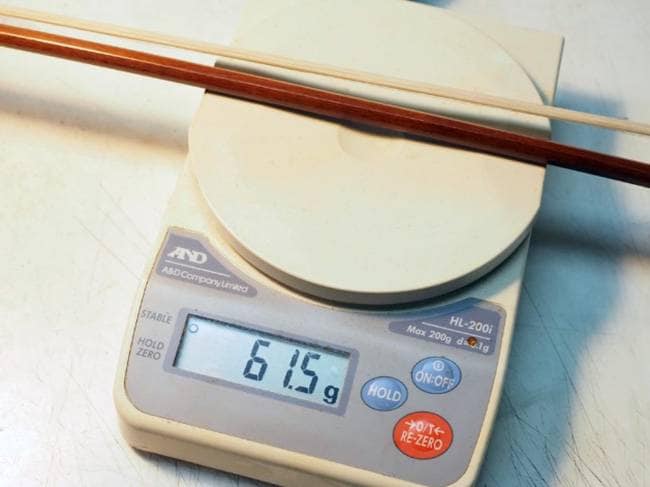
When several PVB300 bows were weighed, some came out to 61.5g.
61.5g? Where did that number come from?
This is only my personal opinion, but among bows I have handled in the past, many of the ones that felt “just right” happened to be around this number. Even though the rationale is weak, this value became a reference point for evaluating whether a bow feels lighter or heavier.
In other words:
For 4/4 size bows, the weight is generally considered to be about 58g–64g.
Many might disagree with this range, and to assert it definitively could be tricky, so I say it’s “considered to be” rather than a strict rule. Nonetheless, many music shops would likely agree with this assessment.
A memory: A conversation in a music store a long time ago
"This bow, it’s beat-up, I don’t even know the maker, and it’s 58g, but it plays really well. I want it."
"This old French bow is 60.5g… How much? Oh, really? Hmm, something doesn’t feel right…"
These comments came from the same person, an amateur named S who could play reasonably well. This is not my story (though I did exaggerate a little—sorry!).
The 58g bow was one that had been a test bow in a music shop I used to work at, and it was attached to a used, old Masakichi Suzuki violin that had been purchased.
The 60.5g bow came from a French dealer and included a certificate of authenticity. The price is better left unsaid.
…(Frustration)… So? In the end, what weight is good? How should I choose?
(Interrogation incoming!) Ah, okay. Here’s a guideline:
“Bows lighter than 58g or heavier than 64g are generally less likely to be ‘good bows.’ Using 61.5g as a reference, selecting bows in the range of roughly 60g to 63g often results in a better chance of finding a suitable bow!”
Today’s summary
As expected, the takeaways can be summarized as follows:
“Neither weight nor price alone determines a bow’s performance. Whether a bow is judged good or bad based on its listed price or measured weight depends on the individual. Advice from others is ultimately subjective, but weight can serve as a useful reference point for selection.”
This blog simply stretches that point over a couple of lines, and what readers take from it is up to them.
In the end, choosing a bow comes down to trusting one’s own sense and judgment.
We’ll continue exploring ways to support that judgment in the next post.
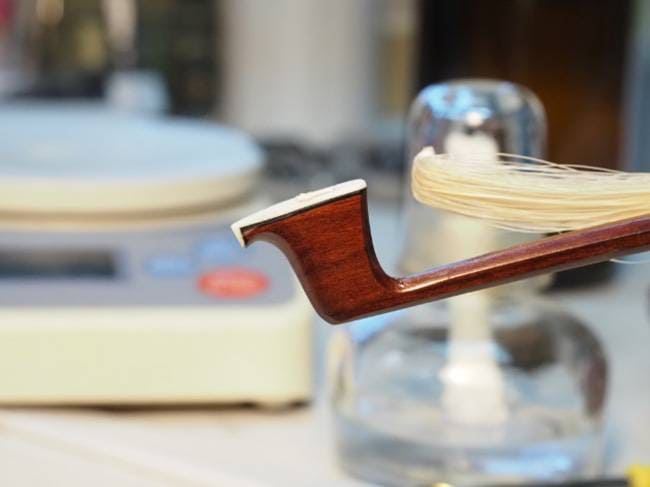
An Alcohol lamp…? Why this tool is necessary will be revealed next time!



![[Violin Bows] Trying Out the PLAYTECH PCV100 Carbon Bow](/contents/uploads/thumbs/2/2025/5/20250515_2_31443_1.jpg)
![[Violin Bows] Trying out the PLAYTECH PVB300](/contents/uploads/thumbs/2/2024/3/20240321_2_26199_1.jpg)
![[Attention, String Players!] How to properly rosin a bow and recommended rosins!](/contents/uploads/thumbs/2/2023/12/20231218_2_25008_1.jpg)
![[PLAYTECH] Round Bow vs. Square Bow Comparison](/contents/uploads/thumbs/2/2023/5/20230531_2_22832_1.jpg)
 チェロの弓の持ち方
 バイオリン弦 セレクター
 バイオリンスタートガイド
 PLAYTECH 弦楽器
 バイオリンの弓の持ち方
 弦楽器 初心者講座
 Discount Sale
 Outlet
 New Arrivals
 Podcast (streaming)
 Headphones / Earphones
 Microphones
 Wireless Equipment
 Speakers
 Power Amps
 Mixers
 Processors
 Portable PA Systems
 Recorders
 Karaoke
 Guitars
 Basses
 Ukuleles
 Drums & Percussion
 Pianos / Synthesizers
 Wind Instruments
 Stringed Instruments
 Japanese Instruments
 Harmonicas, Other
 Software
 DJ & VJ
 Stands
 Cables & Connectors
 Racks & Cases
 Lighting
 Stage & Truss
 Video Equipment
 PC PERIPHERALS
 Power Supplies
 Studio Furniture
 Household Items, Other
 Alcoholic Beverages