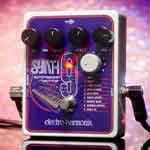
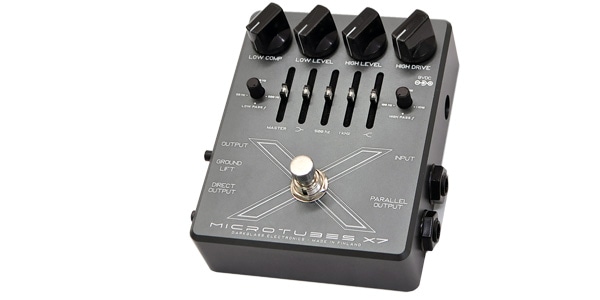
The preamp I regularly use for recordings and other sessions: "Darkglass Microtubes X7"

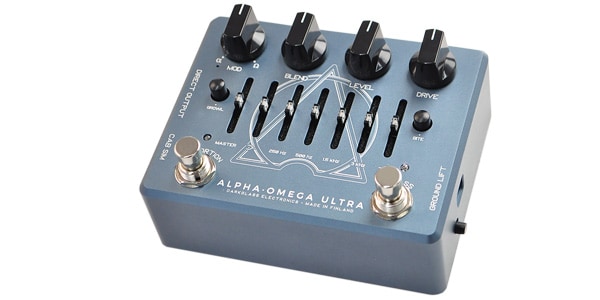
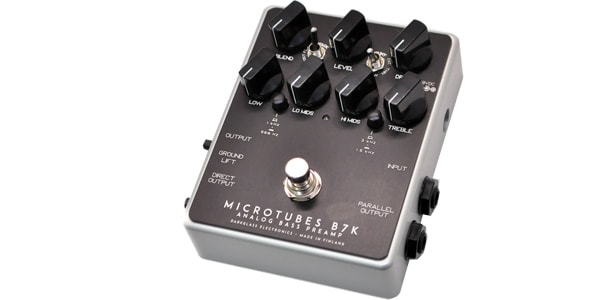
This pedal is a very versatile bass drive/preamp, but when I look around at the bassists in my circle, it seems more people are using standard models like the B7K or Alpha Omega.
For first-time users, the controls may feel a bit complicated, and it can be hard to know what to tweak and where.
So in this article, I’ll introduce the features and controls of the X7, along with some tips on how to actually shape your sound.
Pedal Feature: A Unique Design That Separately Processes Lows and Highs
The biggest feature of the X7 is that it splits the input signal into two paths—"high frequencies" and "low frequencies"—and processes them separately.
While typical distortion pedals distort the full-range bass signal all at once, the X7 is designed to handle lows and highs independently.
- The low-frequency side is shaped with a compressor, resulting in a tight and clean foundational sound.
- The high-frequency side adds distortion, enhancing the tone with sparkling overtones and edge.
By blending these two signals, you can create a distorted bass sound that retains the solid low-end core essential for bass, while also having a strong presence.
As a result, you get an ideal balance that doesn’t get buried in the mix, yet it doesn’t thin out the low end. This becomes a major advantage in a band performance.
A 4-Band GEQ That Bassists Will Love
Another appealing feature of the X7 is the built-in 4-band graphic equalizer (GEQ).
The X7’s 4-band GEQ is designed to let bassists adjust the specific frequency ranges they’d most likely want to tweak.
- Low Shelf(80Hz)
- Adjusts the low end that forms the foundation of the bass. Boost it to increase presence; cut it if it clashes with the kick drum. This is a critical range for building your base tone.
- 500Hz
- The so-called “muddy/muffled” range. Cutting here creates a scooped sound. This is a key frequency for slap players, and even the popular Bartolini XTCT preamp, favored by chopper-style players, is designed to cut at 500Hz.
- 1kHz
- The frequency range most sensitive to the human ear. Since vocals and guitars often crowd this range, it's usually best to cut slightly, but if you're playing solos or lead bass, boosting here brings your sound forward dramatically.
- High Shelf (around 5kHz)
- Perfect for controlling the attack of picking and slap playing.
By mastering these four frequency bands, you can achieve a wide variety of tones with a surprisingly simple setup.
Mastering the High Pass Filter
One of the most important aspects of mastering the X7 is the High Pass Filter.
This filter determines from which frequency upward the signal will be distorted, and depending on how it’s set, the character of the distortion changes dramatically.
- Set around 100Hz → Since distortion starts from the low end, the result is a thick, aggressive sound similar to fuzz.
- Set around 1kHz → The low end remains clean while only the highs are distorted, producing a sharp and edgy sound.
As you can see, the true strength of the X7 lies not just in adjusting the amount of distortion, but in specifying which frequency range gets distorted.
Adjusting Character with the Low Pass Filter
While the High Pass filter determines which frequency range gets distorted, the Low Pass Filter adjusts how much of the low end is retained.
- Set closer to 500Hz → Results in a loose, vintage-style sound.
- Set closer to 50Hz → Yields a modern, tight sound.
In other words, by combining the High Pass and Low Pass filters, you can freely switch between characteristics like fuzzy/sharp and loose/tight.
Recommended Setting Examples
1. Scooped Sound for Slap Playing

- Set the High Pass slightly higher to emphasize the attack.
- Cut 500Hz and 1kHz slightly, and boost 80Hz to thicken the low end.
- If you're using a Jazz Bass with an ash body and maple neck, it’s more natural not to boost the High Shelf too much.
With an alder body + rosewood neck, or with a Precision Bass, a slight push on the High Shelf works well.
This setting gives you a modern, scooped sound with strong attack and clarity.
2. Lead Bass Sound for Solos

- Turn the compressor and drive up close to MAX.
- Boost 500Hz and 1kHz to bring out the midrange.
- Slightly cut the Low Shelf and High Shelf to clean up the frequency range.
This setting may look extreme, but the X7 handles such settings well without falling apart.
It’s effective when taking a solo in a band or when you want to stand out in an instrumental track.
Summary
Compared to other Darkglass pedals, the X7 may seem for advanced users or very niche, but in reality, it’s a versatile unit that can handle a wide range of genres.
It’s likely to shine in various musical styles such as rock, metal, funk, and pop.
At first, it might feel a bit tricky to operate, but once you understand the relationship between the High Pass and Low Pass, you’ll be able to craft your desired sound with ease.
The Darkglass Microtubes X7 isn’t just a distortion pedal—it's a multi-tool that allows you to freely control both low and high frequencies.
For those feeling stuck with their current bass tone, or looking to make their sound stand out more in a band mix, it could become a powerful weapon.
Bonus
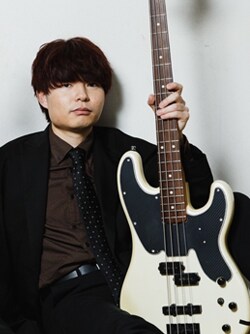
A bass solo using the X7 is featured in the track “Guitar Legend”, included in the album Neckties from Hell by Shinichi Kobayashi, in which I participated as a recording bassist.
The “sound & person” column is made up of contributions from you.
For details about contributing, click here.




![[Latest for 2026!] Best-Selling Bass Preamps Ranking!](/contents/uploads/thumbs/2/2025/9/20250927_2_32994_1.jpg)
 BOSSの最新ベース機材特集
 ベーシストの自宅練習に最適な BOSS ベース・アンプ3選
 基礎から学ぶベースレッスン
 ベーススタートガイド
 ベース用エフェクターの種類
 ベースとベースアンプ(練習編)
 Discount Sale
 Outlet
 New Arrivals
 Podcast (streaming)
 Headphones / Earphones
 Microphones
 Wireless Equipment
 Speakers
 Power Amps
 Mixers
 Processors
 Portable PA Systems
 Recorders
 Karaoke
 Guitars
 Basses
 Ukuleles
 Drums & Percussion
 Pianos / Synthesizers
 Wind Instruments
 Stringed Instruments
 Japanese Instruments
 Harmonicas, Other
 Software
 DJ & VJ
 Stands
 Cables & Connectors
 Racks & Cases
 Lighting
 Stage & Truss
 Video Equipment
 PC PERIPHERALS
 Power Supplies
 Studio Furniture
 Household Items, Other
 Alcoholic Beverages