This may come as a surprise, but have you ever heard of an instrument called the ‘nyckelharpa’?
Sound House has started carrying nyckelharpa strings following the launch of our distributorship for Prim, a Swedish string manufacturer.
But first of all, what exactly is a nyckelharpa...?
To be honest, I hadn’t had many opportunities to learn about it in detail before we decided to carry its strings. Since we’re going to be offering them, I wanted to learn about the instrument itself first! So this time, I looked into the history, mechanism, and strings of the nyckelharpa.
What Is a Nyckelharpa?
The nyckelharpa is a bowed string instrument that has been passed down in Sweden for centuries.
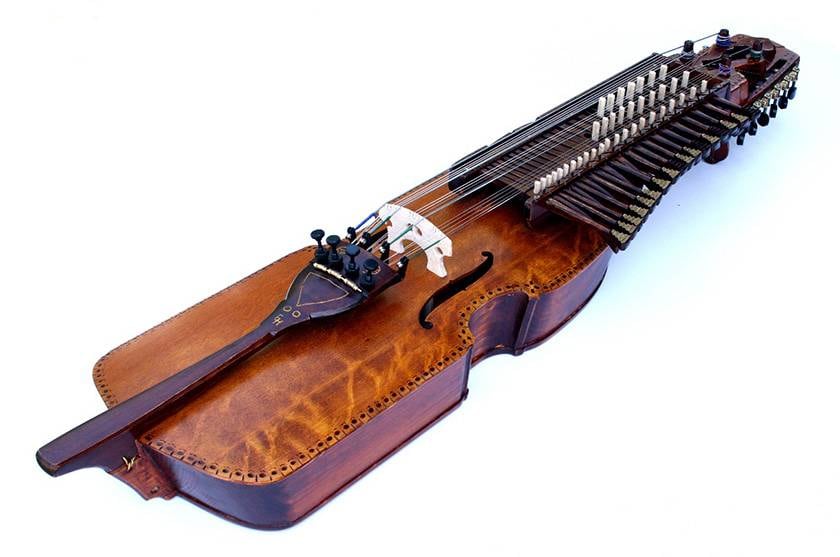
The first thing that caught my attention in the photos was the row of wooden keys lined up along the neck.
“A string instrument with keys?” I wondered. When I looked into it, I found that these keys are one of the nyckelharpa’s defining features.
Rather than pressing the strings directly with the fingers, as you would on a violin, the player presses the keys with the left hand. This causes parts called ‘tangents’ to come into contact with the strings, changing their pitch. The instrument is played with a bow in the right hand.
Incidentally, ‘nyckel’ means ‘key’ in Swedish, while ‘harpa’ is a word used for harps and other string instruments. The instrument’s name reflects its distinctive features!
How Far Back Does Its History Go?
Next, I looked into the history of the nyckelharpa.
Apparently, a church on the Swedish island of Gotland has a relief depicting a person playing an instrument resembling a nyckelharpa, believed to date back to around 1350.
Since then, the playing tradition has been passed down as the instrument’s shape and mechanism evolved, eventually developing into the chromatic nyckelharpa that is widely played today.
Furthermore, in 2023, the activities of a network dedicated to preserving the traditions of nyckelharpa playing and making were selected by UNESCO as a good safeguarding practice for intangible cultural heritage.
It’s an instrument you don’t often come across in Japan, so it’s amazing to discover that its history goes back more than 600 years!
Counting the Strings...
Next, let’s look at the strings, which are the main topic of this article!
Looking at Prim’s products, I found four playing strings available: A1, C2, G3, and C4.
“Is it a four-string instrument?” I wondered. But when I took a closer look at the photos... there were clearly a lot more strings than that!
After doing some research, I learned that modern chromatic nyckelharpas typically have around 12 ‘sympathetic strings’ in addition to the four playing strings.
That means the instrument has around 16 strings in total.
The player mainly bows the four playing strings. The sympathetic strings stretched beneath them vibrate naturally in response to the notes being played.
Even strings that aren’t played directly resonate along with the others, contributing to the rich tone that is unique to the nyckelharpa!
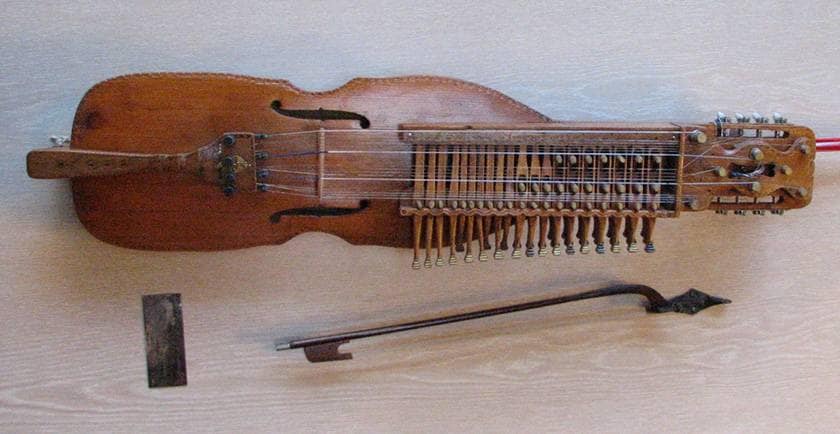
Nyckelharpa, CC BY 3.0 (Image from Wikipedia)
*There are various types of nyckelharpa, and the number of strings and the structure can differ.
What Does It Actually Sound Like?
Now that I understand how the instrument works, I’m curious about what it actually sounds like.
Rather than trying to describe it in words, the best thing to do is listen for yourself! So, here’s a performance video.
■ 2001 Stämma - Tjelvpolskan / @nyckelharpajapan
The sound has the characteristic tone of a bowed string instrument, enriched by the resonance of the sympathetic strings, creating a distinctive, expansive sound.
In the video, you can see the player moving the bow with the right hand while operating numerous keys with the left, giving you a good sense of the nyckelharpa’s unique playing technique.
You May Have Heard One at MUJI!
While researching the instrument, there was one thing that personally surprised me.
Apparently, the nyckelharpa is also featured in the background music at MUJI stores...!
BGM8 STOCKHOLM, produced as in-store background music for MUJI, features traditional Swedish music, and nyckelharpa player Olov Johansson also took part in the recording.
When I visit MUJI, I sometimes find myself absentmindedly humming along to the background music (?). So, realizing that I might have heard the instrument before without even knowing it made it feel much more familiar.
Even if you’ve never heard the name ‘nyckelharpa’ before, you may have unknowingly heard its sound!
A traditional Swedish instrument might seem a little distant from everyday life, but learning about connections like this makes it feel much more familiar.
How Is a Nyckelharpa Tuned?
Since we’re going to be carrying its strings, I also looked into how the instrument is tuned.
One of the common tunings for the four playing strings on a modern chromatic nyckelharpa, from lowest to highest, is:
C - G - C - A
Now I also understand why Prim’s products are labeled A1, C2, G3, and C4.
Apparently, the sympathetic strings are tuned individually as well. With so many sympathetic strings in addition to the playing strings, tuning a nyckelharpa seems to be quite an intricate process...!
*Different tunings may be used depending on the instrument and the player.
Prim Nyckelharpa Strings
Now that we’ve explored the instrument, let’s return to the Prim strings that first prompted me to learn about the nyckelharpa.
Prim is a Swedish string manufacturer, just like the nyckelharpa itself is Swedish in origin. In addition to strings for violins, violas, and cellos, the company also manufactures strings specifically designed for the nyckelharpa, a traditional instrument from its home country.
Prim began making nyckelharpa strings in the 1980s. Working with Swedish nyckelharpa makers, the company started developing strings specifically for the instrument.
After researching the nyckelharpa this time, I can better appreciate the connection between Prim’s long-standing production of dedicated strings and Sweden’s traditional musical instrument.
Prim / Nyckelharpa String Set - Medium

Prim offers the four playing strings used on the standard chromatic nyckelharpa.
In addition to the four-string set, individual strings are also available. And besides the Medium gauge, there are other gauge options, including Soft and Orchestra (Hard).
Prim / Nyckelharpa String A1 0.50 Unwound

The A string is also available as a plain string, in addition to the wound version.
→ Prim Nyckelharpa String Lineup
Through this research, I learned that nyckelharpa players also choose strings according to their instrument and personal preferences. That’s one of the interesting things it has in common with other string instruments, such as the violin!
After Researching It, I Found It a Fascinating Instrument!
This time, I started researching the nyckelharpa from scratch after we began carrying Prim strings.
I discovered many things I hadn’t known before, including its unique mechanism for changing pitch with keys and its numerous sympathetic strings. I also found unexpected connections to everyday life, such as MUJI’s background music, which made the instrument feel a little more familiar.
The nyckelharpa seems to have plenty more to discover. Researching it sparked my interest, and I’d love to hear one played live in person someday!
I hope this article has sparked at least a little interest in the nyckelharpa among those who are learning about it for the first time.
And for those who already play the nyckelharpa, I hope you’ll be glad to discover that Sound House carries nyckelharpa strings, too!




 サウンドハウス管弦楽器ショールーム
 鈴木バイオリン製造
 バイオリン弦 セレクター
 バイオリンスタートガイド
 PLAYTECH 弦楽器
 弦楽器 初心者講座
 Discount Sale
 Outlet
 New Arrivals
 Podcast (streaming)
 Headphones / Earphones
 Microphones
 Wireless Equipment
 Speakers
 Power Amps
 Mixers
 Processors
 Portable PA Systems
 Recorders
 Karaoke
 Guitars
 Basses
 Ukuleles
 Drums & Percussion
 Pianos / Synthesizers
 Wind Instruments
 Stringed Instruments
 Japanese Instruments
 Harmonicas, Other
 Software
 DJ & VJ
 Stands
 Cables & Connectors
 Racks & Cases
 Lighting
 Stage & Truss
 Video Equipment
 PC PERIPHERALS
 Power Supplies
 Studio Furniture
 Household Items, Other
 Alcoholic Beverages