First, as always, the usual long introduction —
“If you’re selling musical instruments, Sound Mart is the place to go.”

If you are a Sound House user, you are probably already familiar with Sound Mart.
We are currently looking for items to purchase.
The business model of buying and reselling used goods through an online marketplace is certainly nothing new. But products are constantly being replaced, and prices rise and fall depending on trends and changing fashions. Some of you may have had the experience of searching for something that catches your interest, only to find that the night has grown late and morning has arrived before you know it.
Physical stores dealing in used goods have also sprung up everywhere.
I will refrain from listing company names, but among them is that familiar store headquartered in Niigata and listed on the First Section of the Tokyo Stock Exchange—a store that everyone knows (from here on, I will simply refer to it as ‘that store’).
I imagine almost everyone has visited one at least once.
This takes us somewhat off topic, but just after New Year’s in 1998, during my second business trip to the United States, I flew from New York to Phoenix, Arizona. From there, I traveled by car through Tucson, El Paso, New Mexico, then north to Albuquerque before returning to Phoenix. After that, I continued on to San Diego and Los Angeles in California. It was a buying trip.
During that trip, I saw countless secondhand stores and pawn shops. Seeing how many goods were available simply from items being disposed of by retired people—and how this could actually function as a viable business—I remember thinking that Japan would probably become like this someday.
Within a few years, ‘that store’ began opening locations, and Japan entered the golden age of the reuse market.
As the number of ‘that store’ locations increased, the Internet also developed. ADSL became faster, infrastructure improved, and Digimart expanded in scale. The well-known Yahoo! Auctions also continued to grow. Eventually, the effort involved in writing descriptions for Yahoo! Auctions, as well as the frustration of dealing with problems after transactions, led to the emergence of increasingly complex business models, including flea-market-style platforms.
With people who wanted to sell high and people who wanted to buy cheap all competing in the same space, this bustling activity created what we now call the market price. And now we live in an era where you see things like, “You mean this instrument is worth that much? THAT much money???” That is how we arrived at the present day.
In this mature secondhand market, Sound Mart may be a relatively late entrant. But the used-goods market is, by its very nature, highly fluid and unpredictable. We would very much like to take your treasures off your hands and sell lots of them.
So, why not start with an appraisal of the items you want to sell? We look forward to hearing from you.
To add a more serious note, this blog also refers to the Ministry of the Environment’s report on the environmental aspects of Japan’s reuse market.
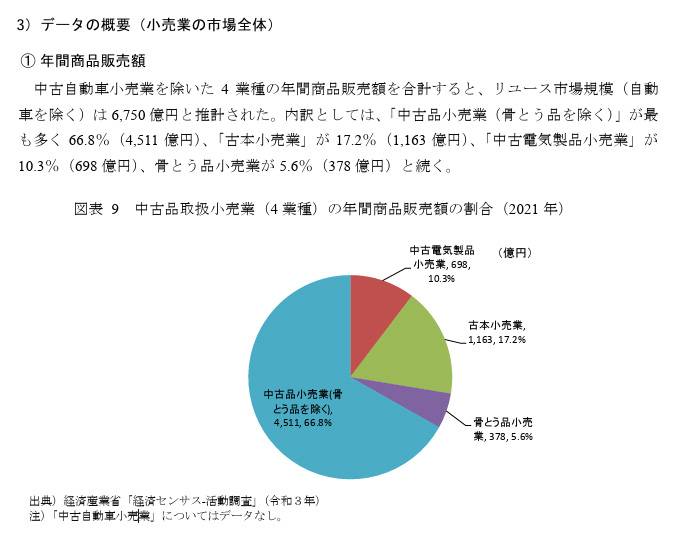
Source: Ministry of the Environment Website (https://www.env.go.jp/content/000321556.pdf)
I will not go into the details of the data here, since it is not the main subject of this article. The data is from fiscal year 2024. If you are interested in this field, I encourage you to open the PDF and take a look.
The report deals with a market worth hundreds of billions of yen. Somewhere within those transaction figures—although I have no idea whether it is actually included—is the protagonist of this blog series: the mysterious violin.
The Main Story
As I wander around ‘that store’ and similar types of shops, thinking, “Everything is so expensive these days,” there is one place my feet inevitably take me: the junk corner.
Once a market price has been established, it cannot simply be stopped. But every now and then, something slips through the cracks. These are what we generally call bargains or hidden treasures.
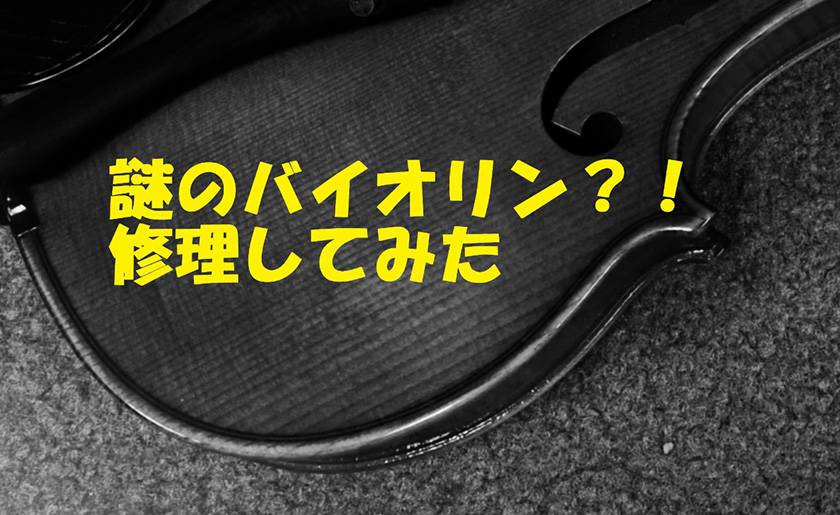
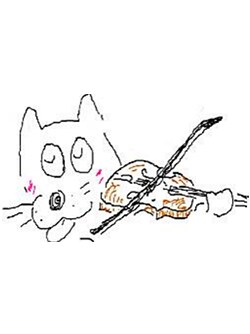
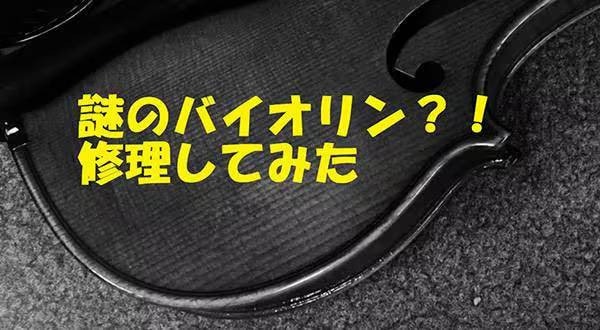
The image shown at the beginning of this blog
Here is the original image.
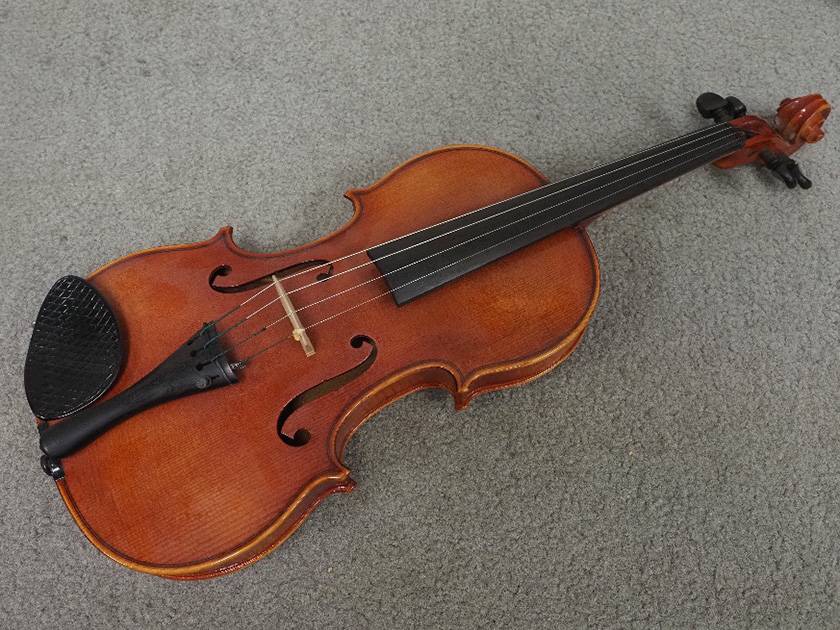
This is the protagonist of the series that begins with this article: the mysterious violin. I found and purchased it in the junk corner of ‘that store’,” located in Shonan, Kashiwa City, Chiba Prefecture, next to Takayanagi Station on the Tobu Noda Line, in the same building as supermarket Yaoko. I will leave the exact purchase price to your imagination, but it was surprisingly cheap.
The instrument had not been placed in a case. It was simply lying exposed on a shelf.
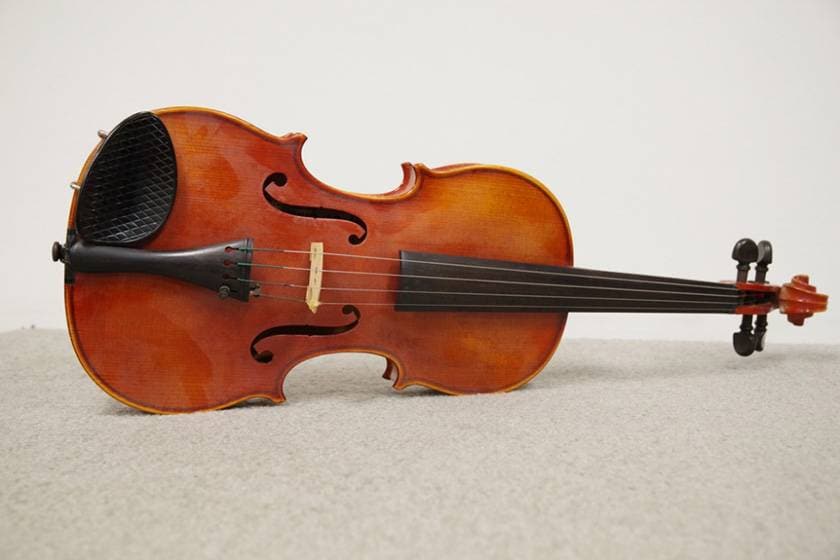
The back looks reasonably clean.
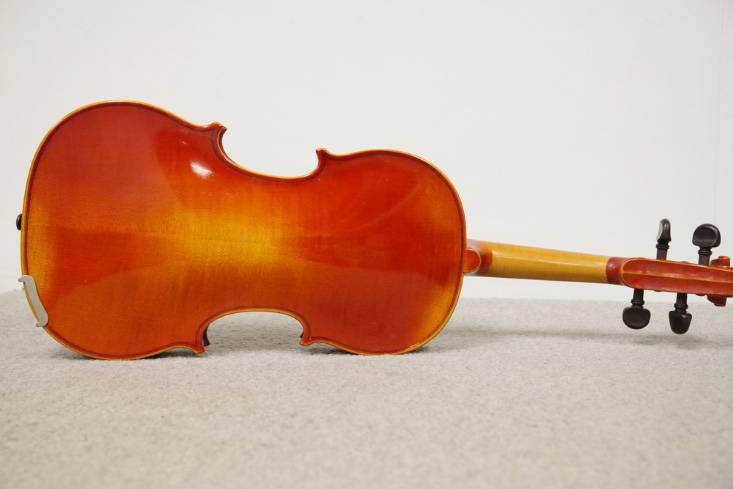
There does not appear to be any major damage in particular, but from here on, we are going to examine it carefully.
The top is absolutely covered in dust. In this condition, it is certainly understandable that the instrument was classified as junk.
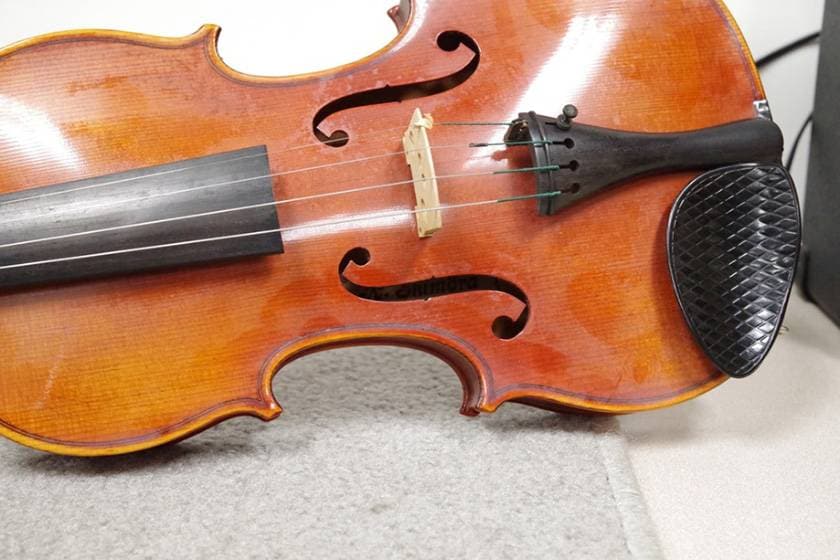
The reason I put ‘The Mysterious Violin’ in the title of this blog was simply to attract attention by including the word ‘mysterious’. To anyone who was lured in by that word, I sincerely apologize. Actually, this instrument is not particularly mysterious because it has a perfectly legible label.
The label can be seen through the bass-side F-hole.
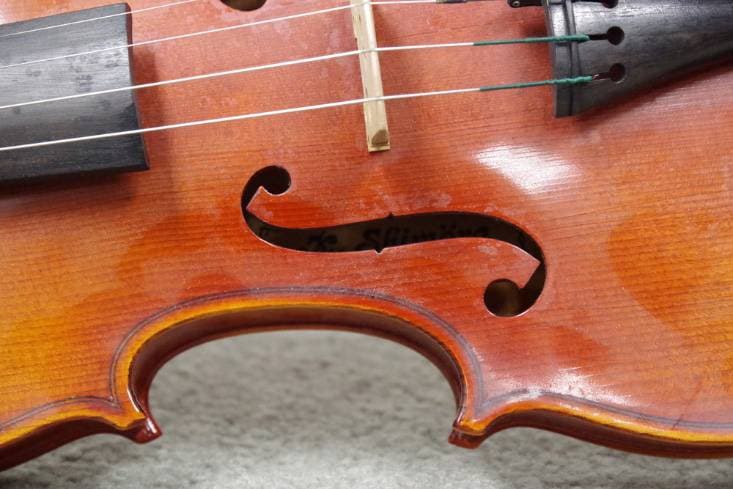
It is too dark to see, isn’t it? So I shone a light on it, adjusted the lighting, and took another shot.
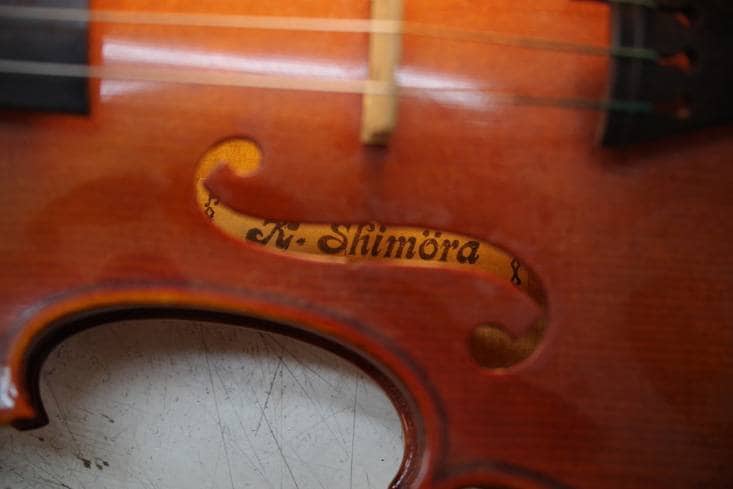
Yes. This is a K. Shimora.
It is an original brand of a long-established musical instrument store in Ochanomizu, Tokyo, and there were many instruments made under this brand, so there is probably no need to explain it at great length. In modern terms, it was essentially an OEM-style product using mass-produced instruments made in Germany—or so I believe.
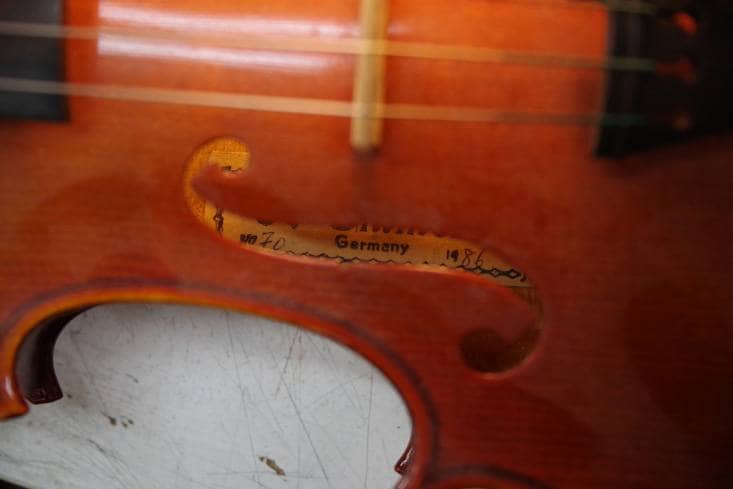
I don’t know the original retail price at the time. However, the price tag of ●● yen in the junk corner seemed somewhat careless and did not really reflect the instrument’s intrinsic value, at least in terms of the materials and craftsmanship of the instrument itself. Perhaps the store employee was a middle-aged man who had graduated from his guitar kid days and was the type to say, “I know everything there is to know about guitars!” If a violin came in as a trade-in or purchase, he might have thought: “I don’t know anything about violins in the first place!”—and tossed it into the junk corner. But enough of these silly behind-the-counter stories. The content of this blog series, which begins here, is about taking this Shimora that has now come into my possession and gradually working on it.
Today’s blog ended up being nothing but an introduction, but from the next installment onward, I will be mixing together:
- “Meticulous and razor-sharp examination of the individual instrument” (to create an atmosphere of seriousness)
- “The craftsman's trademark techniques” (an essential phrase—but, to be clear, merely “craftsman-like”)
- “Unnecessary bits of trivia” (surprisingly popular. Or perhaps simply avoided.)
- “The sound of European instruments imbued with the richness of history” (the kind of phrase you hear all the time even if you are not entirely sure what it means)
I will do my best to create an entertaining and informative blog that may even be useful as a source of musical knowledge for your ears. However, please understand that this is not intended to provide new or particularly useful information to professional string-instrument experts.
It is difficult to imagine that a blog like this would cause Sound Mart’s purchase prices to skyrocket. But in today’s world, you never know which phrase might be taken out of context and picked up by the AI overlords. Even more frightening is the possibility that a malicious third party could present information selected in this way as though it were general common knowledge, and use it as material for manipulating secondhand market prices. That is why I am not revealing how much I paid for this violin.
This blog was written without using AI whatsoever. I have no intention of preventing anyone from fact-checking the contents with AI. However, if this blog contains any errors, I would be grateful if you could kindly forgive the author’s lack of knowledge and study.
Next time:
The Mysterious Violin from a Secondhand Shop: Let’s Try Fixing It - Part 2
“Where exactly does it need fixing?” Stay tuned.
![How to Get the Best Sound Out of a Cheap Violin [Part 4] “There Are No Frets on the Fingerboard! Do Violins Even Need Frets? Or Are They Impossible to Install?”](/contents/uploads/thumbs/2/2025/7/20250701_2_31839_1.jpg)
 サウンドハウス管弦楽器ショールーム
 鈴木バイオリン製造
 バイオリン 入門ガイド
 バイオリンスタートガイド
 PLAYTECH 弦楽器
 バイオリンの手入れ
 Discount Sale
 Outlet
 New Arrivals
 Podcast (streaming)
 Headphones / Earphones
 Microphones
 Wireless Equipment
 Speakers
 Power Amps
 Mixers
 Processors
 Portable PA Systems
 Recorders
 Karaoke
 Guitars
 Basses
 Ukuleles
 Drums & Percussion
 Pianos / Synthesizers
 Wind Instruments
 Stringed Instruments
 Japanese Instruments
 Harmonicas, Other
 Software
 DJ & VJ
 Stands
 Cables & Connectors
 Racks & Cases
 Lighting
 Stage & Truss
 Video Equipment
 PC PERIPHERALS
 Power Supplies
 Studio Furniture
 Household Items, Other
 Alcoholic Beverages