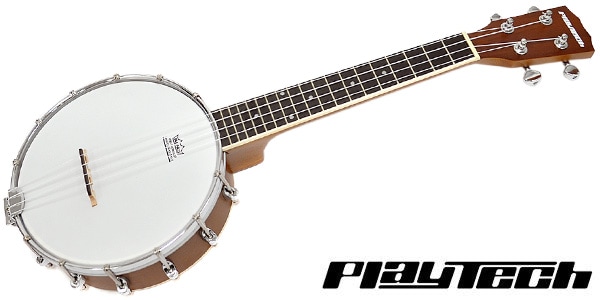
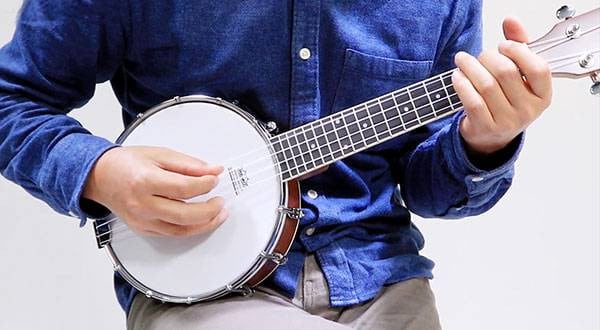
Hello, this is the Sound House ukulele staff!! This instrument is the “best of both worlds” since it looks like a banjo but plays like a ukulele. You’ll probably want to start playing and jamming out the very day it arrives… but first, there’s one small step: you need to set up (stand up) the bridge.
So in this article, I will walk you through the setup procedure from a staff perspective in a clear, easy-to-understand way—even if it’s your first instrument!
1. First, let’s set up the bridge
Banjo ukuleles are shipped with the bridge removed or laid on its side to prevent damage during transport. This is not a defect—it's intentionally done, so please don’t worry!
1-1. Loosen the strings a little
Turn the pegs lightly to slightly loosen the string tension. There’s no need to make them completely slack. You just need enough to make it easier to insert the bridge.
1-2. Place the bridge
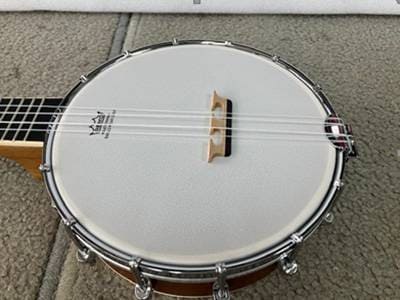
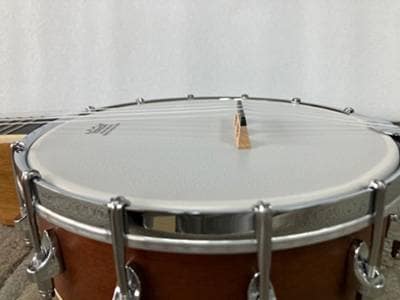
The thin wooden piece placed on the white membrane (the head) is the bridge.
- ① Slide the bridge under the strings
- ② Make sure each string fits properly into the grooves on the bridge
At this stage, precise positioning isn’t necessary. Just place it roughly around the center.
2. Decide the correct position for the bridge
In fact, where you place the bridge determines whether the intonation (pitch accuracy) will be correct.
Guideline for the correct position
The ideal position is where the following two distances are equal:
- Nut (top of the fretboard) → 12th fret
- 12th fret → Bridge
There will be some variation between instruments, but start by placing the bridge roughly in the center of the head, and then fine-tune the position from there!
3. Tuning → Fine Adjustment
Once you’ve placed the bridge roughly in position, tighten the strings again and tune the instrument. (The standard tuning is the same as a ukulele: G–C–E–A.)
After that, check whether the note at the 12th fret is exactly one octave higher than the open string. This is called octave tuning.
- If the 12th-fret note is sharp (too high) → Move the bridge slightly toward the tailpiece (toward the bottom).
- If the 12th-fret note is flat (too low) → Move the bridge slightly toward the neck (toward the head).
The spot where all strings line up correctly is this instrument’s best position!
4. Usage Points
- The bridge is not glued. Be careful, as it can move if you accidentally hit it.
- The tension of the head affects the tone, but usually, you don’t need to adjust it. If necessary, it can be fine-tuned using the hardware around the edges.
- This model comes with a REMO Banjo Head.
5. Storage
- Avoid high heat, high humidity, and sudden temperature changes.
- If you won’t be playing for a long time, it’s recommended to slightly loosen the strings to reduce the load on the bridge.
Conclusion
Simply setting the bridge correctly will greatly improve both the intonation and the tone. It takes a little effort at first, but once the position is set, you can fully enjoy the unique sound of the ukulele banjo!
If you have any questions about the instrument, feel free to consult Sound House anytime!
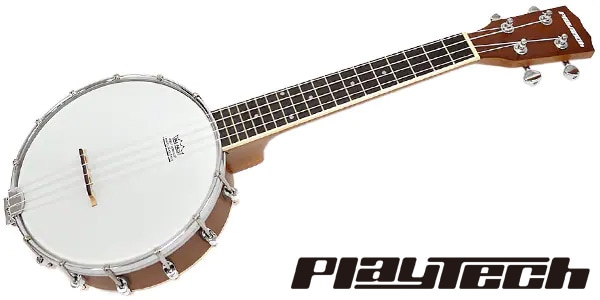
PLAYTECH / PTBAUK Banjo Ukulele


![[Enjoy the Ukulele Even More!] Master the Three-Finger Technique](/contents/uploads/thumbs/5/2022/5/20220509_5_17860_1.jpg)
![[Enjoy the Ukulele Even More!] How to Apply Vibrato](/contents/uploads/thumbs/5/2022/1/20220131_5_16451_1.jpg)
![[Enjoy the Ukulele Even More!] Standard Chord Progressions in Pop, Rock, and Jazz](/contents/uploads/thumbs/5/2022/1/20220124_5_16313_1.jpg)
 サウンドハウスではじめよう!ゆるりウクレレタイム
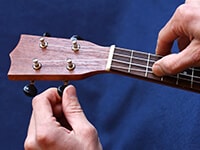 ウクレレのチューニング方法
 初心者必見!PLAYTECH 激スゴの理由!
 ウクレレの各部名称
 ウクレレの種類
 ウクレレスタートガイド
 Discount Sale
 Outlet
 New Arrivals
 Podcast (streaming)
 Headphones / Earphones
 Microphones
 Wireless Equipment
 Speakers
 Power Amps
 Mixers
 Processors
 Portable PA Systems
 Recorders
 Karaoke
 Guitars
 Basses
 Ukuleles
 Drums & Percussion
 Pianos / Synthesizers
 Wind Instruments
 Stringed Instruments
 Japanese Instruments
 Harmonicas, Other
 Software
 DJ & VJ
 Stands
 Cables & Connectors
 Racks & Cases
 Lighting
 Stage & Truss
 Video Equipment
 PC PERIPHERALS
 Power Supplies
 Studio Furniture
 Household Items, Other
 Alcoholic Beverages