Cheena: This time, let's keep it shorter than usual and focus on a single accessory. We'll skip the profiles and get right into it. So, today's topic is this: the String Pillow, or as Scud calls it, the Sound Offset Spacer.
SCUD / SOS-EG1

Nemoto: I watched the video. This is amazing. I want one for a multi-string bass.
Cheena: Conceptually, it's close to BFTS (see the accessory edition), but it seems to be an item based on an original theory called MTS (Minehara Tuning System).
According to reviews, it’s something that resolves pitch issues on budget guitars. It is said that there is no benefit to introducing it to high-end instruments.
Hosco's explanation can be found here:
https://www.hosco.co.jp/mts-theory
Also, here’s the official website of the manufacturer, Gakki Koubou Minehara.
http://www.minehara.com/supertune/supertune1.htm
But I really want one for bass...
Maybe I'll try reaching out to them.
Nemoto: I love these kinds of slightly old-school, "one-person DIY" sites. Like Koshimizu and the like.
Anyway, I think this is a great item.
As explained in the video, on a fretted instrument, the pitch shifts depending on the pressure applied when fretting, and there's no way to fix that. On a fretless, you could just shift your finger slightly. By the way, does this mitigate the pitch deviation caused by the string stretching when you slide? If you can slightly pull your finger back towards the original direction when it hits the fret, that works, but you lose that skill quickly without practicing it. Of course, I can't do it now.
Cheena: It probably can't handle slides...
Oh right, here is the patent document related to MTS.
https://patents.google.com/patent/JP4383272B2/ja
And for BFTS, here:
https://patents.google.com/patent/US5955689A/en
Nemoto: Figures...
It's my first time seeing a patent document. It's surprisingly clear, which makes sense.
Since BFTS requires its own specific tuning method (not just a tuner), it’s a blessing to have an option that doesn't require that.
Cheena: You can read most patents on Google Patents and papers on CiNii. It's interesting because you can see the cutting edge of fields you're interested in.
By the way, it seems both were conceived with the assumption of being applied to acoustic guitars. Both use acoustic guitars as examples in the documents; I wonder if there's a reason for that.
Nemoto: With acoustic guitars, you can't really adjust the octave tuning, right? I think they want to eliminate even the smallest negative factors regarding tuning as much as possible.
Or maybe they just feel a sense of romance in adding a new mechanism to the acoustic guitar, which is a technology that has already completely matured?
Cheena: Both seem likely.
In the case of something like a classical guitar, there might be instances where someone applies a "just-place-it" modification like this to use an instrument that sounds great but is slightly off pitch.
Nemoto: The fact that it’s reversible is great. You can try it out easily.
Whether it’s refretting or replacing the fingerboard, there are some things that are hard to commit to.
Cheena: Still, they really did develop something impressive.
Now, shall we write down the installation method briefly?
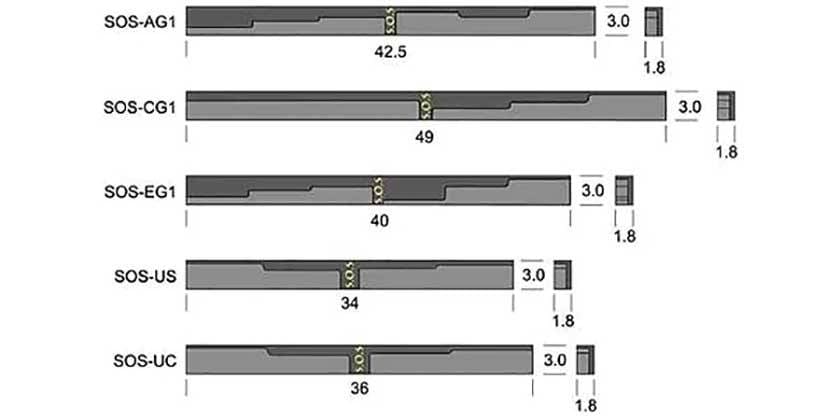
First, as you can see from the dimensional drawings, the amount of pitch compensation changes depending on the string s tructure and thickness, so the structures vary slightly.
I assume the majority of the readers are guitarists, so those who use a wound 3rd string might want to choose the AG1. That’s just my guess, though.
The one I purchased this time is the SOS-EG1. I’m going to try installing this on what used to be a Selder Strat and an Ibanez AS73G.
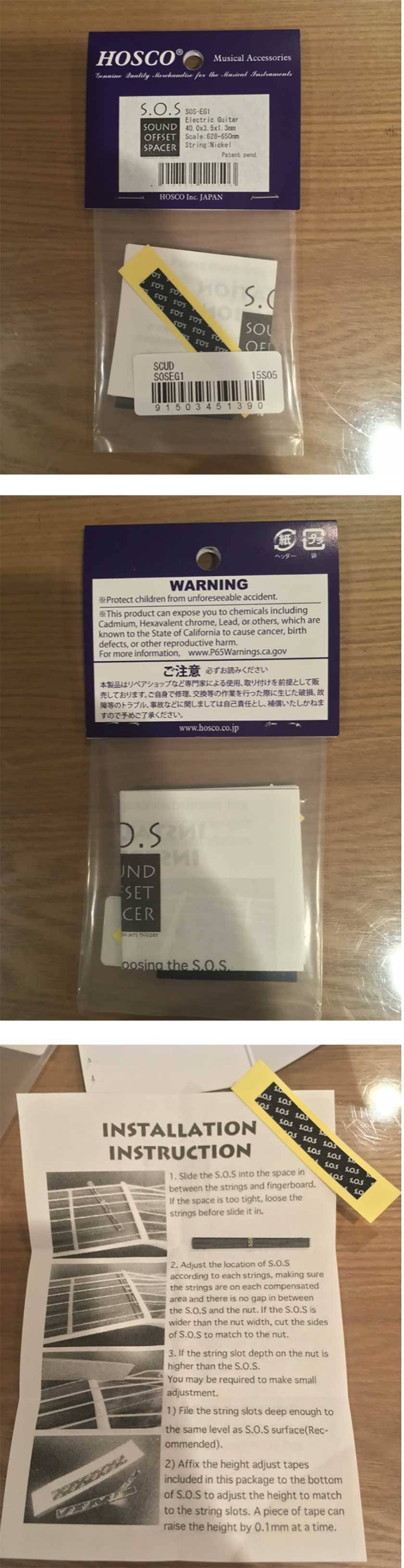
As stated on the package, there are strict specifications for the applicable guitars.
In this case, it’s a 628–650mm scale and nickel strings.
The translation of the instructions is:
- Slide the S.O.S. into the gap between the strings and the fingerboard. If the gap is too narrow, loosen the strings before inserting it.
- Align the S.O.S. position with the strings and adjust it so that the nut and S.O.S. are in close contact and each string falls into its respective compensation area. If the S.O.S. is longer than the nut, trim the ends to match.
- If the string slots in the nut are higher than the S.O.S., the following adjustments will be necessary:
1) File the slots so that they are at the same height as the top surface of the S.O.S. (Recommended)
2) Apply the included tape to the bottom of the S.O.S. to match the height of the original slots. One piece provides a thickness of 0.1mm.
Since the height of the S.O.S. itself is 1.8mm, it cannot be used if the nut string height or fret height exceeds 2.1mm. Well, frets are basically capped at around 1.5mm anyway, so that shouldn't be a concern.
Also, the saddles need to be moved toward the neck side by the same amount as the compensation value.
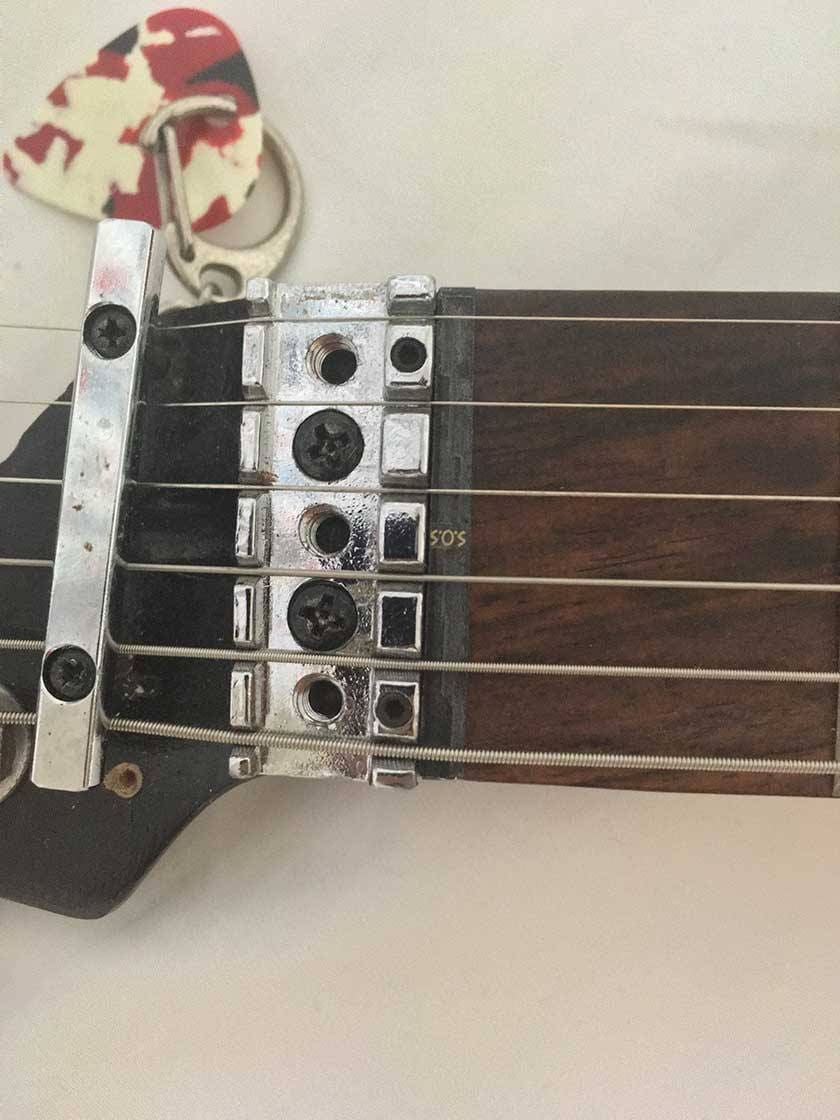
First, I tried it on what used to be a pitch-problematic Strat. The strings are Playtech 9-11-16-26-36-46.
This guitar was in poor condition overall, and the string action was set quite high, but the noticeable sharpness in pitch has settled down.
I added a piece of tape and adjusted the string action.
It might also work well as a simple corrective tool for when a nut has issues like cracks or chips.
Next, onto the Ibanez semi-hollow body. I removed the tape, and the strings are a mix of Playtech 10-14-16-24-32-42.
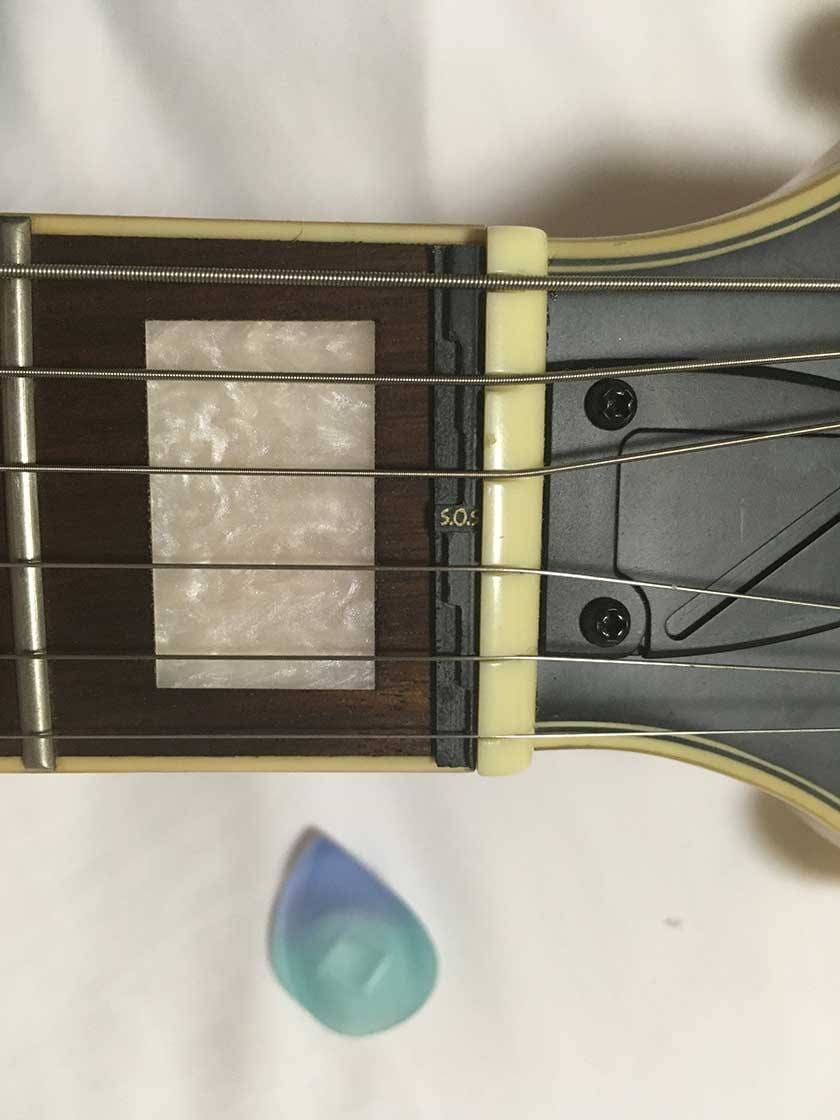
While some reviews mentioned that installing this on a guitar that is already well-adjusted would actually worsen the pitch, it didn't seem to have a negative effect on this guitar, where the action is set very low and the pitch is hard to sharpen, so it seems fine.
I’m not sure how much of it is a placebo effect, but I feel like the wavering in chords has subsided.
Dimensionally, it could be mounted on a Bass VI, but since the developer's intended pitch compensation wouldn't be achieved with an all-wound set on a 30-inch neck, I think I'll pass. If I had baritone strings on it, I would have tried the AG-1, but...
Overall, I’d say it's a part that raises the baseline performance of an instrument. However, since the materials differ between the original Minehara version and the Scud/Hosco version, there might be some differences resulting from that.
Nemoto: Thanks for the detailed review.
I was thinking of buying one if it could be repurposed for bass, but that looks difficult. Let's hope for one to come out eventually...
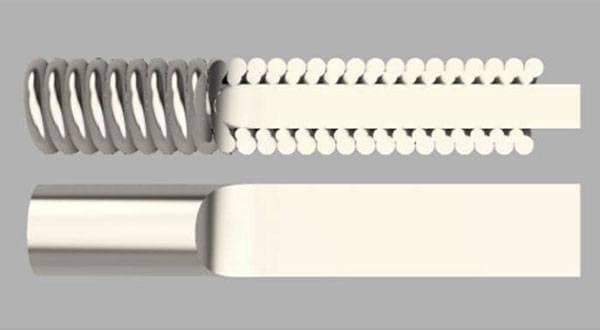
Cheena: The Minehara version for 4-string bass was 33,000 yen, presumably made of brass. For multi-string instruments, it would probably be a custom order... I’m borrowing an image from the official site, but the left side of the top image is after processing and the right is before, so I believe they are made through a process of cutting and then bending.
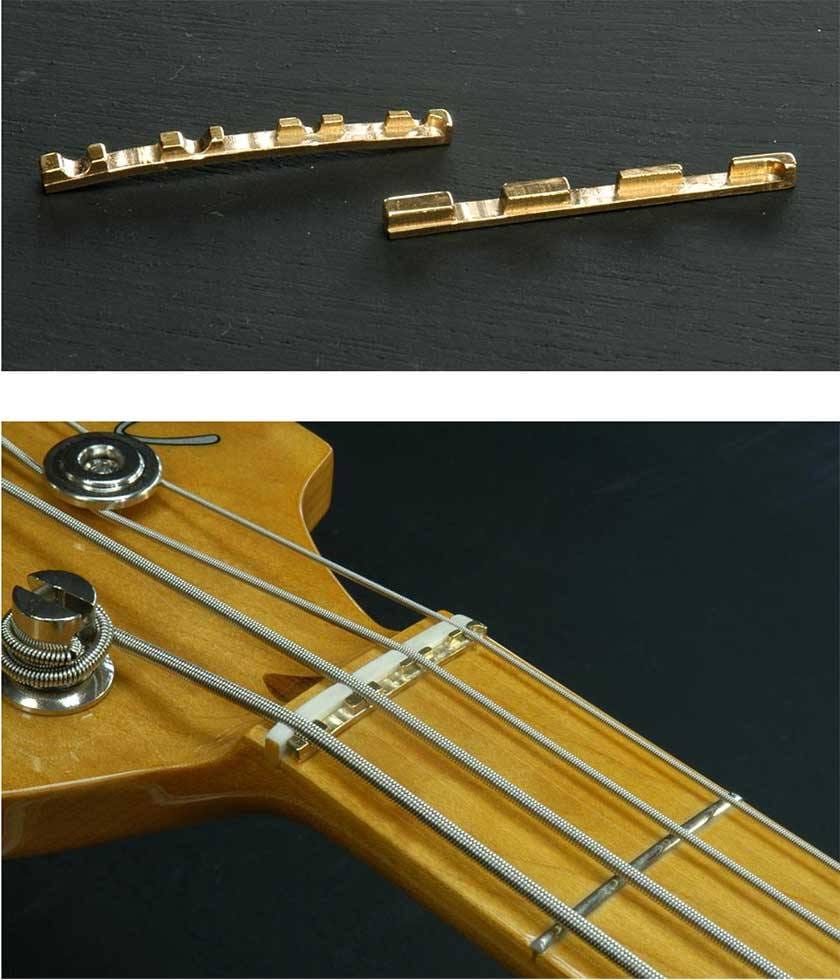
Actually, with the change from metal to plastic, making it possible to install regardless of the radius and allowing it to be cut to some extent, it seems the Scud version has been quite simplified—or rather, generalized.
It makes me want one bass each for MTS, BFTS, and True Temperament.
Nemoto: True. I’d love to have everyone gather with one each... though even if I owned all three, I probably wouldn't end up using them lol.
Cheena: That's true lol. Well, under the title of "Special Accessory Extra Edition," we have introduced most parts of the tuning compensation systems, specifically the Scud SOS and Minehara Tuning System. We will add updates if there is further news. Thank you very much.
Nemoto: Thank you.
The “sound & person” column is made up of contributions from you.
For details about contributing, click here.





![Diving into the Abyss of Weight Reduction in Instruments [Nemoto x Cheena Collaboration Article]](/contents/uploads/thumbs/5/2021/9/20210930_5_14340_1.jpg)
 SKB ギター・ベースケースセレクター
 DIY ギターメンテナンス
 あなたのエフェクターボード見せてください
 弦の張り替え(エレキギター)
 ギターケースの選び方
 ギター名人ラボ
 Discount Sale
 Outlet
 New Arrivals
 Podcast (streaming)
 Headphones / Earphones
 Microphones
 Wireless Equipment
 Speakers
 Power Amps
 Mixers
 Processors
 Portable PA Systems
 Recorders
 Karaoke
 Guitars
 Basses
 Ukuleles
 Drums & Percussion
 Pianos / Synthesizers
 Wind Instruments
 Stringed Instruments
 Japanese Instruments
 Harmonicas, Other
 Software
 DJ & VJ
 Stands
 Cables & Connectors
 Racks & Cases
 Lighting
 Stage & Truss
 Video Equipment
 PC PERIPHERALS
 Power Supplies
 Studio Furniture
 Household Items, Other
 Alcoholic Beverages