Since the recent national election, the phrase “Japan First” has come to be used frequently. In the United States and Europe, political parties that advocate policies putting their own citizens first have already gained the support of ordinary citizens. As news of these overseas developments has become widely known in Japan as well, and because the idea of “first” as prioritizing citizens over foreigners is easy to understand, it has begun to capture the minds of young people in particular. However, on the other hand, it also seems as though the word “first” is taking on a life of its own. What is concerning is that the original meaning of “Japan First” may be misunderstood since people are being swayed by the ways of thinking and ideologies of other countries.
After all, since the nation of Japan exists for its citizens, it is only natural to place the highest priority on improving the rights and standard of living of Japanese people, which no one can argue. However, aren’t we losing sight of an important objective that lies beyond that extension? If only Japanese people are financially well off, will the citizens truly be happy? Is it not important that, through Japanese people living fulfilling and happy lives, foreign residents living in Japan also receive those benefits and are treated with care? Would it not be the true aim of “Japan First” for people from other countries to come to Japan and feel happy and grateful to be able to live in Japan? I cannot help but feel that sharing the prosperity of Japanese people is what truly matters.
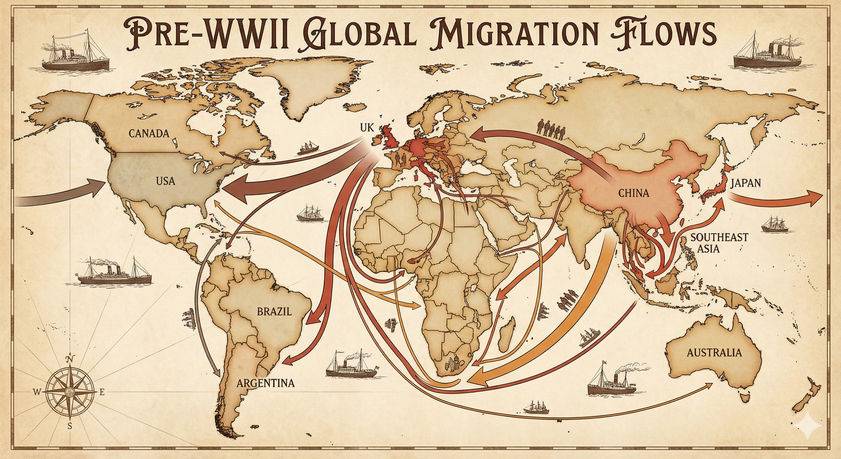
Let’s take a look back on Japan’s history. Before the war, the citizens were forced to live in extreme poverty during the country’s stage of economic development. For the sake of survival, even before the war, more than one million Japanese people went abroad. Their destinations included Hawaii, the United States, and South American countries such as Brazil and Peru. In other words, an incredibly large number of Japanese people have been supported by foreign countries over the years. While some undoubtedly faced hardships, many overseas migrants worked hard in their new lands, were blessed, and continued through generations to the present day. Moreover, many Japanese people have thrived abroad while receiving various benefits.
Indeed, there are many issues surrounding foreigners. Even setting aside the recent over-tourism, which is rooted in the weak yen, there have been concerns raised about tourists’ poor manners, illegal employment, unpaid medical fees, and involvement in crime. However, it cannot be denied that emotional arguments often take precedence, and there remains doubt about how accurately the actual situation is understood, so caution is necessary. In any case, as of June 2025, the number of foreign residents has reached approximately four million people, and in a little over a decade, it is expected to reach ten million—meaning one in ten people will be a foreigner. At a time when the Japanese population is rapidly declining, it is now impossible to reverse this trend. Furthermore, many of these foreign residents work in Japan and will become a pillar of support for the Japanese economy in a society with a shrinking labor force, making them undeniably important.
So, how can we as Japanese create a society that values foreigners? That is what “Japan First” means. If Japanese people become prosperous, gain peace of mind, and are placed in circumstances where they can treat those around them with kindness, they should naturally have no reluctance in taking care of foreigners as well. If one is not in a fortunate environment oneself, how can one show compassion to others? In other words, “Japan First” is essential. Just as we would like to be treated well when we go abroad, it is only natural as human beings to treat visitors and residents from other countries well—and the engine that makes this possible is “Japan First”.
I am wholeheartedly in favor of “Japan First”. Japanese people can become spiritually enriched and build a kind society together with foreigners. It would be ideal if people from other countries come to see living in Japan as positive, enjoy their lives here, and come to love Japan. I want Japan to become an exemplary model of being the kindest country in the world, so that foreigners can also say, “Japan is the best!”




 Discount Sale
 Outlet
 New Arrivals
 Podcast (streaming)
 Headphones / Earphones
 Microphones
 Wireless Equipment
 Speakers
 Power Amps
 Mixers
 Processors
 Portable PA Systems
 Recorders
 Karaoke
 Guitars
 Basses
 Ukuleles
 Drums & Percussion
 Pianos / Synthesizers
 Wind Instruments
 Stringed Instruments
 Japanese Instruments
 Harmonicas, Other
 Software
 DJ & VJ
 Stands
 Cables & Connectors
 Racks & Cases
 Lighting
 Stage & Truss
 Video Equipment
 PC PERIPHERALS
 Power Supplies
 Studio Furniture
 Household Items, Other
 Alcoholic Beverages