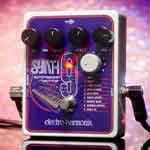
Distortion effects are something that almost every guitarist seems to own. They are essential for playing electric guitar, and the majority of players probably purchase a distortion pedal early on. For beginners, it might be a bit hard to grasp, so simply put: if you play without setting your amp to produce distortion, the sound will be thin and lacking power. Also, practicing without running through an amp can encourage incorrect picking strength or technique, so it’s best to play through an amp whenever possible.
If you absolutely can’t make sound at home or in a quiet environment, it is recommended to use a VOX headphone amp that runs on just two AA batteries. It’s affordable and sounds good (see photo). You can also connect it to audio equipment to enjoy it along with CD tracks or other audio sources. It’s very easy to use.
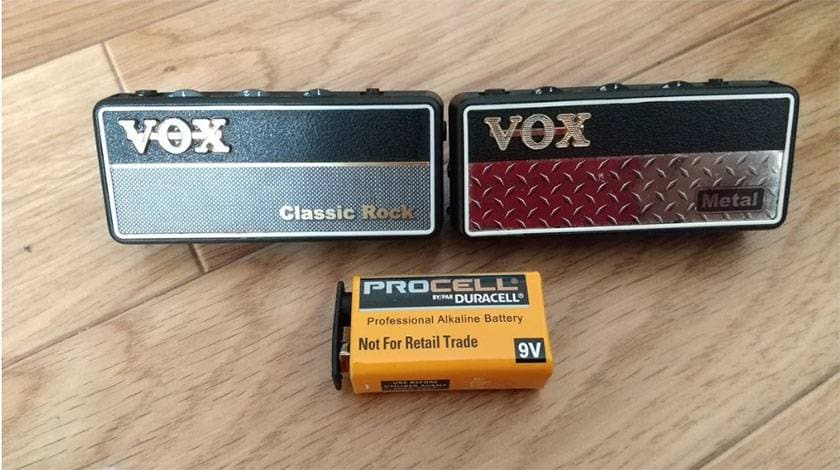
For those who can’t play an amp at home, there’s a battery-powered amp that’s cheap, easy to use, and sounds good, running on just two AA batteries. It costs around 4,000 yen. I personally use the Marshall-type model. Headphones are required separately. If you want to jam along with a CD, you’ll need an audio cable.
→ VOX amPlug2 Headphone Guitar Amp List
Getting back on track, let’s talk about distortion.
Even if you say “distortion” in a single word, the market offers everything from mass-produced budget pedals to handmade, small-batch pedals crafted by artisans. Globally, there may be over 1,000 different types of distortion pedals alone. I’ve divided distortion effects into four categories for reference.
■ Overdrive
This type is said to naturally reproduce the distortion created by driving a tube amp. It’s not extreme distortion; it’s designed with the purpose of adding flavor to a song. Most overdrive pedals from any manufacturer produce a mild, sweet, and natural distortion. It’s not aggressive. Another use is as a booster mainly for guitar solos to gain volume (explained below).
■ Distortion
This type produces a rougher sound when the volume is increased. If you want a sound that isn’t harsh to the ears, the more expensive pedals tend to show their true quality. Too much distortion can make the sound feel artificially processed. Distortion pedals are compatible not only with bands that focus on intense playing but also with techniques like picking harmonics, long sustain, or using rock-style tremolo units like Floyd Rose for arm techniques.
■ Fuzz
Fuzz produces a gritty, raw distortion that isn’t very suitable for chord work, but its tone is unlike anything you’d expect from other distortion types. Subjectively, the Fuzz Factory pedal is considered to be a classic. The riff in The Rolling Stones’ song “Satisfaction” is a representative example of its sound. Jimi Hendrix’s tones are a treasure trove of fuzz sounds. From simple, buzzing tones to, in some cases, pairing a tube amp with a tremolo arm to create a living, almost “guitar screaming” sound, fuzz challenges the player’s sensibility and skill.
Vintage fuzz pedals in good condition often command exorbitant prices. If you’re lucky enough to buy one and open it to insert batteries, you might find… only about ten components inside! You may wonder why such a simple circuit board costs tens of thousands of yen. It can be disappointing, but classic fuzz pedals often use rare vintage components, which are crucial for creating their unique waveform and characteristic sound.
However, many early garage manufacturers had lax quality control, so even famous models aren’t guaranteed to be perfect. Some have lower durability, and after 30+ years, it’s not surprising if the controls or jacks don’t function properly.
■ Booster
A booster is an effect pedal often used when playing backing parts for songs, then stepping into the spotlight for a guitar solo. Many classic overdrive pedals are used in this way as boosters. Using a booster reduces stress and often thickens the tone, helping the guitar solo sing out. Many boosters have only a single control knob, which also reduces the chance of technical issues.
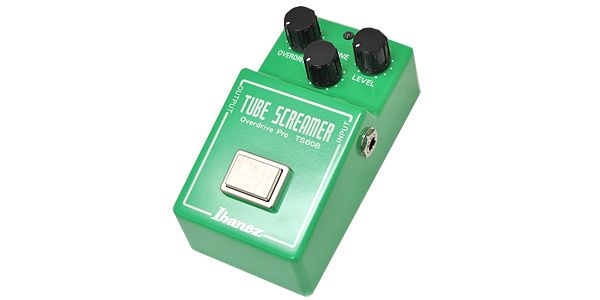
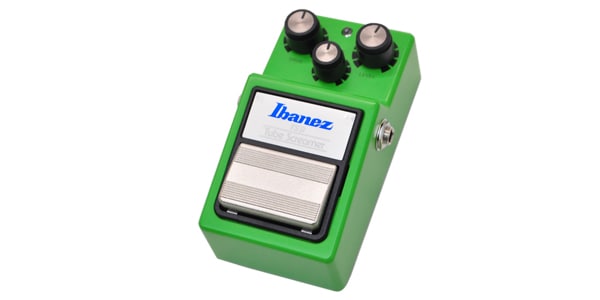
Currently popular examples for which prices have skyrocketed, include the Kemper Centaur and Ibanez TS808 Tube Screamer. These are often left on continuously, with the guitar’s volume used to adjust the amount of overdrive. Personally, I once tried an Ibanez TS9 at a music store and thought, “This doesn’t distort enough… I prefer the BOSS Metal Zone,” which now seems almost embarrassing in hindsight.
Ibanez / TS808 Guitar Effect Tube Screamer
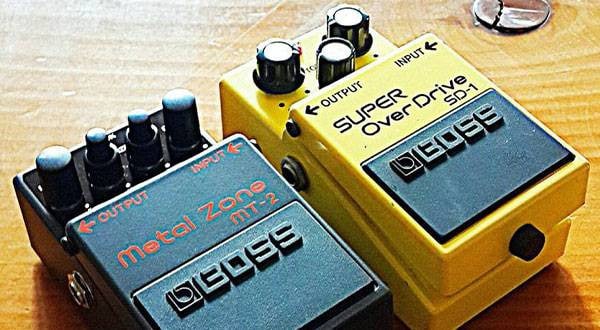
In the early 1980s, distortion pedals in Japan were limited to BOSS, Maxon, Pearl, Yamaha, and imported pedals like MXR or DOD. For high school guitarists, there were very few options, so the standard BOSS pedals dominated. While these pedals lacked individuality, the BOSS SD-1 and DS-1 remain standard items today, which are widely used by both Japanese and international guitarists. BOSS distortions are also modified by Keeley in the U.S., selling for about three times the original price.
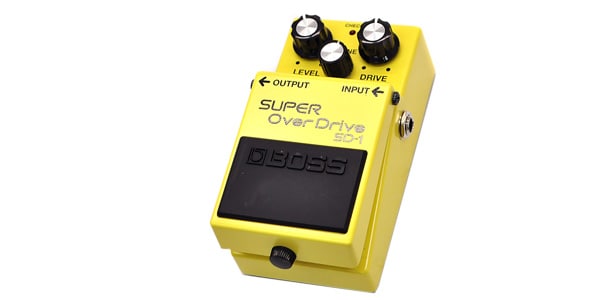
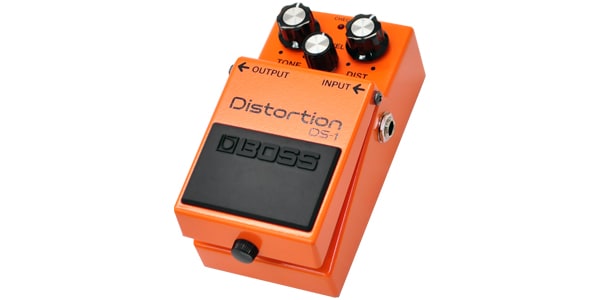
After that era, from the 1990s onward, updates in gear, modifications of pedals, and the trend toward producing higher-quality, more precise effects equipment became popular. Suddenly, a wide variety of handmade boutique pedals started to appear in small quantities. The term “boutique effects” may have started circulating around the same time that Eric Johnson, the sound magician, became famous.
Eric Johnson was so particular about 9-volt batteries in his pedals that there’s a legend claiming he could identify the battery manufacturer inside a pedal. His emergence sparked a trend in guitar customization, especially Stratocasters, which became mainstream from the 1990s onward. In the 1980s, most heavy metal guitarists had little interest in vintage parts. At that time, metal music only needed humbuckers and a tremolo unit.
The first handmade distortion pedal I personally used was an extremely early 1993 “Hot Cake Standard.” Perhaps to prevent copying of the circuit board, it was entirely covered in a glue-like substance except for the switch. Similarly, the Kemper Centaur is encased in a black, bond-like material so the internal components are completely hidden. From the 1990s to 2021, many small-batch handmade pedals were produced, designed to complement the amplifier’s tone while providing rich distortion. Since it’s impossible to check every model, the best you can do is listen to them online. Personally, I’ve had a few opportunities to experience them in person, even up to today.
In 2008, an interesting magazine-style book was released by Rittor Music, titled Guitar Magazine Distortion Effect Book: Experience the Sound of 90 Effects. Although it is now out of print and can only be found online, it introduced 90 pedals with accompanying sample CDs. The first section is short and each playing style differs, making comparisons difficult, but the idea is to show how each pedal can be used, with Syu demonstrating the most popular 30 pedals. Some of the comments may disappoint, but the latter half, by Yasushi Suehara, covers 60 more detailed distortion pedals and is very informative.
If you find it online, I highly recommend purchasing it. YouTube and other platforms cannot provide the same opportunity to quickly test so many distortion pedals. For meaningful results, you need the book with the accompanying CD in good condition. Today, of course, computers and smartphones can provide information, but a CD-accompanied book that allows a side-by-side comparison of pedals remains a valuable resource. There are also interactive books connected to iTunes worth checking out.
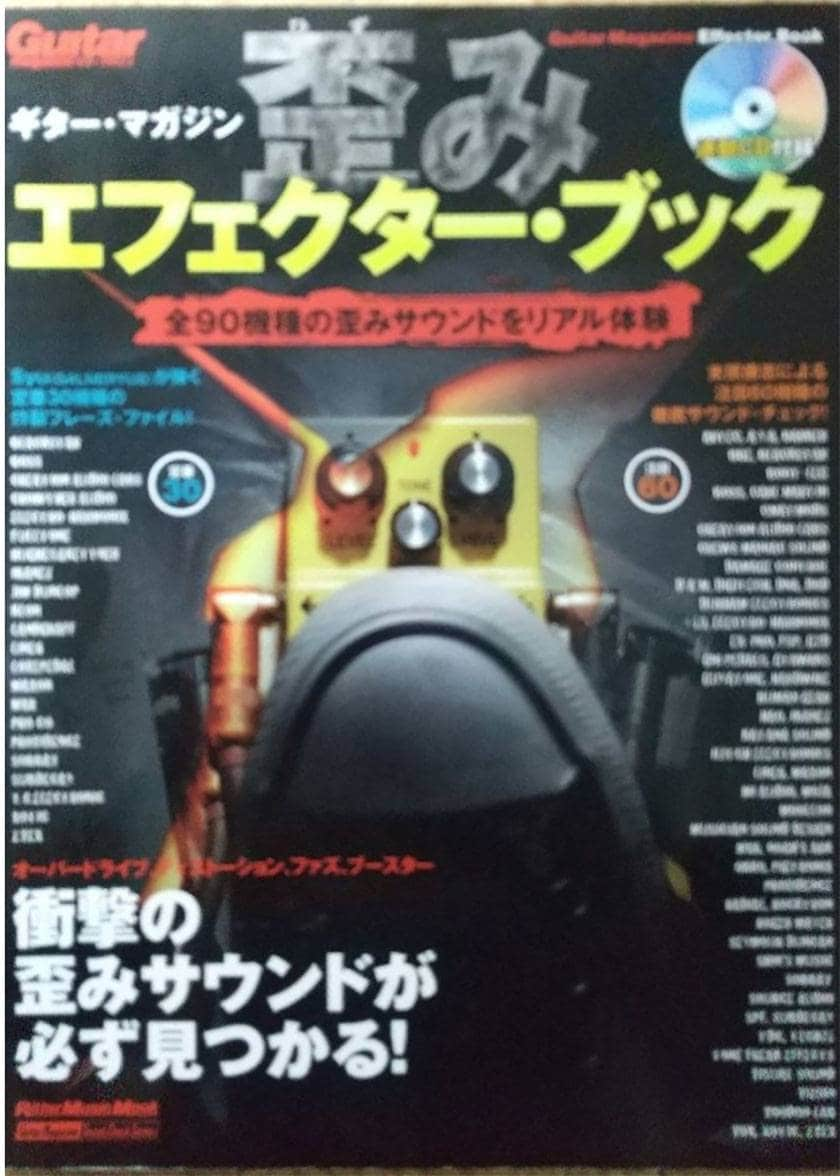
The way to use this distortion book is to first, without looking at the text or photos, close the book and listen to the CD. For the “standard 30 pedals,” direct comparison is difficult, but for the “highlighted 60 pedals,” listen with headphones and immediately write your impressions on paper. For example, jot down notes such as: “beauty of overtones, optimal distortion level, attack response, midrange characteristics, high-end clarity, midrange warmth, transparent highs, clean sustain…”
After listening to all of them, check your notes against the book. Beginners may find it hard to make detailed comments, so giving scores might help. Doing this allows you to compare sounds without preconceptions. Although it takes time, listen to the CD without looking at the photos, write comments, or assign scores. This helps you understand what type of gear you prefer. If you read the article before listening, you waste the advantage of having purchased the book. The book doesn’t come at a premium, either. I checked online and saw one for 200 yen; a famous used bookstore chain was selling it for 980 yen.
I have been playing guitar for many years, and I’ve purchased and sold a total of about 30–40 distortion pedals. Of course, I started with the cost-effective pale yellow BOSS SD-1 and orange DS-1. In high school, given the historical context mentioned earlier, we in Japan had to trust BOSS. However, BOSS pedals still maintain a perfected exterior, easy battery replacement, and reliable durability. I have no memories of failures, only occasional scratchy knobs. This is why BOSS continues to reign as the “King of Effects Pedals.” BOSS offers stable quality and wallet-friendly prices.
‘However, as your skills improve, you naturally shift toward distortion pedals that allow for more precise settings and originality. These often cost around 30,000 yen. Handmade pedals also start at roughly this price range.
Once you own multiple guitars and become more particular about your gear, you might consider pedals around 100,000 yen, such as the powerhouse Landgraff. The Centaur might even be more expensive than a guitar, though that’s an exceptional case. If by chance you purchased a Centaur that was on the verge of failure, including worn knobs, I think it would take me about a year to recover from the shock. For most purposes, a Centaur clone in the 50,000 yen range is sufficient.
When I first started playing guitar, I thought I could manage with just BOSS pedals, but as I continued using them, my ears became more discerning. I started noticing things like, “Could this distort a bit more?” or “The tone control isn’t quite right,” or “The sound isn’t sharp enough.”
Nine years ago, I acquired a Landgraff Dynamic Overdrive. The music store had a soundproof room, so I could try the authentic Landgraff and a Japanese copy model at full volume. I recall the copy model cost around 30,000 yen, but the difference was like a Grumman fighter plane vs. a Zero fighter in terms of performance. The copy model sounded thin and weak, while the Landgraff had both sonic power and richness.
For live performances, due to the risk of accidental damage or theft with the Landgraff, I use a Yamano Gakki Original 3-Mode Overdrive. This pedal has a unique switch that “simulates the sound of a worn-out speaker,” which changes the high-end tone when activated. When I opened the back cover, the effect was achieved by simply adding four or five inexpensive components. It lacks sharpness but is handmade with carefully selected parts, and it appeared online for about 20,000 yen, so I purchased it immediately.
Additionally, I use the TBCFX Micro Echo Plex Preamp “2” as a booster during live performances. Since having too many pedals increases setup time, I limit myself to a maximum of three. I’ve experienced unexpected issues before, like the distortion pedal’s level is set to 0 and no sound comes out, so I keep it simple. I don’t normally use a wah wah pedal either, as it doesn’t allow me to express my personal style in modern playing.
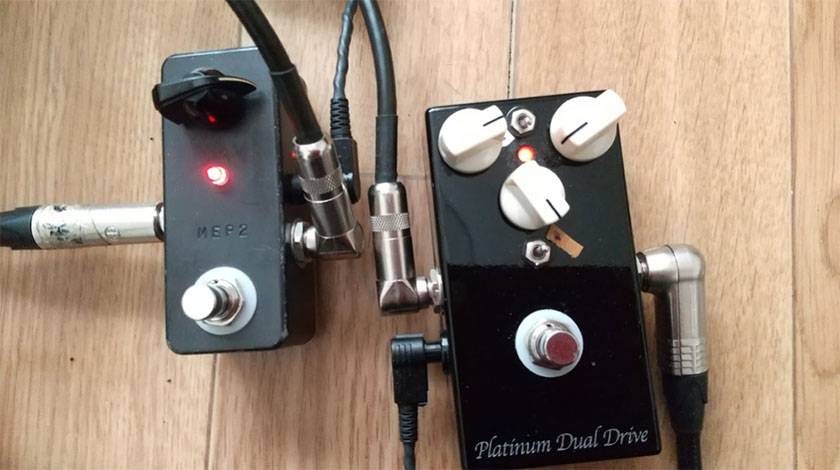
For live use: Yamano Gakki Original Premium Dual Overdrive and TBCFX Micro Echo Plex Preamp “2.”
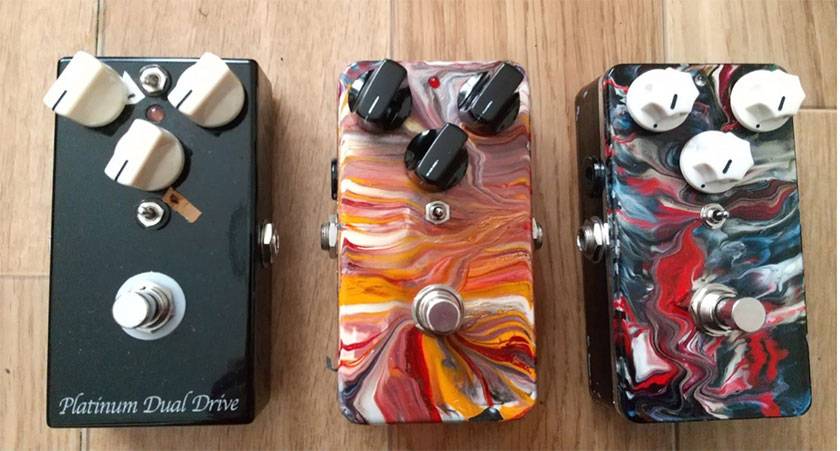
The three main distortion pedals I use are, from left: Yamano Gakki Original Overdrive, Landgraff Dynamic Overdrive 800 series, and Landgraff MOD Distortion 400 series. I also own other pedals such as the RAT and BOSS Turbo Overdrive.
The “sound & person” column is made up of contributions from you.
For details about contributing, click here.
 はじめてのエフェクターは GT-1 にしよう
 YAMAHA ポータブルPAシステム STAGEPAS 1K
 第2弾 あなたのエフェクターボード見せてください
 BOSS ボーカル・エフェクターのススメ
 あなたのエフェクターボード見せてください
 エフェクター編
 Discount Sale
 Outlet
 New Arrivals
 Podcast (streaming)
 Headphones / Earphones
 Microphones
 Wireless Equipment
 Speakers
 Power Amps
 Mixers
 Processors
 Portable PA Systems
 Recorders
 Karaoke
 Guitars
 Basses
 Ukuleles
 Drums & Percussion
 Pianos / Synthesizers
 Wind Instruments
 Stringed Instruments
 Japanese Instruments
 Harmonicas, Other
 Software
 DJ & VJ
 Stands
 Cables & Connectors
 Racks & Cases
 Lighting
 Stage & Truss
 Video Equipment
 PC PERIPHERALS
 Power Supplies
 Studio Furniture
 Household Items, Other
 Alcoholic Beverages