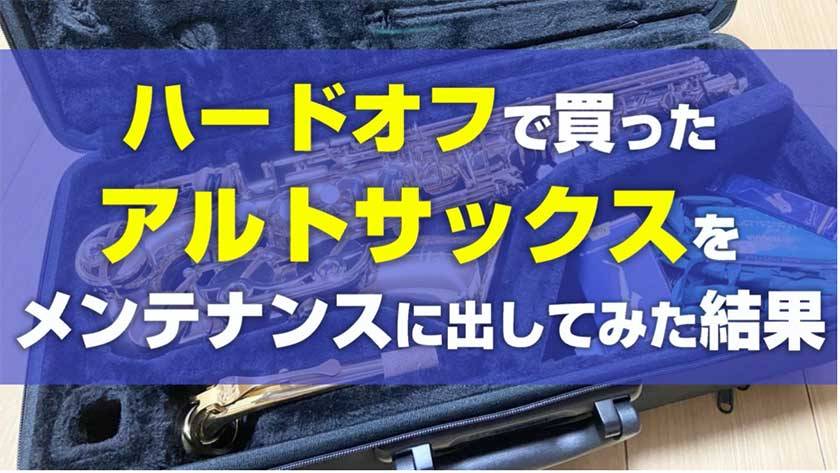
"Since you're a beginner, you won't be able to tell the difference in sound even if you get it fixed!"
"It's such a waste of money to spend on a cheap instrument!"
Because of feelings like these, I think there are many people who can't bring themselves to send their saxophones sitting at home in for repairs.
(Or perhaps they don't know any good repair shops that perform maintenance on instruments, or they feel they aren't very good at saxophone yet.)
So, is it okay for saxophone beginners to not get their instruments maintained? Or should even beginners get it done?
Since such questions have come to mind, this time I (a saxophone beginner) actually sought out a repairman, visited a shop, and listened to their advice while having my instrument repaired.
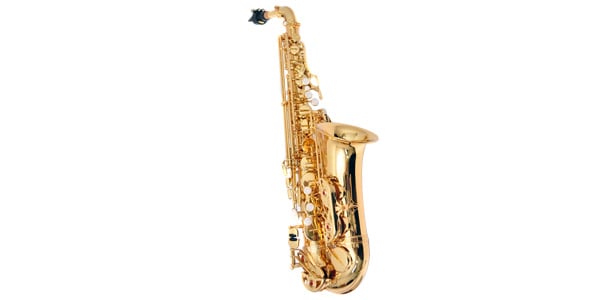
This is the alto saxophone I recently bought at Hard Off.
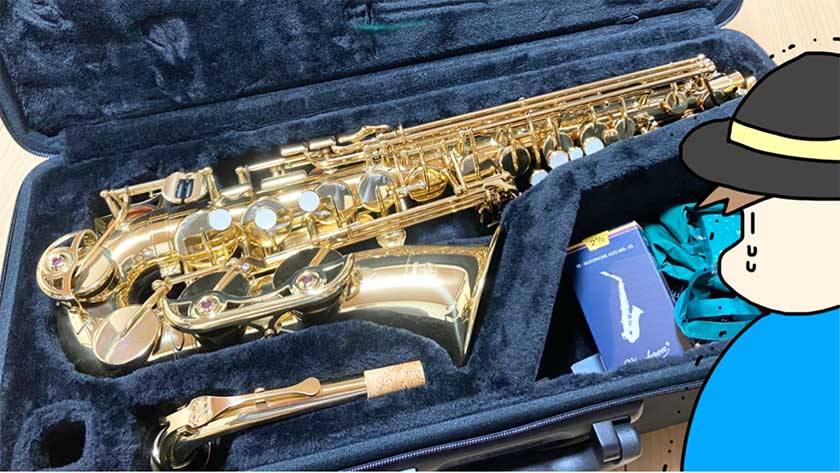
(Justin is moved by its beauty)
〇 Condition before maintenance
Model number: YAMAHA YAS-380
Initial purchase: January 2019
Price when bought at Hard Off: Approx. 88,000 yen (List price: 185,000 yen)
Condition: It appeared to have been used very little. The pad leather also looks clean.
Problems: Only when I start blowing, the G# key sometimes doesn't open. The keys feel like they are clattering overall (I thought that was just how it was).
It looks very clean. Maybe I really don't need maintenance...
(The YAS-380 is the model one step above the YAMAHA YAS-280, the company's cheapest entry-level model. While not the cheapest, it is what is known as a "student model.")
〇 The struggle of finding a repairman
When I searched "saxophone maintenance" online,
I saw a few suspicious-looking websites here and there.
(Is this why many people get discouraged...?)
I decided I shouldn't give up here, so I worked up the courage to consult with a saxophonist acquaintance.
They introduced me to a student of theirs near my home, and through that student's introduction, I was able to get the phone number of a reliable repairman.
I called there and successfully made an appointment. The person who answered the phone was a female repairman who was very knowledgeable about saxophones.
Conclusion: Referrals really are powerful...!
(Even in cases where you find a repairman online and ship your instrument, it is generally better to speak with them over the phone once rather than relying only on text.)
〇 At the repair shop
When I asked the female repairman I met, it seems that there are schools in Osaka and Tokyo that specialize in teaching saxophone repair and adjustment. Many repairmen at music stores across the country are graduates of such schools.
It is reassuring to have someone who has learned the techniques through a systematic curriculum.
Then, the results of the diagnosis and estimate for my instrument were as follows:
- The pads on the low-register keys were misaligned, and there were places where they were not sealing properly.
- The linkage for the high-register keys was not working correctly, causing a delay where they should move simultaneously.
- The pads on keys that are normally closed and open when you press a button (like the G#) had grime built up, causing them to stick.
- The neck screw appeared to have been overtightened, making it difficult to insert the neck.
There were problems like these.
I never imagined that a saxophone that looked so beautiful on the outside could have so many issues...
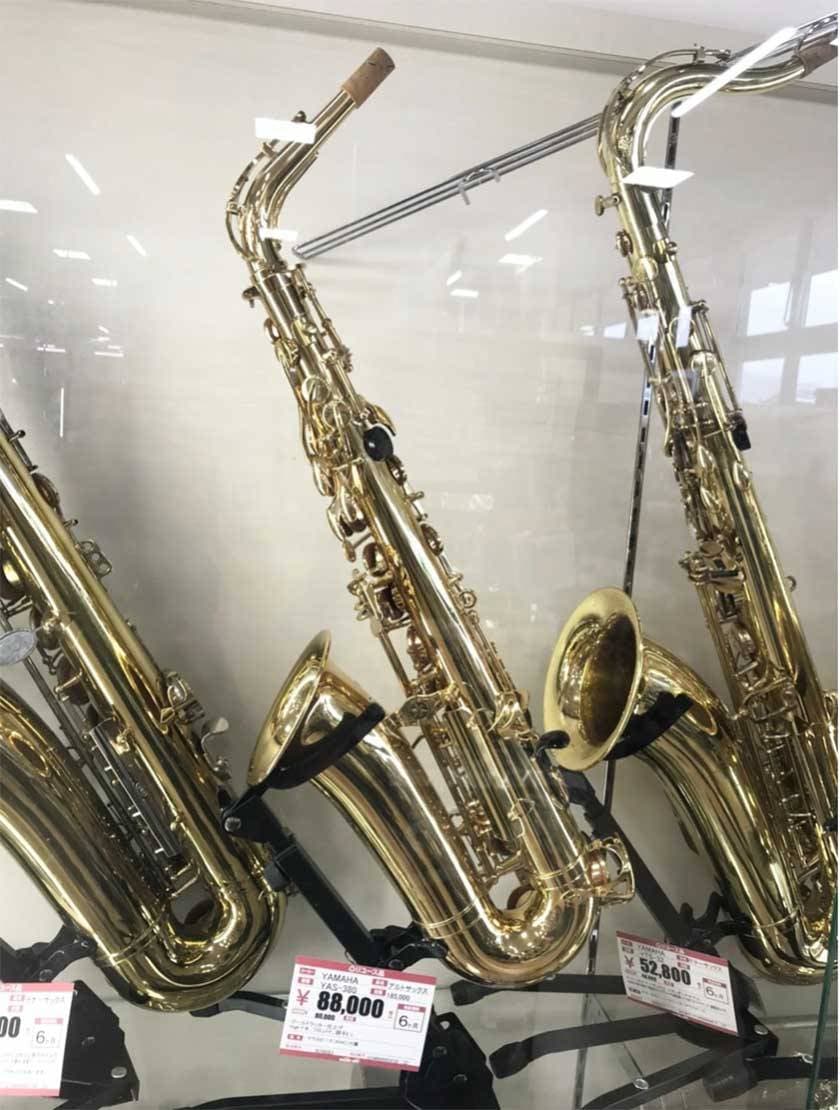
(The YAS-380 when it was lined up at Hard Off)
The total cost for the adjustments was 6,600 yen, and the time required was about 1 hour and 15 minutes, so I immediately asked for the adjustments to be done.
I ate lunch in the area and browsed the music store while I waited.
〇 After maintenance
・It is overwhelmingly easier to play!
・Surprisingly, I can now easily hit the lowest notes! (I thought I couldn't play them because I was unskilled.)
・The noise from the keys has changed from "clattering" to "pattering"!
I was surprised. Even as a beginner, the difference is clearly noticeable. It was as if I had switched to a very expensive instrument.
With 88,000 yen plus 6,600 yen, I feel like I bought a brand-new instrument—or something even better.
Afterward, the repairman very carefully taught me how to take care of the instrument after playing and what points to be aware of.
According to what I heard, the most common accident among those who bring in saxophones is getting the swab (the cloth used to clean the inside of the saxophone) stuck inside the instrument or the neck.
Also, the metal hardware where you attach the strap is not as strong as one might think, and it seems that if you let the instrument dangle from your neck, it can sometimes come off and drop.
The 6,600 yen was well worth it. I will definitely ask for the same person next time.
〇 Conclusion
Question: Is it better for saxophone beginners to take their instruments in for maintenance?
Answer: If you have the intention to play, you should definitely do it.
The basic rule for saxophone maintenance is once every six months to a year. I didn’t know that the saxophone is an instrument built upon such a delicate balance.
If you have obtained a used instrument or have had a saxophone stored away in a closet for a long time, consider taking your instrument in for an adjustment.
Sound House also handles used items!
↓
Sound Mart is a flea market site specializing in musical instruments and audio equipment operated by Sound House
https://www.soundmart.co.jp/
The “sound & person” column is made up of contributions from you.
For details about contributing, click here.








 プラスチック管楽器特集
 デジタル管楽器とは
 PLAYTECH 管楽器特集
 サウンドハウス虎の巻 管楽器入門ガイド
 最新コラム&動画をCheck!! OTOYA通信
 サウンドハウス虎の巻 !
 Discount Sale
 Outlet
 New Arrivals
 Podcast (streaming)
 Headphones / Earphones
 Microphones
 Wireless Equipment
 Speakers
 Power Amps
 Mixers
 Processors
 Portable PA Systems
 Recorders
 Karaoke
 Guitars
 Basses
 Ukuleles
 Drums & Percussion
 Pianos / Synthesizers
 Wind Instruments
 Stringed Instruments
 Japanese Instruments
 Harmonicas, Other
 Software
 DJ & VJ
 Stands
 Cables & Connectors
 Racks & Cases
 Lighting
 Stage & Truss
 Video Equipment
 PC PERIPHERALS
 Power Supplies
 Studio Furniture
 Household Items, Other
 Alcoholic Beverages