Previously, I wrote a column comparing clip-on tuners by manufacturer. This time, I will be focusing on three KORG clip-on tuner models — known for their diverse lineup — and take a closer look at the characteristics and usability of each.
As a long-established manufacturer, KORG offers many different models, so some of you may feel, “There are so many options, and I don’t know which one to choose…”
In this article, I have three models — AW-4G / AW-LT100G / SH-CS100 — and I evaluated them in terms of tuning accuracy, response speed, visibility, and operability.
I hope this will be helpful for those considering a purchase.
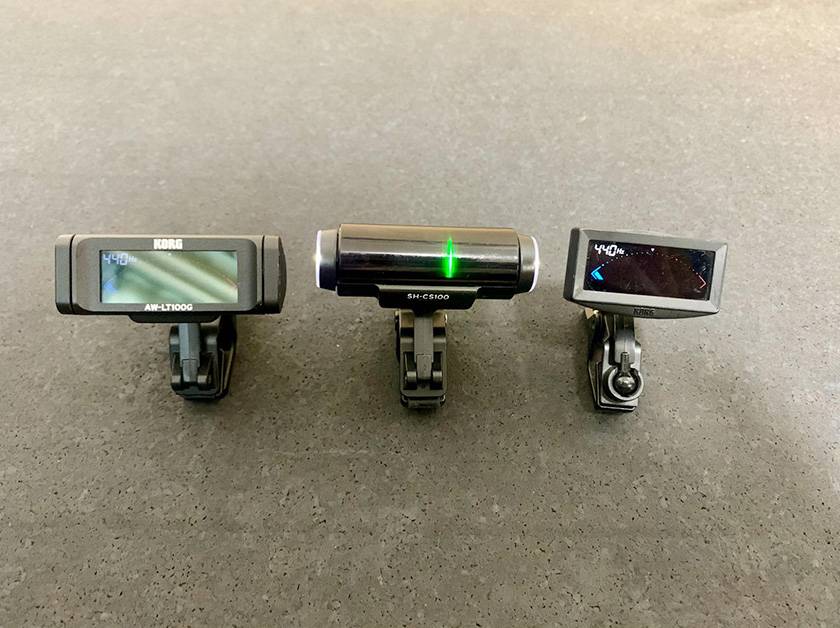
The Three Models Compared This Time
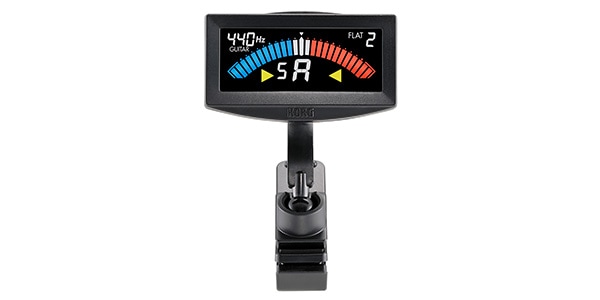
AW-4G
The most compact clip-on tuner while still offering full specifications.
It packs all the necessary functions into a compact body, with an easy-to-read color LCD and excellent usability.
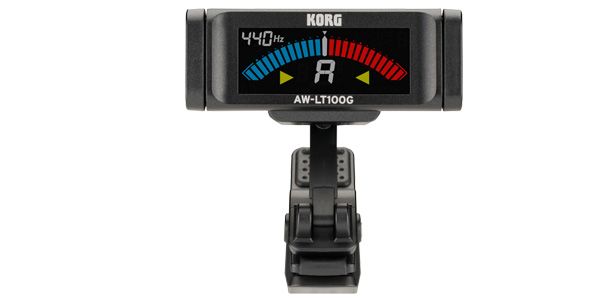
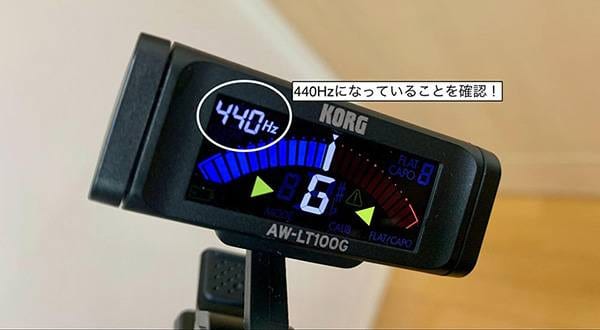
AW-LT100G
A clip-on tuner designed exclusively for guitar.
By eliminating unnecessary functions, it features a very fast response speed.
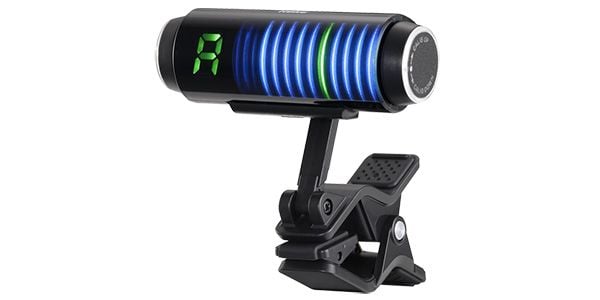
SH-CS100
A clip-on tuner positioned at the top of KORG’s lineup.
Equipped with a 3D visual meter, it offers outstanding visibility even in dark environments or under strong lighting.
Comparison Chart on Specs
| Model | Tuning Accuracy | Tuning range | Power | Battery Lifespan | Weight (w/ batteries) |
|---|---|---|---|---|---|
| AW-4G | ±0.1 cents (fine tuning) | A0~C8 (Chromatic mode) |
CR2032 ×1 | Around 24 hours | 21g |
| AW-LT100G | ±0.1 cents (strobe mode) | B1~E6 | AAA battery ×1 | Around 100 hours | 32g |
| SH-CS100 | ±0.1 cents (strobe mode) | A0~C8 | AAA battery ×1 | Around 100 hours | 37g |
Actual Usage Review
From here, I will provide a detailed review based on testing with guitars (6-string / 7-string) and basses (4-string / 5-string).
AW-4G — Lightweight, Compact, Versatile Model
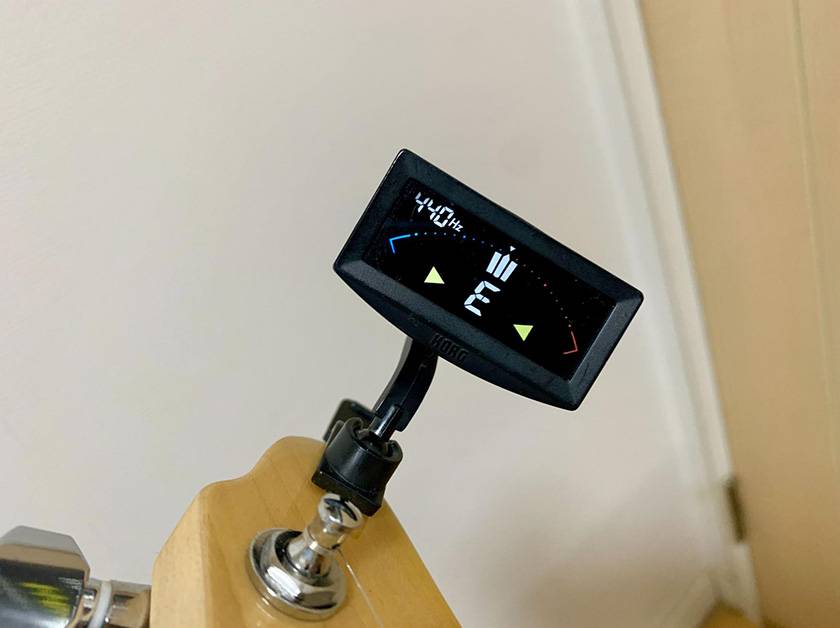
What I felt about the AW-4G is that it is a standard model with all the necessary functions.
Its response speed and accuracy were both reliable, and it correctly responded to the low B on a 7-string guitar.
The display is in color, offering high visibility, and the needle movement feels natural and easy to read. A feature especially helpful for beginners is the “1st string over-winding warning” displayed in guitar mode. When you’re inexperienced, there’s a risk of breaking the 1st string due to over-winding after restringing, so this feature is very useful.
It picks up notes reliably even on basses (4-string and 5-string).
Some lower-priced clip-on tuners respond sluggishly to the low notes of the 4th and 5th strings, but this one does not have that issue.
The fine-tuning mode(±0.1 cents) does not react as quickly as a strobe tuner, so for those who find strobe tuners difficult, this model may feel easier to handle.
Considering its weight of 21g, sufficient functions, and overall balance including price, I highly recommended this tuner for beginners.
AW-LT100G — High-Response Guitar-Specific Model
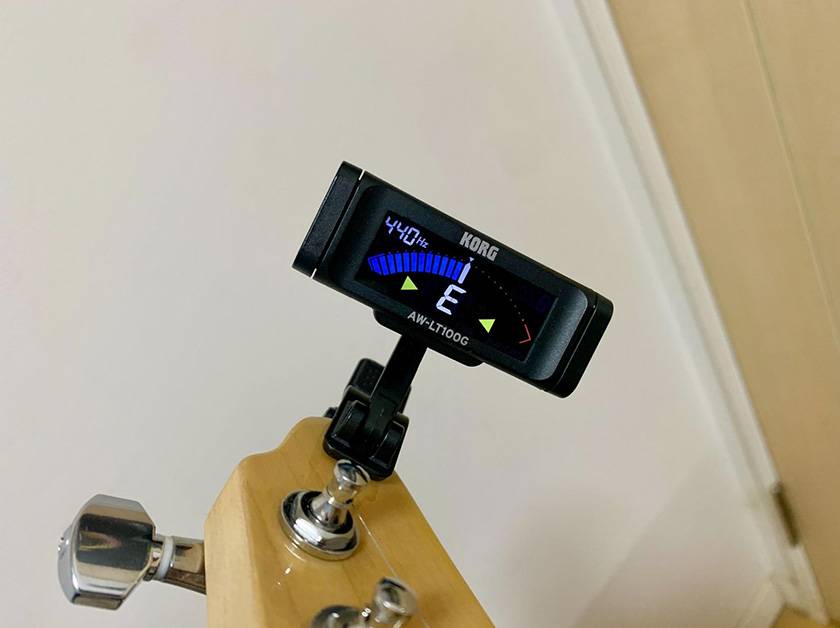
The AW-LT100G felt like the fastest-reacting tuner among those compared this time.
It responds instantly when a string is plucked, making it ideal for guitarists who want to quickly tune before a live show or frequently check their tuning.
The tuning range is set for guitars, from B1 to E6, but in practice it also responded well to basses (4-string and 5-string).
The strobe mode reacts more sensitively than the AW-4G’s fine-tuning mode, making it easier to achieve highly precise tuning in my experience.
Battery life is about 100 hours with AAA batteries, making running costs lower than the AW-4G (which lasts about 24 hours).
The only drawback is that, despite being designed for guitar, it does not display string numbers.
For beginners, having a string number display would make it easier to use.
SH-CS100 — Top Model with Excellent Visibility 3D Visual Meter
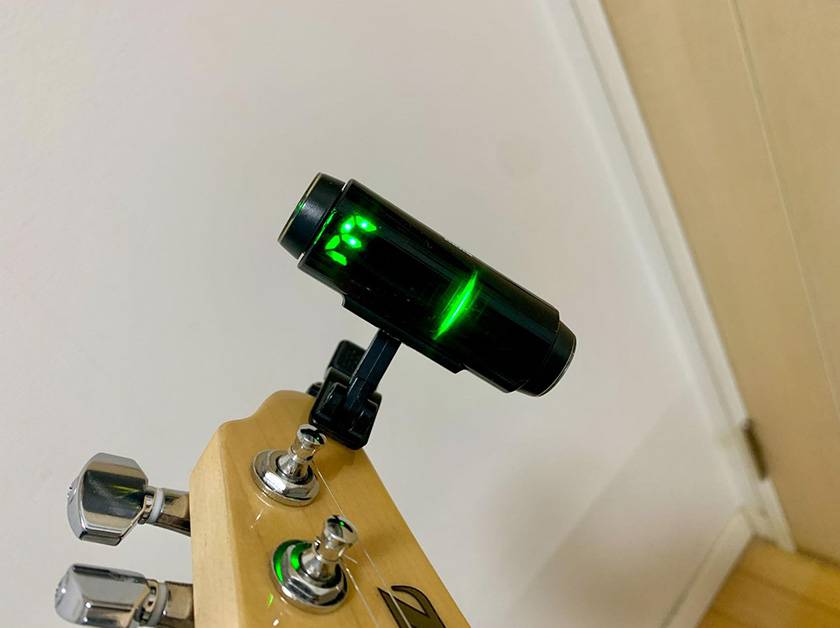
The first thing I noticed when using the SH-CS100 was the clarity of the 3D visual meter.
Unlike a normal LCD, it resists glare, so visibility is not compromised even under stage lighting or sunlight.
This feature proves invaluable in live houses or outdoor stages where lighting conditions are unstable.
Regarding response speed, in normal mode, the AW-LT100G felt faster to me, but in strobe mode, the SH-CS100 feels smoother and more precise.
Tuning stability is excellent, as expected from a top-tier model.
It handles 7-string guitars and 5-string basses without issue.
Weighing 37g, it is the heaviest of the three models, but the clip is correspondingly more stable, so it feels secure when attached to the headstock.
It operates on a single AAA battery for about 100 hours. While this is technically the same as the AW-LT100G, the AW-LT100G achieves that runtime only with the backlight off, so the SH-CS100 may feel like it has slightly longer battery life.
Summary — Which One Should You Buy? Recommended by Use
If you want something extremely light and easy to handle
- 21g, the lightest model
- Packed with beginner-friendly features
If you want something simple with high response speed
- Fastest response of the three models
- Simple functions specialized for guitar
If you want something with excellent visibility
- Easy-to-read 3D visual meter
- Long battery life: approximately 100 hours with a AAA battery
All KORG clip-on tuners offer a certain level of accuracy and reliability, so you can’t go wrong with any of them.
However, preferences may vary depending on response speed, visibility, and features.
Choose the clip-on tuner that best suits your playing style.
The column “sound & person” is built on submissions from our readers.
For more details on submissions, click here.






 エレキギター弦の選び方
 チューナーの選び方
 オクターブチューニングの方法
 弦の張り替え(エレキギター)
 ギターのお手入れ
 音を合わせる(チューニングの方法)
 Discount Sale
 Outlet
 New Arrivals
 Podcast (streaming)
 Headphones / Earphones
 Microphones
 Wireless Equipment
 Speakers
 Power Amps
 Mixers
 Processors
 Portable PA Systems
 Recorders
 Karaoke
 Guitars
 Basses
 Ukuleles
 Drums & Percussion
 Pianos / Synthesizers
 Wind Instruments
 Stringed Instruments
 Japanese Instruments
 Harmonicas, Other
 Software
 DJ & VJ
 Stands
 Cables & Connectors
 Racks & Cases
 Lighting
 Stage & Truss
 Video Equipment
 PC PERIPHERALS
 Power Supplies
 Studio Furniture
 Household Items, Other
 Alcoholic Beverages