When sharing original songs within a band, the first thing that usually comes to mind is sending members a demo recording, either via a voice memo or a DAW. This method is convenient, so many bands naturally use it.
However, if there are members who can read sheet music, it is highly recommended to provide sheet music (a score) in addition to the audio.
That said, trying to transcribe every part in detail like a commercial band score requires an enormous amount of time. Especially if the composer is trying to write all the parts alone, it can be an extremely laborious task without prior experience.
This is where the “master score”, which I will talk about in this article, comes into play.
What Is a Master Score?
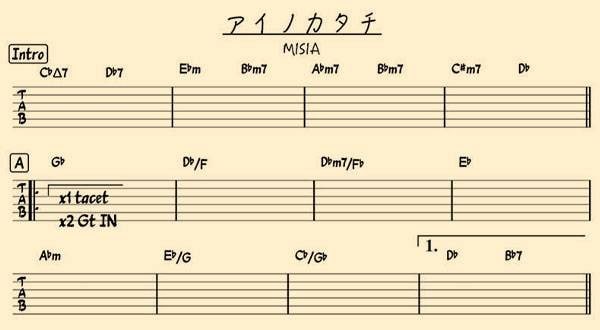
A master score is a simplified sheet that extracts and records only the most essential information needed for arranging a song, such as:
- Time signature
- Tempo
- Chord progressions
- Song structure
- Key rhythmic hits
Unlike TAB notation or scores specialized for a particular instrument, a master score serves as a “blueprint of the song” that all band members can use collectively. In terms of writing, it’s not a “finished manuscript” but more like an outline summarizing chapters and key points. The details are then filled in by each player as they arrange their parts, allowing for flexibility in the creative process while conveying only the necessary information clearly.
Advantages of a Master Score
1. Extremely Easy to Create
There’s no need for detailed notation—just organizing rough information is enough to form a usable score, drastically reducing preparation time.
You can even create a rough master score on the same day you come up with a song idea and take it straight to the studio.
2. Easy to Annotate
Master scores allow plenty of margin space, making it simple to jot down ideas that come up during rehearsal or note arrangements decided on the spot.
For example:
- “Add a guitar cutting in the 4th measure of the A section.”
- “Change the break in the chorus to a two-beat stop.”
Writing these changes directly on the score makes it easier to share information among band members.
3. Dramatically Smoother Communication Among Members
During rehearsal, it’s much faster and clearer to say, “Let’s start from the 2nd measure of the C section” than “The part at 1:38 in the track…,” reducing misunderstandings.
4. Extremely Useful During Recording
During recording sessions, having accurate information about song structure and tempo is crucial.
A master score helps prevent problems such as:
- Re-recording due to miscommunication about the structure
- Differences in rhythm interpretation
- Discrepancies in hits or accents
Actually Creating a Master Score
Next, I will explain key points for creating a master score, using an example from my own experience in band activities.
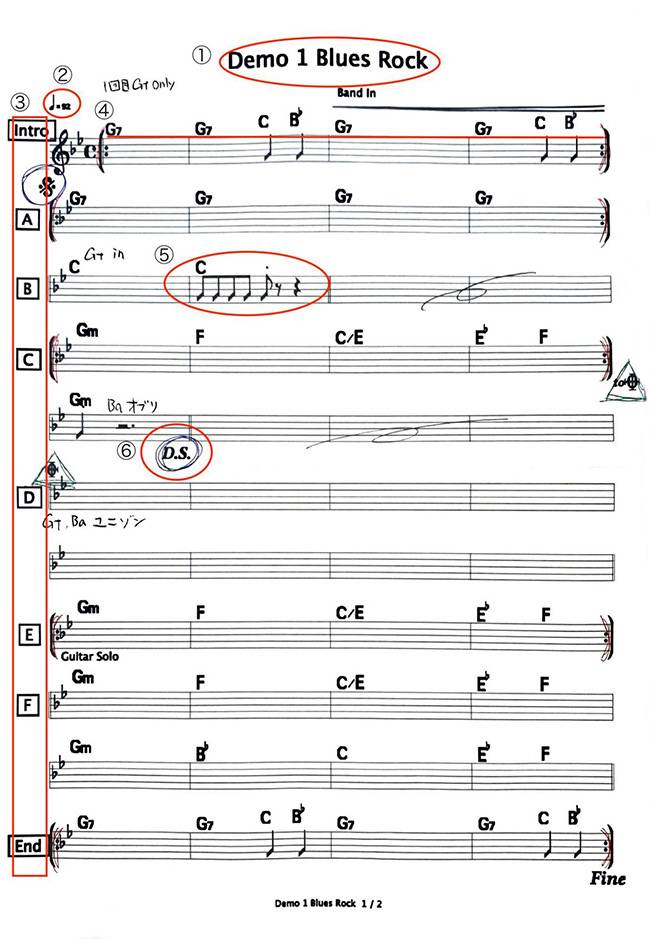
1. Write the Title
Even if the song doesn’t have a finalized title, assigning a temporary one makes it easier to identify the track when looking at the score.
Examples include:
- “Ballade #3”
- “Funk_idea”
- “New mid-tempo song”
A simple keyword that conveys the “feel” of the song is sufficient.
2. Write the Tempo
Tempo is one of the most important elements for sharing the song’s overall feel.
If possible, write the BPM; if it hasn’t been decided yet, abstract descriptions like Slow / Mid / Fast are fine. Adding the style or groove can make the intent even clearer.
- Fast 16beat Funk
- Slow 4beat Ballad
- Mid Shuffle
- Uptempo Rock
Having the genre indicated alone allows even members seeing the song for the first time to get a rough idea of the feel.
3. Write the Sections
Documenting the song structure and section names greatly improves efficiency during later arrangement work. Typically, letters like A, B, C… are used, but you can also use terms that fit your band’s culture, such as:
- A Melody
- B Melody
- Chorus
- Bridge
- Interlude
Simply having these section names makes communication much smoother, for example:
- “Let’s add a drum fill in the 4th bar of A Melody.”
- “Let’s start together from the C Section.”
4. Write the Chords
Chord progressions are essential for guitar, bass, and keyboard, but they are also important for vocalists and drummers.
- ● Vocalists
- → Helps fill in gaps that are hard to grasp from the audio alone when thinking about melody or harmonies.
- ● Drummers
- → Understanding the harmonic progression makes it easier to create fills and dynamics that match the song’s structure.
Having the whole band understand the song as a structure leads to more cohesive arrangements.
5. Write the Key Rhythmic Hits (Hits/Accents)
If there are specific rhythmic hits or phrases that the band wants to synchronize, indicate them on the score, even in a simplified form.
If you’re unsure about the notation, you can program the phrase in a DAW and use its built-in score display to check the notation.
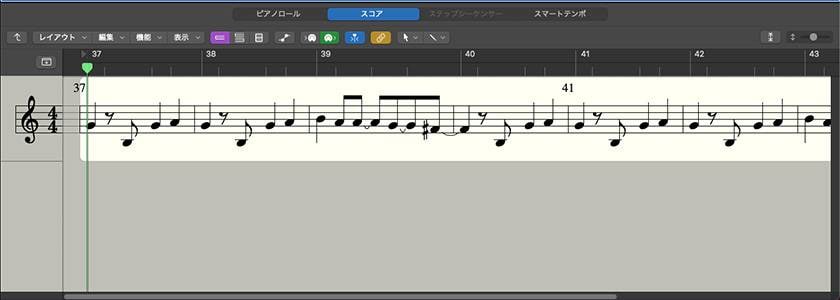
Example in Logic:
The common problem of “the hits being off every time” can be resolved simply by having a master score.
6. Other Notations and Tips
Other Notations and Tips
Using symbols like D.S. (Dal Segno), Coda, and repeat signs can make the score more compact, but if overused, they can make it harder to read.
In recent years, many musicians read scores on tablets and turn pages with a foot switch.
IK MULTIMEDIA / iRig BlueTurn Bluetooth foot pedal
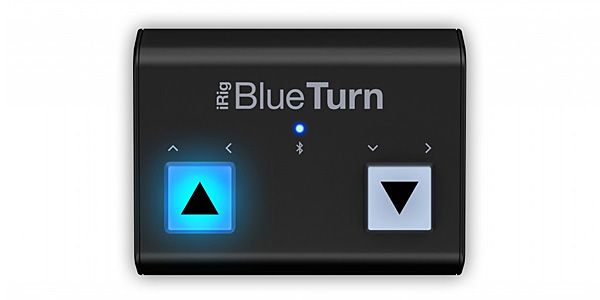
In such cases, overusing repeat signs can require “rewinding” pages, so sometimes it’s more user-friendly to write things out straight through.
Summary
The greatest appeal of a master score is that it allows all band members to approach rehearsals, arrangements, and recordings with a shared understanding of the song.
When sharing only audio, misunderstandings often arise, such as: “I thought this section was 16 bars” or “The structure sounded different to me.”
However, having just one master score can dramatically improve:
- Speed of songwriting
- Accuracy of information sharing
- Consistency of arrangements
Give it a try and see the difference!
The “sound & person” column is made up of contributions from you.
For details about contributing, click here.



![Recommending the App Piascore for iPad Music Scores! [Part 2]](/contents/uploads/thumbs/5/2022/12/20221229_5_20564_1.jpg)
![Recommending the App Piascore for iPad Music Scores! [Part 1]](/contents/uploads/thumbs/5/2022/12/20221229_5_20562_1.jpg)
 バンドマン愛用 推し機材
 DTMに必要な機材
 停電時にパソコン、作曲データを守る!!
 ミュージシャン数珠つなぎ インディーズバンド編
 激レア?激アツ?みんなのお宝自慢
 DTM・DAW購入ガイド
 Discount Sale
 Outlet
 New Arrivals
 Podcast (streaming)
 Headphones / Earphones
 Microphones
 Wireless Equipment
 Speakers
 Power Amps
 Mixers
 Processors
 Portable PA Systems
 Recorders
 Karaoke
 Guitars
 Basses
 Ukuleles
 Drums & Percussion
 Pianos / Synthesizers
 Wind Instruments
 Stringed Instruments
 Japanese Instruments
 Harmonicas, Other
 Software
 DJ & VJ
 Stands
 Cables & Connectors
 Racks & Cases
 Lighting
 Stage & Truss
 Video Equipment
 PC PERIPHERALS
 Power Supplies
 Studio Furniture
 Household Items, Other
 Alcoholic Beverages