The structure for producing voice can be divided into several elements. If I divide vocalization into three parts, they would be breathing, which can be called the engine that sends air; the area around the vocal folds, which serves as the sound source; and the resonating cavities, which can be considered the filter that determines the final sound quality. This time, I would like to write about breathing.
■ Mammals and the Diaphragm
Over the course of evolution, mammals acquired a diaphragm and achieved efficient breathing. The respiration of mammals and closely related species performs gas exchange through the expansion and contraction of the lungs. Since the lungs themselves do not have muscles, they are like bags that cannot expand or contract on their own. By using the surrounding muscles, they can expand and contract, making gas exchange possible.
Animals that do not have a diaphragm expand the rib cage to cause the lungs to expand and contract. Mammals, in addition, can take in oxygen more efficiently by using the diaphragm.
However, muscles function only by pulling in one direction. Naturally, they cannot push back; at best, they can relax and return to their original length.
What is important here is that the role of the diaphragm is a muscle dedicated to bringing air into the lungs, meaning that inhalation, the act of breathing in as a living organism, is prioritized. Conversely, there is no muscle dedicated specifically to exhalation, the act of breathing out. When the diaphragm relaxes, the lungs merely contract to a certain extent, but they cannot push the air out of the lungs.
Humans speak and sing during exhalation, which means there is no dedicated muscle for that purpose. If such a dedicated muscle existed, perhaps anyone could easily produce a stable voice. Singers mobilize all the surrounding muscles to achieve stable exhalation, which means they are performing complex control.
Many vocalizations of other mammals are produced during inhalation. When they vocalize for a relatively long time, the proportion of inhalation is likely higher. A dog’s howl, for example, is thought to be produced during inhalation. With inhalation, stable sound production is possible by using the diaphragm. Because they are using a dedicated muscle that is originally built in, it is natural, requires no instruction, and every dog can do it. Humans can also vocalize during inhalation, but because we are too accustomed to exhalation-based phonation, it seems to be quite difficult.
■ Humans Vocalize during Exhalation
Then why do humans not speak or sing during inhalation? One possible reason is that, as a result of prioritizing greater freedom in articulation, exhalation made it easier to create variations. Another aspect is that producing sounds during inhalation may have increased the risk of foreign objects entering too much.
When humans are babies, they can breathe while drinking milk. If an adult tries to do this, milk can enter the lungs and cause serious trouble. The illustration below compares a monkey and a human.
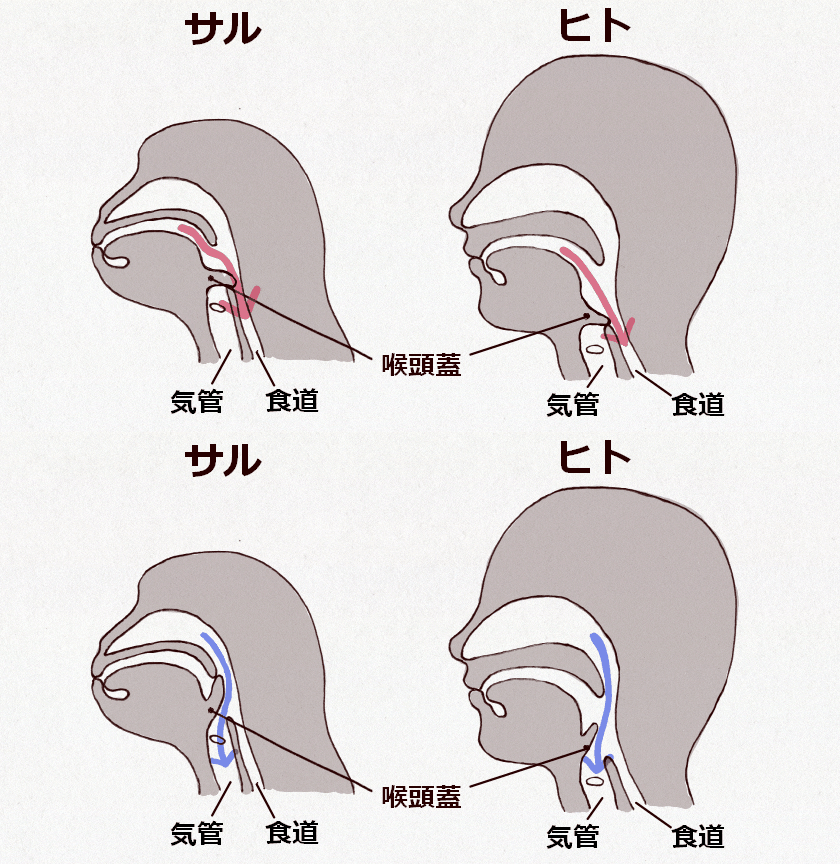
Monkeys and babies have similar structures. When a monkey breathes, the epiglottis rises and shuts out food, but in humans the original switching function using this “lid” no longer works. This allows for complex articulation using the oral cavity, but it also increases the risk of foreign objects entering the lungs. Vocalization using inhalation therefore also becomes risky, so it is thought that humans shifted toward producing voice on exhalation.
■ Abdominal Breathing and Chest Breathing
Breathing is often broadly divided into abdominal breathing and chest breathing, but in reality they are used in combination. Abdominal breathing prioritizes the up-and-down movement of the diaphragm, while chest breathing prioritizes the movement of the rib cage; the terms differ depending on which is emphasized more. It is reasonable to think that an extreme form of breathing that uses only one or the other is impossible.
Structurally, when a certain amount of air is taken into the lungs and the muscles such as the diaphragm are relaxed, the air inside the lungs flows out through the mouth or nose. During that time, the vocal folds vibrate and become sound. Rather than thinking of it as airflow, it is better to think in terms of pressure difference. To achieve stable exhalation, the image is not so much keeping the amount of air coming out constant as keeping the internal pressure of the lungs constant.
As for how to maintain the internal pressure of the lungs, it is quite troublesome because there is no dedicated muscle. Simply relaxing the diaphragm results in unstable exhalation, and phonation in which the abdomen gradually caves in also seems odd. In order to vocalize while maintaining internal lung pressure, there is no choice but to mobilize surrounding muscles such as the back muscles and gradually press on the lungs. Rather than picturing the lungs deflating, it is more like gently pushing on fully inflated lungs from behind or the sides little by little, maintaining a “full” state even as the volume decreases.
■ Ways to Make Breathing Easier
Humans are thought to have evolved from quadrupeds, so adopting a posture similar to that of four-legged animals often makes things more efficient. It can be said that once humans became upright and their arms began hanging from the rib cage, they ended up in a posture that makes breathing more difficult. Originally, the arms supported the body as forelimbs, but by standing upright they became something that hangs from the body. The weight of the arms interferes with the movement of the rib cage and thus hinders breathing. When the arms are raised, the weight of the arms pressing on the rib cage is reduced, the rib cage expands, and air enters the lungs more easily. This corresponds to deep breathing. Movements that we naturally perform in everyday life are rational.
■ Avian Breathing
As an aside, the way birds breathe has evolved to what could be called an entirely different dimension. Instead of expanding and contracting their lungs, birds have a one-way circulatory pump system. The structure takes into account not only efficient gas exchange but also sound production, and it even includes resonating tubes. I think they would be number one in an animal-world vocalization contest. Mammals originally evolved on the dangerous land where there were many natural enemies, so they were sensitive to surrounding sounds, but producing sounds themselves is not that important and is rather a risky behavior. In contrast, birds need to communicate with companions far away in the non-resonant open air, so they can produce sounds at considerable volume and have acquired a level of sound production that is in a different dimension compared to other animals.
Once you understand birds, you come to recognize humans as animals that are not particularly good at singing. Next time, I would like to explore human breathing.
The column “sound & person” is supported by submissions from everyone.
For details about submissions, see here.

![Enchanting Instruments 13 - Timbre of Instruments [Resonance]](/contents/uploads/thumbs/5/2021/10/20211025_5_14727_1.jpg)
 お化けを倒してサウンドGET!
 バンドあるある相談
 サウンドハウス社員が選ぶ 『おもしろ商品』はコレだ!
 ○○やってみた!
 最新コラム&動画をCheck!! OTOYA通信
 サウンドハウス虎の巻 !
 Discount Sale
 Outlet
 New Arrivals
 Podcast (streaming)
 Headphones / Earphones
 Microphones
 Wireless Equipment
 Speakers
 Power Amps
 Mixers
 Processors
 Portable PA Systems
 Recorders
 Karaoke
 Guitars
 Basses
 Ukuleles
 Drums & Percussion
 Pianos / Synthesizers
 Wind Instruments
 Stringed Instruments
 Japanese Instruments
 Harmonicas, Other
 Software
 DJ & VJ
 Stands
 Cables & Connectors
 Racks & Cases
 Lighting
 Stage & Truss
 Video Equipment
 PC PERIPHERALS
 Power Supplies
 Studio Furniture
 Household Items, Other
 Alcoholic Beverages