The piano is often called the king of instruments. Among musical instruments, it has a wide range and is a complete instrument capable of performing complex ensembles alone, so it can certainly be called an exemplary instrument. However, the heart of music has always been the voice. This time, I would like to consider the voice as an instrument and look at it from several perspectives.
■ Do People Want to Hear Other People’s Voices?
In any ensemble, if there is singing, listeners naturally tend to focus on the voice. This can be considered a characteristic of humans as animals. People are sensitive to human voices. Once we recognize a sound as a human voice, it is normal to unconsciously concentrate on it. This is why no other instrument can surpass the presence of the voice.
This also means that humans have a high ability to distinguish voices. We can easily tell the difference between male and female voices, and we can quickly recognize whose voice it is. Subtle emotions can even be inferred from the voice. The amount of information obtained from the voice is vast, and everyone has the ability to distinguish it. For this reason, when testing equipment, using a human voice allows even amateurs to detect subtle differences in the equipment.
Not only humans, but animals are extremely sensitive to the calls of their own species. One might even want to call it a “same-species filter”, as they can clearly distinguish between their own species and others. When I once cared for a baby bird, nearby birds of a similar species would come to investigate whenever the chick made a sound. When they realized it was unrelated, they would leave, but one after another, birds kept approaching, which felt quite strange. Similarly, if you imitate a cat’s meow in front of a cat, it may just watch indifferently, but if the imitation is very accurate, it can startle the cat. Animals seem unable to ignore the calls of their own species.
■ Vocal Range
This corresponds to the range from classical soprano to bass. Each part spans less than two octaves, so the range is not very wide. When combining all four parts, the total range is roughly equivalent to that of an acoustic guitar. The reason each part does not cover a wide range is that volume is necessary. Classical music originally emphasizes resonance with the natural human voice and does not assume electrical amplification. To secure sufficient volume, each part focuses on the range it can perform most effectively.
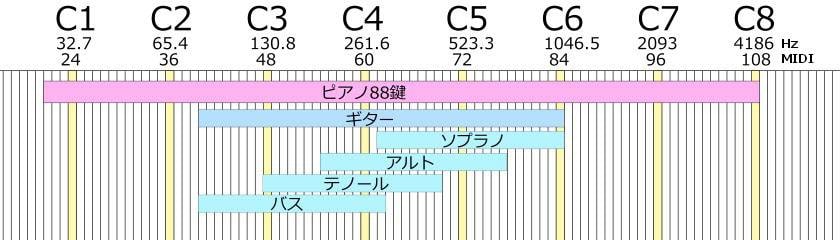
In popular music, the vocal range used often differs from that of classical music and has changed over time. Today, microphones are used to secure volume electrically, so natural vocal volume is not emphasized as much. Instead, the range used tends to shift or be slightly broader.
In the past, many professional singers came from classical backgrounds, so the ranges they used were similar to classical music. Male singers primarily emphasized the “male” quality of their voices by singing in lower ranges, while female singers emphasized the “female” quality by singing in higher, soprano-like ranges.
However, over the past few decades, men have begun singing in higher ranges than before, with tenors hitting their top notes becoming quite normal. Conversely, women tend to sing in lower ranges more prominently. In some cases, it can be difficult to tell whether a singer is male or female just by listening.
Why has this change occurred? It’s not that the human vocal structure has changed over the past few decades. Rather, it reflects a shift in what is expected of singing in popular music.
A clear factor is that changes in ensemble sound have altered the demands placed on vocals. In particular, men singing too low can easily be drowned out in certain ensemble arrangements. In rock music, singing in a relatively higher range is almost inevitable.
The reason women sing in lower ranges has a different cause. Popular music tends to place emphasis on lyrics, so the vocal range has shifted to better match the words. In the high soprano range, pronunciation becomes difficult due to formant characteristics, making the lyrics inevitably less clear. For conveying lyrics effectively, the high range is too extreme.
A more complex factor may be the growing social recognition of the appeal of androgynous or neutral vocal qualities. The music industry has always had many such individuals, and now they can express themselves more openly without hiding it.
In short, vocal ranges change to match the sound and expressive content demanded by the era.

■ Vocal Quality
People have a wide variety of voices. It may seem like there is a very broad range, but this perception may not be entirely objective because of the “same-species filter” mentioned earlier. After all, listening abilities vary greatly between species, so animals whose calls sound similar to us may perceive them as completely different. A familiar example for humans is crows—their voices vary enough to identify individuals, which is fascinating.
Returning to humans, what causes voices to sound so different? Part of it comes from the shape and size of the vocal organs, which is absolute, but much of what we perceive as individuality comes from how the voice is used. Since voices are used every day from birth, the way they are used becomes fixed at a habitual level. These habits are unconscious, so correcting them is difficult. There are good and bad ways of using the voice, but these habits form the basis of individuality. In popular music especially, where almost anything goes, many singers have distinctive vocal styles.
Even among professionals, there are those considered exemplary models to emulate, and others whom it is advised not to imitate. Judging good or bad is subjective. If the listener thinks it is good, then it is good—but professionals need to sing consistently and ideally sustain a long career. From that perspective, a style of singing that allows stable performance over long periods without strain becomes one important standard.
Since vocalization is essentially the culmination of habitual patterns, acquiring a completely new way of producing the voice can, in a sense, be more difficult than learning to play a musical instrument. However, by understanding its structure and mechanisms, useful insights can emerge. Next time, I would like to explain the mechanisms of vocalization.
The column “sound & person” is supported by submissions from everyone.
For details about submissions, see here.



![Enchanting Instruments 19 - Voice 2 [The Breath Part 1]](/contents/uploads/thumbs/5/2021/11/20211105_5_14981_1.jpg)

![Enchanting Instruments 13 - Timbre of Instruments [Resonance]](/contents/uploads/thumbs/5/2021/10/20211025_5_14727_1.jpg)
 お化けを倒してサウンドGET!
 バンドあるある相談
 サウンドハウス社員が選ぶ 『おもしろ商品』はコレだ!
 ○○やってみた!
 最新コラム&動画をCheck!! OTOYA通信
 サウンドハウス虎の巻 !
 Discount Sale
 Outlet
 New Arrivals
 Podcast (streaming)
 Headphones / Earphones
 Microphones
 Wireless Equipment
 Speakers
 Power Amps
 Mixers
 Processors
 Portable PA Systems
 Recorders
 Karaoke
 Guitars
 Basses
 Ukuleles
 Drums & Percussion
 Pianos / Synthesizers
 Wind Instruments
 Stringed Instruments
 Japanese Instruments
 Harmonicas, Other
 Software
 DJ & VJ
 Stands
 Cables & Connectors
 Racks & Cases
 Lighting
 Stage & Truss
 Video Equipment
 PC PERIPHERALS
 Power Supplies
 Studio Furniture
 Household Items, Other
 Alcoholic Beverages