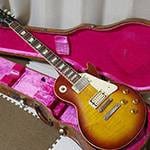
Someone mentioned, “This is a blog by a string specialist staff member, yet the profile says ‘Tokai LS80, made in 1979,’ and I’m curious,” so this time will be a complete bonus article. I’ll be showing my personal 1979 Tokai LS80.
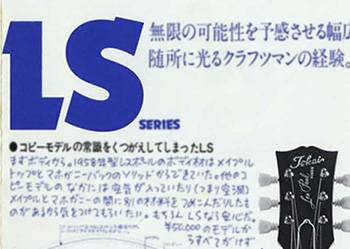
If you’re a guitar enthusiast, you can probably tell what it is just from the model number. It could be said to represent one of the peaks of Japanese electric guitar culture, marketed with claims like “a complete copy of a 1958 Gibson Les Paul.”
We now live in an era where this kind of information can easily be looked up using AI. Someone like me could write nothing and say nothing, and no one would be troubled.
Still, I hope you might find something worthwhile from this blog.
Tokai still sells Les Paul-style copies today. Modern Tokai guitars are of very high quality, and considering how much research has advanced in terms of specifications, there are many aspects where today’s Tokai models may even surpass those from back then.
However, the LS80 introduced here can be considered a model positioned near the origin of it all.
⇒ Recent Tokai Les Paul models
When I Acquired This Instrument
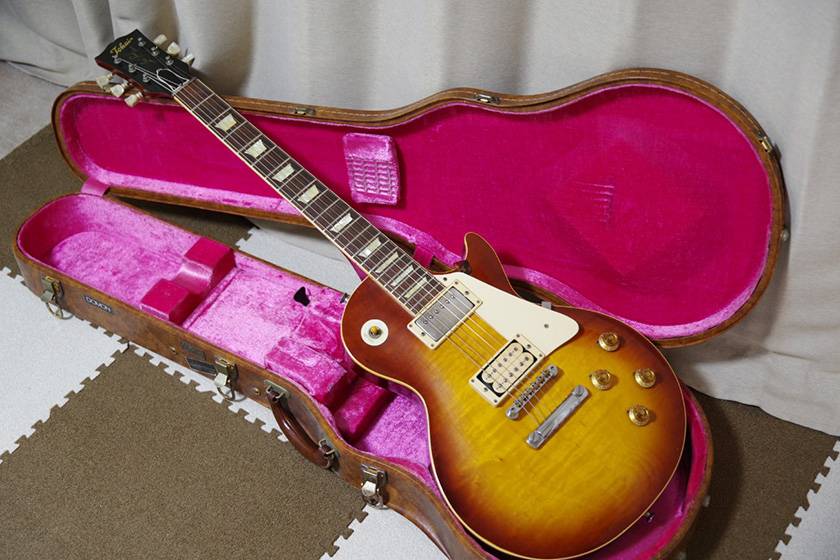
Showa 54 (1979). I was a second-year high school student. I purchased this instrument at the Bunmeidō Musical Instrument Store in Aomori City. It wasn’t one of the items displayed in the store; they ordered it specially for me. The store manager back then, Managing Director Shimoda, went out of his way to arrange with the manufacturer—Tokai Musical Instruments—asking me, “You want a guitar with the tiger flame figure, right?” He saw right through what I wanted.
And here is the instrument that arrived.
At the time this Tokai LS was released, there was a handwritten catalog.
It was about the size of a spread-out newspaper and it wasn’t bound as a booklet. The reason the image is split into top and bottom is because that was the limit when scanning it.
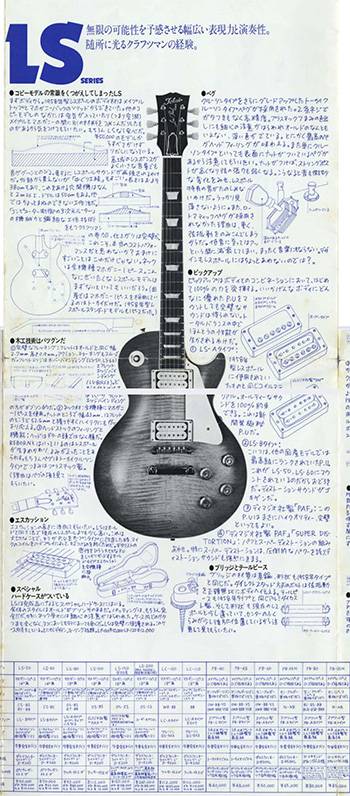
Until I actually got the guitar, I read this catalog over and over until it was in tatters, letting my imagination run wild.
Strange as it may be—or perhaps just coincidence—years later in the 1990s, when I was working at a music store, I had the chance to work with Mr. H, who had been with Tokai Musical Instruments in the 1970s, and Mr. F, the designer who created this catalog. Whether the world is small or I simply had a connection with Tokai, it really made me realize that it was fate.
Headstock
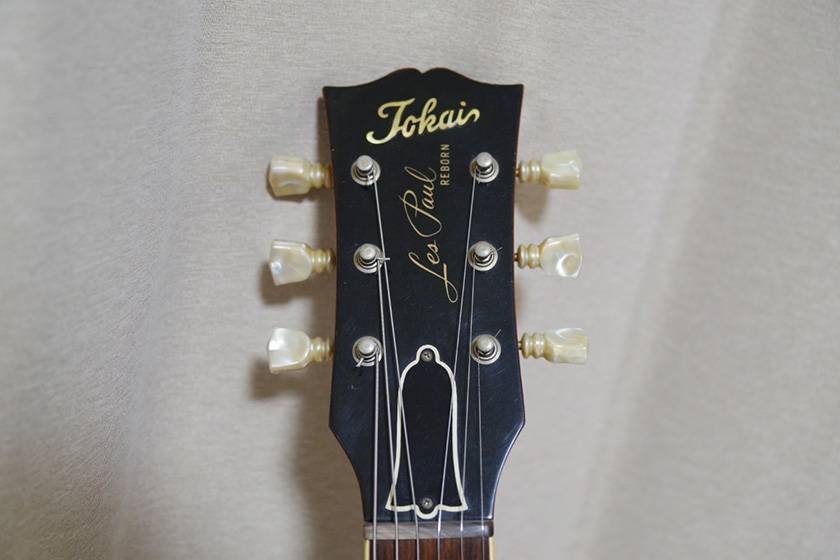
There are small details you could nitpick, such as the peg hole spacing for the 1st and 6th strings being off by about 1mm, the truss rod cover positioned slightly too close to the nut, and the headstock veneer being plastic—but overall, the level of reproduction is impressive.
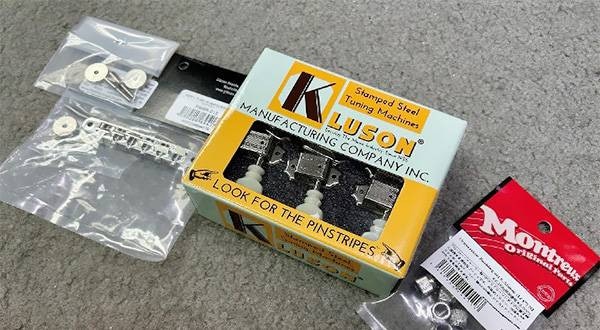
As also noted in the handwritten catalog, the use of Kluson-type tuners plays a major role in the headstock design, and it results in a well-balanced look.
Headstock Angle
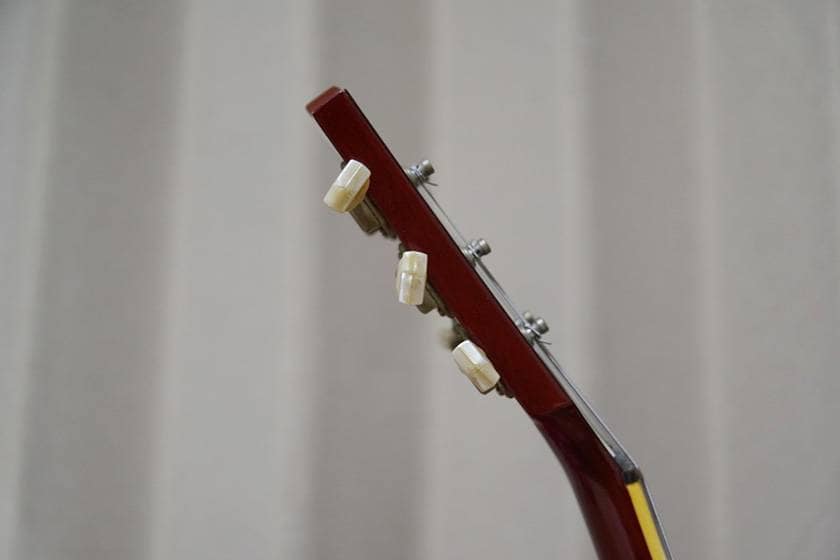
The catalog lists the headstock angle as 18 degrees, but later research on original models, including data from other copy brands like Greco, revealed that the original angle was actually 17 degrees.
It features a one-piece mahogany neck without a volute. The shaping is also excellently executed.
Tuners
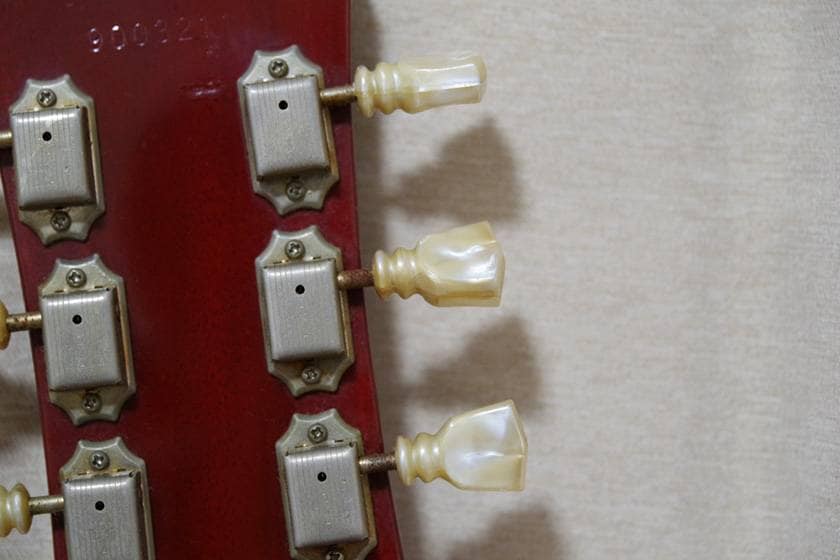
The tuners are Kluson-type with double-ring buttons. Since 1950s models should have single-ring buttons, this double-ring style reflects specifications seen on Gibson models from the 1960s onward.
As mentioned in the handwritten catalog, the color of these tuner buttons is particularly noteworthy—not too white, not too yellow. Of course, they haven’t shrunk like genuine vintage parts, but they truly give off the flavor of an old Les Paul.
Nut and Frets
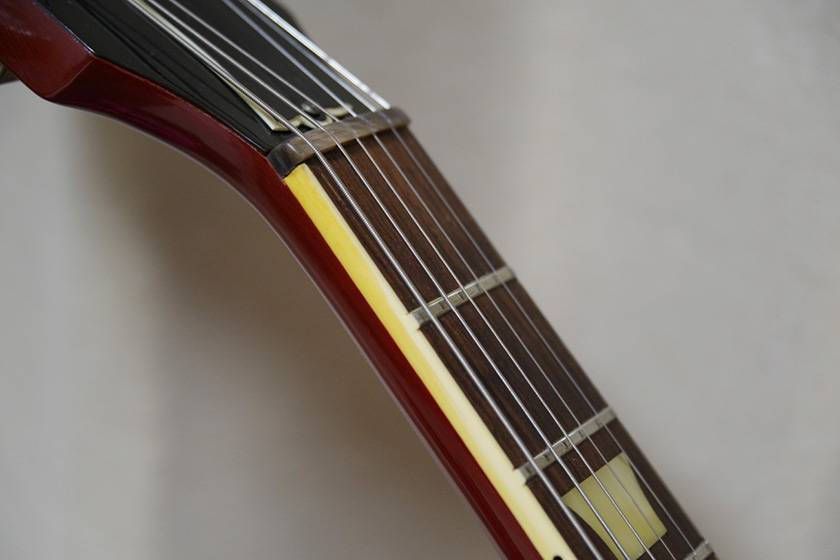
About 20 years ago, I replaced the nut with a buffalo horn one because the original bone nut had deteriorated. That’s why this one is black in color.
The frets are original, but since they have been leveled, their height is lower, but they still seem usable. The fret edge binding is another important point that gives it that “Gibson-like” feel (even though it’s a Tokai).
The neck width and grip are slightly thick, but it truly feels like a “Gibson.” Perhaps it’s because I’ve been playing it for so many years, this neck has become my personal default.
The rosewood fingerboard with mother-of-pearl inlays is also very well finished.
Body
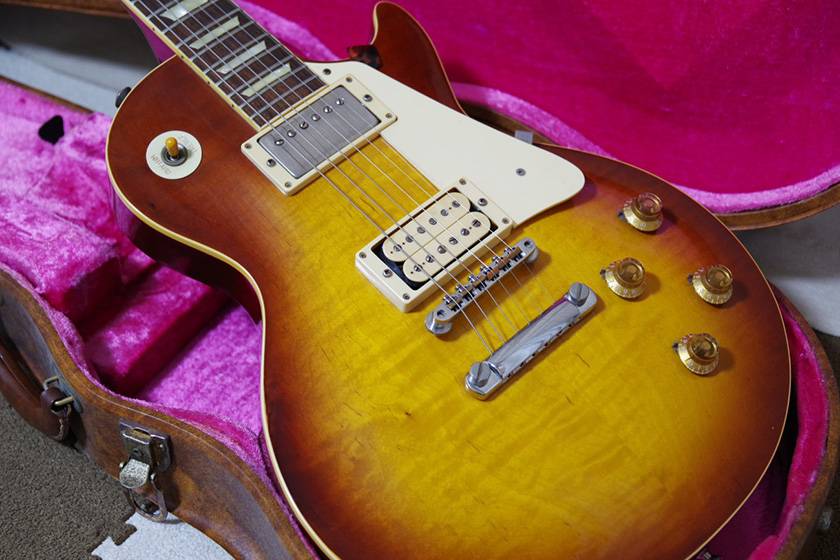
At the time, guitars with flame maple figuring were rare, and higher-end models like the LS200 used carved flame tops. However, as mentioned earlier, this LS80 was special order, so while it doesn’t have the intense flame of a 200,000-yen LS200, I was still able to get a flame-top guitar for 80,000 yen. A Les Paul with visible flame figuring is undeniably appealing.
Back
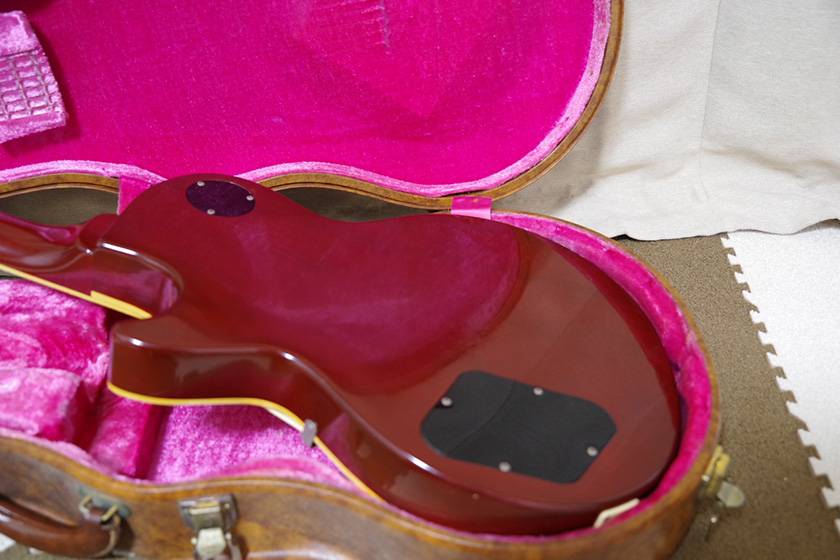
The back wood is made from a single piece of mahogany, which is rare by today’s standards. The origin is unknown, but it is probably not Honduran mahogany because this guitar is very heavy.
Minor Parts Modifications
The original toggle switch was white, but I replaced it with a brown one.
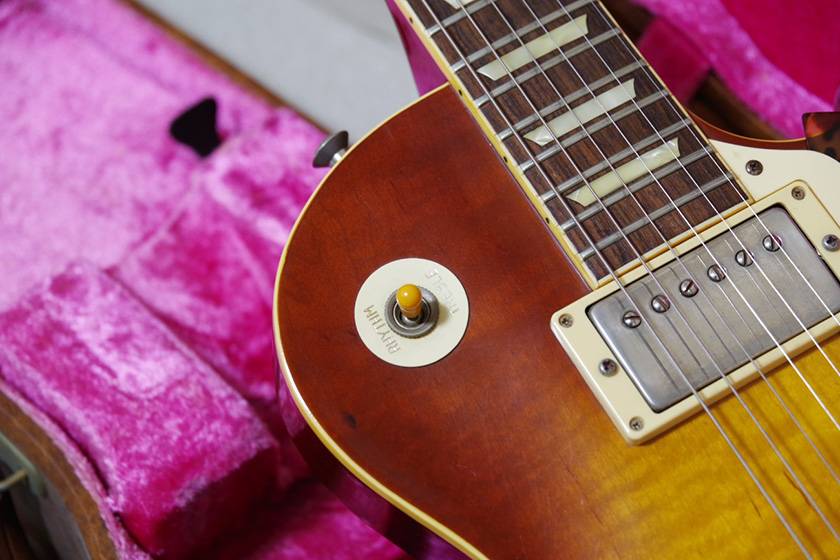
The rear pickup has been replaced with a DiMarzio PAF, and the front with a Seth Lover.
Of course, I have carefully kept the original pickups as well.
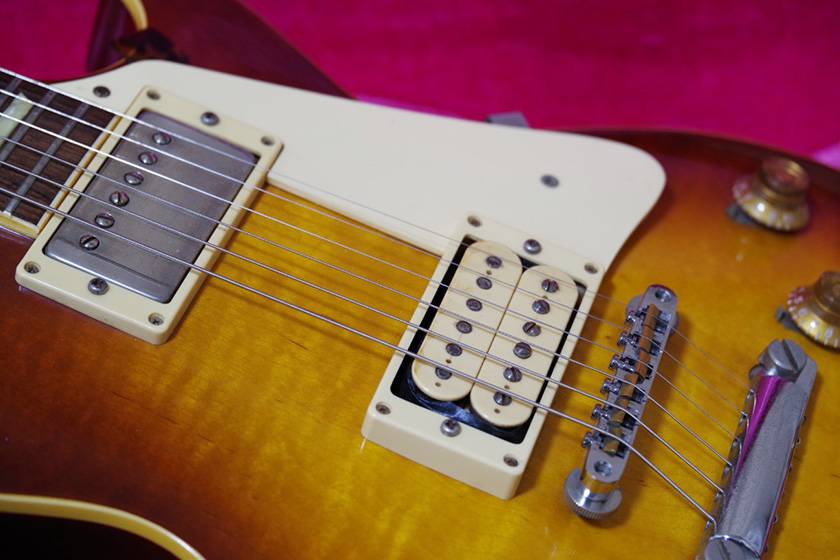
This Tokai Les Paul “copy model” comes with all these specifications. Shortly after its release, due to various circumstances such as design-related claims from the original manufacturer, it transitioned into the “Love Rock” era, making the “Les Paul Reborn” name something that existed only for a very short time.
The overwhelming passion of Japanese manufacturers like Tokai and Greco (with its Mint Collection) may have eventually influenced the original maker and even inspired Gibson’s later old-model revival efforts.
Finally, I would like to show all of you the instrument tag that was probably attached in-store at the time.
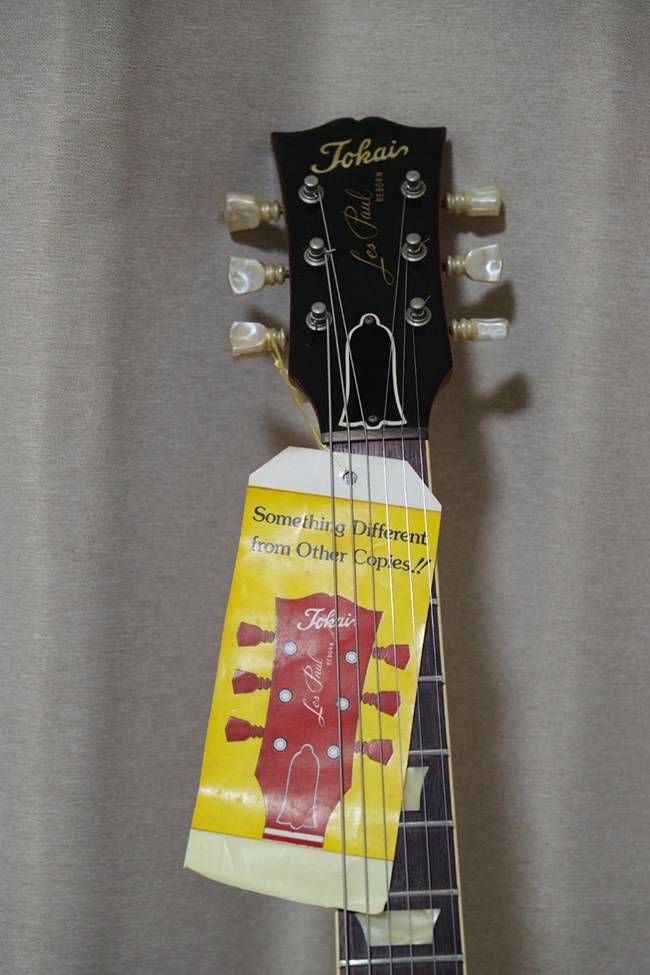
The bottom part of the tag is peeled off, but I remember it originally said “LS80.”
Back then, among rows of instruments of this caliber, an original Gibson Les Paul sat proudly in a display case priced at around 300,000 yen. Even so, this Tokai did not feel inferior at all, and I felt very proud to have it.
That’s all for now.
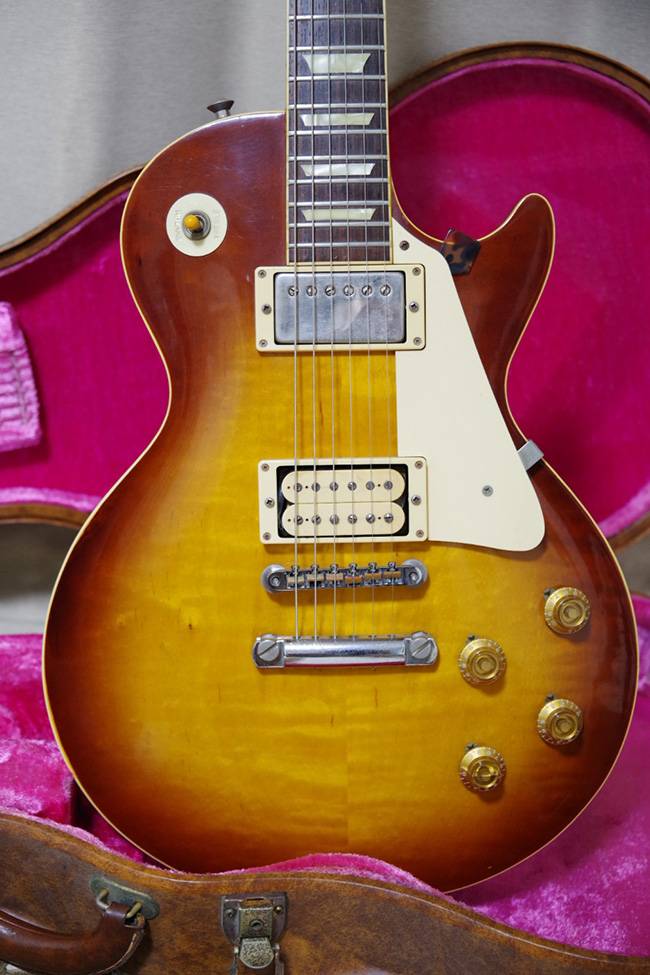
If you’re wondering, “Wait, can’t we hear how it sounds?”—maybe next time.
By the way, the pick I use is a tortoiseshell Ritchie-style pick.
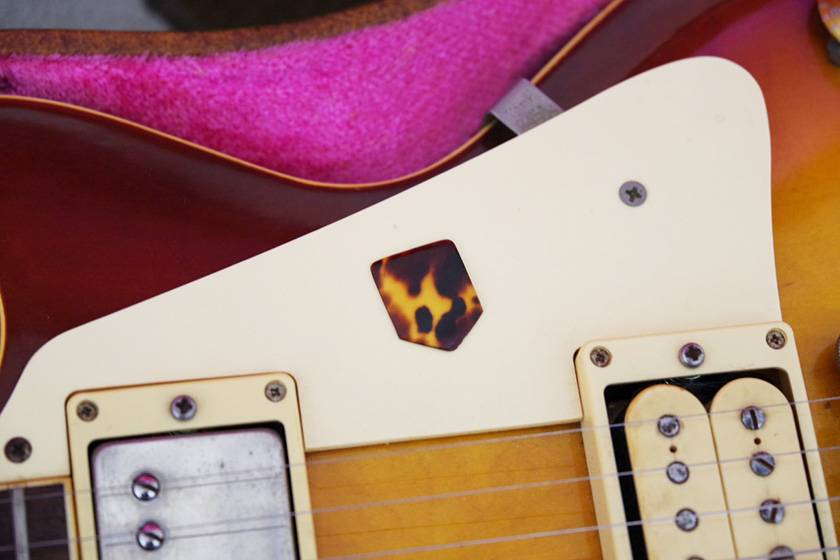
This one has also been around for about 40 years and has become quite small.
Even though it’s a Les Paul… Ritchie? Well, isn’t that good enough?
Meijo Shokai / Genuine Tortoiseshell Pick Bass Shape II (Ritchie Type) 1.2mm
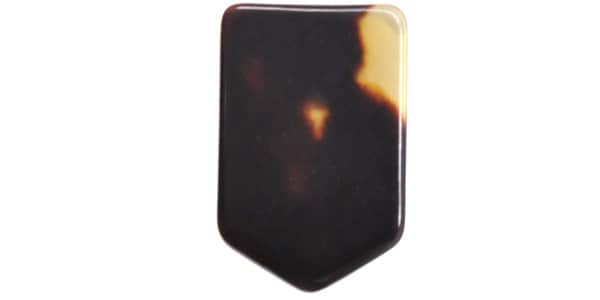
You can still get it at Sound House.



![How to Get the Best Sound Out of a Cheap Violin [Part 1] What Makes for a Good Sound? Who Decides?](/contents/uploads/thumbs/2/2025/4/20250409_2_31047_1.jpg)

 PLAYTECH 弦楽器
 ギターパーツの沼
 初心者必見!PLAYTECH 激スゴの理由!
 弦楽器 初心者講座
 ギター名人ラボ
 ギタースタートガイド
 Discount Sale
 Outlet
 New Arrivals
 Podcast (streaming)
 Headphones / Earphones
 Microphones
 Wireless Equipment
 Speakers
 Power Amps
 Mixers
 Processors
 Portable PA Systems
 Recorders
 Karaoke
 Guitars
 Basses
 Ukuleles
 Drums & Percussion
 Pianos / Synthesizers
 Wind Instruments
 Stringed Instruments
 Japanese Instruments
 Harmonicas, Other
 Software
 DJ & VJ
 Stands
 Cables & Connectors
 Racks & Cases
 Lighting
 Stage & Truss
 Video Equipment
 PC PERIPHERALS
 Power Supplies
 Studio Furniture
 Household Items, Other
 Alcoholic Beverages