Hello.
Lately, I’ve been really into Kirby.
I had a reason to go back to my parents’ house in January, and while I was there, I found my old Kirby Super Star Ultra in my childhood room—the Nintendo DS version of Kirby Super Star that originally came out on the Super Famicom.
I thought, “Wow, so nostalgic! I used to play this so much at my friend’s house!” (That’s my memory of the Super Famicom version—I had completely forgotten that I even bought the DS version.) So I brought it home and turned on my Nintendo DS!!
The opening started, and I was thinking to myself, “It would be funny if it froze,” but it actually ran just fine.
By the way, the Super Famicom version was just as famous for freezing and losing save data as it was for being a fun game.
When I played it at my friend’s house, it would usually freeze about three times during the opening, and every time we’d blow on the cartridge, but since this is the DS version, that wasn’t an issue at all.
So, as I continued playing, I found myself thinking things like, “The title font looks so cool,” and “This background music is great.” I didn’t pay much attention to those details as a kid, but playing it again made me notice so many new charming things about it.
Personally, I really love the BGM that plays in the underwater—or ocean—stage and the one in the airship stage, and I’ve been listening to them a lot lately.
They’re really great tracks, so if you’re interested, try giving them a listen.
There was something else I realized while playing the game. In two-player mode, there’s a system where you can share recovery items.
To share them, you have to collect the item (food) and, within a certain amount of time, bring the characters close together to pass it mouth-to-mouth.
When I was a kid, if we messed up the recovery at that moment, I would yell things like, “Hurry up and kiss!!” “What are you doing?!” “Why didn’t you kiss?!” “Just kiss already!” at the top of my lungs and completely lose my temper. Looking back on it now, that was kind of weird…
I can’t help but wonder now what my parents must have thought.
I probably won’t ever in my life again get that angry while shouting, “Just kiss already!!”
Well, thinking about it like that, I realize Kirby gave me memories I’ll never forget for the rest of my life, and considering that too, it really deserves its reputation as a masterpiece of a game.
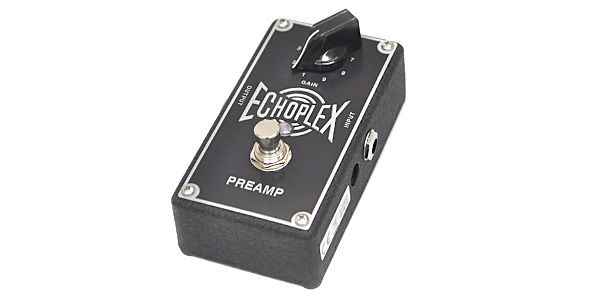
Now then, that was a long story unrelated to the main topic, but starting this time, I’m going to make a JIM DUNLOP / EP101 ECHOPLEX.
To mention in advance, the reason I put “-like” in the title is because I’ll be adding things like current protection into the circuit, so it will be a bit different from the original circuit.
To briefly introduce the EP101, it’s an effect pedal that recreates the preamp section of the Maestro Echoplex (a tape echo unit).
The Maestro Echoplex was a tape echo that became popular around 1960, and it was reportedly used by famous guitarists such as Jimmy Page, Brian May, Eddie Van Halen, and others. One of the reasons often mentioned in online articles and magazines is that “just plugging into it makes your tone sound better.”
The reason for that is said to be the excellence of the preamp circuit in this tape echo, and in recent years, various effect pedals have been released that recreate just this preamp section.
Although it’s called the Maestro Echoplex, the specifications differ depending on the era, but I’m not very knowledgeable about those details, so if you want accurate information, please look it up yourself.
As for how I ended up deciding to make the EP101 this time, last June we received a review of the EP101 on our company’s product page from Takayoshi Ohmura, one of Japan’s leading super guitarists. When I read his review, I thought, “I think I want to make this.” However, I couldn’t quite understand the circuit at the time, so I put it on the back burner.
And so, time passed, and here we are now.
This is a bit of a side note, but Sound House is currently selling a guitar gig bag as a collaboration product between Takayoshi Ohmura and PLAYTECH.
It’s the ultimate gig bag packed with Takayoshi Ohmura’s ideas, so please take this opportunity to check it out.

Alright, now I’m going to quickly make the circuit board.
The circuit itself isn’t that large, so I could have used a universal board with point-to-point wiring, but since I had some leftover board material, I decided to make a printed circuit board again this time.
So, I created the wiring pattern on my computer → printed it out as a mask → attached it to the board and removed the unnecessary parts, which resulted in this:
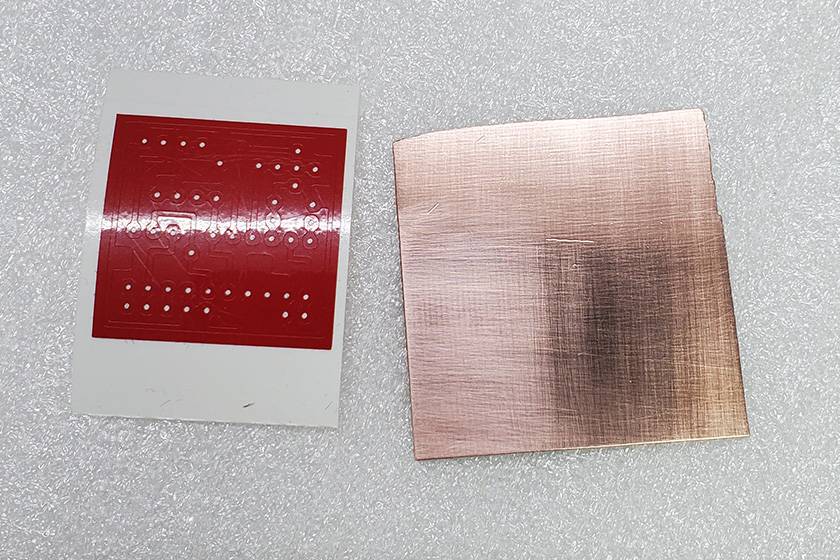
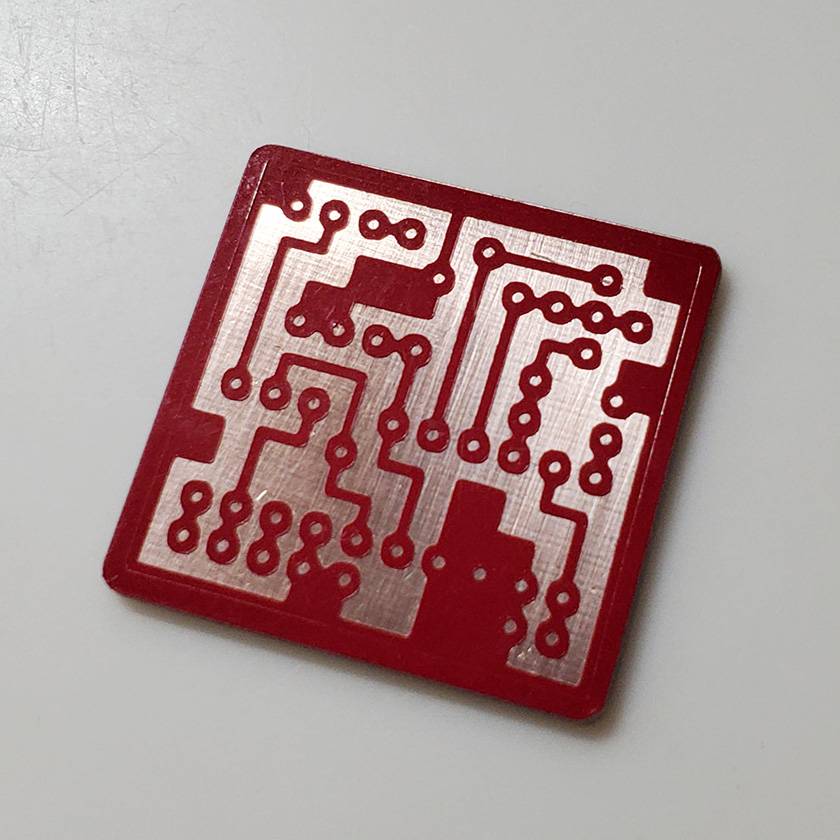
Next, I soaked it in etching solution to dissolve the unnecessary copper → then drilled the holes, and here’s how it turned out:
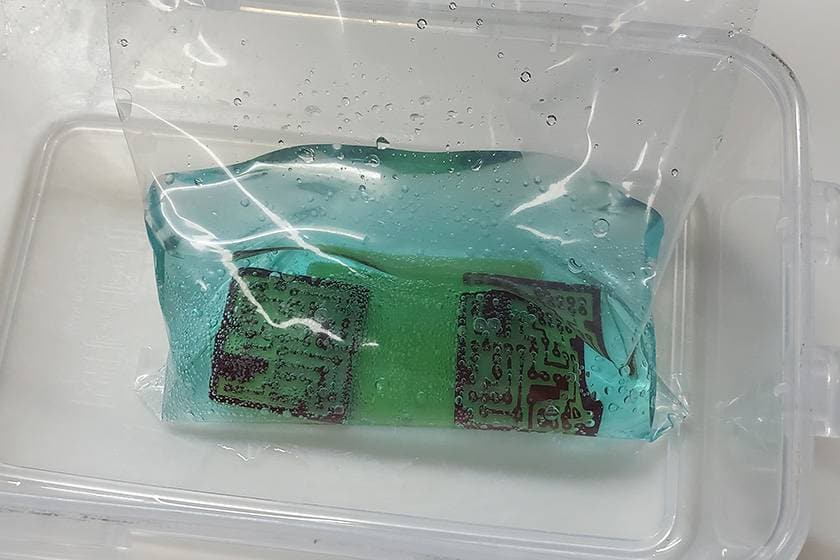
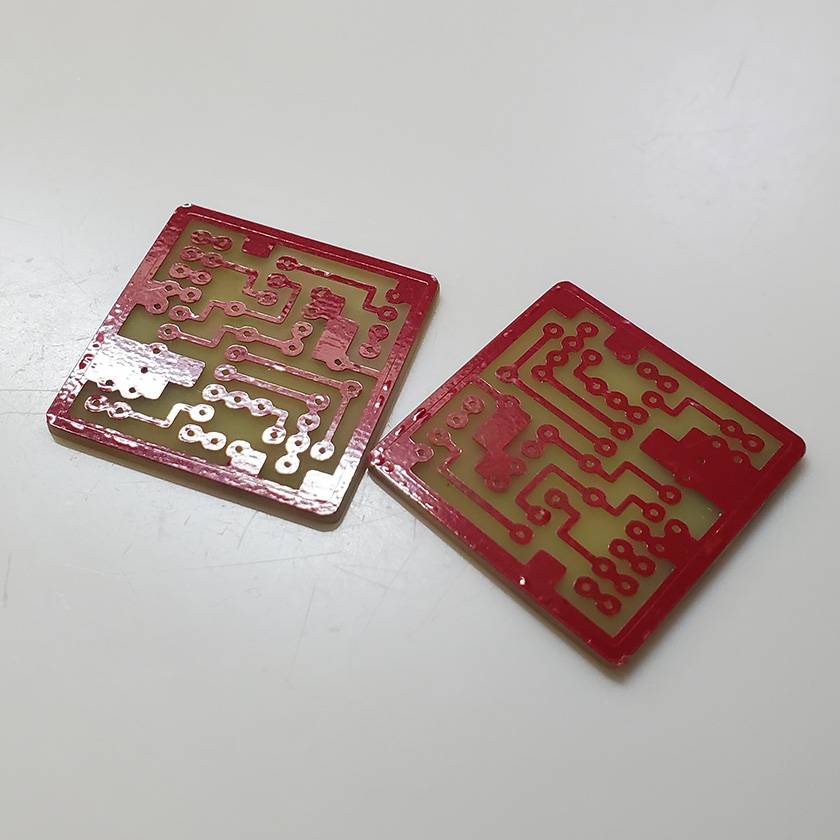
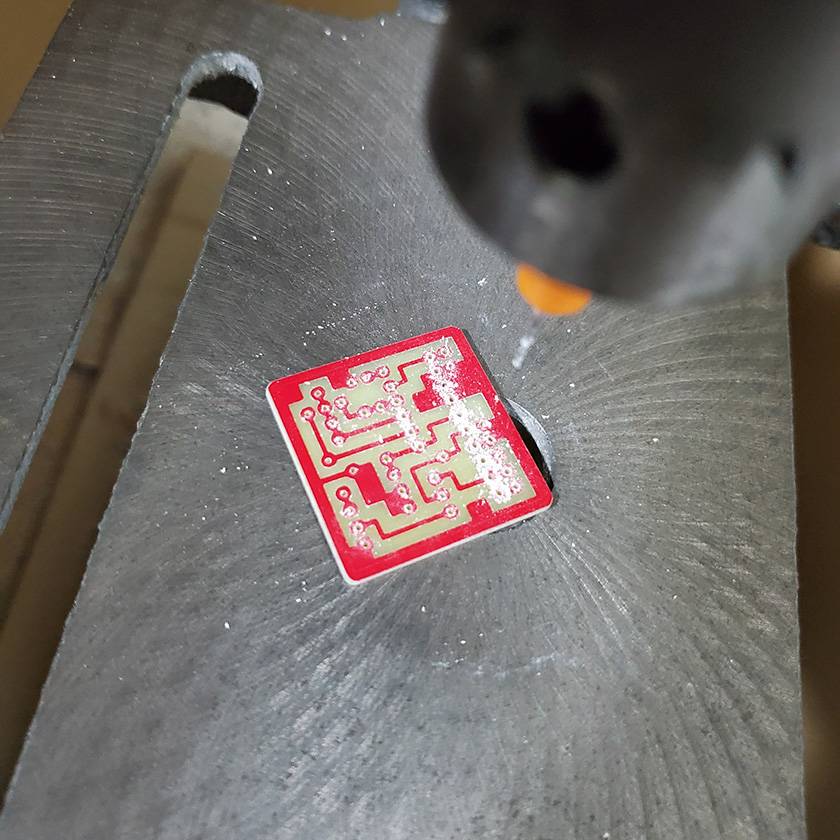
With that, the circuit board is complete.
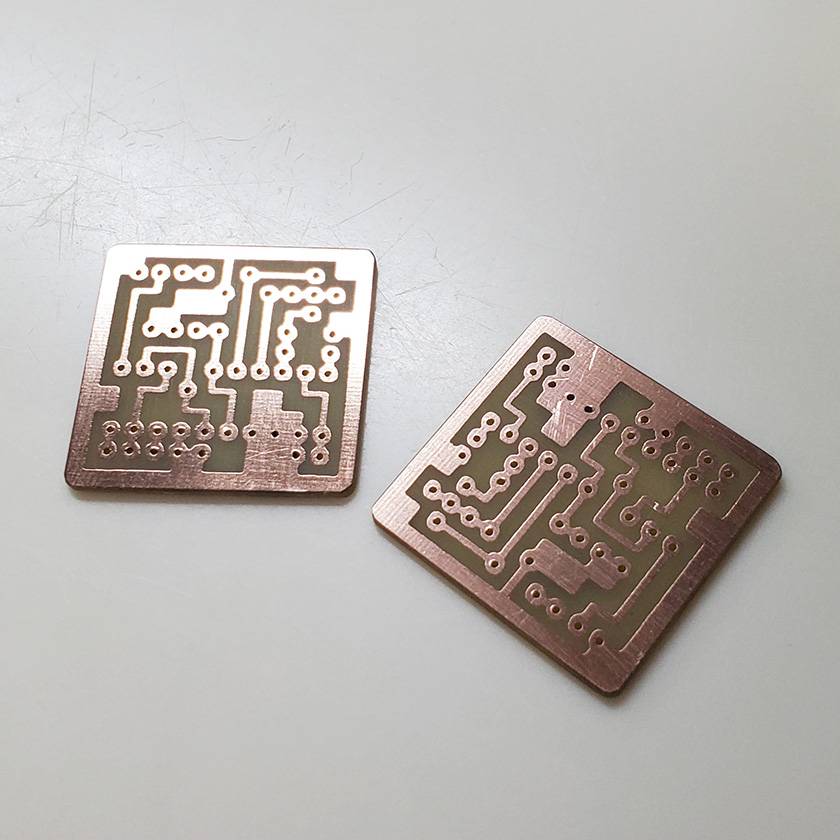
Maybe I glossed over the actual process a bit too much…
How was it? This time ended up being a pretty Kirby-heavy installment, but up to this point the process is the same as when I made the VOODOO-1 last time, so I think it’s fine.
Next time I’ll move on to painting, so I’d like to make it a bit more substantial.
Last time, I forgot to take photos during the painting process and it turned out to be a bit disappointing.
That’s all for this time.
Thank you for reading to the end.
Hope you come back to the Sound House staff blog.
Goodbye.






![[Takayoshi Ohmura] I Want to Be the Nobleman of Speaker Units! - The Path to Becoming a Nobleman of Anything](/contents/uploads/thumbs/5/2025/8/20250812_5_32358_1.jpg)
![Takayoshi Ohmura Electric Guitar String Comparison Review [3 Types of SIT STRINGS]](/contents/uploads/thumbs/5/2019/9/20190920_5_7742_1.jpg)
 はじめてのギター
 【初心者向け】エフェクター講座
 初心者必見!PLAYTECH 激スゴの理由!
 あなたのエフェクターボード見せてください
 エフェクターのつなぎ方
 エフェクターの種類
 Discount Sale
 Outlet
 New Arrivals
 Podcast (streaming)
 Headphones / Earphones
 Microphones
 Wireless Equipment
 Speakers
 Power Amps
 Mixers
 Processors
 Portable PA Systems
 Recorders
 Karaoke
 Guitars
 Basses
 Ukuleles
 Drums & Percussion
 Pianos / Synthesizers
 Wind Instruments
 Stringed Instruments
 Japanese Instruments
 Harmonicas, Other
 Software
 DJ & VJ
 Stands
 Cables & Connectors
 Racks & Cases
 Lighting
 Stage & Truss
 Video Equipment
 PC PERIPHERALS
 Power Supplies
 Studio Furniture
 Household Items, Other
 Alcoholic Beverages