When playing lead guitar with a distorted tone, applying generous amounts of spatial effects such as delay and reverb results in a sound that feels extremely good to the player. The notes sustain, the decay spreads out, and it creates an uplifting sensation as if you were standing center stage. However, on the other hand, applying spatial effects too heavily blurs the outline of the original tone, making it easy for the guitar to get buried within a band ensemble. Especially in a band setting, it tends to clash with vocals, keyboards, and cymbal frequency ranges, often resulting in a sound that feels good but doesn’t come forward. Conversely, if you play lead guitar with almost no spatial effects and rely only on distortion, the sound can stick out too much, making it feel disconnected from the ensemble. While the outline is clear, the sound lacks width and can come across as somewhat sterile and poorly blended. The 3-way system introduced here was created to achieve a high-level balance between these two opposing elements: “definition” and “spatial spread.” This system is well known for being adopted by top guitarists such as Van Halen and Steve Lukather.
What Is a 3-Way System?
Simply put, a 3-way system is a stereo system that outputs the dry sound (original signal) and the wet sound (signal with added effect) completely separately.
As the name suggests, the sound is constructed using three outputs (three ways).
The basic configuration is as follows.
- ● Center cabinet
- Outputs only the dry sound (original signal) with no effects applied.
- ● Cabinets placed on the left and right
- Output only the wet sound with spatial effects such as delay and reverb applied.
With this setup, a solid, well-defined guitar tone is heard from the center, while spatial width alone is added from the left and right.
In other words, it is a highly logical system in which the attack and nuances of the performance are clearly conveyed by the dry sound, while the sense of spatial expansion is created by the wet sound.
Why Is the 3-Way System Effective?
Normally, when delay or reverb is applied to a guitar, both the original sound and the added effect are output from the same speaker. As a result, the attack of the original signal and the reverberation of the effects blend together, making the outline of the sound prone to becoming unclear.
In contrast, with a 3-way system, the original sound and the effected sound are physically (or signal-wise) separated.
This provides advantages such as:
- The attack and picking nuances of the original sound don’t get lost
- The effected sound can be adjusted independently
- It’s easier to monitor your own sound even in large venues
How to Build a 3-Way System (Using AmpliTube 5)
Building a 3-way system with physical gear requires multiple amplifiers, cabinets, and line selectors, resulting in a fairly large-scale setup. However, with the recent advances in DAWs and amp simulators, it has become relatively easy to recreate this system.
Here, as one example, we will introduce how to build a 3-way system using AmpliTube 5.
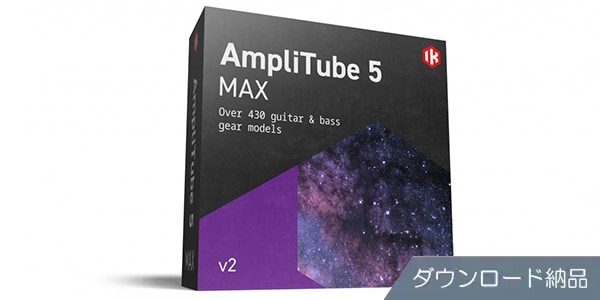
IK MULTIMEDIA / AmpliTube 5 MAX v2 (Download Version)
Signal Splitting
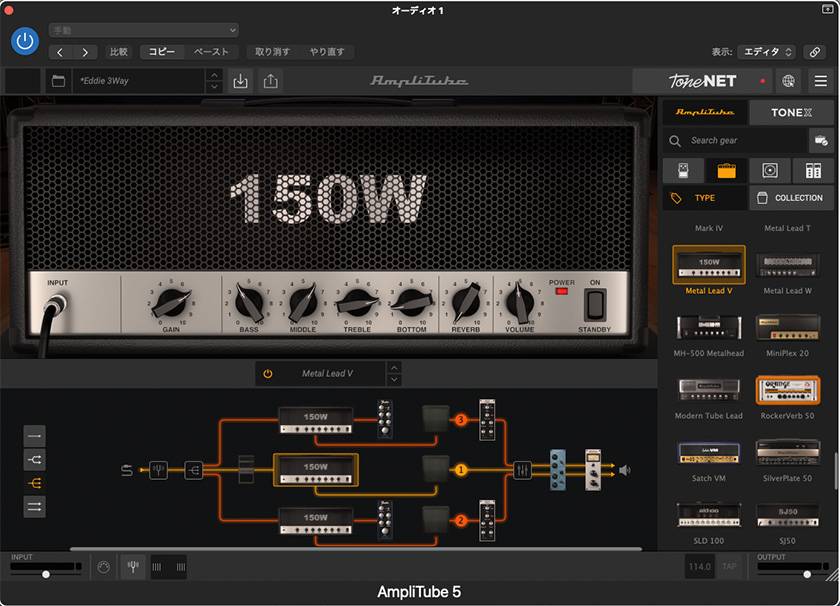
In AmpliTube 5, the input guitar signal can be split into up to three separate paths. Using this feature, divide the signal into the following three paths:
- Center: for the dry sound
- Top: for the wet sound (left)
- Bottom: for the wet sound (right)
This layout is visually easy to understand and makes later adjustments straightforward.
Amp Settings
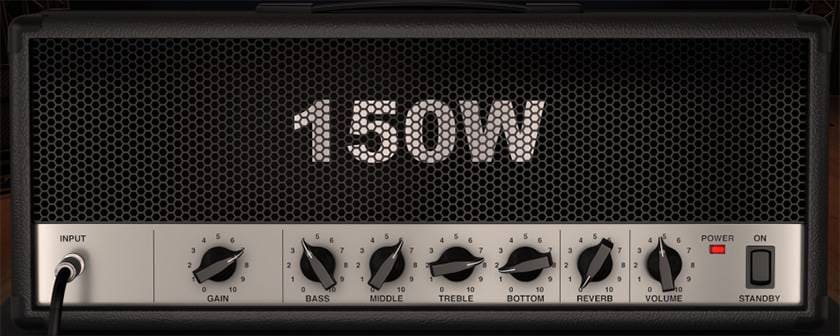
You can use any amplifier you like. In this example, I’m using a 5150-style amp simulator.
By placing an amp on all three signal paths, you can fine-tune volume and tone independently for each one.
To explain it simply, all three amps are set the same here, but in practice, adjustments such as slightly lowering the gain on the wet paths can also be effective.
Creating the Dry Sound
First, create the tone for the center dry sound.
You can set this however you like.
This time, we tried something like this.
Wet Sound Settings
Next, set up the two signal paths for the wet sound.
Insert a mono delay after the amplifier.
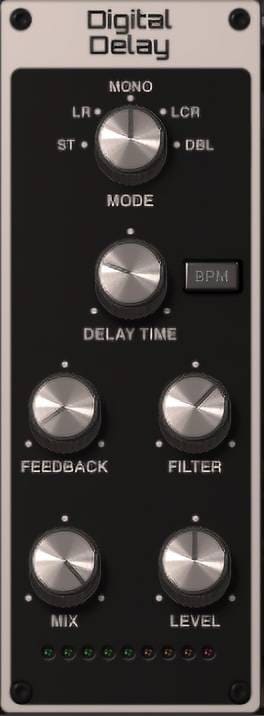
- Delay time: 500 ms
- Feedback: around 5%
Keeping the feedback low helps prevent the sound from becoming muddy.
The most important point here is to set the dry/wet MIX to 100% wet.
By doing this, the original sound is not output, and only the delay signal is heard.
After that, pan this signal to the right. You can control the sense of width by how far you pan it, but for clarity, this example uses a fully panned setting.
Different Delay Settings for Left and Right
Create the other signal path in the same way, but change the delay settings.
- Delay time: 250 ms
By using different delay times for the left and right, the stereo image is emphasized, resulting in a more three-dimensional sound.
This signal is panned fully to the left.
If you try playing only the delay sounds, it will sound like this.
Completion
When all three signals are played simultaneously,
- the center delivers a well-defined dry sound,
- while only the delay sounds come from the left and right.
This completes the expansive guitar sound characteristic of the 3-way system.
Advanced Applications: Taking It One Step Further
If you want to add another layer of refinement, try adding a pitch shifter to the wet signals and detuning them by just a few cents. This adds a chorus-like effect, resulting in an even wider sound.
Additionally, lightly applying a compressor after summing the three signal paths is also recommended to create a greater sense of cohesion across the entire sound.
Summary
The 3-way system is a long-established technique, but in the past it required a large-scale and complex setup. Today, however, it can be recreated relatively easily even in a home environment using a DAW or amp simulator.
“For leads that feel good but somehow don’t cut through.”
“When I add delay, the sound loses definition.”
If you’ve ever felt this way, this is a system well worth trying at least once.
BOSS has also released the SDE-3000 delay pedal, which allows this complex routing to be achieved easily. For those who want to build a 3-way system using physical gear, this is a very strong option as well.
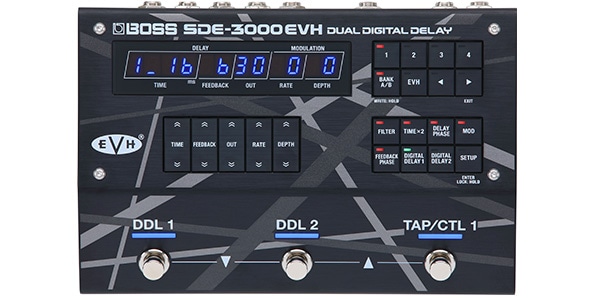
If this caught your interest, be sure to experience the sound of a 3-way system in your own setup.
The “sound & person” column is made up of contributions from you.
For details about contributing, click here.





![[2026 Latest Version] 8 Recommended Reverb Effects Pedals!](/contents/uploads/thumbs/2/2023/8/20230801_2_23473_1.jpg)
![[Latest for 2026] The 10 Best Effects Pedals for Guitar Beginners!](/contents/uploads/thumbs/2/2022/5/20220526_2_18129_1.jpg)
 はじめてのエフェクターは GT-1 にしよう
 BOSS ブランドページ
 IK Multimedia iRig特集
 【初心者向け】エフェクター講座
 ベース用エフェクターの種類
 エフェクターの種類
 Discount Sale
 Outlet
 New Arrivals
 Podcast (streaming)
 Headphones / Earphones
 Microphones
 Wireless Equipment
 Speakers
 Power Amps
 Mixers
 Processors
 Portable PA Systems
 Recorders
 Karaoke
 Guitars
 Basses
 Ukuleles
 Drums & Percussion
 Pianos / Synthesizers
 Wind Instruments
 Stringed Instruments
 Japanese Instruments
 Harmonicas, Other
 Software
 DJ & VJ
 Stands
 Cables & Connectors
 Racks & Cases
 Lighting
 Stage & Truss
 Video Equipment
 PC PERIPHERALS
 Power Supplies
 Studio Furniture
 Household Items, Other
 Alcoholic Beverages