For all intents and purposes, I’m dividing vocal production into three categories: breathing, vocal cords, and resonance. This time, we will focus on the vocal cords. The vocal cords serve as the sound source of the voice and are a crucial part that determines pitch and timbre. In terms of a synthesizer, they correspond to the oscillator.
■ The Role and Mechanism of Vocal Cords in Phonation
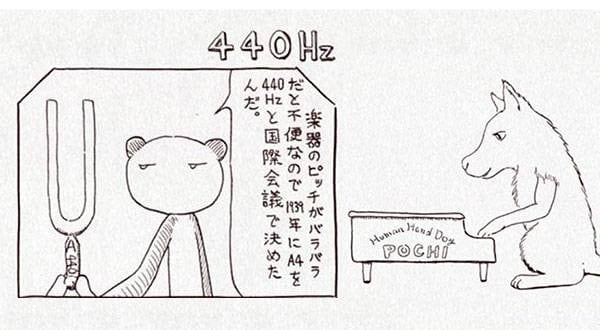
The vocal cords open widely when inhaling and close when producing sound. The diagram below shows a cross-section of the vocal cords during phonation, in a closed state. When the air pressure from the lungs rises, air leaks through the small gap of the closed vocal cords. At this time, the cords open and close subtly in repetition, generating a density wave that becomes the pitch. For example, to produce 440 Hz, the vocal cords open and close 440 times per second. Humans cannot control this speed with muscles, so the vibration occurs due to the pressure difference caused by exhalation. The pitch is determined by factors such as the tension of the vocal cords. As you can imagine from the vibration frequency, the vocal cords are under considerable load. If overstrained, they can become inflamed very quickly.

The components of the vocal cords can be broadly divided into the stiff part of the vocalis muscle and the soft, jelly-like surface layer. Sometimes the entire vocal cord vibrates, while other times only the surface vibrates.
The vocal cords produce density waves with pitch, so in terms of musical instruments, their structure is similar to a free reed, like that of a harmonica. With a free reed, the length of the reed cannot be changed, so you need as many reeds as there are pitches. In contrast, the vocal cords can change pitch and timbre by adjusting tension, making them like a versatile reed.
There is a significant difference in vocal cord length between men and women.
- Women: approximately 10–15 mm
- Men: approximately 15–25 mm
The lowest pitch that can be produced is almost determined by vocal cord length, making it difficult for women to produce the low pitches typical of men. Regarding high pitches, even men can reach high notes comparable to women with proper technique.
■ Chest Voice
The common image of chest voice is a deep, loud, slightly raspy speaking voice that’s typically associated with men. Chest voice involves strong vocal cord closure, with the cords relatively thickly pressed together. The sound is produced by forcibly pushing air through this closure. This allows even the stiff vocalis muscles to vibrate.The resulting sound is not a clean vibration, often producing a slightly muddy tone, and the volume tends to be loud. Because the thicker vocal cords are fully engaged, the vocal range is narrow, generally producing the lower end of the singer’s range. Since the vocal cords collide strongly with each vibration, chest voice places a high load on the vocal cords. In Japanese, where voiced sounds are common, people in vocally demanding professions are prone to vocal cord strain.
In singing, most professional singers rarely use pure chest voice. Even when it sounds like chest voice, it is often a falsetto or mixed voice that resembles chest voice.
■ Falsetto
The common image of falsetto is a higher, weaker voice. In falsetto, mainly the surface of the vocal cords vibrates, producing low volume, but the load on the vocal cords is relatively small. Because the vocal cords are lightly closed or not fully closed, falsetto often includes breathy noise. High notes are easier to produce, making it much easier to control a wider range compared to chest voice.
In singing, many singers develop their technique from falsetto. It makes sense, as it allows for singing a wide range comfortably while keeping vocal cord strain minimal.
■ Voice That Sounds Neither Chest Nor Falsetto
This refers to a type of singing voice used in popular music, which goes by various names. In terms of tone, it does not sit at the extremes of chest voice or falsetto, but rather somewhere in between. Depending on the person, it may sound closer to chest voice or closer to falsetto, varying individually.
In principle, most singers base this voice on falsetto. By starting from a partially open falsetto state and slightly closing the vocal cords, they achieve a powerful tone while maintaining a wide vocal range. The tone color changes depending on how the vocal cords contact and which part vibrates.
■ Changes in Vocal Cord States
Pitch is determined by the length and tension of the vibrating part of the vocal cords. The tension also relates to volume.
When producing louder sound, the amount of exhaled air increases, so the vocal cords need to be slightly closed and tense to withstand it. If volume cannot be produced in the higher range, it may be because the vocal cords are too open or too slack, unable to resist the airflow. However, resonance also plays a major role in volume.
Tone color is mainly determined by the degree of vocal cord contact.
- Thicker contact: the vocal cord muscles vibrate, producing richer harmonics and greater volume. - Less or no contact (more open): only the surface of the vocal cords vibrates, resulting in a lighter sound.
The vocal cords can mainly stretch and adjust the opening. These adjustments allow you to change the vibrating length and control the thickness of the contact area.
Since vocal cords are invisible, one must rely on sensation, but controlling them with awareness rather than unconsciously makes it easier to produce the desired sound. A good approach is to first understand fully closed and fully open states, then gradually develop an imaginable intermediate state.
■ The Balance Between Vocal Cords and Exhalation Pressure is Crucial
The vocal cords vibrate due to exhaled air, so maintaining a proper balance with the airflow is extremely important. The vocal cords must adapt and be optimized according to the pressure of the exhalation. It is important to note that exhalation is about air pressure, not forcefully pushing air out of the lungs.
- Too strong exhalation can damage the vocal cords and cause the breath to run out quickly, making long tones impossible.
- It is essential to achieve sufficient vibration with the minimal necessary airflow.
The difficulty of producing strong high notes comes from the fact that it requires an advanced technical culmination.
- Stable high-pressure exhalation is needed.
The vocal cords must withstand the pressure, maintain closure and tension, and vibrate at ultra-high speed.
Each part of the vocal cords is under extreme stress, and precise balance is required, making it very challenging. Singers who can produce tense, focused high notes are highly technically skilled.
■ Vocal Cord Vibration During Inhalation
The vocal cords can vibrate during inhalation just as they do during exhalation. However, it becomes more difficult at lower pitches.
- For higher notes, the contact between the vocal cords is minimal or almost nonexistent, so there is little difference between exhalation and inhalation.
- For lower notes, the vocal cords have more contact, so if the vocal cords are optimized for exhalation, it can be difficult to produce the desired sound.
The sound produced by the vocal cords resonates through the mouth and nose. Resonance is essential for vowel production and also significantly affects volume.
Next time, I will write about resonance.
The “sound & person” column is made up of contributions from you.
For details about contributing, click here.




![Enchanting Instruments 20 - Voice 3 [The Breath Part 2]](/contents/uploads/thumbs/5/2021/11/20211116_5_15167_1.jpg)
![Enchanting Instruments 19 - Voice 2 [The Breath Part 1]](/contents/uploads/thumbs/5/2021/11/20211105_5_14981_1.jpg)


 MXLマイク購入ガイド
 BOSS ボーカル・エフェクターのススメ
 コンデンサーマイクとは
 AUDIXマイク購入ガイド
 ワンランク上のボーカルマイク選び
 虎の巻 カラオケ初心者講座
 Discount Sale
 Outlet
 New Arrivals
 Podcast (streaming)
 Headphones / Earphones
 Microphones
 Wireless Equipment
 Speakers
 Power Amps
 Mixers
 Processors
 Portable PA Systems
 Recorders
 Karaoke
 Guitars
 Basses
 Ukuleles
 Drums & Percussion
 Pianos / Synthesizers
 Wind Instruments
 Stringed Instruments
 Japanese Instruments
 Harmonicas, Other
 Software
 DJ & VJ
 Stands
 Cables & Connectors
 Racks & Cases
 Lighting
 Stage & Truss
 Video Equipment
 PC PERIPHERALS
 Power Supplies
 Studio Furniture
 Household Items, Other
 Alcoholic Beverages