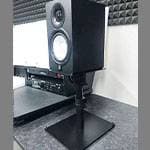
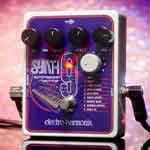
Recently, I was looking into power amps and came across the term “DSP.”
For people like me who spend most of our time in the audio world, we kind of understand what it means and have a general sense of what it does, but isn’t this a tricky term for PA beginners outside the industry? First of all, I don’t really understand English, and I’m not good at it! Digital… signal… processor??? Is that like an ultimate move by Professor X or something? Oh, if you understand that reference, look up the X-MEN. I personally love MCU movies, so I’m already too excited to sleep at night thinking about the new Avengers movie coming out in December 2026.
Anyway, with that out of the way, I want to explain DSP (Digital Signal Processor) properly this time.
The main job of a DSP is to digitally process audio signals and fine-tune them in detail.
Power amps with built-in DSP can do things like this.
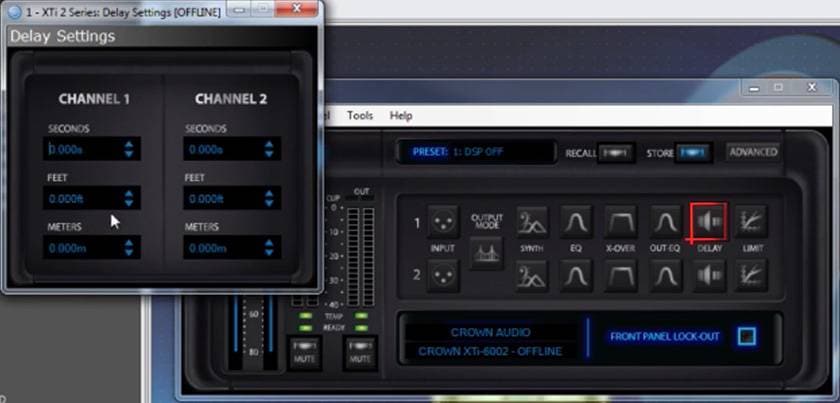
Time Alignment
DSP digitally compensates for the differences in distance from each speaker to your ears, creating a sound image that feels like it’s coming from directly in front of your listening position. This kind of feature is used in car audio to adjust the sound so it’s optimal from the seat you’re actually sitting in.
Digital Crossover
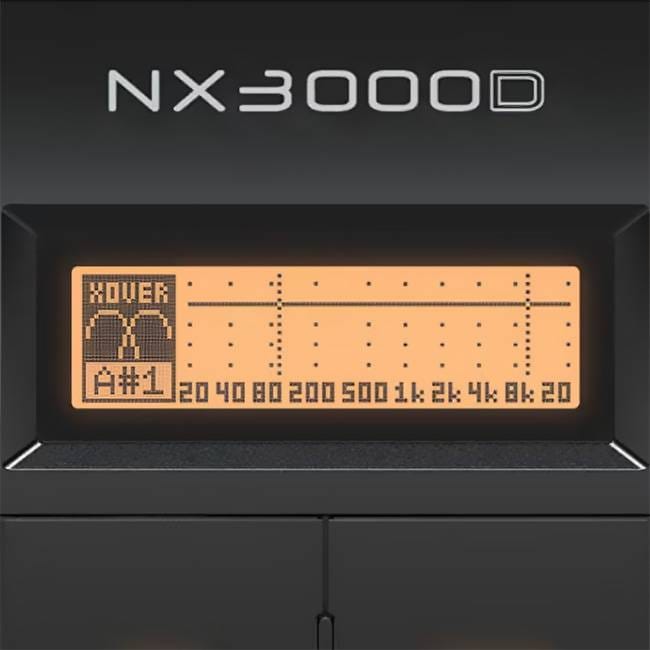
The DSP precisely assigns the optimal frequency ranges to each speaker, like the tweeter or woofer. If the higher frequencies meant for the woofer overlap with the lower frequencies for the tweeter or midrange, both units output the same range, which can make the sound feel muddy. By cleanly separating the bands, the sound becomes much clearer and more defined.
Limiter
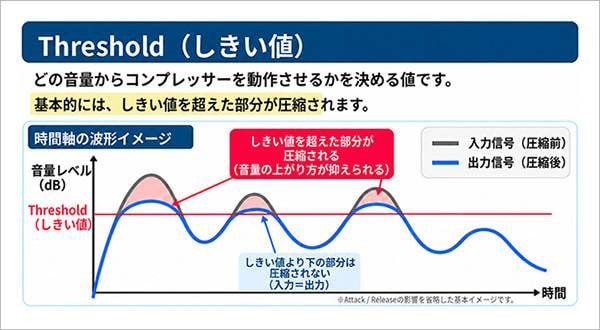
The DSP limits the output to prevent speaker damage from excessive input and to avoid amplifier clipping (distortion).
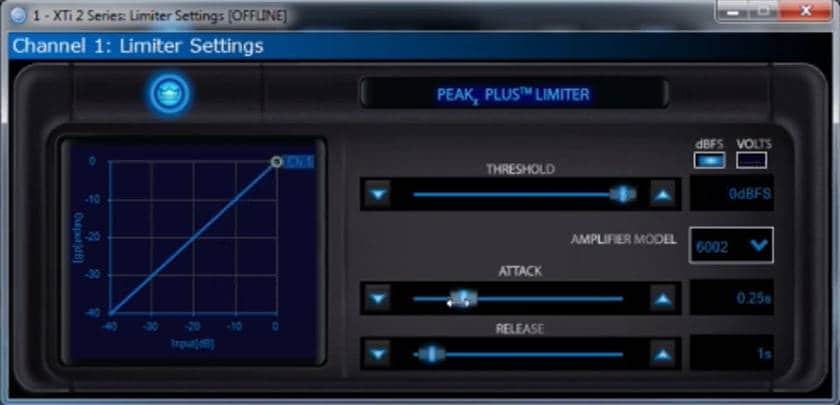
Speaker Presets
You can save optimal voltage and frequency limit settings for specific speaker models and recall them with a single button press. Some DSP-equipped models have this feature, while others do not.
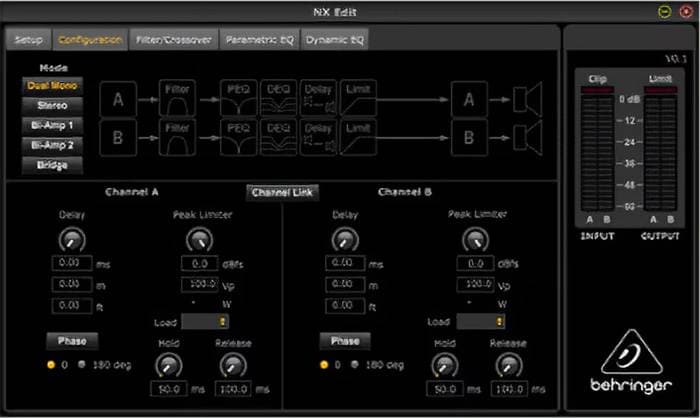
Parametric EQ
This allows you to precisely reduce specific frequency peaks caused by reflections or resonance in the venue. It can tame harsh high frequencies for easier listening, clear up muddy midrange, or lift the vocal range when vocals are buried, making them more intelligible.
Let’s think about the pros and cons of DSP-equipped power amps versus analog power amps.
DSP-equipped Power Amp
- Advantages
- Overwhelming sound field correction capability: Using time alignment (distance correction between speakers) and equalizers, you can “forcefully” create an optimized acoustic space for the listening position.
- Space-saving: Since the processor and amp are combined in one unit, wiring stays clean and installation is easier.
- High S/N ratio: Because the signal is processed digitally from input to amplification, there are fewer paths for noise to enter, and many models excel in signal-to-noise ratio.
- Disadvantages
- Complex setup: To fully utilize its functions, you need some knowledge of acoustics and may have to connect a PC for measurements and settings.
- Risk of failure: If one part breaks, not only does the sound stop, but all the adjustment functions are lost as well.
Analog Power Amp
- Advantages
- Sound quality and richness: Physical transformers and capacitors directly affect the sound, so you can enjoy a freshness and sense of energy that doesn’t go through DSP processing.
- Expandability and Longevity: I can add an external DSP later or replace the amp with another one, allowing me to partially upgrade the system. Also, because the structure is simple, many models can be repaired and used for a long time.
- Intuitive Operation: Physical switches for gain and other adjustments are the main controls, so I can set things up without needing a PC.
- Disadvantages
- No built-in correction: You can’t fix phase differences between speakers or reflections unique to a room or car.
- Takes up space: To get good sound, the chassis can become large and heavy, or you may need a separate processor. More gear also means more complex wiring.
- Noise considerations: Analog signal paths are longer, so you have to pay attention to cable quality and routing.
Looking at it this way, if you want to create a precise soundstage (like a clear vocal position) in a limited space, a DSP-equipped amp makes sense. If you care about the natural tone of the speakers or want the flexibility to swap gear in the future, an analog power amp wins out.
For PA beginners, it seems smart to start with analog amps to gain knowledge and experience, then upgrade gear later—with the next natural step for the power amp being a DSP-equipped model.
(I’m a huge Pokémon fan, so I like to think of it like Pokémon evolution: I start with Charmander, then eventually go to Charmeleon, and finally Charizard…)
Well, that’s my serious take on DSP for now.
Finally, I would like to introduce a few DSP-equipped power amps.
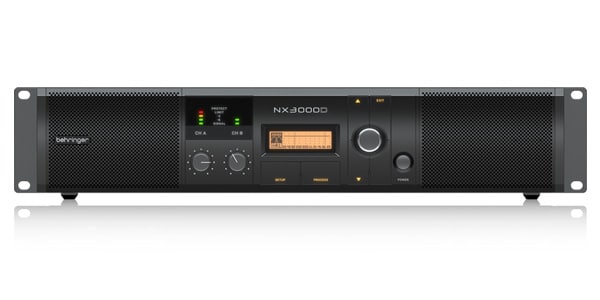
BEHRINGER / NX3000D – Stereo Power Amp
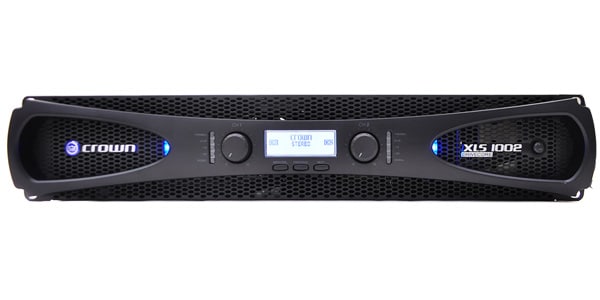
CROWN / XLS1002 (3-Year Warranty) – Stereo Power Amp
CROWN / XTi 4002 (3-Year Warranty) – Stereo Power Amp
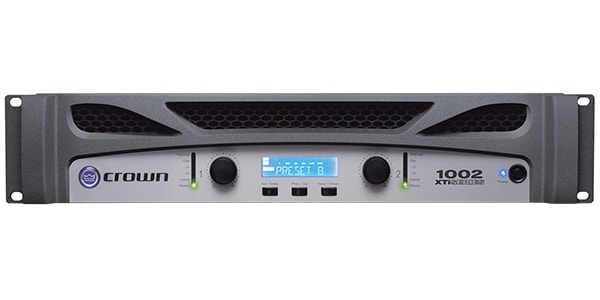
I hope these help make your audio setup even better.
See you next time.








![[2025 New Products] CLASSIC PRO CSR Series Powered Speakers with DSP](/contents/uploads/thumbs/2/2025/1/20250128_2_30347_1.jpg)
![How to Greatly Improve Your Home Monitoring Environment - Calibration with Neumann KH Series [Automatic Correction of Acoustic Characteristics]](/contents/uploads/thumbs/5/2023/7/20230728_5_23441_1.jpg)
![[PA Guide for Beginners] Let’s Put Together A PA System for Your Live Show!](/contents/uploads/thumbs/2/2023/1/20230131_2_20980_1.jpg)

 BEHRINGER パワーアンプ
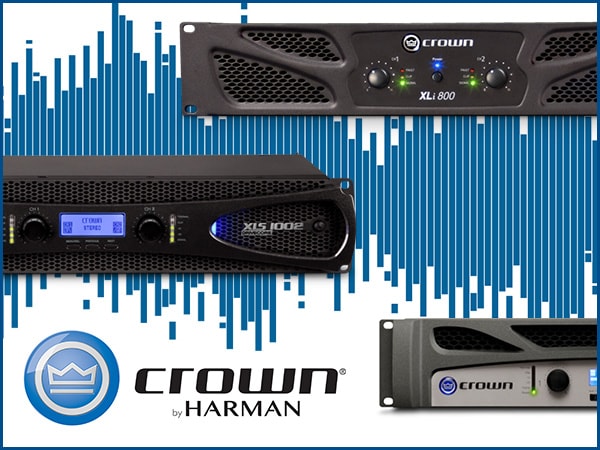 CROWN パワーアンプ特集
 DYNACORD パワーアンプ特集
 パワーアンプの定番 Classic Proのおすすめモデル
 QSC パワーアンプ特集
 スピーカーとパワーアンプの選び方
 Discount Sale
 Outlet
 New Arrivals
 Podcast (streaming)
 Headphones / Earphones
 Microphones
 Wireless Equipment
 Speakers
 Power Amps
 Mixers
 Processors
 Portable PA Systems
 Recorders
 Karaoke
 Guitars
 Basses
 Ukuleles
 Drums & Percussion
 Pianos / Synthesizers
 Wind Instruments
 Stringed Instruments
 Japanese Instruments
 Harmonicas, Other
 Software
 DJ & VJ
 Stands
 Cables & Connectors
 Racks & Cases
 Lighting
 Stage & Truss
 Video Equipment
 PC PERIPHERALS
 Power Supplies
 Studio Furniture
 Household Items, Other
 Alcoholic Beverages