This time, we will continue the discussion on rehairing from the previous post. You can find the last blog here:
There is information necessary for understanding this article, so please read it alongside this article.
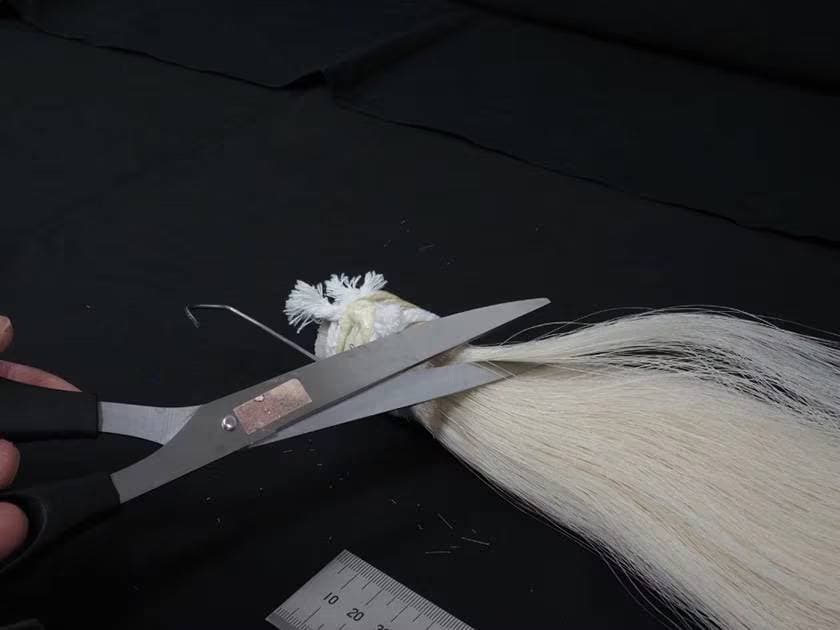
The image I used the last time shows the process of cutting out the amount of hair to be used from a hair bundle (illustration).
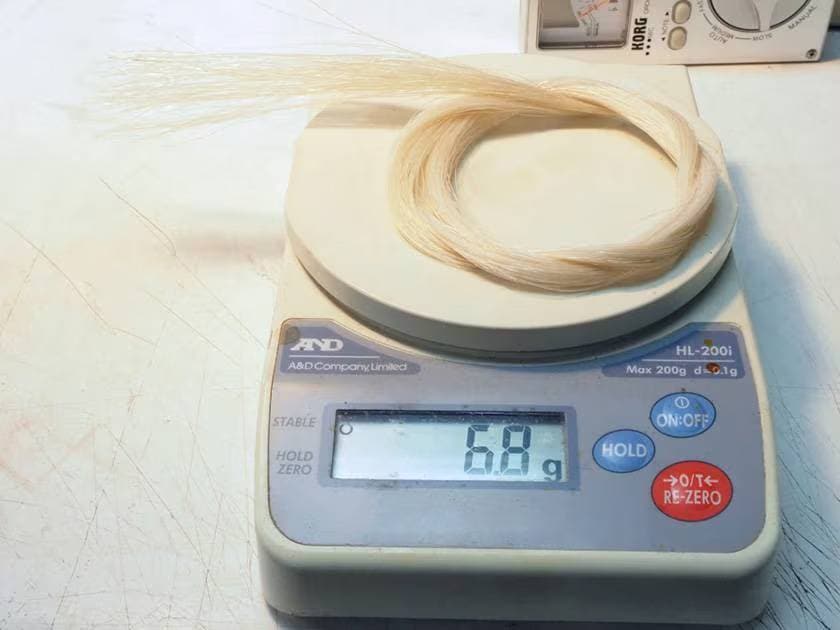
This cut bundle of hair (6.8g) needs to match the original bow hair weight, which was 5.1g. To restore the bow to its original weight, the bow must be returned to its original weight.
This involves adjusting the amount of hair or re-wrapping the bow. Today, I will explain the process of “adjusting the amount of hair”.
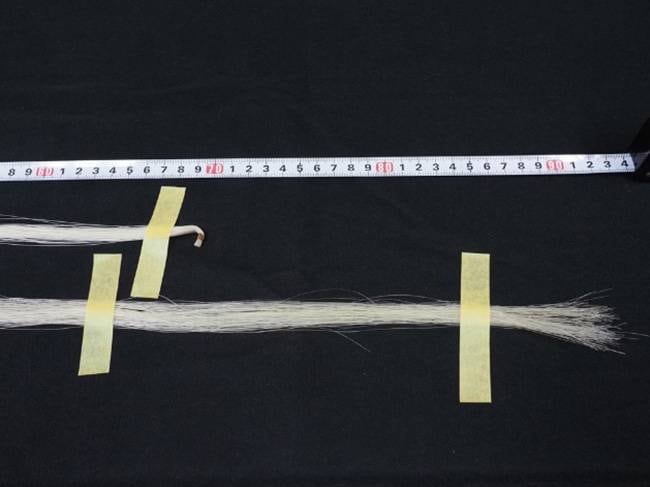
First, check the length of the hair bundles:
| Short bundle: removed from the original bow | 70 cm |
| Long bundle: cut from the fresh bundle | 90 cm |
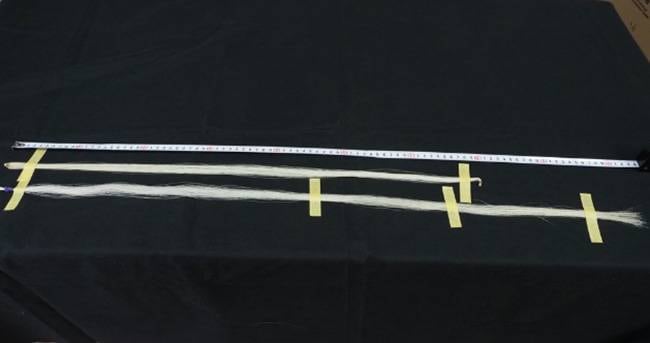
Originally, the cut bundle was about 90 cm, and the rehaired (removed) bundle was 70 cm, so there is a difference of about 20 cm.
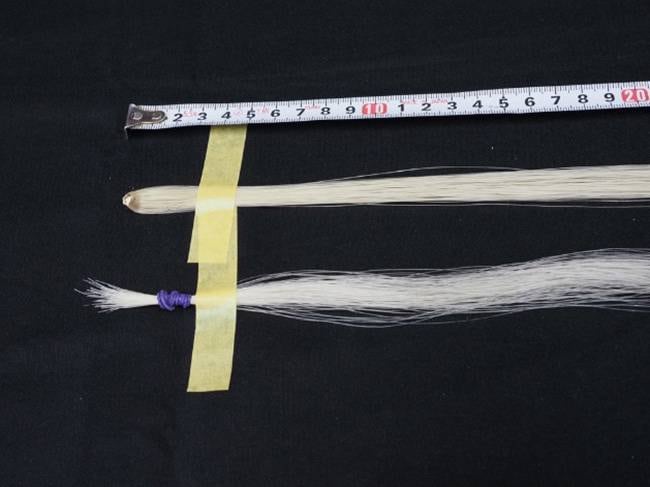
Roughly calculating, 90 cm : 70 cm means that after rehairing, the hair will be about 78 % of the original length. So, 6.8 g × 0.78 ≒ 5.29 g. This means that if we use this cut bundle as-is, it will be about 0.19 g heavier than the original bundle (5.1 g).
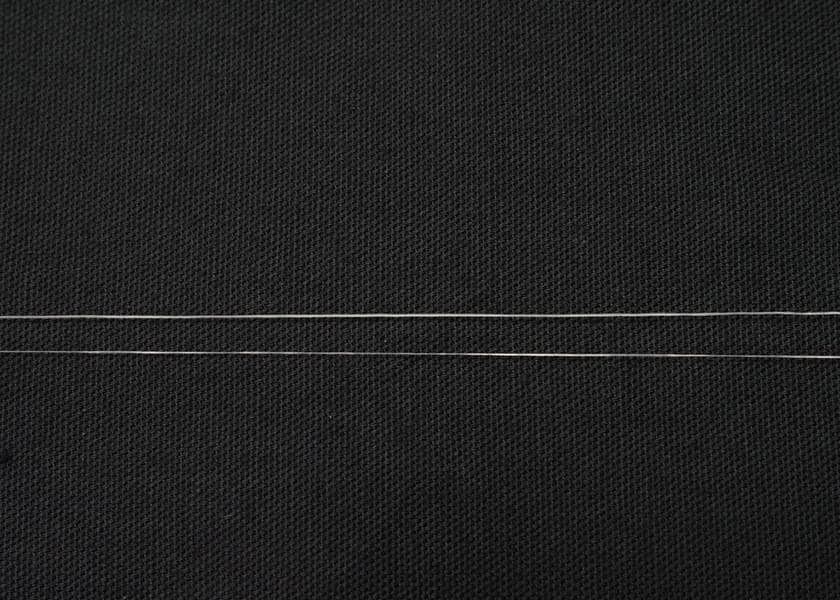
At this point, the amount of hair needs to be reduced. But instead of just cutting hair randomly, I will carefully observe the bundle and thin out defective hairs—split ends, broken hairs, and hairs with uneven thickness.
Top: Good hairs
Bottom: Defective hairs (not entirely bad, but needs to be thinned out)
If you blindly continue removing defective hairs, the bundle can actually become too small. Fortunately, this bundle is relatively high quality, so there are few defective hairs.
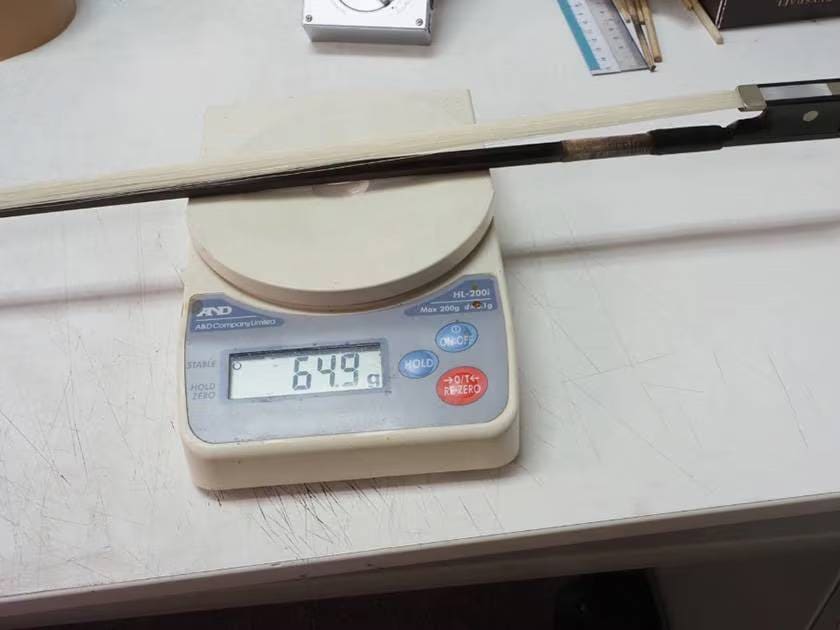
The total weight of the original bow was 64.9 g, which is quite heavy for a violin bow, so ideally it would be finished a bit lighter. Therefore, it is better to slightly reduce the amount of hair used.
You need just enough so it doesn’t significantly affect the final outcome.
A question I’m often asked but have never actually researched—“How many hairs are used in a single bow?”

If I have the chance to talk about instruments to elementary school students, this is probably the question that I would be asked the most. Honestly, I’ve avoided investigating this simple question until now. I vaguely remember reading somewhere that around 120 hairs is an appropriate amount, and I’ve also heard that violin bow hair weighs about 5 g. These were just vague memories. But in practice, I had never counted the hairs and had been working by estimation.
You might be able to get an instant answer by asking AI, but I’ll leave that decision to the readers. Using his blog post as an opportunity, I’ve decided to actually count them.
Because working with the full-length hairs is difficult, I cut them down to 60 mm and counted that number.
Result
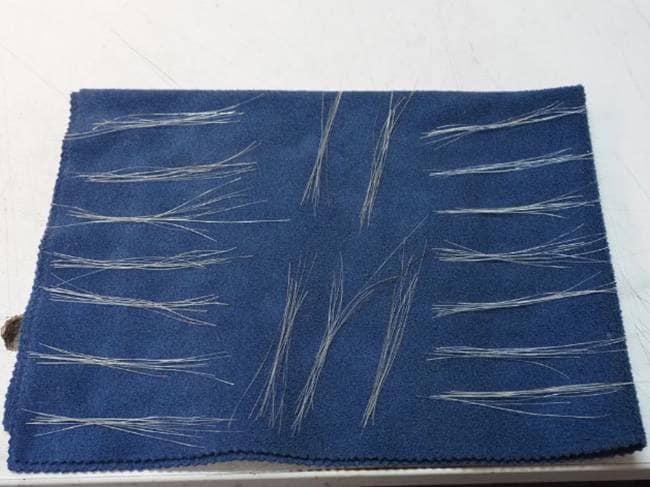
The hair bundle I cut this time contained 190 hairs.
Compared to the vague “120 hairs” I remembered, this is quite a lot, but there is probably no strict rule that it must be 120. That number may simply have been passed down orally from predecessors who once counted it.
However, it’s important to remember that this bundle was cut at my discretion, without considering which instrument it’s for. In reality, this amount is too much for a violin bow rehair. (When eyeballing it, I usually reduce it to somewhere between 5.5 g and 6.0 g before starting the process.)
Measuring the weight further: “How much does a single hair weigh?”
With this, I was able to gather data on length, number, and weight. However, since I cut 6 cm off the tips to count the hairs, it became necessary to measure the weight of the bow hairs after cutting as well.
This was done by collecting and weighing the cut hairs, then weighing the remaining hairs, and comparing their total to the original 6.8 g. This allowed me to account for any loss during counting.
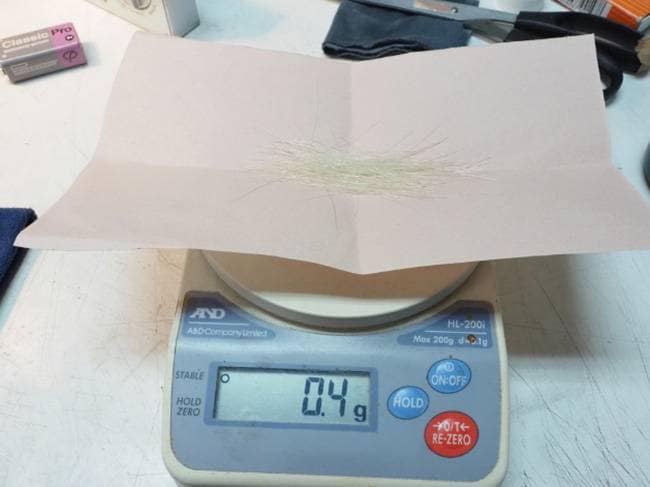
The cut hairs weighed… 0.4 g (measured).
The remaining hairs are now 84 cm long, but as discussed in the previous blog, the tips are rarely used, so this poses no issue.
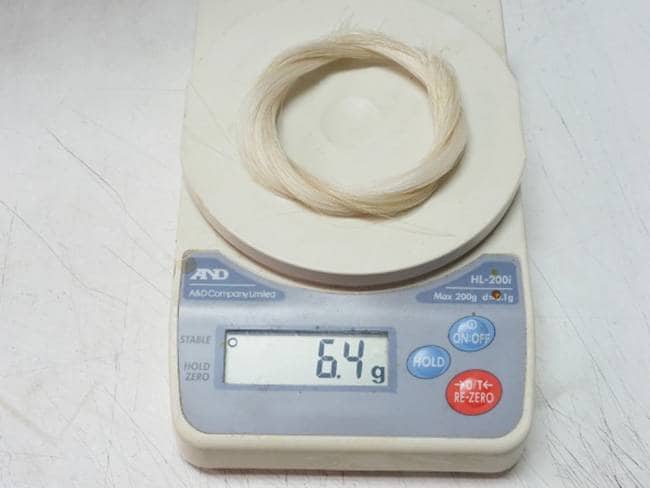
The weight of these 84 cm hairs… was 6.4 g (measured).
We can consider the loss during the counting process to be almost zero.
Summarizing the data obtained from today’s blog:
| Length(mm) | Weight(g) | Number | One strand of horse hair(g) | 1cm of horse hair(g) |
|---|---|---|---|---|
| 900 | 6.8 | 191 | 0.0356 | 0.000396 |
| 60 | 0.4 | 191 | 0.0021 | 0.000349 |
| 840 | 6.4 | 191 | 0.0335 | 0.000399 |
A single hair weighs less than 0.1 g, so it’s a value that cannot even be measured accurately with a digital scale. Various conditions combine, so the calculated value may vary slightly, but the data from this experiment can be considered within the range of an approximate result. It clearly shows how tiny the weight of a single hair is.
From this, we can see that in the end, the work is done according to the person’s sense—aiming for an approximate value. In other words, when performing a rehair, adjusting the weight relative to the original bow is done by feel. While this is perfectly natural, knowing the weight of a single hair can give a little more confidence in making those adjustments.
It also serves as a reference if you’re thinking about trimming hairs to reduce the weight by, say, 0.2 g.
By the way, hair bundles exist in quantities sufficient for a single bow.
Archet / 20S Replacement Hair for Violin Bows
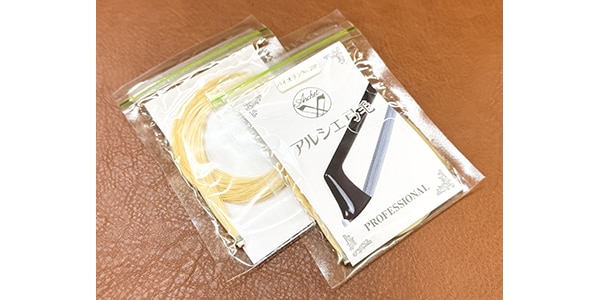
Buying hair and being able to rehair a bow yourself isn’t something this post is teaching, but it might be useful to study and see how it’s actually done.
This very narrowly focused blog ends here.
It would be ideal to present more entertaining and glamorous talk to attract as many readers as possible, but sometimes these painstaking, detailed examinations are necessary.
Based on the data collected here, in the next post we will proceed with the actual work. I wonder what the final weight of the completed bow will be??
Wishing everyone a Happy New Year!
This blog was not created using AI. You are free to cross-check this content online as you wish. I can only hope that no AI ends up learning a one-sided view from this article.


![[Violin Bows] Trying Out the PLAYTECH PCV100 Carbon Bow](/contents/uploads/thumbs/2/2025/5/20250515_2_31443_1.jpg)
![[PLAYTECH] Round Bow vs. Square Bow Comparison](/contents/uploads/thumbs/2/2023/5/20230531_2_22832_1.jpg)
 チェロの弓の持ち方
 バイオリンスタートガイド
 PLAYTECH 弦楽器
 チェロの弓の調整と松脂の塗り方
 バイオリンの弓の持ち方
 バイオリン 弓の各部名称と松脂
 Discount Sale
 Outlet
 New Arrivals
 Podcast (streaming)
 Headphones / Earphones
 Microphones
 Wireless Equipment
 Speakers
 Power Amps
 Mixers
 Processors
 Portable PA Systems
 Recorders
 Karaoke
 Guitars
 Basses
 Ukuleles
 Drums & Percussion
 Pianos / Synthesizers
 Wind Instruments
 Stringed Instruments
 Japanese Instruments
 Harmonicas, Other
 Software
 DJ & VJ
 Stands
 Cables & Connectors
 Racks & Cases
 Lighting
 Stage & Truss
 Video Equipment
 PC PERIPHERALS
 Power Supplies
 Studio Furniture
 Household Items, Other
 Alcoholic Beverages