A Live Performance by a Musician Who Performed Alongside His Favorite Musicians
This is part 4 of the “timeless live albums”.
If you’re someone who plays music, you will inevitably have the desire to perform with the musicians you admire. And, that feeling becomes even stronger when the style of music you play matches the style of the musicians you love.
I am not a professional musician, but if I could perform with musicians who play the genre I love, I could clearly specify “this person and this person” for this genre, and “that person and that person” for that genre. For example, in the jazz genre: I would pick keyboardists would be Chick Corea and Richard Tee; guitarists I would pick Pat Metheny, and if I’m leaning toward bebop, Jim Hall; bassists would be John Patitucci, and if leaning toward bop, Charlie Haden; drummers I would pick Dave Weckl, Dan Gottlieb, Peter Erskine, and so on.
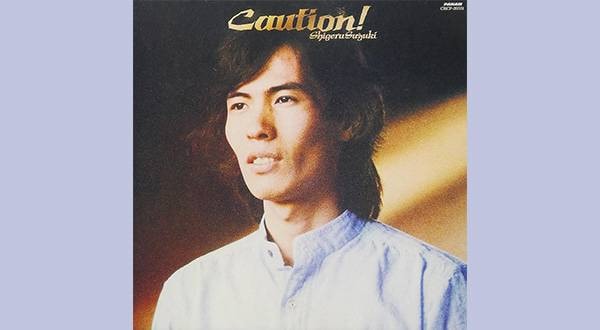
If I were limited to only Japan, then keyboardists would be Masahiro Sayama, Ken Shima, Hiroshi Sato, Ryuichi Sakamoto, Soichi Noriki; guitarists would be Tsunehide Matsuki, Kazumi Watanabe, Shigeru Suzuki… and so on—the names of my favorite musicians come to mind one after another.
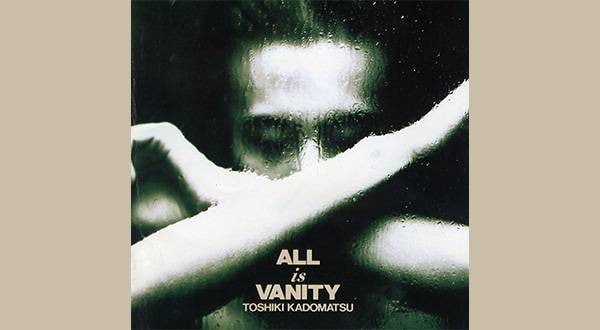
What happens when a professional musician does this in real life? There is a musician who actually put this into practice: Toshiki Kadomatsu. This time, I’m introducing a very unusual live album packed with his personal taste. It’s an album in which Kadomatsu gathered members entirely according to his own preferences and performed the music he loves in an actual live setting.
■ Recommended Album: Toshiki Kadomatsu – TOSHIKI KADOMATSU SPECIAL LIVE MORE DESIRE '89.8.26 (1989)
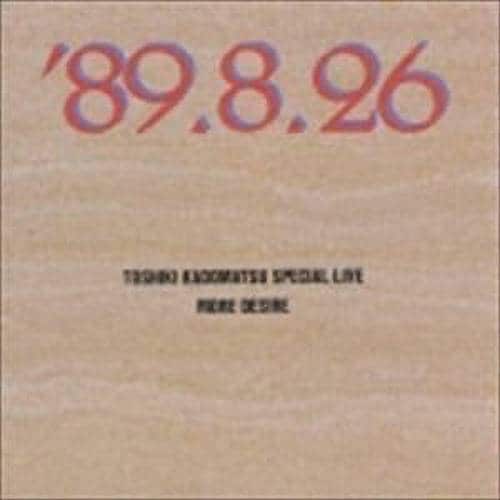
This is a live show that I really wish I could have attended in person, but because I prioritized Sadao Watanabe’s concert, I unfortunately wasn’t able to see it. The ticket price wasn’t particularly high, and it was held at Hibiya Open-Air Concert Hall, which I love, so this album became one I sincerely regretted missing.
The members Toshiki Kadomatsu assembled were outstanding. The album concept was excellent. They covered songs by Tin Pan–related musicians he loved, such as Shigeru Suzuki (g), Hiroshi Sato (key), and Chu Kosaka, and recreated them by gathering members he himself adored. It was something everyone dreamed about but could never actually achieve—a feat that in a sense seemed almost fearlessly audacious.
The selection of members was also an essential piece in enriching the album. The drummer was Shuichi “Ponta” Murakami, the guitarists were Shigeru Suzuki and Tsuyoshi Kon, percussion was Nobu Saito, bass was Tomohito Aoki from the Kadomatsu band, and keyboards were Shingo Kobayashi.
Another point worth noting is that many of the lyrics were written by Takashi Matsumoto. The composers varied with Shigeru Suzuki, Hiroshi Sato, and others, but what unfolded was the Takashi Matsumoto world, shared as a central axis by Kadomatsu himself and the musicians performing, and this was reflected throughout the album. Moreover, with Shigeru Suzuki—the composer—participating, the expressive power of the songs was enhanced even further.
In particular, when it comes to performing Shigeru Suzuki’s songs, there are also parts that diverge from originals even though they respected them. That element of surprise is part of what makes the live performance so interesting. You don’t hear obvious slap bass in Suzuki’s original recordings, but this album features Tomohito Aoki, the master of slap bass. His combination with Ponta Murakami is outstanding, and this live album carries a groove different from Suzuki’s originals. However, I don’t find that any of the essential elements of the originals are broken; instead, I can feel the love that Kadomatsu and the other members have for Shigeru Suzuki’s music. In that sense, I can say this is a rare live cover album overflowing with the performers’ love for the original creator.
Recommended Track: “Rainy Station”
This masterpiece remains as a staple in the history of J-Pop as it showcases the true essence of Shigeru Suzuki and Takashi Matsumoto, with vivid, cinematic scenery. The situation is a moment between a young man and woman on a rainy train platform. With just the phrase “Sunglasses blur the colors of the city in the rain,” Matsumoto’s world is already fully formed. Other great songs set on platforms come to mind, but somehow this one feels more sophisticated and urban. This is Matsumoto’s “Kazemachi” that he’s depicting here. The original performance is a refined recording by masters Shigeru Suzuki, Masataka Matsutoya, Haruomi Hosono, and Tatsuo Hayashi. Meanwhile, in this live rendition, Ponta Murakami and Tomohito Aoki’s slap bass make everything burst open. It creates a groove very different from the original.
In terms of gear, the sound is dominated by digital synthesizers like the Yamaha DX7II and Roland D-50. While the high frequencies are rich, the mid-lows tend to be thin since they are highlighting the characteristics of digital synths. In the middle of the track, Shingo Kobayashi takes over the original sax part with a solo on the Roland D-50. The D-50’s hallmark is its hybrid approach from the transitional period of synthesizers: combining sampled attack fragments of real instruments (such as the breath blown into a flute) with analog-style synth tones. He makes excellent use of this iconic digital synth’s features. Above all, I really appreciate how he manages to make the phrases just sing with that transitional-era sound.
Recommended Track: “Yamate Hotel”
This is a masterpiece by the great Hiroshi Sato, a keyboardist, composer, and producer. From my listening to Toshiki Kadomatsu’s vocals, I can hear his love for Hiroshi Sato’s music throughout. The synthesizer solo by Shingo Kobayashi in the middle section is played on a D-50. The attack, reminiscent of a shakuhachi, is emphasized, creating very striking phrases. Kobayashi’s obbligato, fills, and solos on the electric piano overflow with musical sensibility and brilliance. After this track, the Roland TR-808 comes in, and the intro to Shigeru Suzuki’s famous song “Suna no Onna” begins. It is a shame that it fades out immediately afterward.
Featured Musicians, Album, and Recommended Tracks
- Artists: Toshiki Kadomatsu, Shigeru Suzuki, Shingo Kobayashi, Ponta Murakami, Tomohito Aoki, Nobu Saito, etc.
- Album: TOSHIKI KADOMATSU SPECIAL LIVE MORE DESIRE '89.8.26
- Recommended Tracks: “Rainy Station”, “Yamate Hotel”
The “sound & person” column is made up of contributions from you.
For details about contributing, click here.


 スタジオモニタースピーカーを選ぶ
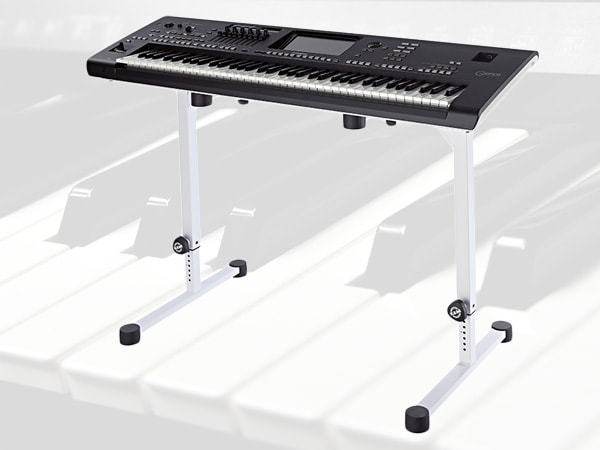 キーボードスタンドの選び方
 ワイヤレスイヤホンの選び方 用途別おすすめランキング
 人気のワイヤレスイヤホン おすすめランキング
 超オススメのフレーズ道場 キーボード
 キーボードスタートガイド
 Discount Sale
 Outlet
 New Arrivals
 Podcast (streaming)
 Headphones / Earphones
 Microphones
 Wireless Equipment
 Speakers
 Power Amps
 Mixers
 Processors
 Portable PA Systems
 Recorders
 Karaoke
 Guitars
 Basses
 Ukuleles
 Drums & Percussion
 Pianos / Synthesizers
 Wind Instruments
 Stringed Instruments
 Japanese Instruments
 Harmonicas, Other
 Software
 DJ & VJ
 Stands
 Cables & Connectors
 Racks & Cases
 Lighting
 Stage & Truss
 Video Equipment
 PC PERIPHERALS
 Power Supplies
 Studio Furniture
 Household Items, Other
 Alcoholic Beverages