Hello! I’m a bassist who used to hate compressors.
As the title suggests, today’s story is about my experience with compressors.
Compressors are often said to be an essential tool for bassists, but I had never owned one myself. The reasons were mainly twofold:
- I didn’t really feel I needed one.
- The person who taught me electric bass absolutely hated using compressor pedals.
Regarding the second point, just mentioning compressors would trigger a 30-minute lecture—that was the vibe at the time (laughs).
To clarify, that teacher used compressors during recording and understood their importance. The lesson was more along the lines of: “Before worrying about compressors, focus on improving your technique.”
For me personally, I always felt it might be better to let the engineer apply compression from the mixing board rather than using a pedal. Of course, I’d still be careful not to overdrive or clip the signal, but my mindset was basically: “If the engineer gets mad at me, maybe I’ll buy one.”
This story is about how someone like me finally decided to buy a compressor.
What Exactly Is a Compressor?
Many people aren’t quite sure what a compressor pedal actually does. Simply put, a compressor is an effect that evens out the volume of your sound—making quiet notes louder and loud notes quieter.
For bassists, this can be especially important. Instruments naturally have big variations in volume, and techniques like slap bass can make those variations extreme.
This often sparks the debate: “Why use a compressor? Just control it with your fingers!” That’s a fair point, but because stringed instruments naturally produce a big difference between the initial attack and the sustained note, compression can help smooth that out.
By evening out the dynamics, a compressor makes the overall volume more consistent and makes it easier to increase the perceived loudness.
Personally, though, I always felt that compression was something more in the engineer’s domain rather than the performer’s.
How to Use a Compressor
Compressor pedals can vary by model, but most let you adjust four main parameters: Threshold, Ratio, Attack, and Release.
Threshold
This sets the volume level at which the compressor starts working. You adjust it according to your instrument and playing style to control how much compression is applied.
Ratio
The ratio determines how much the volume is compressed once the threshold is reached. For example, a 4:1 ratio means that if the input exceeds the threshold by 4 dB, the output will only increase by 1 dB.
- Rack compressors used in studios allow very precise ratio settings.
- Bass-specific pedals often have a pre-set ratio suitable for the instrument, so some models don’t even provide a control knob for this.
Attack
The attack knob sets how quickly the compressor engages after the threshold is exceeded.
- A very fast attack clamps down immediately, which can reduce the punch of the initial note, making the sound flatter.
- A slightly slower attack allows the initial “attack” of your note to pass through, keeping the tone more natural and lively.
Release
The release controls how long it takes for the compressor to stop compressing and let the signal return to its normal level. If the release is too long, the decay of the note can sound unnatural, making even a live bass performance feel off.
Basic Compressor Controls for Bass Players
- Threshold: Determines the volume level at which the compressor starts working.
- Ratio: Sets how much the signal is compressed once it passes the threshold.
- Attack: Controls how much of the initial note’s punch or attack is preserved.
- Release / Sustain: Decides how long the note’s tail (sustain) remains after compression.
Key Point: A compressor doesn’t directly increase volume. Its main job is to even out the dynamics:
- It reduces louder notes and boosts softer notes, creating a more balanced sound.
- This makes it easier to increase overall volume later, either through the amp or in mixing/mastering.
In short, the core purpose of a compressor is to smooth out the sound.
So, what’s the deal with compressors?
Up to now, I’ve just gone over the basic knowledge on compressors that can be looked up anywhere. But here’s my personal take, as someone who used to hate them:
They’re definitely useful.
That’s my conclusion. In short: yes, get one.
The compressors I ended up buying were BOSS and Empress units. The BOSS compressor is more pronounced, which is great for rock settings or when using it with distortion.
Overall, I preferred the Empress for my playing—it suited my style better and felt more natural.
For me, the key benefit was controlling the transition from attack to sustain. This isn’t something an engineer will fully handle for you—it’s something you actively manage as a player. How much of the attack do you want to keep? What volume level are you imagining when you pick the string? It’s about how much of the bass sound you imagine in your head actually reaches the audience. That’s where a compressor really becomes meaningful.
By first delivering that sound to the engineer, the engineer can better understand the nuances of our playing, which helps the audience hear the sound we actually imagine in our minds.
Of course, there are plenty of players who don’t need a compressor at all and can control everything with their fingers (laughs).
Another reason to use a pedal is simply because the player likes the sound.
You might not need a heavy “compressed” sound, but you enjoy the tone you get when you plug in that compressor.
These days, very few people are against putting distortion or chorus on a bass, so using a compressor can just be another option.
So, basically: a compressor can be useful, but for older styles of music, it might not be necessary—it’s just one choice among many.
There’s a common saying:
“If you rely on a compressor, you’ll get worse at playing.”
Personally, I think it’s the opposite: the worse you are, the more a compressor can help.
For me, the output is everything; the result is everything.
If you can’t fully control your sound with your fingers, using a compressor in a live setting is totally fine.
However, it’s important to work on minimizing the gap between using a compressor and not using one.
By learning how your touch affects the compressed and uncompressed sound, you can adjust your playing.
Understanding how your sound gels in the band mix helps clarify your ideal tone and improves practice precision.
Getting to know how your sound comes together is essential.
That said… don’t overdo it (laughs).
Too much compression makes playing feel boring.
Use it carefully!
Recommended Compressor Pedals
EBS / MultiComp BlueLabel
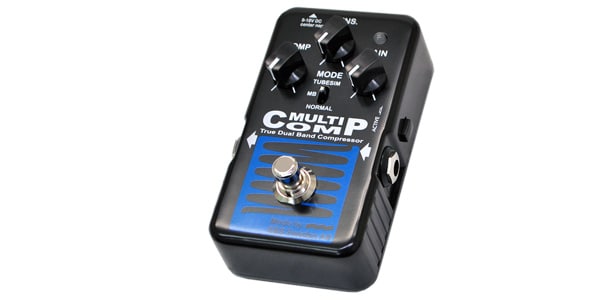
Also known as “MaruCon” in Japanese, this is one of the more popular models. This is the new version. Previously it was a simple 2-knob pedal, but the new model adds a SENS (threshold) knob, allowing for more precise tone shaping.
When you engage it, the sound is instantly recognizable: “Ah, that’s MaruCon.” Many bassists specifically seek out this distinctive character.
BOSS / BC-1X Bass Comp
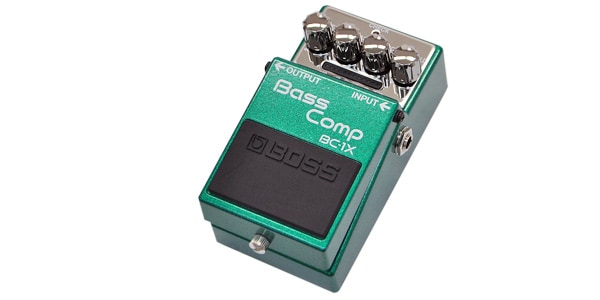
This model uses BOSS’s proprietary MDP technology to provide natural compression without compromising the original tone of your instrument.
It also allows you to adjust the ratio, so you can dial in the amount of compression you prefer.
The pedal features an input indicator, making it easy to visually monitor your signal, which adds to its user-friendliness and makes it highly recommended.
Empress Effects / Bass Compressor Blue
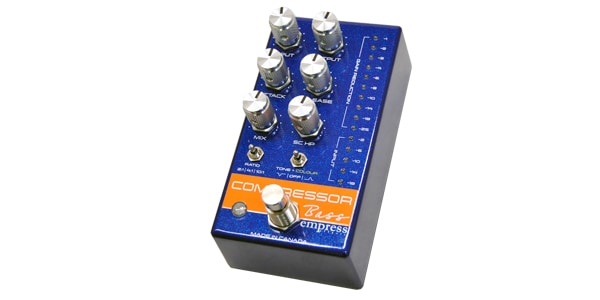
A popular compressor from Empress Effects, specifically tuned for bass.
The new version is smaller than the previous model, making it easier to fit onto a pedalboard.
You can select the ratio from 2:1, 4:1, or 10:1, and it also features a tone control, allowing it to adapt to a wide range of playing environments.
Compared to BOSS or EBS, it’s more expensive, but the quality is top-notch, making it a reliable choice.
The “sound & person” column is made up of contributions from you.
For details about contributing, click here.








![[Latest for 2026] Recommended for Beginners! Bass Effects Pedals](/contents/uploads/thumbs/2/2023/6/20230606_2_22909_1.jpg)

 BOSSの最新ベース機材特集
 BOSS ワイヤレス特集
 BOSS Xシリーズ
 ベース用エフェクターの種類
 ベース奏法(指弾き編)
 ベース奏法(ピック弾き編)
 Discount Sale
 Outlet
 New Arrivals
 Podcast (streaming)
 Headphones / Earphones
 Microphones
 Wireless Equipment
 Speakers
 Power Amps
 Mixers
 Processors
 Portable PA Systems
 Recorders
 Karaoke
 Guitars
 Basses
 Ukuleles
 Drums & Percussion
 Pianos / Synthesizers
 Wind Instruments
 Stringed Instruments
 Japanese Instruments
 Harmonicas, Other
 Software
 DJ & VJ
 Stands
 Cables & Connectors
 Racks & Cases
 Lighting
 Stage & Truss
 Video Equipment
 PC PERIPHERALS
 Power Supplies
 Studio Furniture
 Household Items, Other
 Alcoholic Beverages