Hello!
I’m Takuto Fujioka, a chiropractor specializing in guitarists.
Thanks for your hard work today!
When you play the guitar, do you use a pick or do you play fingerstyle?
I’ve been playing with a pick for many years, so when I started practicing fingerstyle, I really struggled. Among the various difficulties, the hardest part was picking with my thumb. The balance of force and consistently hitting the intended string were basic skills I couldn’t quite nail.
Now, I don’t have that sense of difficulty anymore, but I want to share the key point I focused on during my practice. If you focus on this one thing, the rest is just about practice! So, if you have a hard time picking with your thumb, give this a try.
Thanks for reading!
Getting to the point:
If you focus on the "thumb carpometacarpal joint" while practicing picking, the movement of your thumb will stabilize.
Let me explain step by step.
The key point is the base of your thumb, the thumb carpometacarpal joint. As I mentioned in my column about fingering, how you use this joint is very important in this case as well.
Let me quickly review the basic characteristics of the thumb. The thumb consists of three joints, and the thumb carpometacarpal joint is at the base of the thumb. In order to move this joint, there are many muscles attached to the base of the thumb, known as the thenar eminence.
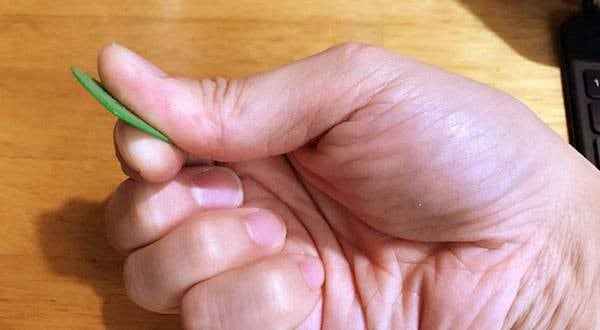
If you try to pick with the tip of your thumb, the joint that mainly moves is the IP joint (Interphalangeal joint) at the tip of the thumb. This joint is responsible for adjusting the fine angles of the thumb’s tip or for pinching objects. However, I don’t think this joint is suitable for continuous, precise movements like fingerpicking.
The reason the IP joint is not ideal for movements like fingerpicking is that the muscles responsible for moving it are located a bit further away. The IP joint moves through long tendons that connect it to the muscles, so there’s a delay between muscle contraction and joint movement. This results in a slight time lag, making fast or continuous movements harder to perform.
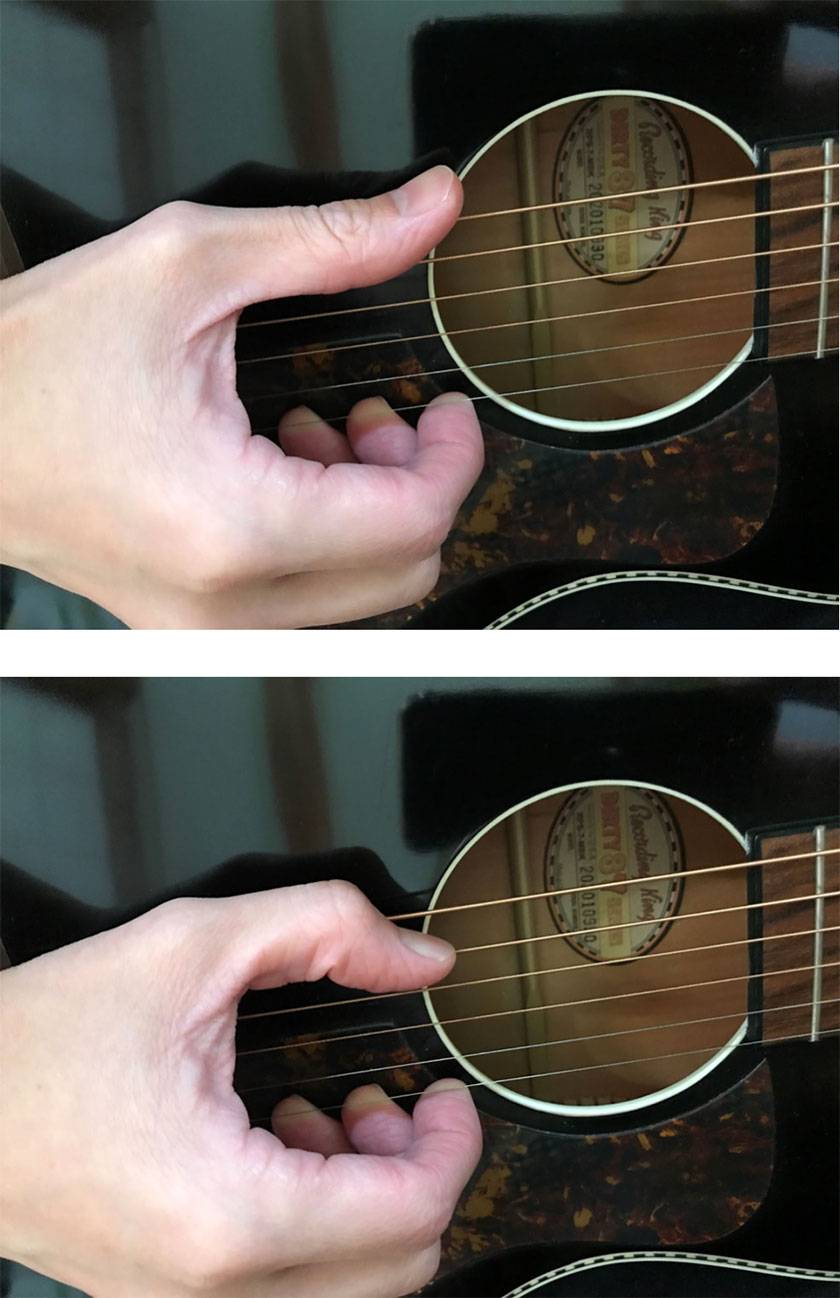
When you pick with the tip of your thumb (IP joint), the movement looks something like this.
Of course, it’s not wrong to pick using the IP joint, and if you’ve become used to that style, there’s no need to change it. Don’t think that there’s only a single correct way to play the guitar!
However, in my case, when I started practicing fingerstyle, I couldn’t help but focus on the tip of my thumb, and I ended up trying to pick using the bending motion of the IP joint. This led to unstable picking and uneven volume, and my mistakes became quite noticeable.
That’s where the thumb carpometacarpal joint comes into play.
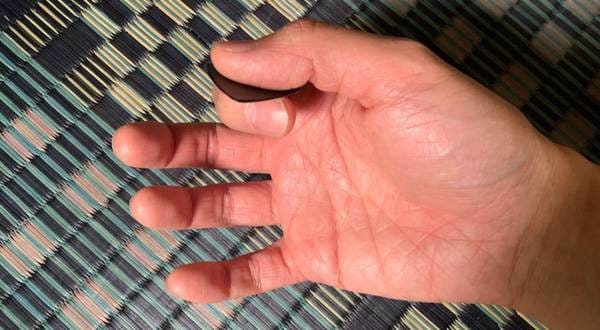
The muscles responsible for moving this joint are attached to the thenar eminence, meaning the distance between the muscles and the joint is shorter. For this reason, this joint is better suited for quick, stable movements.
Try this experiment: move the tip of your thumb and then move the base of your thumb. You’ll likely notice that the strength and ease of movement feel very different. You can also try holding the guitar and feel how the difference in the joints makes it easier or harder to play.
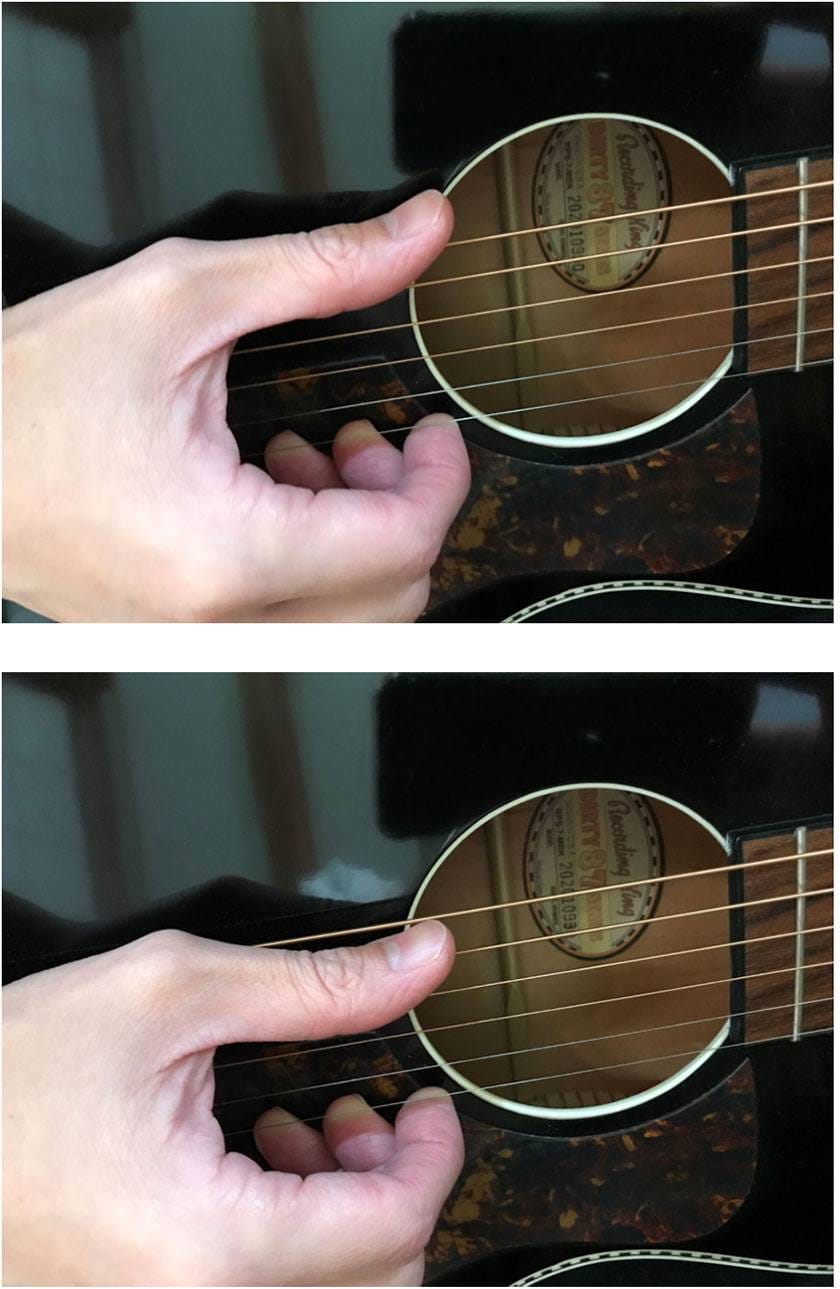
When you pick using the thumb carpometacarpal joint, the movement looks something like this.
Now, most people don’t consciously move the thumb carpometacarpal joint in everyday life. So, if you're suddenly told to focus on this joint’s movement while playing, it might be hard to picture. That’s why I’d like to introduce an exercise that will help you train this joint movement, even without a guitar. By doing this exercise alongside your regular guitar practice, I believe you’ll find it easier to incorporate thumb picking using the thumb carpometacarpal joint.
The thumb movement involved in thumb picking is called opposition movement, which is the same movement you use when bringing the tips of your thumb and another finger together. Therefore, to train the thumb carpometacarpal joint, the key is to repeatedly practice this opposition movement and let your body memorize it.
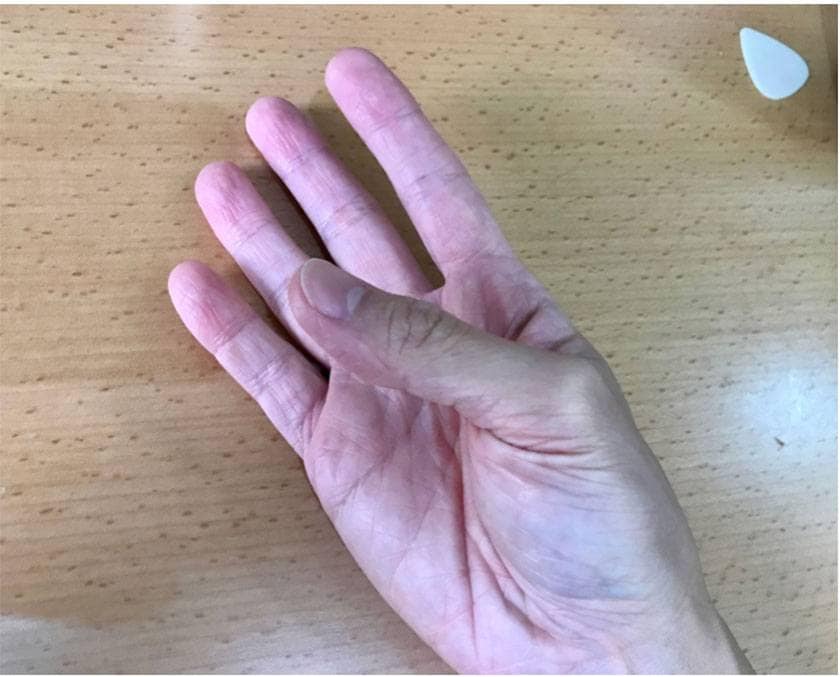
At first, try bringing the tips of your thumb and pinky together, and move primarily using your thumb. Keep the movement of the pinky to a minimum, as this will allow you to focus the effort on your thumb and make the practice more efficient.
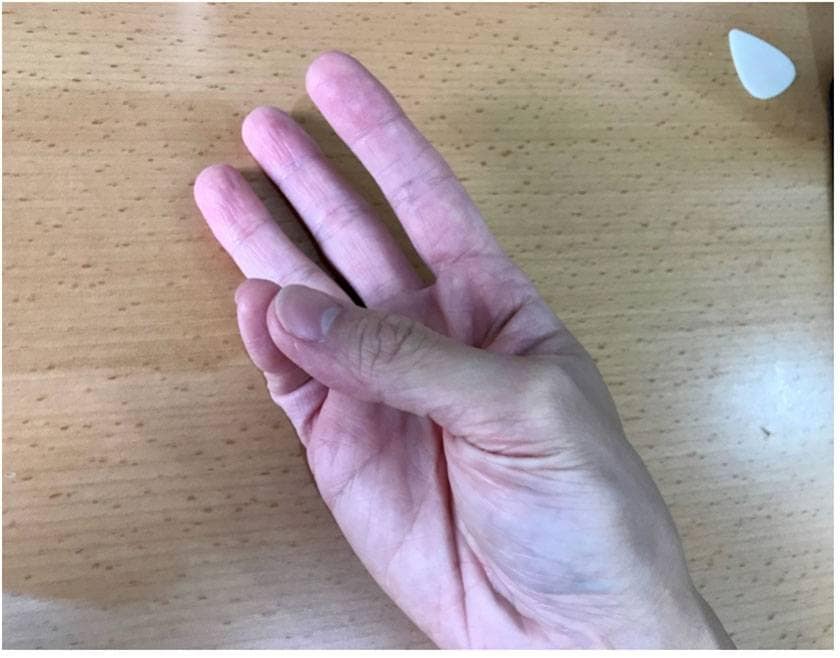
Once you get used to this, try not to move your pinky and focus only on moving your thumb. At this point, try to move your thumb as much as possible. A key tip to keep in mind is to not overexert yourself. If you use too much force, you’ll end up unnecessarily tensing other parts of your body. Since this is an extension of picking practice, focus on eliminating any unnecessary tension.
What did you think? Just by being conscious of joint movement, your playing will improve significantly, so I hope this helps those struggling with fingerpicking.
See you next time!
The column "sound & person" is made possible by submissions from our readers.
For more details on how to submit, click here.


 お化けを倒してサウンドGET!
 バンドあるある相談
 ギタースタートガイド
 めちゃラク!ギター講座
 最新コラム&動画をCheck!! OTOYA通信
 サウンドハウス虎の巻 !
 Discount Sale
 Outlet
 New Arrivals
 Podcast (streaming)
 Headphones / Earphones
 Microphones
 Wireless Equipment
 Speakers
 Power Amps
 Mixers
 Processors
 Portable PA Systems
 Recorders
 Karaoke
 Guitars
 Basses
 Ukuleles
 Drums & Percussion
 Pianos / Synthesizers
 Wind Instruments
 Stringed Instruments
 Japanese Instruments
 Harmonicas, Other
 Software
 DJ & VJ
 Stands
 Cables & Connectors
 Racks & Cases
 Lighting
 Stage & Truss
 Video Equipment
 PC PERIPHERALS
 Power Supplies
 Studio Furniture
 Household Items, Other
 Alcoholic Beverages