Hello, this is Dr. Baukoff.
I have written before that, when it comes to instruments, I am a ‘resident of the used-instrument world’.
In fact, apart from instruments that I have custom-ordered from workshops, I have hardly ever purchased a new instrument.
These days, the focus of my performance activities is historical instruments (all of them custom-made by workshops), but when I was playing modern trombone, I stood on countless stages together with a wide variety of used instruments.
When I returned to Japan permanently from the United States, many of those instruments went on to new owners, and there was even a period when I did not own a single modern trombone. I currently own one tenor trombone and one bass trombone, but of course, both are used. Both were made by Kawai Musical Instruments, a company that no longer manufactures brass instruments. I believe that being able to encounter rare instruments that are difficult to find nowadays is one of the unique attractions of used instruments.
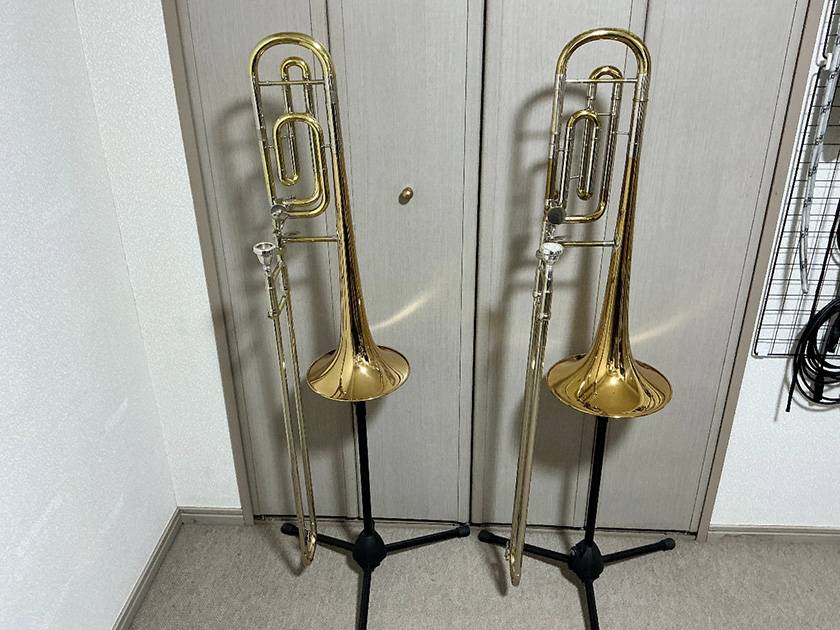
When I was a child, I longed for shiny, brand-new instruments that no one had ever touched.
However, even a well-used instrument can produce the sound you envision. And you can obtain an instrument in a class that would be out of reach if purchased new, at an affordable price. The moment I realized that, my ‘used-instrument rabbit hole’ began.
This time, I would like to introduce some of the memorable instruments I have encountered over the years while writing about the appeal of used instruments.
01. Kurt Schertzer Tenorbass-posaune
This is an instrument made by Kurt Schertzer, a master craftsman from Augsburg, Germany.
Although it was made after World War II, it has the weighty, deep sound characteristic of the German Romantic tradition. I was looking for an instrument to play the third trombone part in Bruckner symphonies as a ‘sort-of-period instrument’.
Since the other members of the section were using Piering-made instruments, I was originally looking for another Piering instrument, or at least an instrument from the same period. However, I could not find one, and that was when I encountered this Schertzer. As it turned out, it performed even better than I had expected.
And this instrument has another special story.
Its previous owner was Mr. Jay Friedman, the former principal trombonist of the Chicago Symphony Orchestra.
He is also known as a collector of German-made posaunen (trombones), and apparently this particular instrument was the memorable first one he purchased during the Chicago Symphony Orchestra’s concert tour of Germany in the 1970s.
I heard through someone I knew that Mr. Friedman was planning to part with several of his instruments, so I contacted him directly. In the end, he offered me two instruments to choose from, and this Schertzer was the one I selected.
It is not only the player who has a history—the instrument itself does, too. This is an instrument that taught me about this unique appeal of used instruments.
02. King 607F
I purchased this instrument for an extended run of the musical Chicago.
I needed a relatively small instrument with an F attachment (*1) that would be easy to handle even in a cramped orchestra pit.
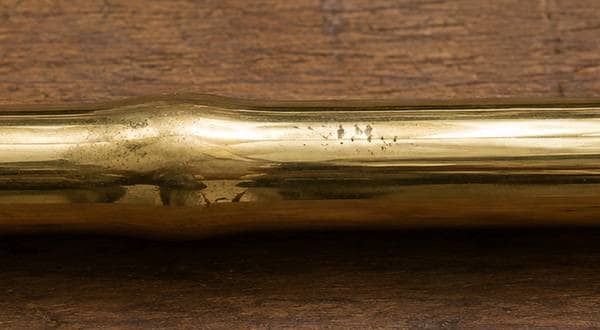
The lacquer on this instrument was almost completely worn away, and there were noticeable dents. In terms of appearance alone, it was a completely ‘well-used secondhand instrument’. You could even call it a junk instrument.
But when I played it, I was amazed.
Both the slide and valve were astonishingly smooth, and it became a partner that probably ranks among the one or two instruments I have ever owned that felt most natural in my hands.
During that run, it also gave me the very unusual experience of receiving words of praise by name from the mayor of the city where the performance was held (a city in the suburbs of Chicago), who had come to see the show.
An instrument’s value is not determined by its appearance alone. This is an instrument that made me truly realize that.
*1 F attachment: An extension tube operated by a lever. It expands the range of notes that can be played without fully extending the slide.
03. Edwards T350-E
When I was in my fourth year of university, I went to the United States with the casual thought, “Maybe I’ll study some English.”
However, I was overwhelmed by an opera performance I saw at the university I was attending, and decided on the spot that “I have to do this!” and went on to pursue a study-abroad program in music.
At the time, I had not brought an instrument with me, but an American student happened to be selling this Edwards (thanks, Jason!).
All of the lacquer had been stripped from the bell, and it had none of the shine of a new instrument.
At the time, I still had a strong longing for new instruments, so I thought, “A new one of the exact same model must be better,” and the following year I ordered exactly the same model from the manufacturer.
However, the result was completely unexpected.
Despite being exactly the same model, the tone, the playing feel—everything about the original used instrument suited me better.
Even today, this remains one of my most memorable stories of a major mistake.
I ultimately continued using that instrument until I graduated from university, but afterward I let it go and returned once again to a used instrument that I really liked.
I believe that experience greatly changed the way I think about used instruments.
Instruments Are Not Disposable
The greatest appeal of used instruments is, above all, the once-in-a-lifetime nature of each encounter.
I have such strong attachments to the instruments introduced here, as well as the many other partners I have encountered over the years, that I would love to welcome them back into my possession if I ever had the chance.
Of course, that does not mean I am dissatisfied with the instruments I use now. There is also the possibility that I may once again encounter a new ‘instrument of destiny’. That anticipation is another unique pleasure of used instruments.
With string instruments, it is not unusual for instruments that are several hundred years old to still be actively played. Brass instruments, too, can be passed down from parent to child and grandchild, or even beyond, if they are properly maintained.
I myself have played a French trombone made more than 100 years ago with a period orchestra at a music festival in New York.
Even when production has ended and genuine replacement parts from the manufacturer are no longer available, a skilled repair technician can make the necessary parts and repair the instrument. If it is a renowned instrument from a bygone era, having conversations with such craftsmen can be one of the pleasures in itself.
Instruments are never disposable.
If you already know the appeal of used instruments, please join me in this deep ‘rabbit hole’.
And even if you prefer new instruments, if you ever feel that the instrument in your possession has finished serving its purpose with you, please do not throw it away or simply put it away in a closet. Instead, please pass it on to the next player.
I am sure that the story of that instrument still has a long way to go.
*Sound House also buys and sells used musical instruments. If you are looking for the next owner of an instrument that is important to you, please consider using our service.
![[Lots of Rare and Hard-to-Find Items!] Shop at Sound Mart and Save Money!](/contents/uploads/thumbs/5/2022/4/20220419_5_17556_1.jpg)
 吹奏楽・ブラスバンド特集
 プラスチック管楽器特集
 トロンボーンの仲間
 虎の巻 トロンボーン
 トロンボーンの選び方
 トロンボーンとは
 Discount Sale
 Outlet
 New Arrivals
 Podcast (streaming)
 Headphones / Earphones
 Microphones
 Wireless Equipment
 Speakers
 Power Amps
 Mixers
 Processors
 Portable PA Systems
 Recorders
 Karaoke
 Guitars
 Basses
 Ukuleles
 Drums & Percussion
 Pianos / Synthesizers
 Wind Instruments
 Stringed Instruments
 Japanese Instruments
 Harmonicas, Other
 Software
 DJ & VJ
 Stands
 Cables & Connectors
 Racks & Cases
 Lighting
 Stage & Truss
 Video Equipment
 PC PERIPHERALS
 Power Supplies
 Studio Furniture
 Household Items, Other
 Alcoholic Beverages