Nice to meet you. I’m Joshua and I love talking about Western music.
I’ve been given the opportunity to write this column. I’ve been immersed in Western music since elementary school, and the moment I truly felt my life had changed was in upper elementary school when I listened to Led Zeppelin’s “Led Zeppelin II.” At the time, I looked at the album jacket and genuinely believed that Led Zeppelin must be a band with a lot of members. (Just to clarify, there are actually four.)
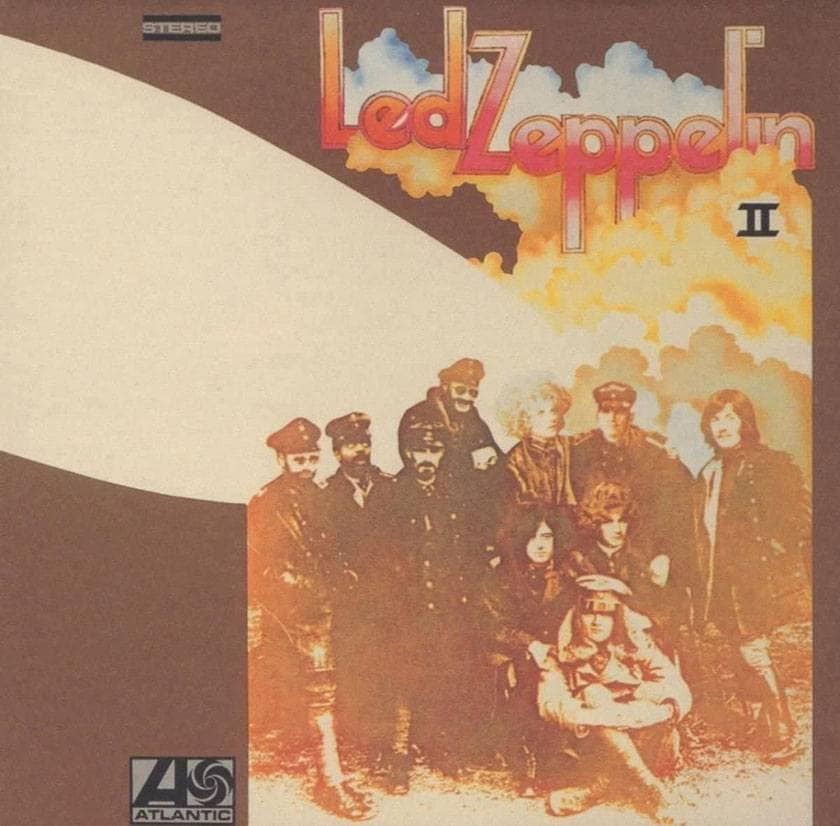
Led Zeppelin “Led Zeppelin II”
Now, for the first blog post, I’ll be covering the band I respect the most: Rush. If I had to describe Rush in one line, it would be: “The ultimate three-piece band aiming for progressive (forward-thinking) rock perfection.”
Rush was formed in Toronto, Canada in 1968. High school classmates Geddy Lee (vocals, bass) and Alex Lifeson (guitar) formed the band with other members, and they debuted in 1974 with the album Rush as a trio with John Rutsey on drums. Their musical style at the time was heavily influenced by Led Zeppelin and blues rock, but Rutsey left the band just before a U.S. tour. As a result, Neil Peart (also sometimes written as “Part”) joined as the drummer, and he became a new driving force not only through his highly technical drumming but also as a lyricist.
On the opening track of their second album Fly By Night (1975), “Anthem,” the song begins with a complex and unusual 7/8 time signature unison performance. You can see Geddy delivering soaring high vocals while playing a gritty bass line, Alex playing a Gibson ES-335 while shaking his blond hair, and Neil—who hardly seems like a new member—already fully integrated into the band with his incredible technical skills. From this point on, Rush became a fixed trio.
■ ”Anthem”
The band continued steady touring activities, but sales did not improve. Facing the risk of having their contract terminated, the three members decided, “If that’s the case, we’ll just do exactly what we want,” and created their fourth album, 2112 (1976). The album features a 7-part suite titled “2112,” which takes up the entire A-side of the record (just over 20 minutes). It received high praise, and especially parts 1 and 2 became signature pieces that continued to be performed in live shows.
However, what makes Rush remarkable is that they did not become complacent. With each album, they pursued greater technical skill and more complex lyrics, and their song structures became increasingly intricate through extensive use of odd time signatures. Geddy’s already high-pitched vocals became even higher, his bass playing while singing became even more demanding, and he even began playing keyboards and bass pedals simultaneously.
Alex began playing on Gibson double-neck guitars to switch between 12-string and 6-string parts, brought out acoustic and classical guitars, and even started operating bass pedals with his feet. Neil, whose drum kit was already massive with double bass drums, kept expanding it further—adding gongs, chimes, triangles, and percussion instruments assembled like a fortress, and even lining up multiple cowbells to play melodies, resulting in an all-out display of creativity.
Even so, their unwavering principle remained that they would perform exactly what was recorded, as a trio. Rush is often categorized as progressive rock (“prog rock”), but in reality, they created a truly original sound that was not bound by any genre classification. Their epic-oriented style continued through A Farewell to Kings (1977) and Hemispheres (1978), but with Permanent Waves (1980) and Moving Pictures (1981), they shifted toward more compact songwriting. These works combined complexity with a certain pop sensibility, and are often cited as their definitive albums. In particular, “The Spirit of Radio” from “Permanent Waves” and “Tom Sawyer” from “Moving Pictures” became signature songs.
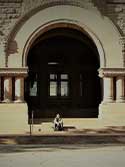
The instrumental track “YYZ” from the latter features solo parts for all three members, offering the ultimate trio performance. By the way, “YYZ” comes from the airport code of their home base, Toronto. When I once visited Toronto, I got excited just seeing the “YYZ” luggage tag on my suitcase, and the very first place I went to was Queen’s Park in Ontario, the filming location of one of the album covers. Starting from a 5/4 time signature intro based on Toronto airport’s Morse code (a system that transmits letters using long and short signals), the piece is packed with highlights such as an intense unison section and individual solos.
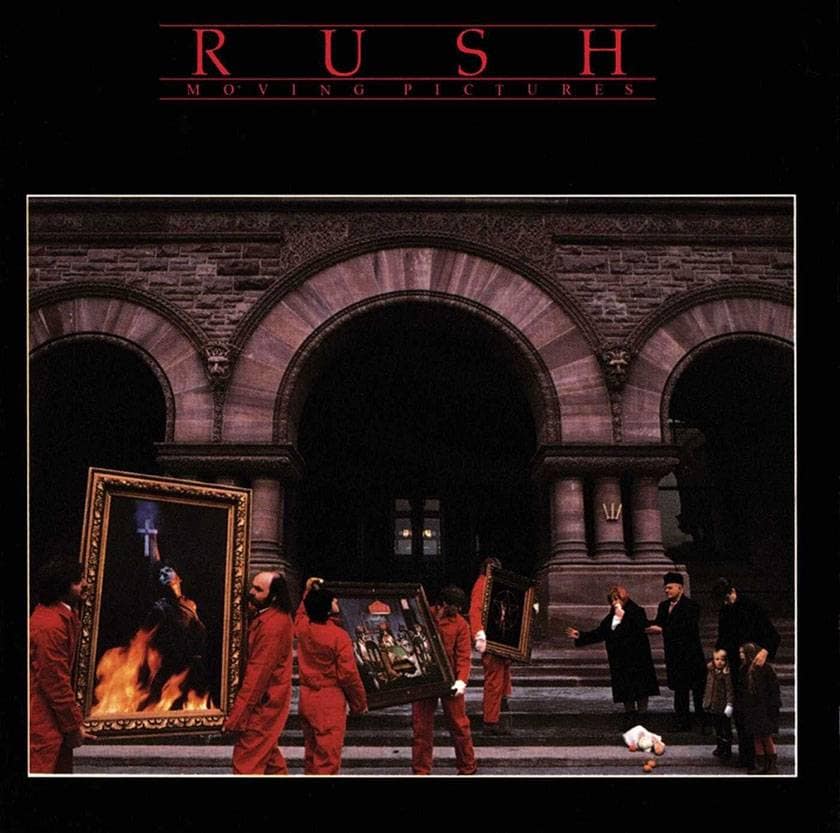
Rush “Moving Pictures”
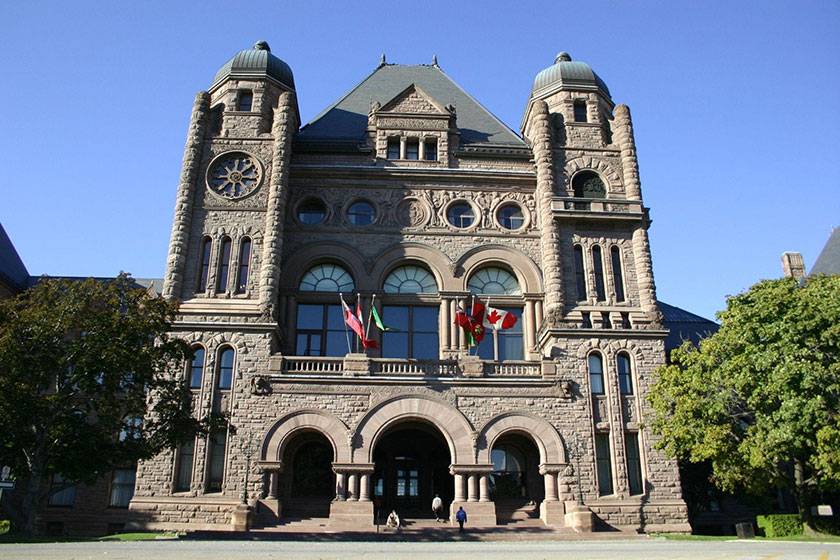
Ontario Legislative Building
■ Rush “YYZ”
Rush’s musical style, which seemed to have reached its peak, continued to evolve afterward. In 1982’s “Signals” and 1984’s “Grace Under Pressure,” they shifted direction under the influence of then-cutting-edge bands such as The Police and U2. During their 1984 tour, they also performed in Japan, which significantly increased their recognition there. After that, they went through a period of heavily using synthesizers in response to the trends of the time, but starting with 1993’s “Counterparts,” they returned to their basic guitar–bass–drums setup and shifted once again toward a heavier sound.
■ Driven
This version is from the live album Rush in Rio, performed in front of an audience of 40,000 in Brazil. Geddy’s heavily distorted bass solo (starting at 1:39) is outstanding, and Alex’s switching between heavy drive tones and acoustic sounds via piezo pickups, as well as Neil’s full 360-degree drum setup, all deliver excellent performances.
However, in 1997 the band suddenly went on hiatus. Neil’s daughter died in a traffic accident, and in 1998 his common-law wife passed away from cancer. Neil stopped making music and embarked on a journey of travel and reflection, while the other two patiently supported him. As Neil recovered, the band resumed activity and released “Vapor Trails” in 2002. They continued releasing albums periodically afterward, but statements suggesting retirement from members became more frequent, and the 2015 tour effectively marked their retirement. Tragically, Neil suffered from a brain tumor and passed away in January 2020, making a reunion forever impossible.
After retirement, Alex largely stayed out of the public eye, but this year Epiphone released his signature model (Alex Lifeson Les Paul Axcess Standard), leading him to give interviews again and release solo material. This guitar is selling extremely fast worldwide, and in Japan it’s also selling out immediately upon restock at the time of writing. This alone shows the depth of their fanbase. Geddy published the book Geddy Lee’s Big Beautiful Book of Bass in 2018, exploring vintage bass guitars, and also released a signature version of his beloved SansAmp preamp (appropriately named “YYZ”). Recently, news also broke that Alex and Geddy are releasing beer (!?), which has excited fans.
I have been fortunate enough to see Rush in concert six times: in 1984 in Tacoma, Washington (with Gary Moore as the opening act!) and at the Nippon Budokan in Japan, in 2002 in Baltimore, Maryland, in 2004 in Virginia Beach and Bristow, Virginia (suburbs of Washington, D.C.), and in Bristow again in 2010. Being able to experience them live repeatedly while still in my teens was a great privilege, and witnessing their “comeback” during the 2002 tour after their hiatus was also a major joy. I will never again be able to see them live, but their music is so deep that I still discover something new every time I listen. If this article has sparked your interest, I highly encourage you to give them a listen.
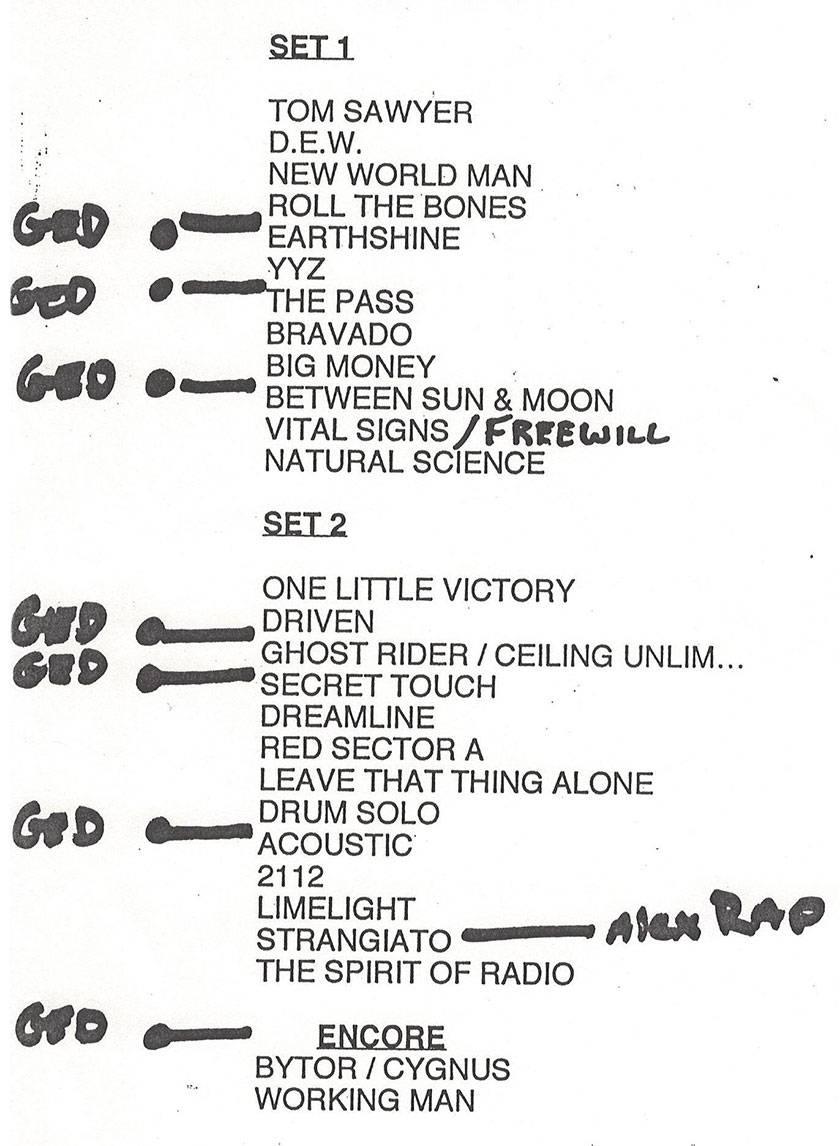
October 15, 2002 Baltimore concert setlist (copy of the original)
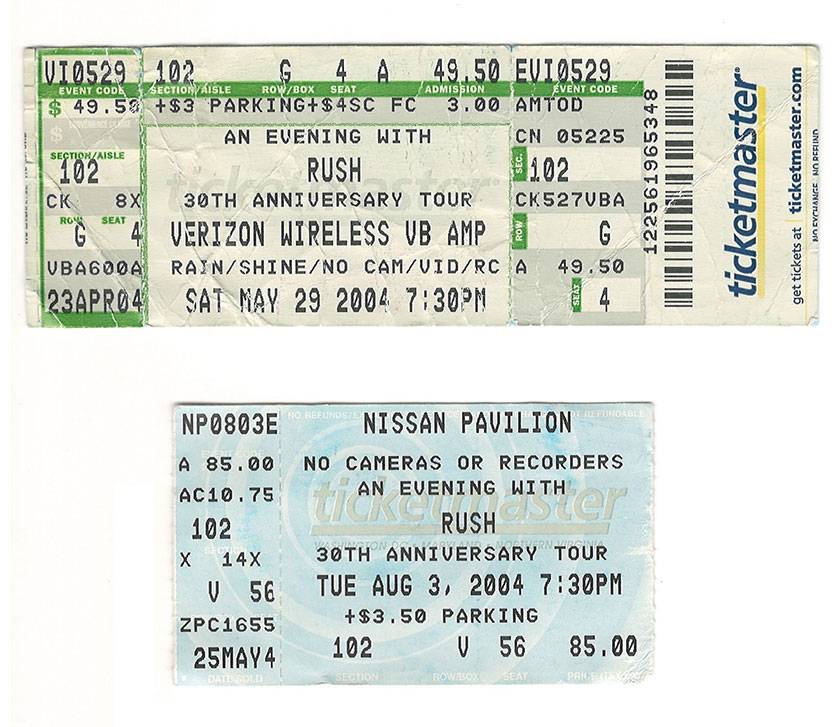
May 29, 2004 Virginia Beach concert and August 3 Bristow concert tickets
The “sound & person” column is made up of contributions from you.
For details about contributing, click here.
 Discount Sale
 Outlet
 New Arrivals
 Podcast (streaming)
 Headphones / Earphones
 Microphones
 Wireless Equipment
 Speakers
 Power Amps
 Mixers
 Processors
 Portable PA Systems
 Recorders
 Karaoke
 Guitars
 Basses
 Ukuleles
 Drums & Percussion
 Pianos / Synthesizers
 Wind Instruments
 Stringed Instruments
 Japanese Instruments
 Harmonicas, Other
 Software
 DJ & VJ
 Stands
 Cables & Connectors
 Racks & Cases
 Lighting
 Stage & Truss
 Video Equipment
 PC PERIPHERALS
 Power Supplies
 Studio Furniture
 Household Items, Other
 Alcoholic Beverages