Have you ever been listening to music on Spotify or Apple Music and wondered, “What genre is this song?”
Or maybe someone has asked, “What kind of music do you usually listen to?” and you’ve found yourself thinking, “I listen to all sorts of things, but I don’t know how to explain it!”
With so many music genres out there—and plenty of overlap between them—it’s easy for beginners to feel overwhelmed.
The good news is that once you learn a few simple listening tips, discovering new music becomes much more enjoyable.
In this beginner-friendly guide, I’m going to cover the benefits of understanding music genres, how to identify them, and introduce some of the most popular genres you’ll encounter.
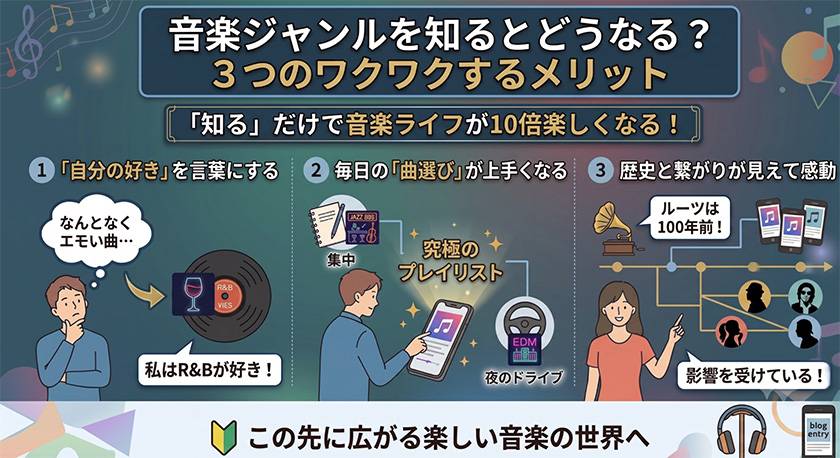
1. Why Learn About Music Genres? 3 Reasons You’ll Enjoy Music Even More
You don’t need to know music genres to enjoy music—but understanding them can make your musical life much more exciting!
① You’ll Be Able to Describe Your Musical Taste
Instead of saying, “I like emotional songs,” you’ll start to understand what specifically appeals to you. Maybe you enjoy the smooth groove of R&B or the energetic sound of rock. Knowing the genre makes it easier to discover new artists and songs you’ll love!
② You’ll Become a Pro at Choosing the Perfect Music for Every Moment
Imagine thinking, “I need something to help me focus, so I’ll put on some jazz,” or “It’s a late-night drive, so EDM is the perfect choice.” Once you understand music genres, you’ll be able to pick songs that match your mood and the situation. You’ll also be able to create your own ideal playlists, making everyday life that much more enjoyable.
③ You’ll Discover the History and Connections Behind Music
You may find yourself thinking, “Wow, this latest hit song actually has its roots in a genre that originated over 100 years ago!” or realizing that two of your favorite artists were influenced by the same musical style. Understanding genres lets you appreciate not only the music itself but also the stories and backgrounds behind it.
For example, Japanese artist Gen Hoshino is widely known for drawing strong inspiration from Black music genres, including the Motown sound that became immensely popular in the United States during the 1960s!
2. No Music Theory Required! 3 Easy Ways to Identify Music Genres
There are countless music genres out there, but if you’re just getting started, there’s no need to learn complicated music theory. The next time you listen to a song, simply pay attention to these three key points. You’ll be surprised at how much easier it becomes to recognize different genres.
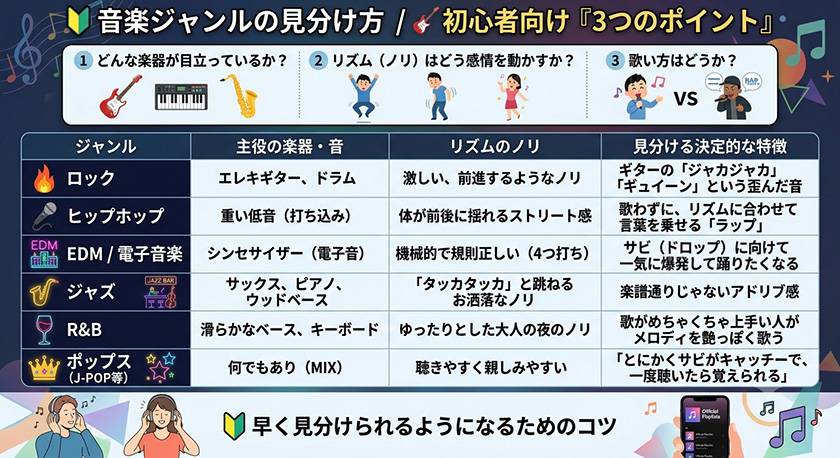
① What Instruments Stand Out?
One of the biggest clues to a song’s genre is the instruments it uses. Do you hear crunchy electric guitars? Electronic synth sounds? Or is the song driven by acoustic instruments like saxophone and piano? Start by focusing on the most prominent sound—the instrument that takes center stage in the mix!
② What Kind of Rhythm or Groove Does It Have?
Does the song make you want to bang your head to an energetic beat? Gently sway from side to side? Or jump up and dance to a steady, driving rhythm? Paying attention to the song's groove can tell you a lot about its genre.
Another important factor is BPM (Beats Per Minute), which refers to the song’s tempo—the number of beats that occur in one minute. For example, when you’re relaxing at a café with a cup of coffee, you might naturally gravitate toward laid-back jazz or R&B rather than fast-paced music. On the other hand, if you’re out for a run, high-energy rock or EDM with a faster BPM may be the perfect fit (though, of course, the best music is always whatever you feel like listening to!). Simply paying attention to a song’s rhythm and tempo can reveal a great deal about its musical character.
③ How Is the Vocal Performed?
The way vocals are used varies greatly from genre to genre. Is the singer delivering a melodic vocal performance, or are they rhythmically speaking or rapping over the beat? If you think of the human voice as another musical instrument, the differences between genres become much easier to recognize.
It’s also worth noting that not all music includes vocals. Songs without singing are called instrumentals (or ‘instrumental tracks’) and are common in genres such as jazz, classical music, and EDM. Whether a song has vocals—or none at all—is another useful clue when identifying its genre.
3. A Beginner’s Guide to Music Genres: Essential Styles and Their Characteristics
Now that you know the three key points to listen for, let’s take a look at six of the most popular music genres that you can start identifying right away.
Rock
- Main Instruments:
Electric guitar, powerful drums, bass guitar - Rhythm & Groove:
Energetic and driving, with a strong ‘head-bobbing’ feel - Key Characteristics:
The distorted sound of electric guitars—those crunchy, soaring riffs—is one of rock’s defining features. Rock is often performed by bands and delivers its energy and message directly to the listener. It’s the perfect genre when you want to feel energized or motivated.
Representative Artists
Bump of Chicken, One Ok Rock, B’z, Kana-Boon, One Direction, The Beatles, Deep Purple
Hip Hop
- Main Instruments:
Heavy bass, sampled sounds, and programmed beats - Rhythm & Groove:
A laid-back, street-inspired groove that makes you nod your head - Key Characteristics:
Rather than singing melodies, hip hop is centered around rap—rhythmically delivering words over a beat. DJs and producers create the instrumental foundation while rappers express themselves through lyrics, wordplay, and storytelling. Paying attention to the lyrics can make the experience even more enjoyable.
Representative Artists
Creepy Nuts, Chanmina, Kendrick Lamar, Eminem, Snoop Dogg
EDM (Electronic Dance Music)
- Main Instruments:
Synthesizers and other electronic sounds - Rhythm & Groove:
Steady, four-on-the-floor dance beats - Key Characteristics:
As the name suggests, EDM is music made for dancing at clubs and music festivals. Songs typically build tension before exploding into an exciting climax known as the ‘drop’. It’s ideal for parties, workouts, or whenever you want to boost your energy levels.
Representative Artists
Avicii, Zedd, The Chainsmokers, Martin Garrix, Alan Walker, Skrillex, Perfume, Wednesday Campanella
Jazz
- Main Instruments:
Saxophone, trumpet, piano, upright bass - Rhythm & Groove:
Stylish, swinging rhythms with a relaxed feel - Key Characteristics:
Jazz is sophisticated and expressive—perfect for a cozy café or a late-night lounge atmosphere. One of its greatest charms is improvisation, where musicians create spontaneous solos based on the mood of the moment. It's an excellent companion for relaxing evenings or reading.
Representative Artists
Miles Davis, Bill Evans, Herbie Hancock, Chick Corea, Hiromi Uehara
R&B (Rhythm and Blues)
- Main Instruments:
Smooth bass lines and electronic keyboards - Rhythm & Groove:
Relaxed, mellow grooves that gently sway from side to side - Key Characteristics:
R&B combines rich rhythms with expressive and technically skilled vocal performances. Modern R&B often incorporates elements of hip hop while placing a strong emphasis on soulful singing and emotional delivery. It's the perfect soundtrack for winding down or enjoying a quiet evening.
Representative Artists
Hikaru Utada, Misia, Toshinobu Kubota, Stevie Wonder, D’Angelo, Alicia Keys
Pop (Pop Music / J-Pop)
- Main Instruments:
Anything goes—pop music freely blends elements from many genres - Rhythm & Groove:
Accessible, catchy, and easy to enjoy - Key Characteristics:
Pop music is designed to be memorable and enjoyable for a wide audience. It often combines the best elements of rock, EDM, R&B, and other genres to create songs with irresistible choruses and broad appeal. If you’re looking for crowd-pleasing music, pop is hard to beat.
Representative Artists
Mrs. Green Apple, Kenshi Yonezu, Yoasobi, Vaundy, Michael Jackson, Ed Sheeran, Bruno Mars, Taylor Swift
[A Quick Note] Genres Often Overlap
Of course, just because a song doesn’t fit every characteristic listed above doesn’t mean it belongs to a different genre. You can find hip hop tracks driven by heavy electric guitars or jazz songs that incorporate EDM-style four-on-the-floor beats. Music is constantly evolving and borrowing ideas from different styles. Think of these genre descriptions as a helpful starting point—a musical map that will make exploring new sounds even more enjoyable!
4. 2 Tips for Identifying Music Genres More Quickly
If you’re thinking, “I understand the characteristics, but I still can’t tell which genre my favorite songs belong to,” give these simple methods a try!
① Compare Official Playlists (Highly Recommended!)
Try searching for terms such as “Rock Playlist” or “R&B Playlist” on streaming services like Spotify and Apple Music, and listen to the official curated selections. As you listen, you’ll naturally begin to recognize things like, “Oh, this is what a typical rock guitar sounds like,” or “This is the laid-back groove of R&B.” By comparing what you hear with the characteristics you’ve learned, your ears will start to recognize genres surprisingly quickly!
You can even find official playlists dedicated to trending Vocaloid songs!
② Look Up Your Favorite Artists
Another simple method is to search for your favorite artists on websites such as Wikipedia. In many cases, you’ll find the genres associated with their music listed alongside their profiles. You may discover patterns in your own musical tastes and understanding these preferences is also a great way to find new artists and songs you’ll likely enjoy.
5. Conclusion: Grab Your Map and Explore the World of Music
Music genres aren’t strict rules that limit how you should listen to music. They’re simply useful tools that help you discover new favorites.
Learning about genres isn’t about putting music into boxes—it’s about giving yourself a map for a bigger and more exciting musical adventure.
With that map in hand, you’ll be able to confidently explore genres and artists you may have previously overlooked. Why not broaden your musical tastes and go discover a new favorite song waiting to be found?
In the next installment of this series, I will dive deeper into individual genres and explore what makes each one unique. If you’re excited to discover even more music, I’d love for you to join us on the journey and expand your musical horizons together!







 AIAIAI TMA-2特集
 DJアプリの選び方
 DJ YUTARO特別インタビュー
 DJミキサー編
 DJを始めるのに必要なもの?
 ニコニコ生放送やUstreamでDJプレイをネット配信する
 Discount Sale
 Outlet
 New Arrivals
 Podcast (streaming)
 Headphones / Earphones
 Microphones
 Wireless Equipment
 Speakers
 Power Amps
 Mixers
 Processors
 Portable PA Systems
 Recorders
 Karaoke
 Guitars
 Basses
 Ukuleles
 Drums & Percussion
 Pianos / Synthesizers
 Wind Instruments
 Stringed Instruments
 Japanese Instruments
 Harmonicas, Other
 Software
 DJ & VJ
 Stands
 Cables & Connectors
 Racks & Cases
 Lighting
 Stage & Truss
 Video Equipment
 PC PERIPHERALS
 Power Supplies
 Studio Furniture
 Household Items, Other
 Alcoholic Beverages