In recent years, music production environments have evolved significantly. Centered around DAWs and software synths, we’ve reached an era where sound design that once required large hardware setups can now be completed on a single PC.
On the other hand, as you continue producing, you may find yourself thinking:
“I can create sounds, but it doesn’t really feel like I’m playing.”
“It’s convenient, but somehow it lacks that sense of actually ‘touching’ something.”
Amid this trend, instruments with a “physical, tactile feel” are once again gaining attention.
The KORG “phase8” is a perfect response to that desire.
Rather than just being another new product, it feels like an instrument that makes you reconsider the very experience of creating sound itself.
A new approach combining acoustic elements and electronic control
The biggest feature of the phase8 lies in its concept as an “acoustic synthesizer.”
While typical synthesizers generate waveforms electronically, this unit takes a completely different approach.
The source of the sound is a metal resonator (resonance plate) positioned at the center of the unit.
This plate physically vibrates, and its resonance is captured by pickups, then shaped into sound through a combination with electronic control.
In other words,
it’s a synthesizer built on the foundation of “actual, physically produced sound.”
Thanks to this mechanism, subtle fluctuations and harmonic changes that are difficult to fully reproduce digitally arise naturally, giving the sound a rich, organic texture.
A level of completeness as an instrument that turns anyone’s first impression on its head
When you hear the term “acoustic synthesizer,” some people might get the impression that it’s somewhat experimental.
However, once you actually get your hands on it, that opinion completely flipped.
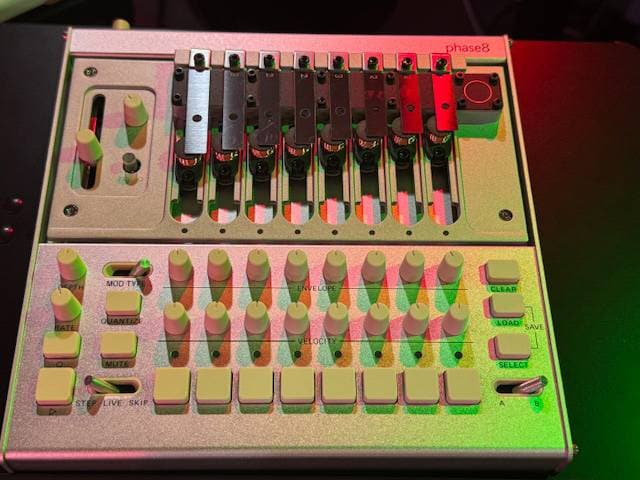
The texture of the metal panel, the rigidity of the body, and the precision of each component are all of a high standard, giving you a reassuring sense that it’s a solid instrument the moment you pick it up.
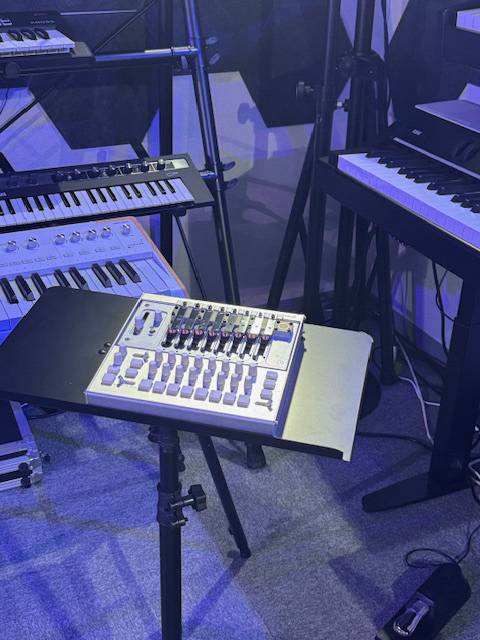
Despite its compact size, it has a strong presence, and it remains stable when set up.
It feels fully practical not only for studio use but also for live performance.
Rather than being driven solely by concept, the fact that it stands firmly as a practical instrument is a major draw.
Impression of the sound — a balance of nostalgia and newness
The first thing you notice when you actually play it is its distinctive “organic resonance.”
The sound produced by the vibrations of the metal plate has warmth while containing complex harmonics, clearly setting it apart from overly polished digital sounds.
Its texture carries nuances reminiscent of Rhodes-style electric pianos, while still blending naturally into modern tracks.
It strikes the perfect balance between nostalgia for those familiar with sounds from the ’80s and ’90s, and the freshness for those accustomed to software synths.
It also pairs well with genres like ambient, electronica, and minimal techno, and can handle a wide range of expressions, from pad-like usage to percussive playing.
An expressive experience completed through “touch”
What makes the phase8 interesting is that it’s not just a sound source—it’s that the sound changes through touch.
By raising the AIR slider, you can mix in the raw vibrations of the resonator, and in this state:
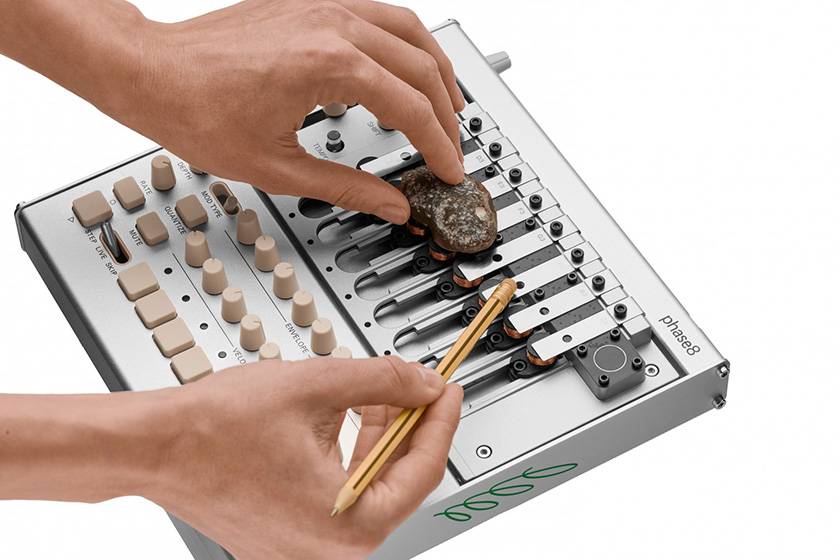
- Touching with your fingers
- Tapping
- Rubbing
These actions themselves are directly reflected in the sound.
For example, simply touching it lightly to dampen the vibration changes the sustain, and the way you tap it alters the attack and harmonics.
In other words,
“There’s no separation between playing and sound design.”
This kind of intuitive, physical control—something difficult to achieve with mouse operations or automation—is a unique appeal of this instrument.
Ease of use that balances simplicity and depth
The control layout is very well organized, with only the essential knobs and buttons.
Even on first use, it’s easy to navigate and naturally get into shaping sounds.
One particularly impressive feature is the 8-voice step sequencer.
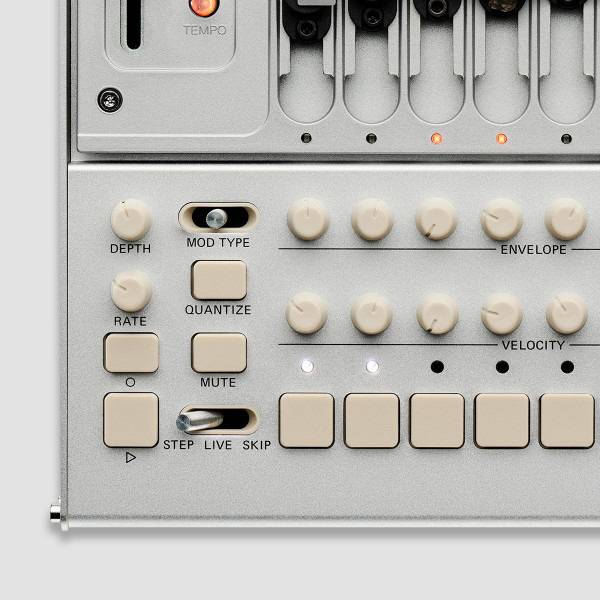
Each voice allows you to set the number of steps individually, making it easy to intuitively build polyrhythmic and polymetric patterns.
It also supports real-time recording of knob movements, allowing changes during a sequence to be captured as part of a phrase.
This sense of “performing the movement of sound itself” offers a distinctly different experience from conventional sequencers.
Expandability through interchangeable resonators
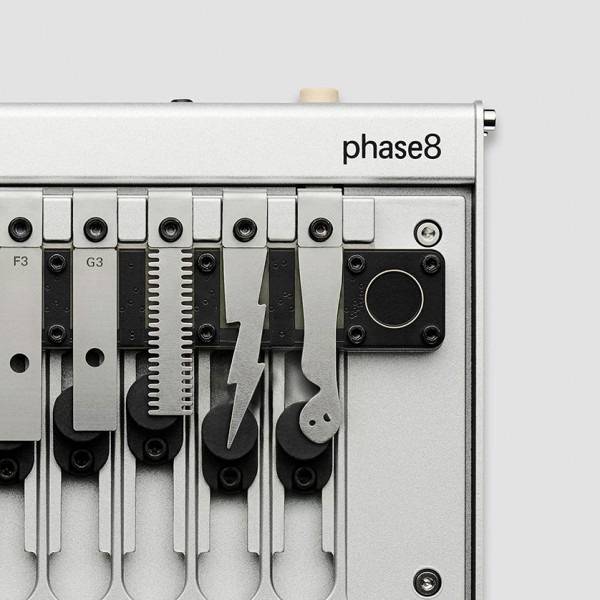
The phase8 also supports swapping out its resonators.
By changing the type or length of the plate, you can alter the pitch and resonance, effectively changing the character of the sound itself.
Using the included multiple resonators makes it easier to create more percussive sounds or unique tones.
The swapping process is not difficult, and it can be naturally incorporated as an extension of sound design, which leaves a positive impression.
Flexible integration with external gear
While the unit is highly complete as a standalone instrument, it also offers strong compatibility with external equipment.
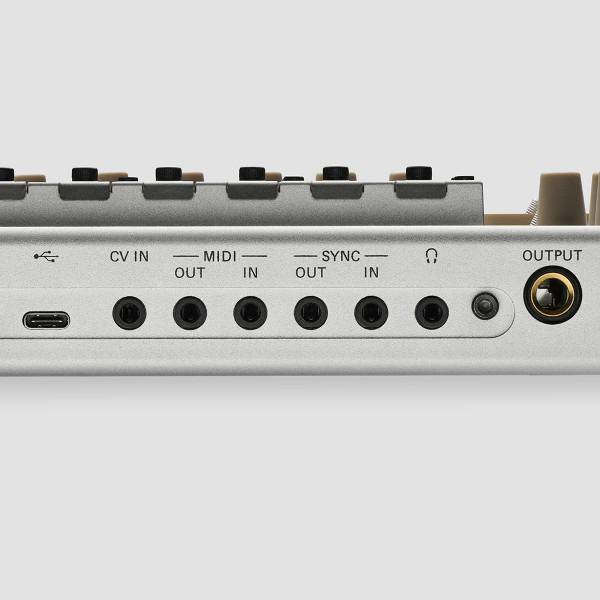
- MIDI / USB-MIDI
- CV input
- SYNC terminal
This allows not only synchronization with a DAW, but also integration with modular synths and performance via external keyboards.
In particular, within a modular setup, it stands out as a unique sound source that involves physical vibration.
Why it resonates across generations
What makes the phase8 especially interesting is that it appeals to a wide range of users, not just a specific group.
For those familiar with hardware, it represents a return to the roots of “creating sound through touch.”
For those accustomed to digital environments, it offers a new kind of interface.
The way it successfully combines both nostalgia and innovation is one of its most distinctive charms.
Recommended for the following people
- Those who value the tactile control of hardware synthesizers
- Those who want to add some variation to software-centered production
- Those interested in experimental sound design
- Those seeking an intuitive playing experience
It is especially recommended for those who want to enjoy not just the quality of the sound, but the process of creating it itself.
To Summarize: Returning to the Origin of “Touching the Sound”
KORG’s “phase8” presents a different approach from conventional synthesizers by combining physical vibration with electronic control.
In today’s production environment, where efficiency and speed are emphasized, the simple experience of “sound changing through touch” feels rather fresh.
For those looking for a new kind of inspiration in sound creation, and for those who value the feeling of actually performing, the “phase8” should be a highly satisfying option.
Be sure to check it out.




![[2026 Latest Edition] Choosing a Synthesizer/Popular Synthesizers Ranking](/contents/uploads/thumbs/2/2022/9/20220916_2_19446_1.jpg)
 シンセサイザー 入門ガイド
 PLAYTECH キーボードセレクター
 PLAYTECH 鍵盤特集
 おすすめサイレント楽器特集
 おすすめの電子ピアノ
 キーボードスタートガイド
 Discount Sale
 Outlet
 New Arrivals
 Podcast (streaming)
 Headphones / Earphones
 Microphones
 Wireless Equipment
 Speakers
 Power Amps
 Mixers
 Processors
 Portable PA Systems
 Recorders
 Karaoke
 Guitars
 Basses
 Ukuleles
 Drums & Percussion
 Pianos / Synthesizers
 Wind Instruments
 Stringed Instruments
 Japanese Instruments
 Harmonicas, Other
 Software
 DJ & VJ
 Stands
 Cables & Connectors
 Racks & Cases
 Lighting
 Stage & Truss
 Video Equipment
 PC PERIPHERALS
 Power Supplies
 Studio Furniture
 Household Items, Other
 Alcoholic Beverages