Hello, this is Yoshitaka posting here.
I’ve wandered through the acoustic guitar world for several years. However, I never had the financial means to dive into major U.S. brands like Martin, Gibson, or Taylor, and I also feared that after purchasing a high-end instrument, I might stop playing due to maintenance concerns or the fear of it getting damaged. As a result, carbon fiber acoustic guitars have become my go-to choice.
Carbon acoustic guitars are somewhat underappreciated in Japan, but today I will compare two major brands in this field: Rain Song and Composite Acoustics. These two brands, both made in the USA, are well-known in the world of carbon guitars, but there are only a few articles comparing them. Since both brands are handmade and not widely distributed in Japan, there aren’t many people who own guitars from both brands. Therefore, this review might be a rare one. While these instruments are niche, I’d appreciate it if you could accompany me on this subjective review from the perspective of a fellow carbon guitar enthusiast.
1. Overview of Carbon Acoustic Guitars
The first acoustic guitars made from materials other than wood were likely created by Ovation. The Ovation Adamas, which was loved by artists like Paul Simon, used a composite material of fiberglass and wood for its top. Later, with the introduction of new materials like graphite and carbon fiber, brands like Rain Song and Composite Acoustics were born. There are a few key characteristics that these guitars share:
- Durability / Maintenance-Free
Carbon guitars are free from common issues that occur with wood, such as neck warping, top sinking or bulging, and bridge lifting.
As a result, maintenance is primarily limited to fret replacement and electrical components like pickups and preamps. - High Precision / Consistent Sound
Thanks to the robust materials used, carbon guitars are made with such high precision that they eliminate dead spots.
They maintain a stable, consistent sound whether in high heat and humidity or low temperatures and dry conditions.
2. Rain Song H-WS1000N2 Review
Rain Song is a brand that continually focuses on material development. Currently, they offer a series with a top made from a composite of spruce and carbon, which seems to enhance the acoustic feel even further. However, the model I’m using is from their Hybrid Series, made from a mix of carbon and graphite (as of October 2021, is no longer in production). The body has a shape where the neck side is similar to Martin’s OM series, while the bridge is closer to a D-size, giving it a deep body and what could be described as a semi-jumbo size. The pickup is the same Fishman Prefix+T piezo system found on the Composite Acoustics GX that will be discussed later.
In the acoustic guitar world, it’s often said that “the more durable the guitar, the less it resonates," but I find that this guitar still produces a nice tone even with fingerpicking (though I admit, I haven’t experienced high-end acoustic guitars, so there are certainly others that sound even better). The natural sound has a rich, harmonic resonance typical of carbon, and with the added depth from the body thickness, it produces a deep and resonant tone. The line-out sound is pure piezo, but with the added resonance of the carbon, it creates a wide, electric-acoustic sound. It doesn’t sound exactly like an acoustic guitar, but I personally like it, so I plan to continue using it without modification.
However, attention is needed when setting up the pickup, especially with strumming. As noted in the manual, you need to cut some of the midrange to avoid a muffled sound. This is also true for the Composite Acoustics I’ll be mentioning later, so I believe it’s due to the characteristics of the pickup itself.
In terms of playability, the nut width is 44.5mm, which is relatively wide, but the neck is thin, making it a standout feature. For me, it’s very comfortable to play, and especially when performing bossa nova, it’s easy to press down tension chords, which is a big advantage.
The string height, as I recall when I purchased it, was 2.7mm at the 6th string, 12th fret, and 2mm at the 1st string. I believe the manufacturer ships it at what they consider to be the best setup. With the thin neck, it’s easy to play, and despite the guitar's size, it’s lightweight.
As for the construction, the appearance features a gloss finish of carbon and graphite, which looks modern and beautiful. However, the inside of the body, particularly around the waist area, has a handmade feel where it seems like graphite pieces have been joined and glued together. This somewhat detracts from the polished aesthetic, and some might think, "what is this?" when they see it.
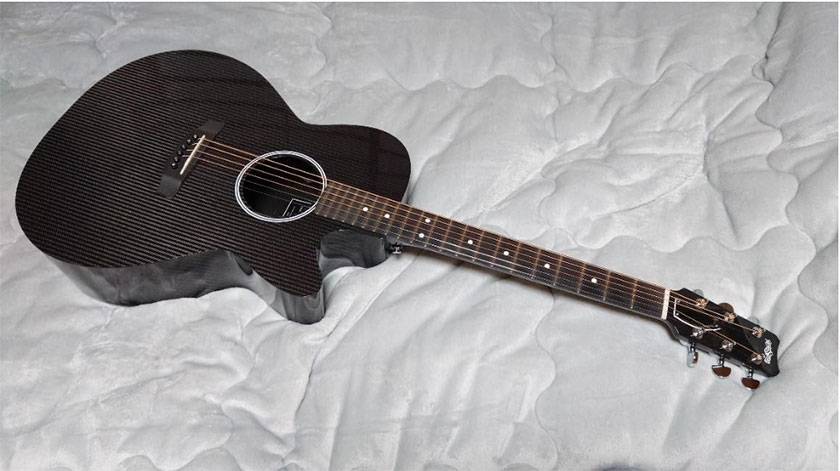
Rain Song H-WS1000N2 (Note: The soundhole ring pattern may vary depending on the shipping period).
3. Composite Acoustics GX Review
Composite Acoustics is now a brand under Peavey, and recent models feature TRACE ELLIOT pickups, which are also part of the Peavey family. The one I acquired was a used model, which came with a Fishman pickup, but I ended up letting it go during a big cleaning and decluttering session at home. After some time and regret, I found the previously mentioned Rain Song (a nearly new second-hand model) a few months later.
The Composite Acoustics GX has a futuristic design. From the front, this is not immediately obvious, but the back—particularly around the neck heel—features a seamless, integrated neck and body design, with a smooth curve that connects in a "through-neck" style. This gives it excellent high-position playability, and while it is handcrafted, it has the finish and precision of a high-quality industrial product.
The GX's size is similar to the semi-jumbo Rain Song WS but is slightly more compact with a shallower body. The GX I had was even more specialized, with a narrower neck (43mm nut width), but since the neck flares out in a fan shape, it didn’t feel cramped. The string height was 2.5mm at the 6th string, 12th fret, and 2mm at the 1st string, making it quite playable (the neck is designed to remain stable, so it doesn’t have a truss rod, which I believe is the standard setup from the manufacturer).
In terms of sound, I feel that this guitar is better suited for picking firmly rather than fingerpicking. Particularly in terms of natural acoustic sound, the previously mentioned Rain Song seems to resonate better when fingerpicked. However, for solo picking, I found the Composite Acoustics GX to have a sharp, punchy tone with good definition.
The line-out sound, like the Rain Song, has the same Fishman Prefix+T pickup and carbon body, resulting in a thick, electric-acoustic tone. (I’ve heard that the latest TRACE ELLIOT pickups are very excellent, so they might offer even more of an acoustic feel). As mentioned earlier, this sound might be a matter of personal preference, but when I did a remote collaboration with a grand piano using this guitar, I received feedback that the sound didn’t overlap, creating a well-balanced mix. If I had used a traditional acoustic guitar, my own recording skills might have led to the dynamic range of the grand piano burying the guitar's tone.

Composite Acoustics GX Narrow Wine Red (Fishman PICKUP Model)
4. Finally
Carbon acoustic guitars, even when new, are scarce in Japan and rarely seen online. However, if you don't part with one, it can be a lifetime instrument with minimal maintenance (though the electronics might need checking from time to time). It's a great piece of gear that you don’t have to worry about using. While new models are quite expensive, many well-maintained used guitars occasionally appear on the market, so if you’re looking, this could be a good opportunity. Carbon guitars have very little variation in quality even when second-hand, so as long as you know the condition of the frets, any scratches, and the electronics, it’s relatively easy to make a judgment.
Additionally, having a piece of gear that remains stable under any conditions is incredibly reassuring (though I may sound presumptuous since I'm not a professional).
Recently, emerging brands like ENYA and LAVA have released carbon acoustic guitars packed with the latest technology. These guitars not only break away from traditional designs but also feature built-in effects and are available at more affordable prices, making a big impact on the market. If you're interested in carbon guitars, these brands are definitely worth checking out.
I’ve also written an article about the LAVA ME2 FB Carbon Mini Guitar. Feel free to check it out.
Related article: "[Acoustic Guitar] Trying Out A Carbon Mini Guitar"
Thank you for reading all the way through!
The “sound & person” column is made up of contributions from you.
For details about contributing, click here.






![[Acoustic guitar] Acoustic guitar or acoustic-electric guitar](/contents/uploads/thumbs/5/2020/9/20200923_5_11215_1.jpg)

![[Acoustic] Bossa Nova Recommendation](/contents/uploads/thumbs/5/2020/6/20200608_5_10270_1.jpg)
![[Acoustic Guitars] About materials used in acoustic guitar](/contents/uploads/thumbs/5/2020/6/20200605_5_10266_1.jpg)

 DIY ギターメンテナンス
 超オススメのフレーズ道場 アコースティックギター
 アコギの選び方
 ピックアップの種類(アコースティックギター)
 弦の張り替え(アコースティックギター)
 ギターの選び方
 Discount Sale
 Outlet
 New Arrivals
 Podcast (streaming)
 Headphones / Earphones
 Microphones
 Wireless Equipment
 Speakers
 Power Amps
 Mixers
 Processors
 Portable PA Systems
 Recorders
 Karaoke
 Guitars
 Basses
 Ukuleles
 Drums & Percussion
 Pianos / Synthesizers
 Wind Instruments
 Stringed Instruments
 Japanese Instruments
 Harmonicas, Other
 Software
 DJ & VJ
 Stands
 Cables & Connectors
 Racks & Cases
 Lighting
 Stage & Truss
 Video Equipment
 PC PERIPHERALS
 Power Supplies
 Studio Furniture
 Household Items, Other
 Alcoholic Beverages