Hello! I’m Sugimoto, a PA specialist at Sound House, and in my private life, I play drums.
August has arrived, bringing the rush of summer festivals and outdoor events. By the way, have you ever heard PA staff repeatedly saying “one, two...” or “check, check...” into a microphone onstage or from the PA position at the back of the audience area during a changeover at a live house or event venue?
It’s a familiar sight to people who frequently attend live shows, but for those who aren’t familiar with PA work, it may seem a little mysterious. A commonly heard explanation for this kind of mic check is that “one” is used to check the low frequencies, while “two” is used to check the high frequencies. However, when I looked into PA and live sound again, I found that while this explanation isn’t entirely wrong, actual mic checks seem to be a little more complicated.
How true is the theory that “one is for the lows and two is for the highs”?
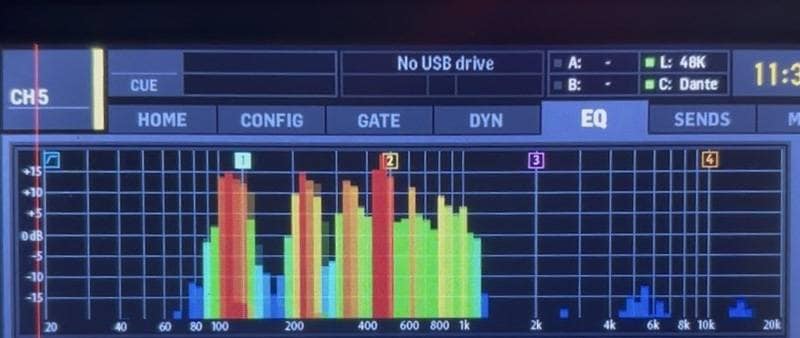
To put it simply, the closest explanation seems to be: “It makes sense as a general impression, but it’s not a strict rule.” The human voice isn’t made up of just a single frequency. In addition to the components that determine pitch, it contains various elements ranging from low to high frequencies, including the resonance of vowels, consonants, and the sound of breath. In fact, even when looking at the waveform on a PA console (X32), you can see that the positions of the peaks on the frequency graph clearly change between “one,” “two,” and “check.”
Saying “One”
When saying “one,” the amount of low-to-midrange content that forms the foundation of the voice becomes easier to hear. At a venue, this provides a reference for checking whether the voice is too thin, whether the low end is too prominent, or whether the sound is becoming muffled and muddy in the venue. Some PA engineers may also change the distance from the microphone while saying “one” to check how the low frequencies respond (the proximity effect).
Saying “Two,” “Sss,” and “Check”
On the other hand, the beginning of “two,” as well as breathy consonants such as “sss...” and “check,” contain high-frequency components. This makes them useful for checking whether the words can be heard clearly, whether the voice is projecting properly, and whether the high frequencies are becoming harsh or piercing.
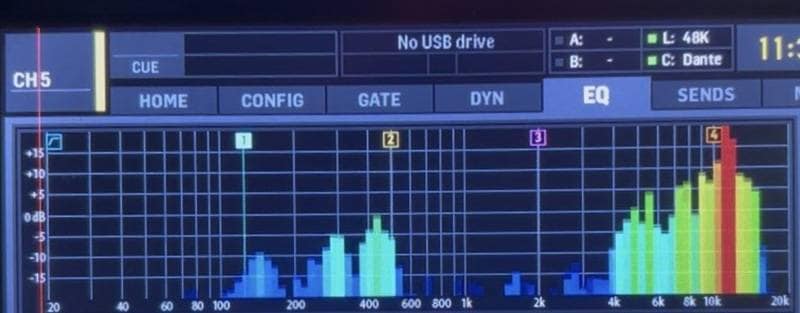
I think the way of remembering it as “one is more low-frequency oriented, while two and C are more high-frequency oriented” is simply an easy-to-understand way of describing this difference.
However, it’s not as though a PA engineer listens only to the low frequencies the instant they say “one,” and only to the high frequencies the instant they say “two.” In actual practice, it is probably more accurate to say that they are repeatedly making various short sounds to check the overall balance from low to high frequencies, as well as how the voice sounds as a whole.
What is the PA Engineer listening for when saying “one, two”?
When a PA engineer says “one, two,” they are checking not just a specific frequency range, but the entire PA system from the microphone to the speakers.
- Checking that the signal is passing through: They check whether the voice entering the microphone is passing correctly through the cables and mixer and coming out of the intended speakers. They also check that the left and right channels have not been reversed and that no noise is being introduced along the way.
- Adjusting tonal balance: Is the low end too boomy? Are the mids recessed, making the words difficult to understand? Are the highs too piercing? Low-cut filters and EQ are adjusted as necessary.
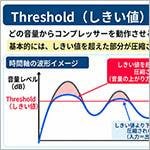
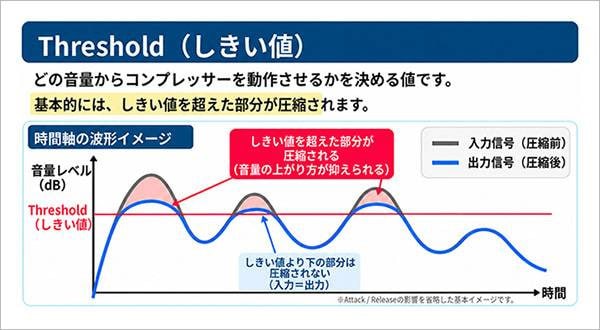
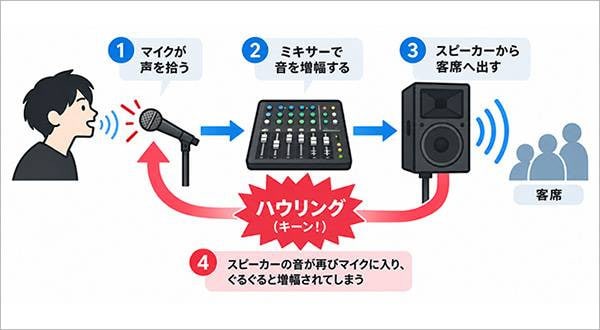
- Adjusting dynamics: They check whether the input distorts when the person speaks a little louder, whether the beginning of the voice is being unnaturally compressed, and whether feedback is about to occur.
- Checking the monitor return: It is also important to check whether enough of the voice is being returned from the monitor speakers onstage (floor monitors), whether the sound is muffled, and whether feedback is about to occur.
For a PA staff member, their own voice is the easiest and most familiar sound to use for checking. Precisely because it is a voice they hear all the time, they can more easily notice anything that feels unusual when it comes out of the speakers.
Why say “Sss...”? Why do the words differ from person to person?
When it comes to PA mic tests, you will often hear the distinctive “sss...” sound as well.
“C” and “S” contain the high-frequency, breathy sounds characteristic of these consonants. By pronouncing them a little more strongly, it becomes easier to check whether the definition and clarity of the words are reaching the audience, and whether the “S” sounds alone are becoming painfully harsh. The “C-” or “Sh-” sounding component of these consonants is called ‘sibilance’ in the audio world.
Even when looking at columns written by PA engineers overseas, the words used for mic tests really do vary from person to person. In addition to the familiar “check, one, two,” some people say “hey, hey,” “hello,” or “sibilance,” while others start singing or speak a set phrase.
Vocal check tips that are helpful for PA engineer during rehearsal
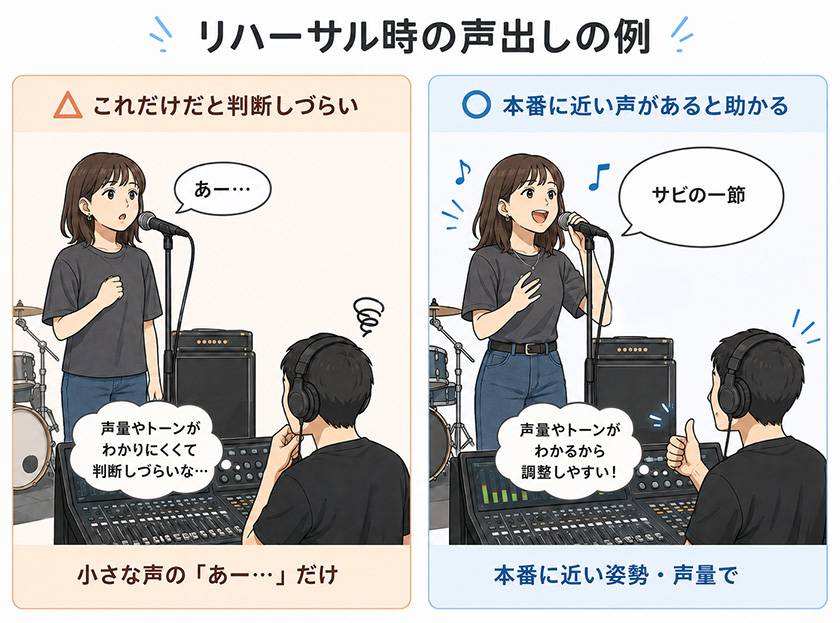
During a band soundcheck, you may sometimes see vocalists or drummers doing backing vocals speaking softly into the microphone, saying “ahh, ahh...” There is nothing inherently wrong with saying “ahh,” but doing only that makes it difficult to determine the range of frequencies actually contained in the singing, or how loud the loudest part of the song will be.
Also, if someone speaks quietly during rehearsal but suddenly sings at full volume during the actual performance, the input level and tonal balance set up by the PA engineer may change.
Here are three points to keep in mind when doing a vocal check during rehearsal.
1. Sing a line from the chorus of a song you will perform
Rather than speaking, it is helpful if you sing a line from the song using the same vocal technique and volume you will use when actually singing. In particular, if you can let the PA engineer hear the part where you sing with the most power, such as the chorus or a high-register section, for a few seconds, they can get an idea of “So this is about how loud the loudest part will be today.”
2. Sing with the same mic work you use during the actual performance
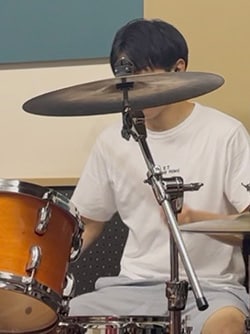
If you normally change your distance from the microphone—for example, moving closer during quieter sections and moving slightly away when singing more forcefully—it is helpful if you can demonstrate those movements as well, in a state as close as possible to the actual performance. For drummers doing backing vocals, if possible, it is also better to sing while sitting on the drum stool rather than standing, using your actual playing posture. This makes it easier to create a backing-vocal sound that is closer to what it will be during the actual performance.
3. Connect “one, two” to the actual singing
If it feels embarrassing to suddenly start singing right at the beginning of rehearsal, there is nothing wrong with saying “one, two, one, two” first and then moving into the actual song. Once you have confirmed with “one, two” that the sound is coming through, if you can also sing a line from the actual song, it becomes easier for the PA engineer to make adjustments while imagining what your vocal will sound like during the performance.
Conclusion
The “one, two” and “check, check” sounds that PA staff casually repeat. Looking into them again this time, I found that while there is a reason behind the commonly heard explanation that “one is for the lows and two is for the highs,” that is not all they are checking. PA staff use their own familiar voice to check the sound as a whole, from the low and high frequencies to everything from the microphone all the way to the speakers.
The next time you go to a live music or event venue, be sure to listen closely to the PA staff’s mic check as well.
By the way, if you are curious about what an actual mic check sounds like, be sure to check out this video as well.




 ミキサーとは
 コンデンサーマイクで「合唱」を収録!
 MACKIE GOシリーズ特集
 神社でお祭りバンド
 ZOOM LiveTrakシリーズ比較表
 YAMAHA DM3 / Tio1608-D2 特集
 Discount Sale
 Outlet
 New Arrivals
 Podcast (streaming)
 Headphones / Earphones
 Microphones
 Wireless Equipment
 Speakers
 Power Amps
 Mixers
 Processors
 Portable PA Systems
 Recorders
 Karaoke
 Guitars
 Basses
 Ukuleles
 Drums & Percussion
 Pianos / Synthesizers
 Wind Instruments
 Stringed Instruments
 Japanese Instruments
 Harmonicas, Other
 Software
 DJ & VJ
 Stands
 Cables & Connectors
 Racks & Cases
 Lighting
 Stage & Truss
 Video Equipment
 PC PERIPHERALS
 Power Supplies
 Studio Furniture
 Household Items, Other
 Alcoholic Beverages