So what’s today’s topic?
This time we’re talking about the capo!
The capo!?
I know it’s something bassists don’t usually deal with…
Not “don’t usually deal with”—I’ve never used one.
Right… but it’s actually quite a deep topic, so I wanted to cover it at least once.
Alright, let’s give it a try. I’ll basically leave this one up to you.
Okay! So, let’s start with an explanation of the capo.
Please do.
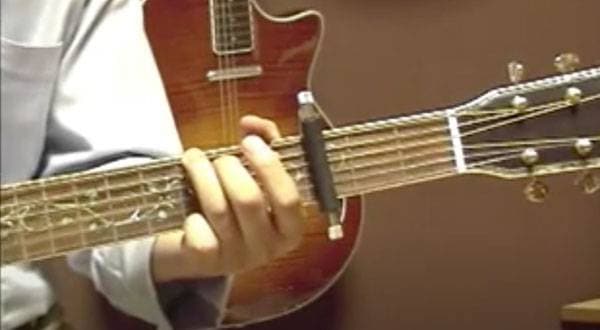
A capo’s full name is “capotasto.” According to Wikipedia, “A capotasto (from the Italian words capodastro, capo tasto, capotasto, meaning ‘head of the fingerboard’) is an accessory for stringed instruments like guitars and ukuleles, used to assist playing. It is commonly abbreviated as ‘capo’. By attaching a capo and treating its position as the nut (0th fret), it allows players to perform songs that would be relatively difficult in standard tuning more easily.” (Wikipedia quote)
That… was a pretty technical explanation…
I use it a lot too. It’s really handy when changing the key of a song. For example, when covering a song by a female vocalist, I can raise it a few semitones with a capo and sing an octave lower.
I see. So it’s kind of like changing the key in karaoke—just upward, though.
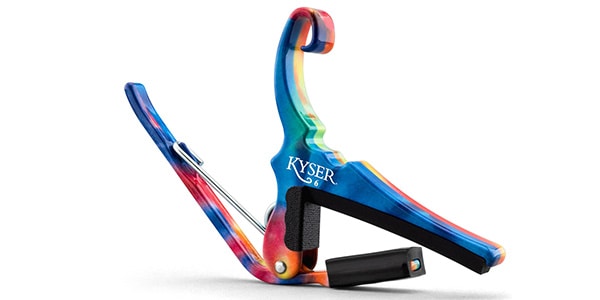
Exactly. There are actually many types of capos. The one I always use is the modern classic, the Kyser Capo!
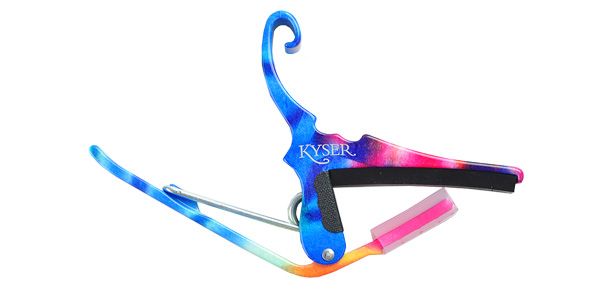
KYSER / KG6 Tie-dye
You use that one a lot.
It’s easy to put on and take off, comes in lots of colors, and it’s a great product!
I see.
Some players who prioritize stability during performance might use a screw-tightened type that locks in place, but for me, after one song I often remove it or move the capo for the next song, so the Kyser Capo, which is quick to attach and detach, is really convenient.
Got it. It’s user-friendly, then. No wonder it’s so commonly seen and must have a lot of fans.
By the way, the first type of capo I ever used was this one. The Jim Dunlop rubber-style capo. It’s still the same model!
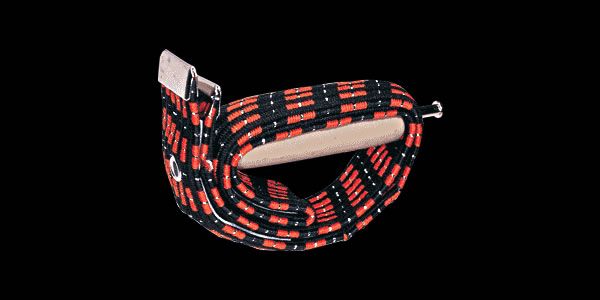
JIM DUNLOP / ELASTIC HEAVY DOUBLE CAPO
That’s quite different from the Kyser capo…
Yeah, it’s a classic type that’s been around since the folk boom. If you use it a lot, the metal ring part can come off… Man, that brings back memories.
Definitely nostalgic at this point.
I think there were two models—one for acoustic guitars and one for classical guitars.
And why is that?
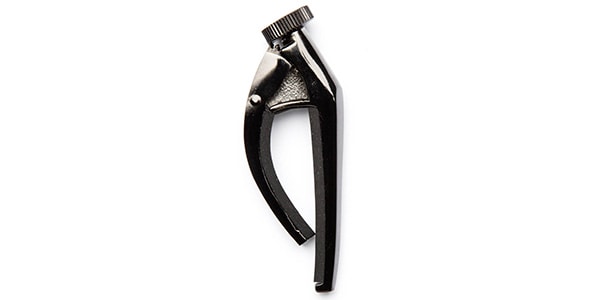
It seems they’re each designed to fit based on the width and radius of the fingerboard. After the rubber-style, the one I used for a while was this type. Also Jim Dunlop.
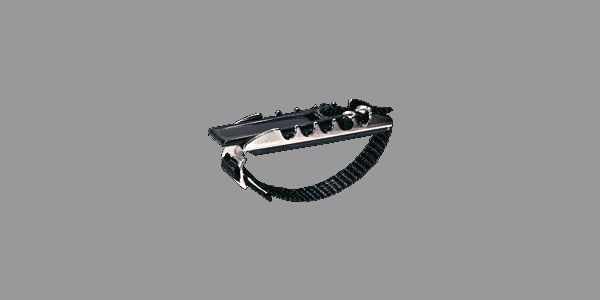
JIM DUNLOP / PROFESSIONAL GUITAR CAPO FLAT
This one… is it plastic?
Yeah. You fit the plastic part into one of the grooves on the metal piece to adjust the tightness.
I’ve seen this one a lot too… I’m definitely feeling nostalgic now.
Right… it doesn’t really break, but the string part stretches over time!
I guess you could say that counts as “broken”…
Yeah (laughs). But it was convenient and easy to use.
I see.
If you look closely, even within the acoustic and classical models, you can choose curved or flat—pretty detailed. Back then, I used them without really understanding.
Yeah, there are those small accessories like that, that you use without really knowing how. You only realize later.
Right. Now, onto the unusual ones!
Unusual? With a capo?
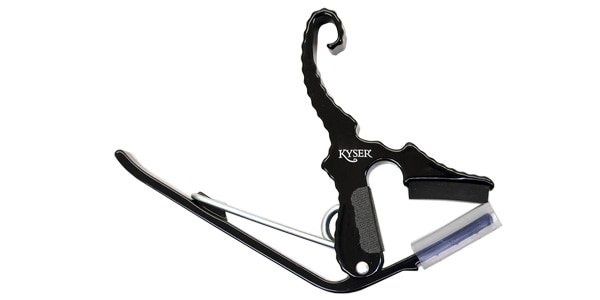
KYSER / KG3B
It’s a variation of the Kyser capo—amazingly, it can clamp only 5, 4, or 3 strings!
Huh… usually capos press all the strings at the same fret, but something like this exists too.
Yeah, it’s pretty cool.
Anything else?
There are also signature models of capos, like this one!
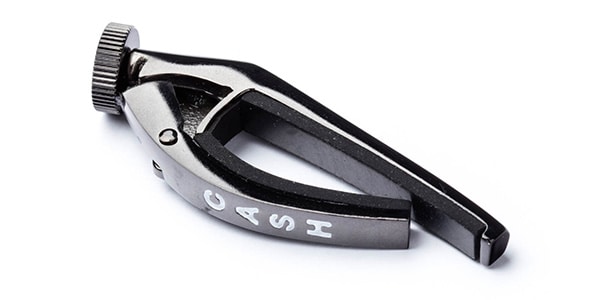
JIM DUNLOP / Johnny Cash Capo/Curved
Signature? And Johnny Cash? That’s a cool choice…
I wonder… maybe he was a capo master or something. I like that his name is boldly on it! And it looks like a screw-type, so it should be very stable.
That’s true.
By the way, there’s also a capo for ukulele.
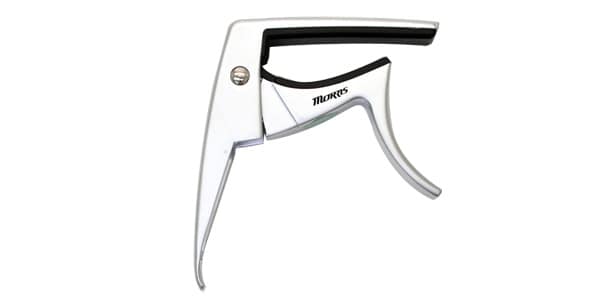
MORRIS / CA-900 EAGLE CAPO
Oh, I see that.
I want this one soon. But, even after searching, I couldn’t find one for bass.
Right, I guess it’s only really needed for stringed instruments that can play chords.
Hang in there, bass!
“Hang in there”… I don’t think you need to try that hard (laughs).
Now, finally, I’ll introduce the ultimate unique one, this!
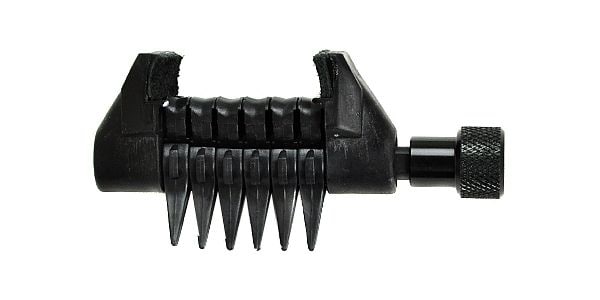
TONE GEAR / SPIDER CAPO
Huh?
This is also a capo.
Oh come on… no need for jokes here.
No, seriously.
True… The product description says, “Each string is independent, so you can set open chords or whatever you like!”
In other words, you can freely set, like, the first string on this fret, the second string on that fret! For example, you could make this capo hold an F chord throughout an entire song.
That’s great news for people who struggle with F… or maybe not (laughs).
It’s a pretty fun capo, so I once gave it as a birthday present to our guitarist, Jackie.
Jackie must have been confused, right? (laughs) But… maybe he could actually handle it?
I hope he managed! So, we’ve looked at a bunch of capos, and they’re pretty interesting, right?
They are interesting, but…
Oh, I just remembered the ultimate capo!
What was that?
A person!
I said, no more jokes!
No, really. I’ve actually had someone do it when I forgot the capo.
Ah… you mean Ted-san (the bassist from The Captains)… right?
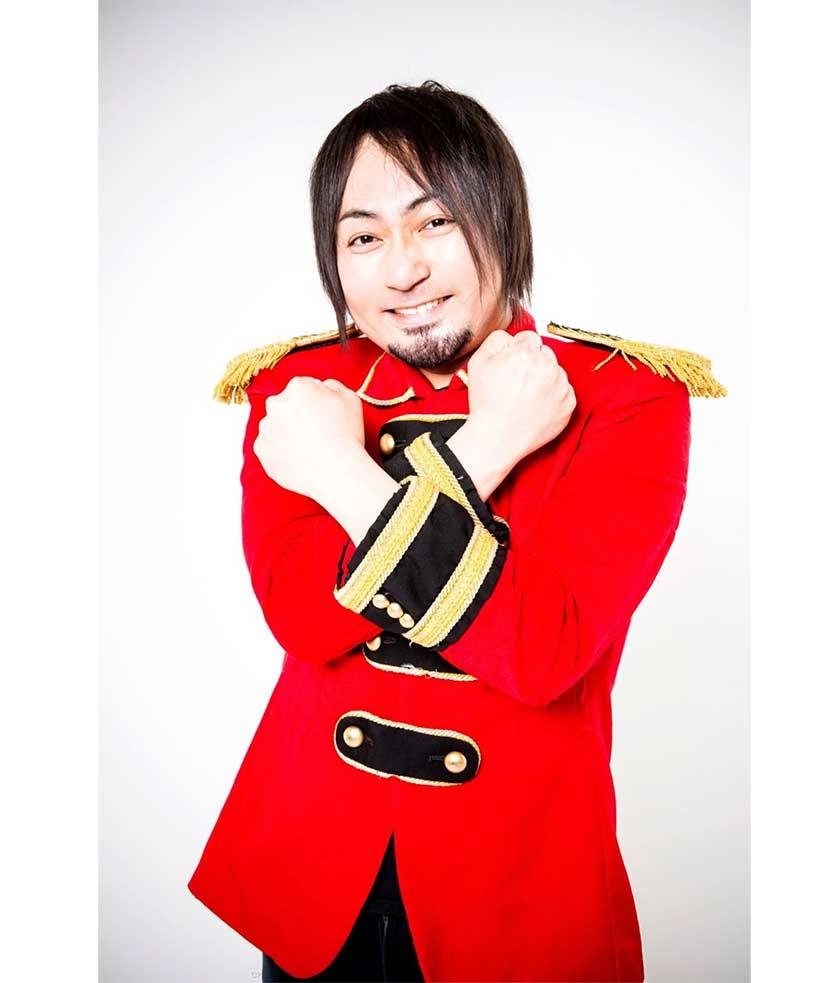
Exactly! A capo that can even play backup! He said holding a barre on the first fret for that long is tough!
A capo that’s also an amazing bassist… kudos! (laughs) Anyway, regarding capos, for a single-note instrument like the bass, there’s probably not much benefit… Capos are meant to raise the pitch, right? Bassists might tune down, but rarely tune up, so it’s even less useful.
That might be true… Oh, I just remembered another capo!
What is it?
The roller capo that comes standard on my Steinberger “Synapse”—I think it’s called a “TransScale”.
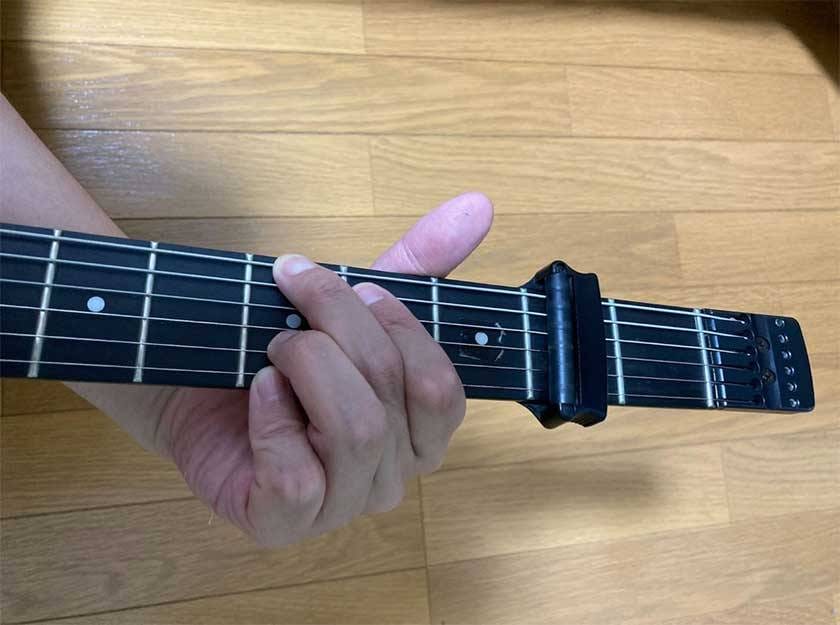
Ah, the one that’s attached to the neck from the start. That looks convenient.
It’s super convenient! You can even move it to lower the key—by just one semitone!
That does look handy. Guitarists would definitely get excited about that (laughs).
Yeah. For some people, that’s actually their favorite feature (bitter laugh).
Speaking of which, on the downward side, my Michael Lull bass (Mikey) has a Hipshot installed. Even the Steinberger copy model I have came with one. I’ve never actually used either… but you could say they serve a capo-like function, right?
Ah, I see! So capo-like devices exist in many forms.
Like a whammy pedal too? There are effects that lower string tuning. Was it the DIGITECH Drop? Could those also be considered capo-like devices?
Yeah! Well, pitch is one of the biggest elements in music after all!
Well…that’s true, I suppose.
By using various capos that change pitch, you can expand the possibilities of music even more! Maybe! So, everything is?
For love!
The “sound & person” column is made up of contributions from you.
For details about contributing, click here.









![[Acoustic guitar] Acoustic guitar or acoustic-electric guitar](/contents/uploads/thumbs/5/2020/9/20200923_5_11215_1.jpg)

![[What is a good posture for practicing?] Things Guitarists should know about their body](/contents/uploads/thumbs/5/2019/7/20190717_5_6948_1.jpg)
![[2025 Recommended Ranking] How to Choose Acoustic Guitar Pickups](/contents/uploads/thumbs/2/2017/4/20170405_2_1124_1.jpg)
 超オススメのフレーズ道場 アコースティックギター
 ギター 初心者講座
 愛されたフェンダーギターたち
 アコギの選び方
 ギターのお手入れ
 ギターケースの選び方
 Discount Sale
 Outlet
 New Arrivals
 Podcast (streaming)
 Headphones / Earphones
 Microphones
 Wireless Equipment
 Speakers
 Power Amps
 Mixers
 Processors
 Portable PA Systems
 Recorders
 Karaoke
 Guitars
 Basses
 Ukuleles
 Drums & Percussion
 Pianos / Synthesizers
 Wind Instruments
 Stringed Instruments
 Japanese Instruments
 Harmonicas, Other
 Software
 DJ & VJ
 Stands
 Cables & Connectors
 Racks & Cases
 Lighting
 Stage & Truss
 Video Equipment
 PC PERIPHERALS
 Power Supplies
 Studio Furniture
 Household Items, Other
 Alcoholic Beverages