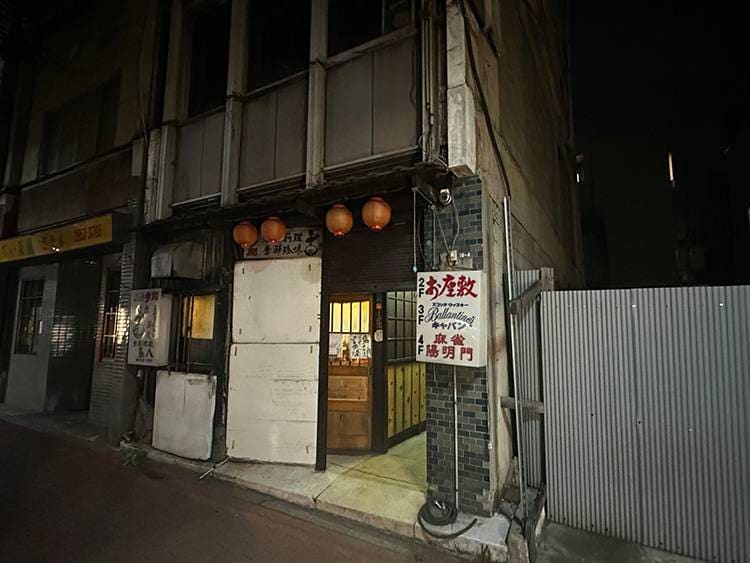
At last, the inevitable moment has arrived. Torihachi, the famous yakitori tavern in Mejiro that had carried on the postwar Showa-era atmosphere for decades, will close its doors on June 30, 2026. Established in 1970, the place has continued serving the Mejiro community for more than 56 years. The owners are an elderly brother and sister duo. I’ve heard they endured tremendous hardship after returning to Japan from Taiwan following the war. Thinking about that history alone is enough to make one emotional. More than anything, I simply want to say: thank you for all your years of dedication.
Torihachi is difficult to describe in any other way than “incredible.” Despite being famous enough to appear on TV programs such as Rui Yoshida’s Sakaba Horoki and Onna Sakaba Horoki, the interior has remained almost completely untouched since the Showa era. The moment you step inside, it feels like entering another world, where the atmosphere of old Tokyo still lingers. The counter is narrow, the stools are tiny, and at first glance it looks like nothing more than a worn-out old izakaya. But once you notice the menu covering the walls and the astonishingly low prices, your impression changes instantly. Not only the building itself, but even the prices seem frozen in the Showa period.
That said, I’ve heard they were recently forced to raise prices slightly. Handwritten paper patches now cover parts of the menu where the old prices used to be. Even so, five skewers of yakitori cost only 550 yen — roughly 100 yen per skewer after tax. Their chicken wings, loaded with meat, are just 450 yen for three pieces and are so perfectly seasoned they’ve become one of the restaurant’s signature dishes. In fact, once you’ve tasted Torihachi’s chicken skin skewers, it becomes difficult to enjoy them anywhere else. And those are only 330 yen for three skewers. Fresh tuna sashimi is 680 yen. A generous serving of freshly fried potatoes costs 400 yen. Sour cocktails are also 400 yen. Then there are the oversized grilled shiitake mushrooms — two for 550 yen. It’s almost unbelievable.
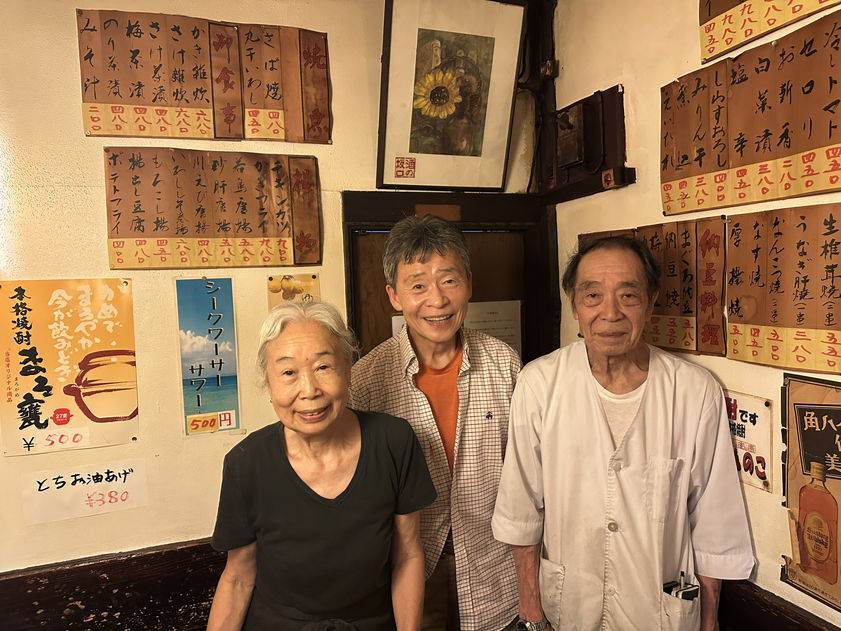
The reason Torihachi remained beloved in Mejiro for so long was never simply the low prices. The true charm came from the personalities of the brother and sister who ran it. Having returned from Taiwan, they both speak fluent Chinese. The younger brother quietly focuses on grilling and cooking, while the older sister handles customers and service. Her lively conversation naturally draws everyone in. Torihachi was long known as a yakitori spot frequented by the local intellectual crowd. Mejiro is surrounded by universities such as Waseda University, Gakushuin University, and Japan Women’s University, and even professors teaching at those schools regularly visited the restaurant. For a humble red-lantern tavern, it was unusually common to overhear highly intellectual discussions across the counter. That atmosphere was part of what made the place so unique.
In recent years, inbound tourism and social media exposure brought a sharp increase in Chinese visitors. The owners would respond fluently in Chinese, and even a lecturer from Waseda University who spent several hours there almost every night would casually join the conversation in Chinese as well. It’s hard to imagine another yakitori restaurant anywhere in Japan quite like it. That is precisely why its closure feels so painful. Over the past decade, many of the places that mattered to me in Mejiro have gradually disappeared. Before the pandemic, a Matsuya I visited several times a week as a regular customer shut down. Shortly afterward, the Hidakaya I loved also vanished. Even the Osaka Ohsho that replaced it eventually closed a few years later. At one point, even the McDonald’s in front of the station disappeared. The common issue facing Mejiro’s restaurants was labor shortages. Especially over the last decade or so, many establishments became increasingly dependent on foreign part-time workers because younger Japanese staff were difficult to recruit. Eventually, even hiring foreign workers became challenging, and the closure of Matsuya became symbolic of that problem.
So many restaurants have vanished from Mejiro in rapid succession. What, then, will become of the neighborhood? Mejiro occupies one of Tokyo’s best locations, situated between Ikebukuro and Shinjuku, and also has historical ties to the Tokugawa family. In other words, it is an exceptionally privileged area in both geography and environment. Yet while traditional restaurants declined, coffee shops rapidly rose to prominence. Mejiro has transformed into a fierce battleground for major coffee chains.
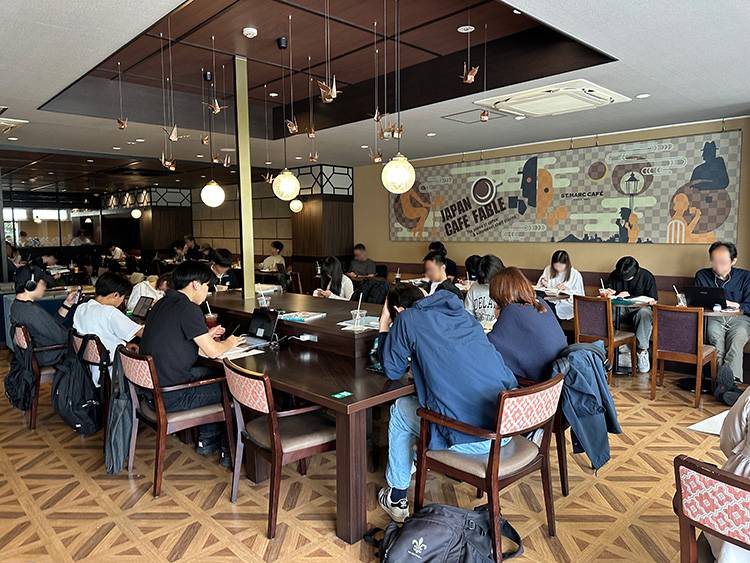
transformed into a student ‘library’ (Sunday morning)
A Starbucks opened where an Italian restaurant once stood, while a St. Marc Café replaced the former McDonald’s. Both feature spacious interiors that resemble libraries more than cafés. Across the street sits a Doutor, next to the long-established underground coffee shop Bancha-mu. Then Miyakoshiya Coffee arrived across from Starbucks, serving premium coffee approaching 1,000 yen per cup. A few years later, Doutor’s upscale Excelsior Caffé opened directly opposite Miyakoshiya Coffee. More recently, even the Chinese-backed chain Cotti Coffee entered the area. Within just 100 meters of Mejiro Station, more than ten coffee shops now compete side by side. Astonishingly, nearly all of them remain packed with students every day.
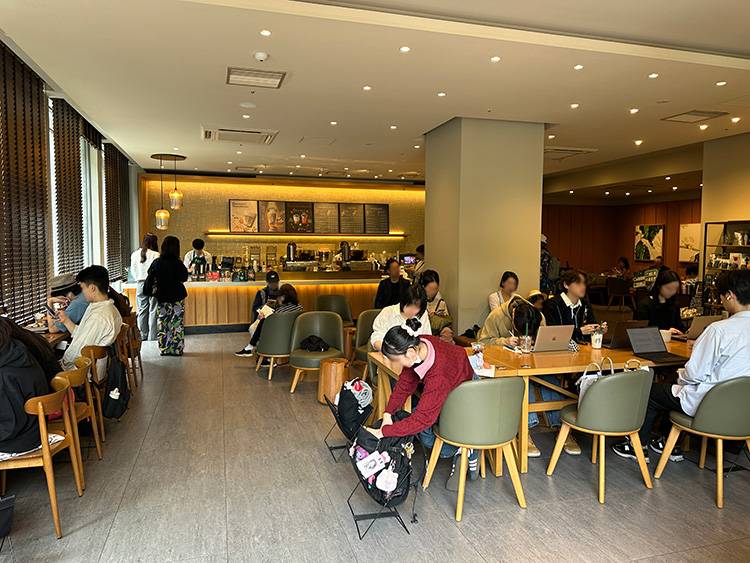
is always packed with students!
This raises an obvious question. If restaurants closed because of labor shortages, why can coffee shops continue opening in the same locations? The answer likely lies in perception. Large coffee chains operated by major corporations are viewed as stylish and comfortable places to work. Mejiro has many women’s universities nearby, including Japan Women’s University and Kawamura Gakuen Woman’s University, along with Gakushuin University near the station. The area has an especially large student population, particularly female students. For them, coffee shops offer clean environments, bright atmospheres, structured manuals, and a more attractive image as part-time workplaces. Beef bowl chains, curry shops, and especially ramen restaurants filled with grease and cooking smells tend to be avoided. Coffee shops, by contrast, feel approachable. Friends can stop by casually, and wages are reasonably good. That is why these businesses have largely avoided the staffing problems that devastated older restaurants. As a result, the area around Mejiro Station is now saturated with cafés, all bustling with students.
I’ve drifted away from the point. What I truly wanted to say is not that coffee shops are thriving. It is simply that the loss of Torihachi feels deeply sad. Times change. Another red-lantern tavern rich with the spirit of the Showa era will disappear from Mejiro. In its place will likely come another modern business aimed at younger generations. There is nothing inherently wrong with that. Yet for someone born and raised in the Showa era, the coexistence of old and new was precisely what gave the neighborhood its charm. The contrast between tradition and modernity gave the streets their unique character.
And now, it feels as though that good old era is finally reaching its end. Thinking about it leaves me with nothing but a quiet sense of loneliness.

 Discount Sale
 Outlet
 New Arrivals
 Podcast (streaming)
 Headphones / Earphones
 Microphones
 Wireless Equipment
 Speakers
 Power Amps
 Mixers
 Processors
 Portable PA Systems
 Recorders
 Karaoke
 Guitars
 Basses
 Ukuleles
 Drums & Percussion
 Pianos / Synthesizers
 Wind Instruments
 Stringed Instruments
 Japanese Instruments
 Harmonicas, Other
 Software
 DJ & VJ
 Stands
 Cables & Connectors
 Racks & Cases
 Lighting
 Stage & Truss
 Video Equipment
 PC PERIPHERALS
 Power Supplies
 Studio Furniture
 Household Items, Other
 Alcoholic Beverages