01 Introduction: The Importance of ‘Power’ and Batteries in Audio and Music Production
There are many situations in music production and live performance where batteries are used, such as guitar and bass effects pedals, wireless microphones, instruments with active circuitry, and portable recorders. However, there are many cases in which batteries are selected simply because they were cheap or they were already on hand, resulting in the equipment not performing to its full potential or unexpected power-related problems occurring.
For audio equipment and musical instruments, batteries are not merely a source of power; they are an important element directly connected to sound quality, operational stability, and ultimately, the safety of the equipment. From the perspective of a staff member, this article provides a detailed explanation of the electrical characteristics of batteries used in musical and audio equipment, how to select the appropriate type for each piece of equipment, and management know-how for preventing malfunctions.
02 Electrical Characteristics of Batteries: Differences from AC Adapters and Their Effects on Sound Quality
When it comes to music production and powering effects pedals, you may sometimes hear people say that “battery power produces less noise than an AC adapter” or that “the sound becomes more natural.” There is a clear electrical basis for this.
① Power Quality of AC Mains Power and Batteries (DC)
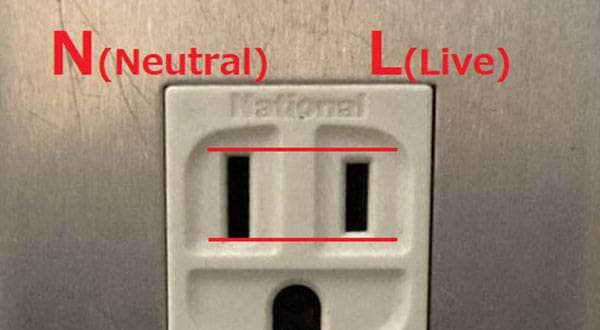
Power supplied from commercial AC power (100V AC) through an AC adapter or power supply may contain hum noise caused by the commercial frequency (50Hz/60Hz), as well as ripple noise. In addition, connecting multiple devices to wall outlets can create a ground loop, which can also cause ‘buzzing’ loop noise.
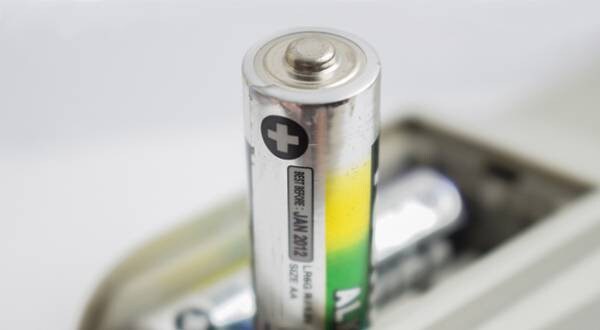
Batteries, on the other hand, are a pure DC power source generated by a chemical reaction. Since they are a completely independent power source physically isolated from the wall outlet, they can prevent ground loops and reduce power-related noise to an extreme degree. (When multiple devices are connected via cables or other means, a ground loop may still occur even when running on batteries.) The reason batteries are recommended for powering highly sensitive microphone preamps and pedal effects is their extremely excellent S/N ratio.
② Initial Voltage (OCV) and Load Voltage (CCV)
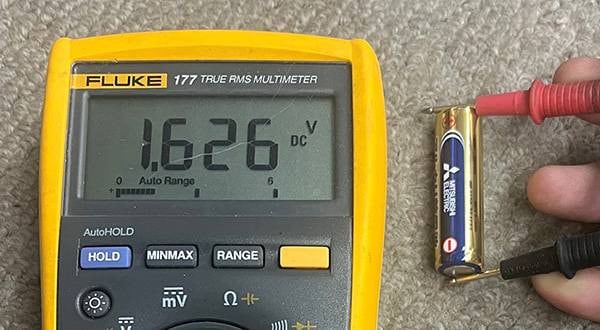
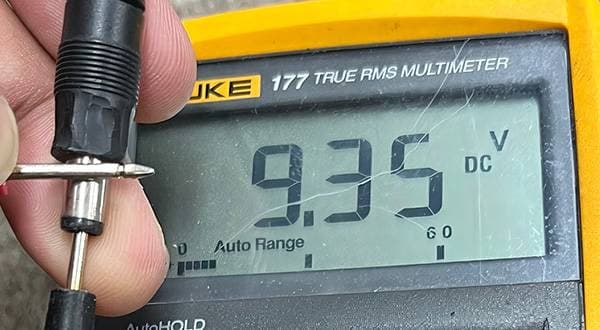
The ‘1.5V’ indicated on common primary batteries such as AA batteries is the nominal voltage. The open-circuit voltage when new varies depending on the type of battery, product, temperature, storage conditions, and other factors, and may exceed the nominal voltage for alkaline batteries. The voltage when a device is connected and current is flowing is called the ‘load voltage (closed-circuit voltage: CCV)’. With equipment that requires a large amount of current, the load voltage may decrease due to the resistance inside the battery (internal resistance). Differences in this internal resistance appear as differences in suitability among battery types.
③ Relationship Between Power Supply Voltage Fluctuations and Headroom
In audio and preamp circuits, the level of the supplied power voltage is directly related to the circuit’s ‘headroom (the amount of tolerance before distortion occurs)’. When a high voltage is supplied stably, even when a large input signal is received, the waveform does not clip (distort), allowing the circuit to output a clear sound with a wide dynamic range. Conversely, when the voltage drops, the maximum output level decreases, causing distortion and a loss of resolution.
03 Characteristics of the ‘Four Major Types of Batteries’ Used in Audio and Musical Instrument Applications
Here, I explain the characteristics of the four main types of batteries used in audio and musical instrument equipment.
*The table can be scrolled horizontally.
| Battery Type | Nominal Voltage | Internal Resistance / Discharge Characteristics | Suitable Musical Equipment / Applications |
|---|---|---|---|
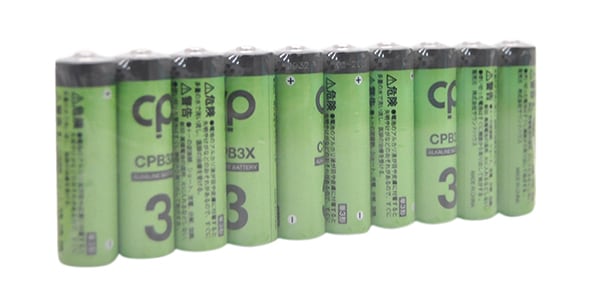
| Alkaline Battery CPB3X 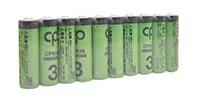 |
1.5V | Low internal resistance. Little voltage drops even when consuming large amounts of current. | Wireless microphones, instruments with active circuitry, handheld recorders |
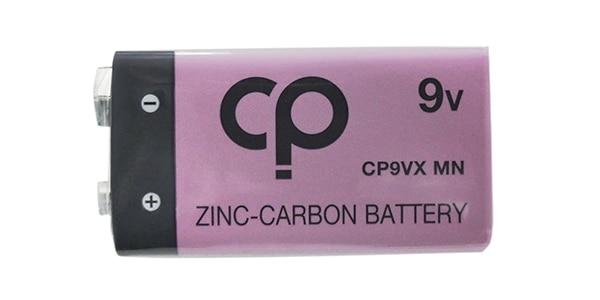
| Manganese Battery CP9VX MN 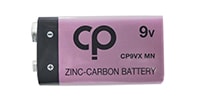 |
1.5V (9V/006P batteries used for effects pedals, etc., contain six internal cells to provide 9V) | High internal resistance. Voltage temporarily recovers when the battery is allowed to rest. | Analog effects such as fuzz pedals, clip-on tuners |
| Lithium Battery | 1.5V (disposable AA/AAA-type batteries, etc. Coin-type CR batteries are 3V, etc., depending on the type) | High capacity and high output. Maintains a high voltage until near the end of discharge. Lightweight. | Outdoor field recording, permanently installed or high-mounted microphones |
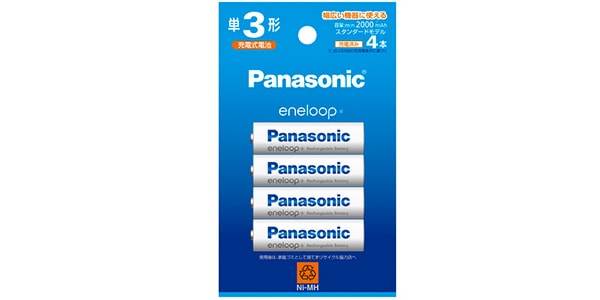
| Rechargeable Battery (Nickel-Metal Hydride) Panasonic/eneloop 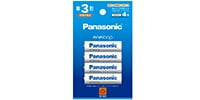 |
1.2V | Very low internal resistance. Maintains 1.2V relatively flat over a long period. | Equipment for daily individual practice, MIDI keyboards, PC peripherals |
① Alkaline Batteries
They use potassium hydroxide as the electrolyte and have a structure suitable for high-current discharge. Because they have low internal resistance, they can continuously provide stable power. They are the most reliable choice for wireless microphones, where signal attenuation or interruptions cannot be tolerated, and active basses that drive a preamp.
② Manganese Batteries
Although they are not suitable for applications requiring a continuous high current, some products have the characteristic that when current stops flowing, the chemical reaction stabilizes and the voltage temporarily recovers. They are suitable for clip-on tuners, clocks, and other devices that operate with low current. In addition, because their voltage drops gradually, they can produce a unique effect when powering certain analog effects pedals.
③ Lithium Batteries
These are disposable primary batteries that use metallic lithium as the negative electrode. They have an extremely high energy density, and depending on the product, can provide stable output even in low- or high-temperature environments. They are relatively lightweight compared with alkaline batteries and are particularly useful for outdoor field recording and microphones permanently installed in high locations.
④ Nickel-Metal Hydride Rechargeable Batteries
They can be used repeatedly and offer advantages in terms of environmental impact and cost. They have low internal resistance and can handle high currents, but attention must be paid to their nominal voltage of 1.2V. In precision audio equipment designed on the assumption of alkaline batteries (1.5V), they may sometimes be judged to have insufficient voltage.
04 Battery Selection by Type of Musical Equipment
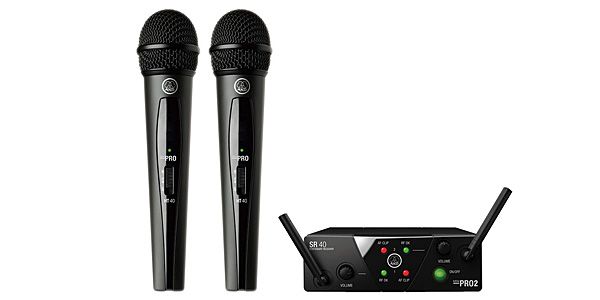
① Wireless Microphones and Receivers: New Alkaline Batteries
Wireless transmitters continuously consume a large amount of current for radio transmission and audio signal processing. If the supplied voltage falls below the operating threshold, some products may activate the mute function on the receiver side, or in the worst case, generate intense noise and disconnect communication. In live environments such as stages, it is a good practice to always replace the batteries with new alkaline batteries before a performance.
Representative products available from Sound House
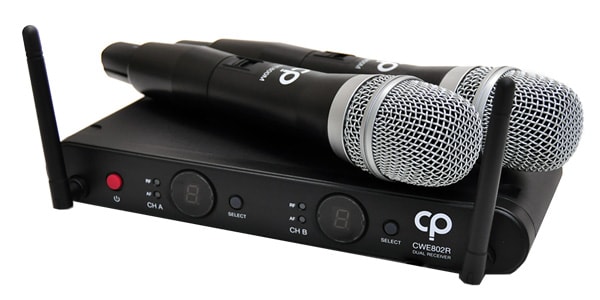
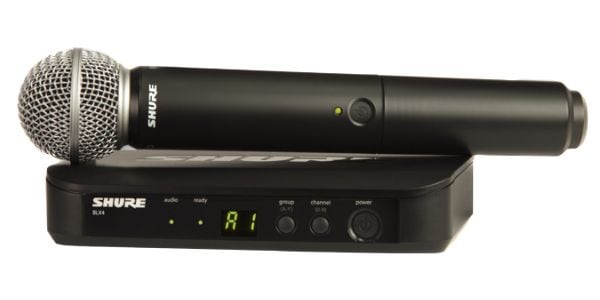
AKG / WMS40 PRO MINI VOCAL SET
② Vintage Analog Effects Pedals: Manganese Batteries
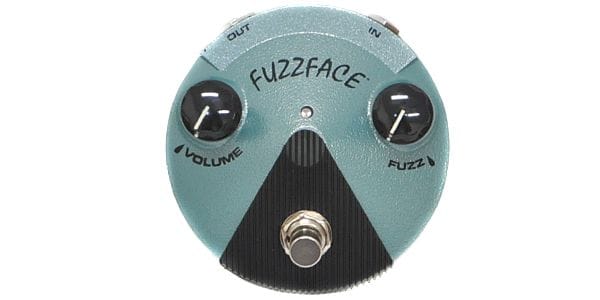
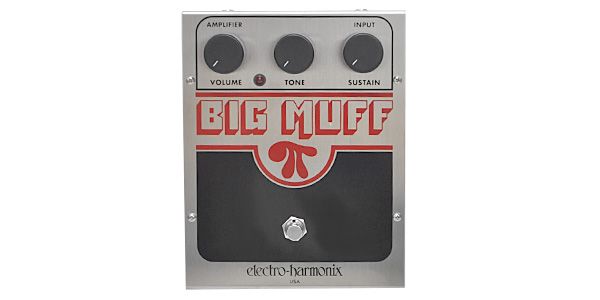
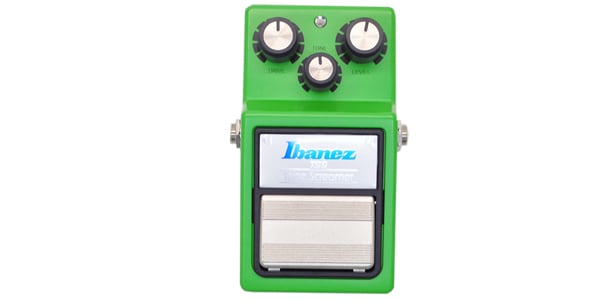
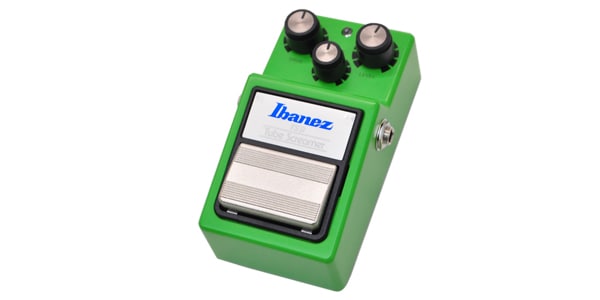
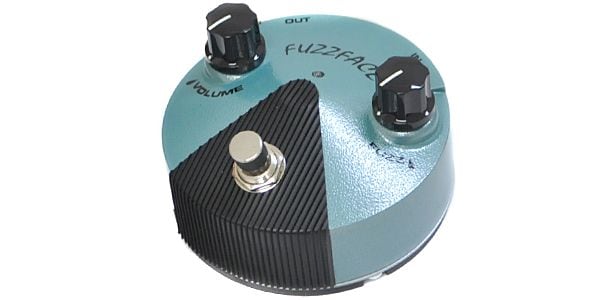
With early analog distortion pedals such as the Fuzz Face, a technique is used in which manganese batteries intentionally create a voltage drop (the SAG effect). As the voltage gradually drops to around 1.2V–1.3V, the tendency is for harshness in the high frequencies to be reduced and sustain to become smoother. While they are not suitable for modern digital effects pedals, they can be an effective approach to sound creation in analog circuits.
Representative products available from Sound House
Jim Dunlop / FFM3 Fuzz Face Mini
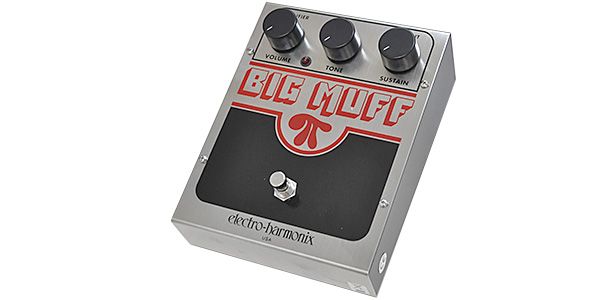
Electro-Harmonix / Big Muff Pi
③ Basses and Guitars with Active Circuitry: Alkaline 9V Batteries (006P)
Built-in preamps and active pickups require sufficient voltage to secure high headroom (the amount of tolerance against distortion). Therefore, an alkaline 9V battery, which is more likely to maintain stable output, is recommended. In many designs, inserting a shielded plug into the output jack completes the power circuit, so unplugging the cable when the instrument is not being played is a basic measure for preventing battery drain.
Representative products available from Sound House


④ Preamps for Acoustic Guitars: Alkaline 9V Batteries (006P)
Built-in preamps and pickup systems in electric-acoustic guitars are similarly powered by 9V batteries. If the battery voltage drops during a live performance, the dynamics of the audio signal sent to the PA system may be lost, resulting in unnatural distortion or a drop in level. As with active basses, it is essential to unplug the cable from the jack after playing in order to disconnect the power circuit.
Representative products available from Sound House
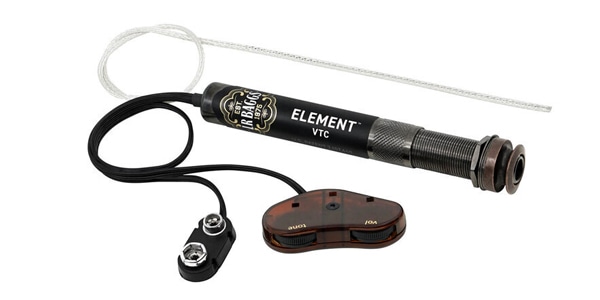
Fishman / Matrix Infinity Mic Blend

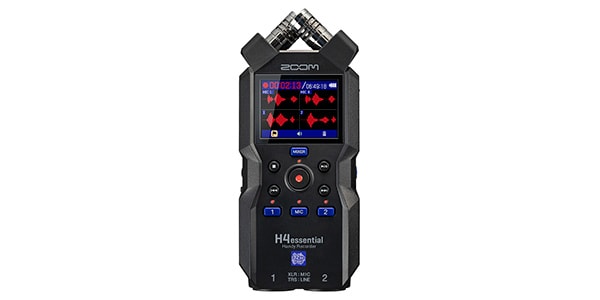
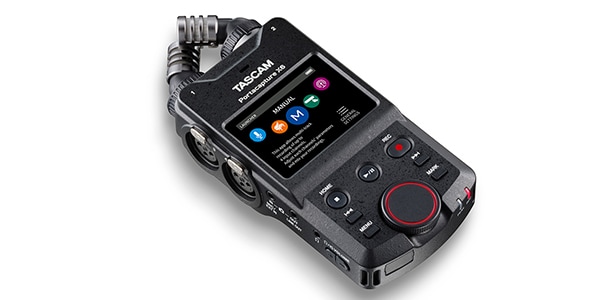
⑤ Field Recorders and Portable Recording Equipment: Alkaline or Lithium Batteries
Handheld recorders that perform multitrack recording while supplying phantom power (48V) to condenser microphones consume an extremely large amount of power. For indoor filming or short recording sessions, alkaline batteries are appropriate, while lithium batteries are a suitable choice for outdoor recording in extremely cold locations or long-duration event recording.
Representative products available from Sound House
⑥ Desktop MIDI Keyboards, Electronic Instruments, and Equipment Inside Effects Boards: Nickel-Metal Hydride Rechargeable or Alkaline Batteries
When running desktop-sized MIDI controllers, portable keyboards, practice mini amps, and similar equipment on batteries during music production at home or daily practice, nickel-metal hydride rechargeable batteries are suitable because of their low running cost. However, equipment that requires stable external power or precise control may in some cases require the nominal voltage of an alkaline battery (1.5V).
Representative products available from Sound House


■ Points to Note Regarding Voltage Detection in Audio Equipment
[Technical Supplement] The 1.2V Voltage Detection Issue When Using Rechargeable Batteries
The nominal voltage of a nickel-metal hydride rechargeable battery is 1.2V. If a device specifies “1.3V or lower = low battery”, a fully charged rechargeable battery may still cause the battery indicator to show a low level or the device may fail to power on. Use rechargeable batteries only with equipment whose operation has been verified, or check the recommended power source in the manual.
05 Internal Structure of 9V Batteries (006P) and Measures to Prevent Short Circuits
9V batteries (006P), which are widely used in effects pedals, active basses, acoustic guitar preamps, and similar equipment, have a different shape and characteristics from common AA-type batteries.
① Internal Structure of 9V Batteries
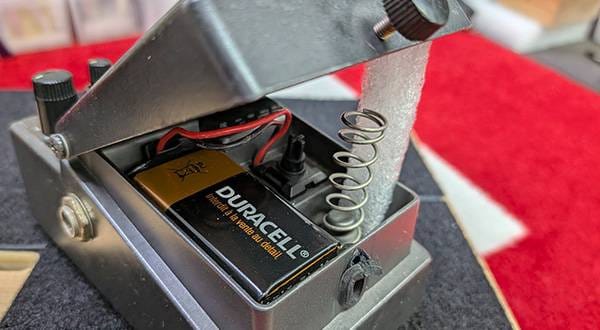
Inside the metal casing of a typical 9V battery, six small 1.5V cells are connected in series. Therefore, compared with AA batteries, the battery capacity itself is smaller, and they tend to run out quickly when used in applications requiring a continuous high current.
② Preventing Terminal Short-Circuit Accidents and Storage Precautions
The snap terminals (positive and negative) of a 9V battery are positioned close together on the same side. If the battery comes into contact with metal objects such as plugs, keys, or screwdrivers inside an effects case or toolbox, the terminals may short-circuit, causing sudden high-current discharge and potentially resulting in heat generation, swelling, or rupture.
■ Rules for Storing and Handling 9V Batteries
- Always attach the terminal protection cap that came with the battery when storing both unused batteries and batteries that are partially used.
- If the cap is not available, protect the terminals by applying insulating tape (such as vinyl electrical tape).
- Do not carry them together with metal parts boxes, coins, plugs, or other metal objects.
06 Mechanism and Prevention of ‘Battery Leakage’ to Prevent Equipment Damage
One of the most common causes of audio equipment failure is corrosion of circuit boards and contacts caused by battery leakage. Leaked electrolyte (strongly alkaline or acidic) can severely deteriorate metal components and cause short circuits or breaks in circuit-board traces.
① Mechanism of Battery Leakage
Battery leakage can occur due to multiple factors, including over-discharge, insertion in the wrong direction, mixing different types, brands, or new and old batteries, high temperature and humidity, long-term storage, impact, and aging. When gas is generated inside the battery and pressure rises, electrolyte may leak out to prevent the battery from rupturing. This is what causes battery leakage.
② Operating and Management Rules to Prevent Battery Leakage
- Always remove batteries from equipment that will not be used for a long period: Even when the power switch is OFF, some circuits may continue to draw a small amount of current, potentially resulting in over-discharge.
- Do not mix different brands or new and old batteries: When batteries with different capacities are mixed, the battery with the smaller capacity will run out first, forcing it into over-discharge and potentially causing leakage.
- Avoid high-temperature environments (such as inside a car in summer): High temperatures excessively accelerate chemical reactions, increasing the risk of self-discharge and leakage. Store batteries at room temperature (approximately 15°C-25°C).
07 Conclusion: Optimizing the Audio and Performance Environment by Improving the Power Environment
Batteries are an important power component for properly bringing out the potential of equipment and eliminating risks such as noise and malfunctions. By selecting the optimal battery according to the electrical characteristics of the equipment (required current and voltage sensitivity), and thoroughly implementing proper storage and management, you can create a more comfortable and reliable music production and performance environment.
From daily practice to the stage and recording environment, reviewing the power environment at your feet is the most reliable first step toward improving sound quality and preventing equipment problems. Make it a habit to keep batteries appropriate for each application on hand and to regularly check and replace them, so you can make the most of your musical activities with your equipment in optimal condition.














 電源アダプター特集
 CLASSIC PRO こだわり商品特集
 【初心者向け】エフェクター講座
 CLASSIC PRO パワーディストリビューター特集
 あなたのエフェクターボード見せてください
 エフェクターのつなぎ方
 Discount Sale
 Outlet
 New Arrivals
 Podcast (streaming)
 Headphones / Earphones
 Microphones
 Wireless Equipment
 Speakers
 Power Amps
 Mixers
 Processors
 Portable PA Systems
 Recorders
 Karaoke
 Guitars
 Basses
 Ukuleles
 Drums & Percussion
 Pianos / Synthesizers
 Wind Instruments
 Stringed Instruments
 Japanese Instruments
 Harmonicas, Other
 Software
 DJ & VJ
 Stands
 Cables & Connectors
 Racks & Cases
 Lighting
 Stage & Truss
 Video Equipment
 PC PERIPHERALS
 Power Supplies
 Studio Furniture
 Household Items, Other
 Alcoholic Beverages