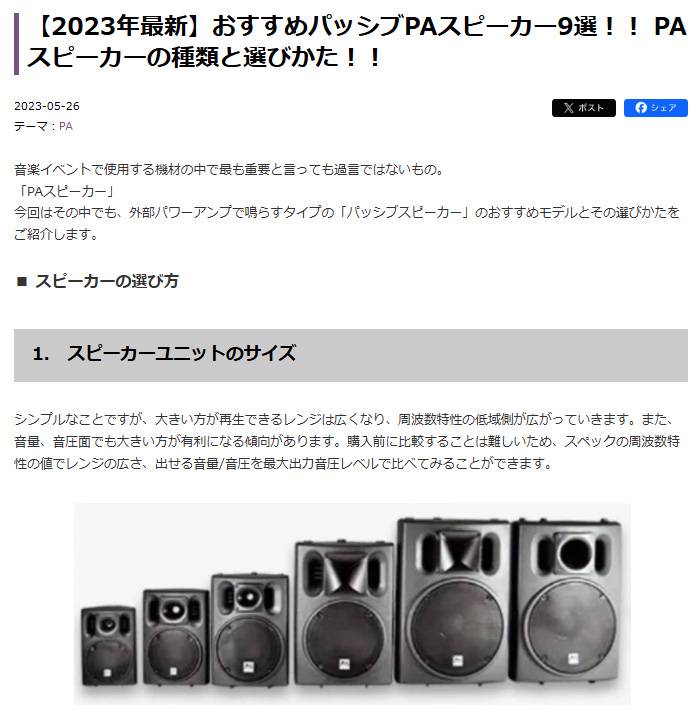
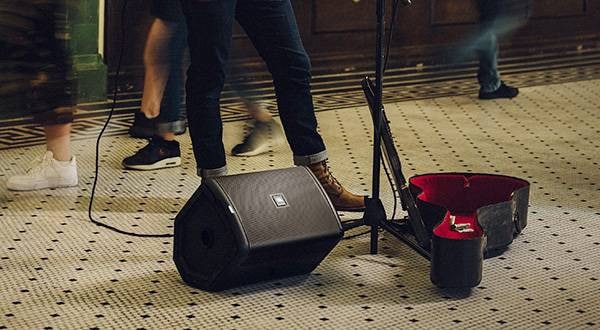
PA speakers are essential in various situations, such as live performances, DJ events, festivals, sports events, school activities, dance competitions, lessons, speeches, and more.
PA speakers can be broadly categorized into two types:
Passive Speakers: Require a separate power amplifier.
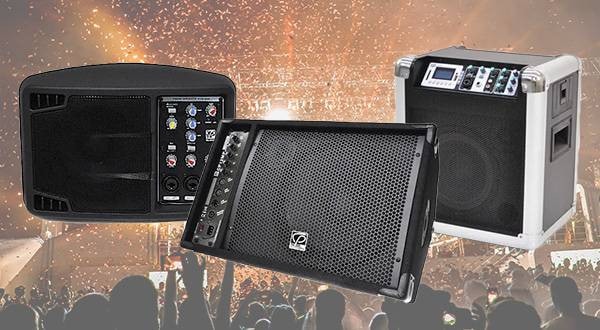
Powered Speakers: Have a built-in power amplifier.
The easiest way to tell them apart is by checking if there is a place to connect a power cable.
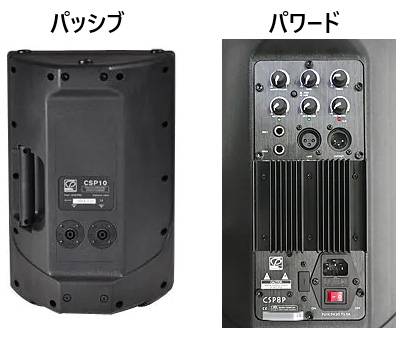
In recent years, many of the PA speakers announced as “new products” have been powered speakers with built-in power amplifiers.
There are several reasons for this.
- There is no need to think about matching a power amplifier with the speaker.
- Since a separate power amplifier is not required, you can bring fewer pieces of equipment and cables.
- Because the speaker itself may include a mixer function and Bluetooth streaming capability, there are situations where the speaker alone is sufficient.
- Built-in power amplifiers have become lighter, and the overall weight is now not very different from that of passive speakers.
- Some models can even be remotely controlled using a smartphone or tablet.
Hearing all this, many people probably think, “Powered speakers only have advantages!!”
However, in this article, I would like to introduce key points that make me recommend the “Passive PA Speaker + Power Amplifier” combination!
< Table of Contents >
- High Flexibility in Installation Location
- High Flexibility in Combinations
- Enjoying Sound Variations
- Connecting Multiple Speakers to a Single Power Amplifier
- How to Choose Speakers and Power Amplifiers
- Speaker and Power Amplifier Selector
- A Comparison of Various PA Speakers!! [By Type, Size, Function, and Brand]
- 9 Recommended Passive PA Speakers!! Types of PA Speakers and How to Choose Them!!
1. High Flexibility in Installation Location
Passive Speakers: No need to prepare a power supply; only the speaker cables connecting to the power amplifier are required.
Powered Speakers: Cannot be used unless there is a nearby power outlet.
For outdoor events, such as "sports days" or "school festivals," where a certain length of cable is needed, I generally recommend passive speakers.
With the "Passive PA Speaker + Power Amplifier" setup, you only need one power source for the power amplifier, so it’s easy to consolidate everything, including analog mixers, in one location.
Additionally, when installing speakers in hard-to-reach places, such as on walls or ceilings using brackets, powered speakers may require you to turn them on manually every time, depending on the model. Even if the power switch can be fixed in the ON position, you may still need to turn it ON/OFF while the volume level is set high, which can be problematic.
For audio equipment, it’s a fundamental rule to have the volume set to zero when turning it ON/OFF. This is another reason why I recommend passive speakers.
2. High Flexibility in Combinations
Passive Speakers: Can be used with any manufacturer. You can choose from various output channel numbers and output wattages, selecting the best match for your system configuration.
Powered Speakers: The key advantage of powered speakers is that they come with an optimal built-in power amplifier. However, you cannot change the power amplifier.
In terms of repair support, if you have a powered speaker and either the power amplifier or the speaker itself breaks, you’ll have to send in the entire unit for repairs. On the other hand, if you use separate components, you can send only the faulty part (either the speaker or the amplifier) for repair, which is an advantage.
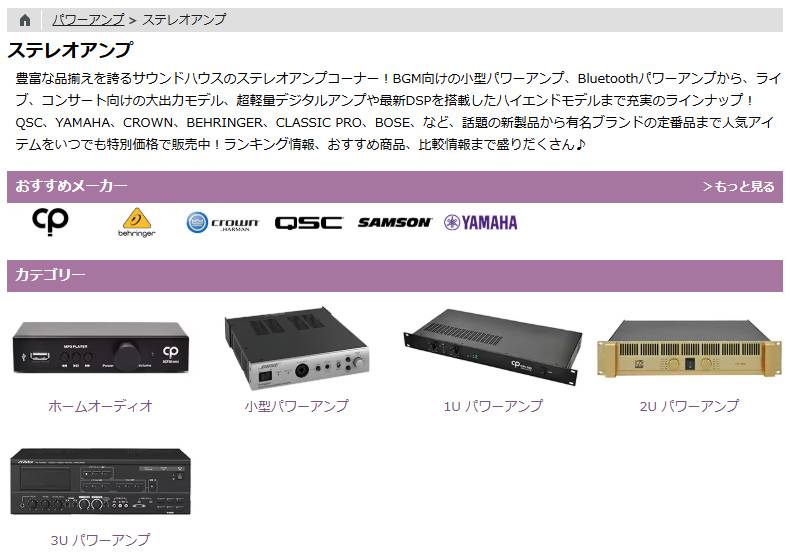
↓ 2-channel power amplifier is here
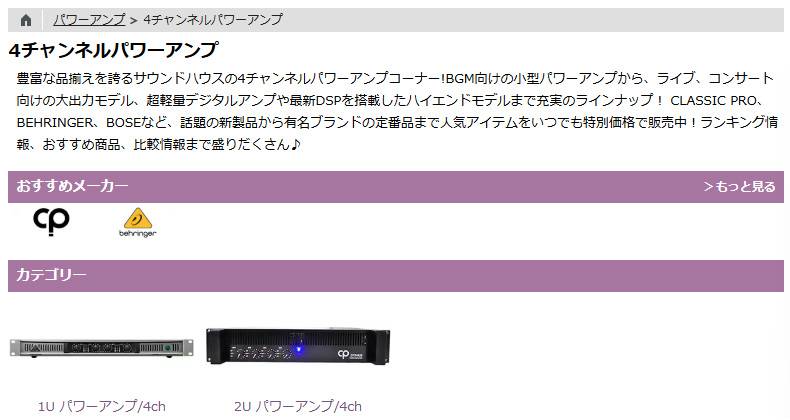
↓ 4-channel power amplifier is here
3. Enjoying Sound Variations
The quality of the sound coming from a speaker is influenced by more than just one factor.
Even with the same passive speakers, the sound will change if the power amplifier is different.
Likewise, with the same power amplifier, the sound will change if the passive speakers are different.
Other factors, such as the mixer and cables, all come together to create the final sound.
While it’s ultimately a matter of personal preference, when I explain this to customers, I usually say:
"When comparing speakers of the same size and power amplifier of the same output wattage, the higher-priced option generally produces a sound that most people will perceive as better."
However, since the difference in sound is subjective and hard to convey in words, I've created this for you at Sound House!!
Here’s a comparison audio source:
Power Amplifier Comparison Audio
→ Using QSC/E112, recorded at a level that ensures the power amplifier doesn't clip.
Passive PA Speaker Comparison Audio
→ Using QSC/PLD4.3 (which is now discontinued). The limiter settings on the PLD4.3 were adjusted to ensure that the limiter doesn’t activate, and the recording was done at a level that kept it within acceptable input limits.
4. Connecting Multiple Speakers to a Single Power Amplifier
You can easily connect a second speaker by linking it to the first speaker from the power amplifier, allowing you to play sound from both speakers simultaneously.
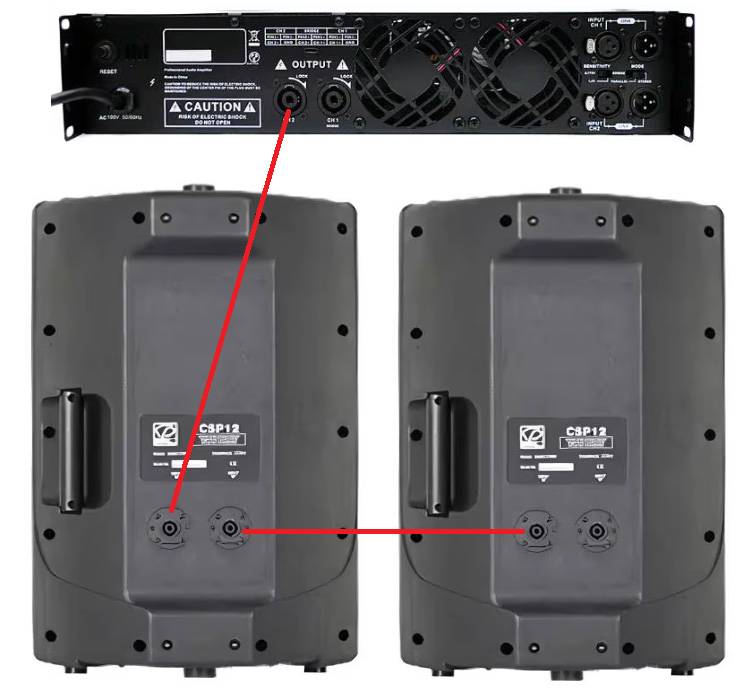
However, the number of speakers you can connect depends on the minimum impedance supported by the power amplifier and the impedance of the passive speakers.
The basic rules are:
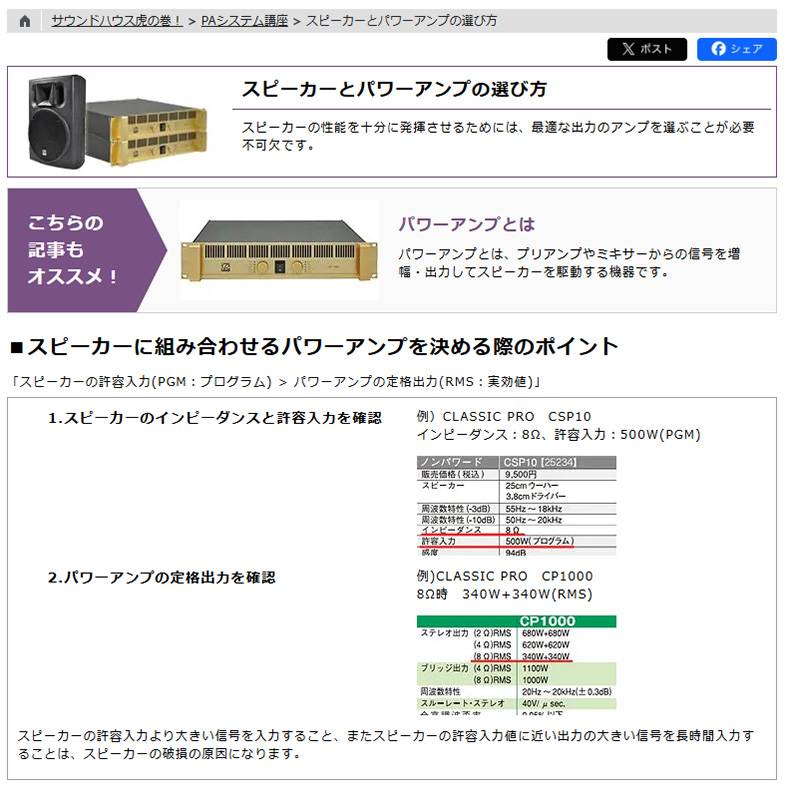
Speaker's combined impedance ≥ Power amplifier’s minimum impedance
Total speaker wattage ≥ Power amplifier’s output wattage
Important!
If you connect a speaker with impedance lower than the minimum impedance of the power amplifier, it may cause damage, so always ensure this rule is followed.
A power amplifier that is too large for the speaker increases the risk of damage due to excessive input. Of course, it is usable as long as you don't raise the volume too much. Always check by listening if the sound is distorted, or visually inspecting if the woofer unit’s movement is abnormal, to ensure safe use.
There is no combination that is guaranteed to never cause failure.
Let’s take a look at an example with a 2-channel power amplifier:
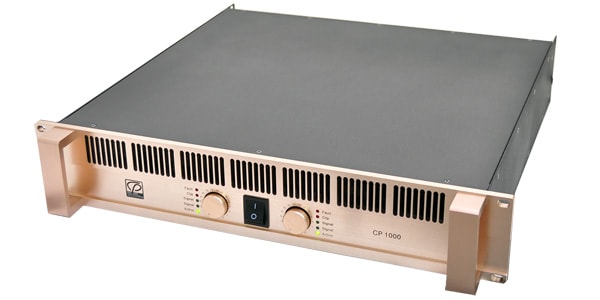
CLASSIC PRO CP1000
And for the passive speakers:
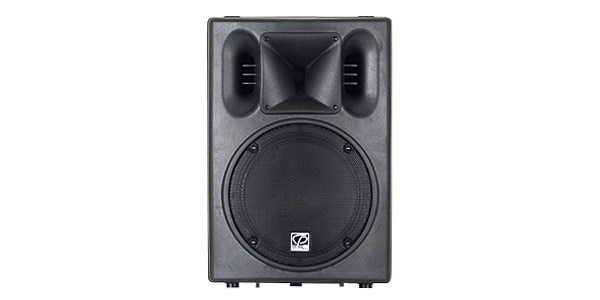
CLASSIC PRO CSP12
CLASSIC PRO / [3-year warranty] CP1000 Stereo Power Amplifier
![CLASSIC PRO / [3-year warranty] CP1000 Stereo Power Amplifier](https://www.soundhouse.co.jp/images/shop/prod_img/c/cp_cp1000xa_3.jpg)
CLASSIC PRO / CSP12 PA Speaker
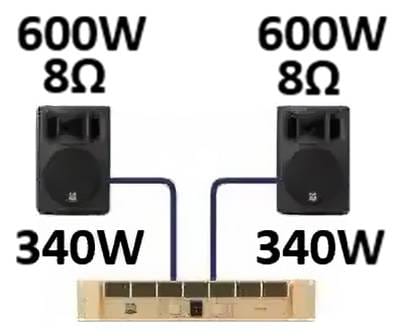
① Connecting one 8Ω passive speaker on the right and one on the left.
→ For 8Ω 340W output, the 8Ω acceptable input is 600W, so this is OK!!
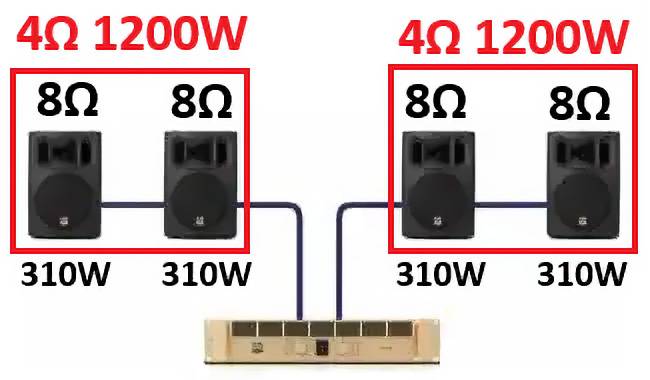
② Connecting two 8Ω passive speakers on the right and two on the left.
→ For 4Ω 620W output, when two 8Ω speakers are connected in parallel, the combined impedance becomes 4Ω. The total acceptable input is 1200W, so this is OK!! This results in an image of 310W per speaker.
③ Connecting four 8Ω passive speakers on the right and four on the left.
→ For 2Ω 680W output, when four 8Ω speakers are connected in parallel, the combined impedance becomes 2Ω. The total acceptable input is 2400W, so this is OK!!
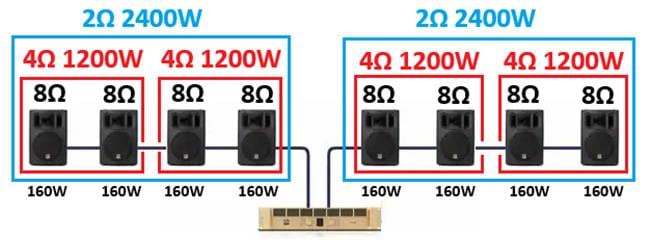
This results in an image of 170W per speaker.
| Speaker 1 | ||||||
|---|---|---|---|---|---|---|
| 4Ω | 6Ω | 8Ω | 12Ω | 16Ω | ||
| Speaker 2 | 4Ω | 2Ω | 2.4Ω | 2.7Ω | 3Ω | 3.2Ω |
| 6Ω | 2.4Ω | 3Ω | 3.4Ω | 4Ω | 4.4Ω | |
| 8Ω | 2.7Ω | 3.4Ω | 4Ω | 4.8Ω | 5.3Ω | |
| 12Ω | 3Ω | 4Ω | 4.8Ω | 6Ω | 6.9Ω | |
| 16Ω | 3.2Ω | 4.4Ω | 5.3Ω | 6.9Ω | 8Ω | |
For more details on how to choose speakers and power amplifiers, please refer to the following page:
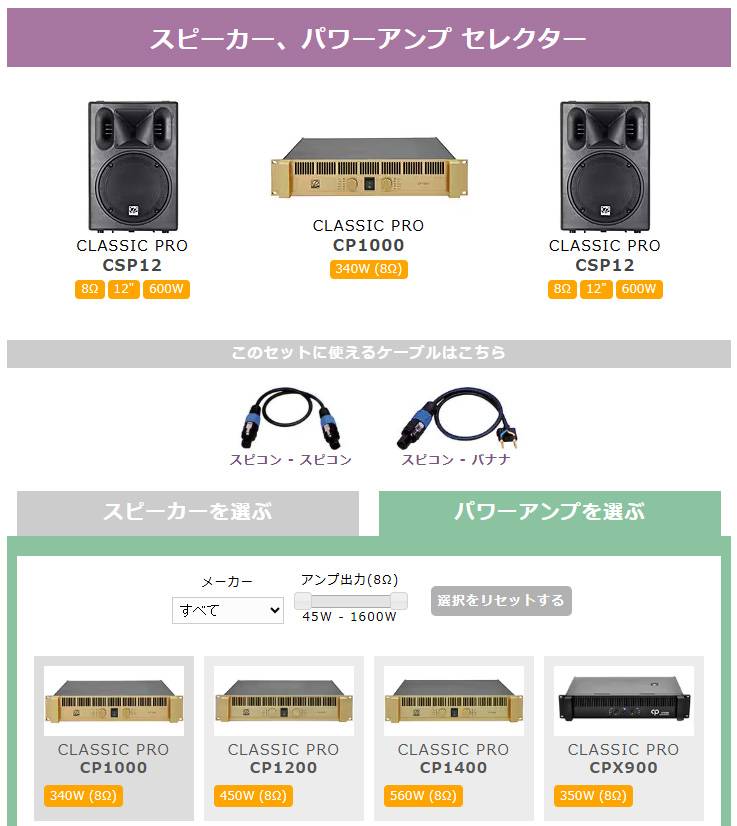
"Speaker and Power Amplifier Selector"
On this page, you can select a passive speaker or power amplifier, and it will show you the ideal combination of a power amplifier or passive speaker, along with the necessary speaker cables for connection. Feel free to make use of this tool!

How was it?
Did I manage to convey why I recommend the "Passive PA Speaker + Power Amplifier" combo? (lol)
However, in reality, "Choosing equipment that best fits the situation" is the best approach.
There are definitely scenarios where powered speakers are a better fit, so please consider the pros and cons of each and choose accordingly.
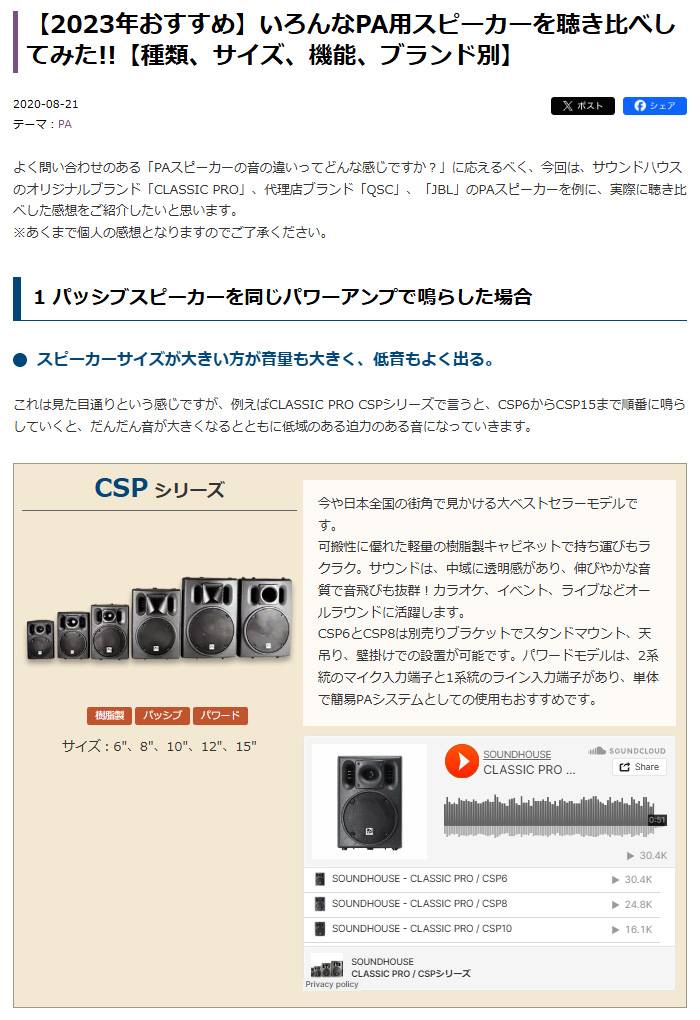
Additionally, we have more helpful staff blogs related to PA speakers, so feel free to check them out whenever you have time!






![[PA Guide for Beginners] Let’s Put Together A PA System for Your Live Show!](/contents/uploads/thumbs/2/2023/1/20230131_2_20980_1.jpg)

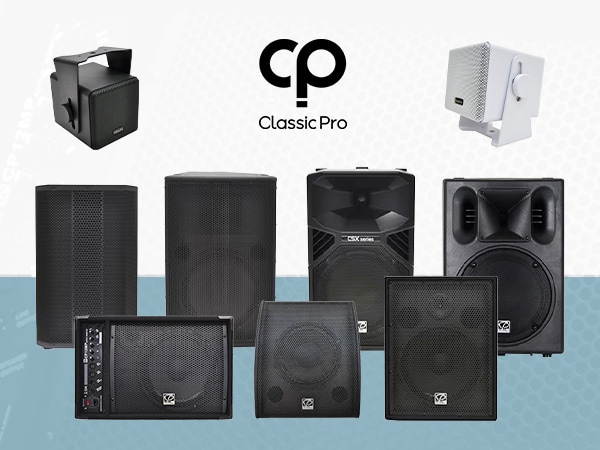 スピーカーの定番 Classic Proのおすすめモデル
 スピーカースタンドの選び方 K&M編
 神社でお祭りバンド
 CLASSIC PRO
 スピーカーとパワーアンプの選び方
 ケーブル購入ガイド
 Discount Sale
 Outlet
 New Arrivals
 Podcast (streaming)
 Headphones / Earphones
 Microphones
 Wireless Equipment
 Speakers
 Power Amps
 Mixers
 Processors
 Portable PA Systems
 Recorders
 Karaoke
 Guitars
 Basses
 Ukuleles
 Drums & Percussion
 Pianos / Synthesizers
 Wind Instruments
 Stringed Instruments
 Japanese Instruments
 Harmonicas, Other
 Software
 DJ & VJ
 Stands
 Cables & Connectors
 Racks & Cases
 Lighting
 Stage & Truss
 Video Equipment
 PC PERIPHERALS
 Power Supplies
 Studio Furniture
 Household Items, Other
 Alcoholic Beverages