Hello.
Today, I would like to talk about an important aspect of daily throat care for singers: humidity management.
First, the "humidity" displayed on a typical hygrometer (like "○○%") refers to relative humidity.
Relative humidity shows the percentage of water vapor dissolved in the air compared to the maximum amount of water vapor that the air can hold at a given temperature (saturated vapor pressure). In other words, relative humidity represents the proportion of water vapor in the air.
For example, if the temperature is 30°C or 15°C, the water vapor amount will change even if the relative humidity is the same.
On the other hand, there is also absolute humidity, which refers to the weight of the water vapor contained in a 1-meter cube of air, measured in grams.
In short, absolute humidity represents the amount of water vapor itself in the air.
For example, it is written as 12g/㎥.
Let’s assume today’s temperature is 30°C with a relative humidity of 50%, then the absolute humidity will be 15.2g/㎥.
If the temperature drops to 15°C but the relative humidity remains at 50%, the amount of water vapor in the air (absolute humidity) will drop to 6.4g/㎥.
This time, I would like to talk about absolute humidity.
■ Absolute Humidity in Autumn and Winter
When the weather gets cold in winter, have you ever felt like the air is dry, even though the hygrometer in your room says the humidity is around 40%?
Let’s assume the room temperature is 15°C with a relative humidity of 40%, the absolute humidity would be 5.1g/㎥.
(I referred to the article "The Difference Between Absolute and Relative Humidity" from Weather News.
To keep your throat in the best condition, a certain level of humidity is needed. However, it seems that the humidity we feel (the moisture in the air) is based on absolute humidity, not relative humidity.
Additionally, it is generally known that influenza viruses spread more easily in dry conditions. As a guideline, absolute humidity below 7g/㎥ makes it more likely for outbreaks to occur. Other cold viruses (including COVID-19) tend to behave in a similar manner.
First and foremost, to prevent catching a cold or illness, we need to humidify the air. Assuming the room temperature is around 25°C with heating, and the humidity is about 50%, the absolute humidity would be 11.5g/㎥ according to the table on the previous page.
From the article on the previous page, we can conclude that it’s safe if the absolute humidity is above 11g/㎥. However, constantly checking the table to find out can be a hassle.
For that, you can use an absolute humidity meter.
■ Various Absolute Humidity Meters
A&D Miharinbo Double AD-5687
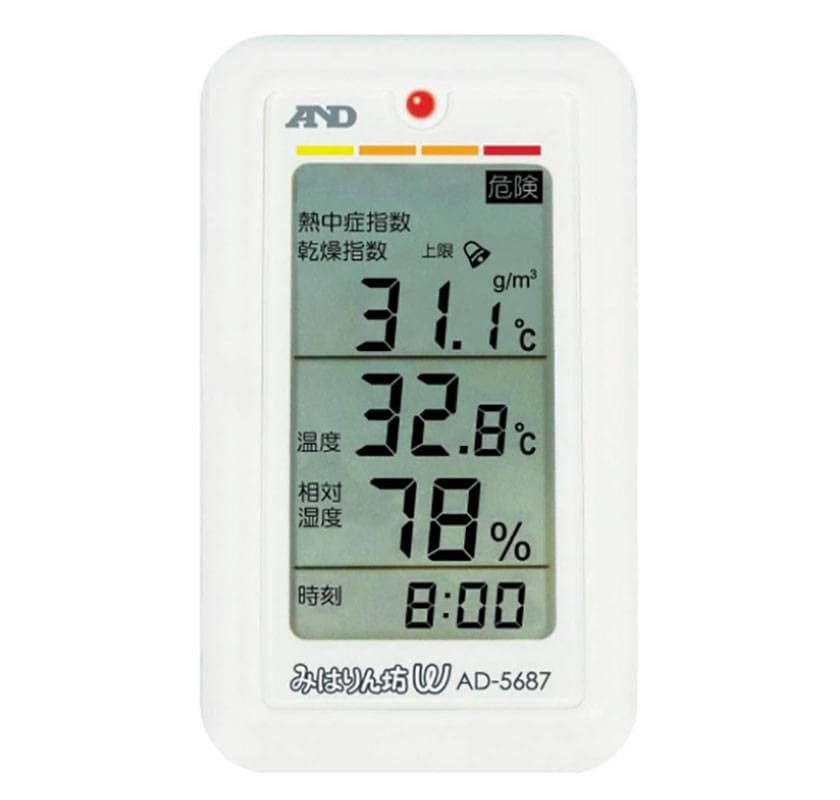
This is a small temperature and humidity meter that’s about the size of a business card, which can measure the heatstroke index in summer and the dryness index (absolute humidity) in winter.
A&D Kurashi Kankyo Onshitsudo Keii AD5686
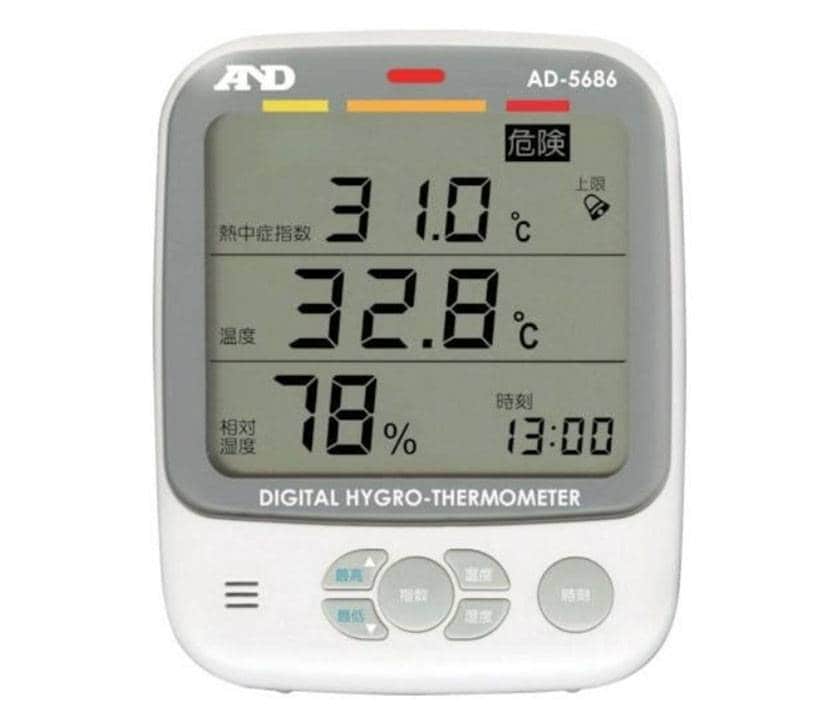
This is a wall-mounted environmental temperature and humidity meter.
With these types of hygrometers, it may be a good idea to adjust the humidity to around 11g/㎥ to 13g/㎥ (similar to the comfortable humidity in October or May) for proper humidification.
(If you can increase the absolute humidity a little more, that's fine, but there’s a limit to how much you can raise the absolute humidity with a commercially available humidifier in winter. If you raise the humidity too much, condensation might occur, causing mold to easily develop.)
Often, you’ll see articles online suggesting that "singers should maintain the room humidity around 50%," but relative humidity varies the actual moisture level (absolute humidity) depending on temperature. It’s highly recommended to manage humidity with an absolute humidity meter for more accurate control.
■ Humidifiers
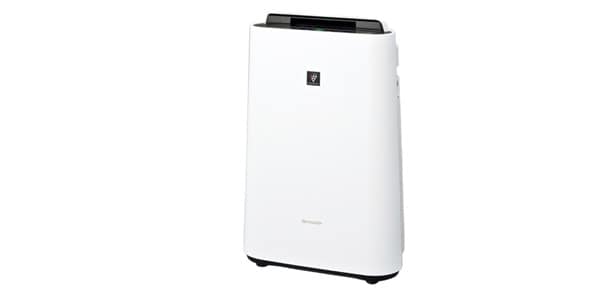
Among the humidifiers sold by Sound House, the following models seem to be a good choice as they also have air purifying functions. Please consider them.
SHARP / KC-J50W Humidifying Air Purifier
■ Reference Material
I have been recording hourly data from nearby weather observation points using the OpenWeatherMap weather service (not just for my area but also for places like Shinjuku, Osaka, Fukuoka, and Sapporo since around March 2020). During late October, November, and also March and April, the absolute humidity is lower than most people think, and it is during this time that the new waves of COVID-19 tend to start.
So, in addition to humidifying your room, when going outside, please choose masks that may help with moisturizing as well. Please stay cautious.
If you are interested in the data collection method, please refer to this:
The “sound & person” column is made up of contributions from you.
For details about contributing, click here.







 MXLマイク購入ガイド
 タイプで選ぶ「良音」カラオケ配信機材
 AUDIXマイク購入ガイド
 ワイヤレスマイクロホン
 ワンランク上のボーカルマイク選び
 虎の巻 カラオケ初心者講座
 Discount Sale
 Outlet
 New Arrivals
 Podcast (streaming)
 Headphones / Earphones
 Microphones
 Wireless Equipment
 Speakers
 Power Amps
 Mixers
 Processors
 Portable PA Systems
 Recorders
 Karaoke
 Guitars
 Basses
 Ukuleles
 Drums & Percussion
 Pianos / Synthesizers
 Wind Instruments
 Stringed Instruments
 Japanese Instruments
 Harmonicas, Other
 Software
 DJ & VJ
 Stands
 Cables & Connectors
 Racks & Cases
 Lighting
 Stage & Truss
 Video Equipment
 PC PERIPHERALS
 Power Supplies
 Studio Furniture
 Household Items, Other
 Alcoholic Beverages